LICONN: Revolutionary Light Microscopy Technique Maps Brain Networks in Unprecedented Detail


5 Sources
[1]
Detailed mouse brain map created with off-the-shelf microscope
Scientists have found a way to map the intricate patterns of cells in mouse brain tissue with an off-the-shelf light microscope, using a trick that inflates a tiny sample to 16 times its original size. Until now, charting the tangled forest of neurons in the brain -- known as the connectome --
[2]
Piecing together the brain puzzle
Our brain is a complex organ. Billions of nerve cells are wired in an intricate network, constantly processing signals, enabling us to recall memories or to move our bodies. Making sense of this complicated network requires a precise look into how these nerve cells are arranged and connected.
[3]
Microscopy method can reconstruct mammalian brain tissue in synaptic detail
Our brain is a complex organ. Billions of nerve cells are wired in an intricate network, constantly processing signals, enabling us to recall memories or to move our bodies. Making sense of this complicated network requires a precise look into how these nerve cells are arranged and connected.
[4]
New Method Maps Brain Networks With Unprecedented Detail - Neuroscience News
Summary: A revolutionary microscopy method called LICONN enables scientists to reconstruct brain tissue and map synaptic connections using standard light microscopes. By embedding brain tissue in hydrogel, expanding it, and imaging at nanoscale resolution, researchers achieve a detailed view of
[5]

Google Research and ISTA are using light microscopes to "map" the brain.
For more than a decade, Google Research has been using AI to precisely map the connections between every cell in the brain in an endeavor called connectomics. Now, in collaboration with the Institute of Science and Technology Austria (ISTA), we've helped develop a new method for brain mapping,
Share
Copy Link
Scientists develop LICONN, a new microscopy method that uses off-the-shelf light microscopes and AI to map brain tissue with synaptic detail, rivaling electron microscopy while offering color imaging and molecular insights.

Breakthrough in Brain Mapping Technology
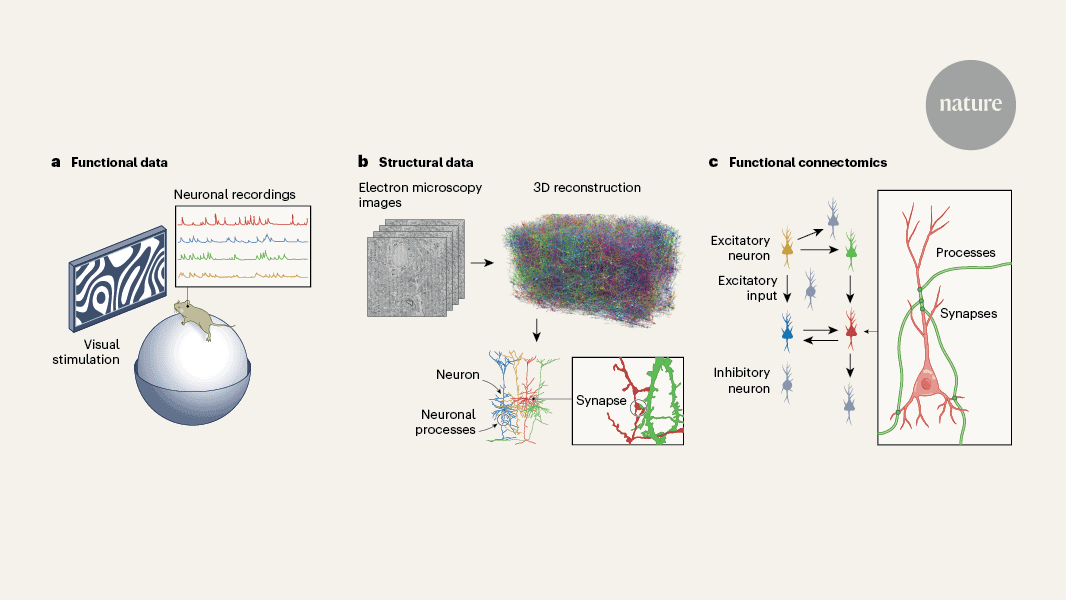
Scientists at the Institute of Science and Technology Austria (ISTA) and Google Research have developed a groundbreaking microscopy method called LICONN (light-microscopy-based connectomics) that enables the detailed mapping of brain tissue using standard light microscopes. This innovative technique rivals the capabilities of electron microscopy while offering additional benefits such as color imaging and molecular insights
1
.The LICONN Technique
LICONN employs a clever approach to overcome the resolution limitations of traditional light microscopes:
- Brain tissue samples are embedded in a hydrogel, a polymer network with properties similar to those of baby diapers
2
. - The hydrogel is expanded by adding water, increasing the sample size by 16 times while maintaining the relative spatial arrangements of cellular structures
3
. - This expansion allows researchers to achieve an effective resolution better than 20 nanometers, which is 10,000 times smaller than the width of a human hair
4
.
Advantages over Electron Microscopy
LICONN offers several advantages compared to traditional electron microscopy:
- Use of standard light microscopes, making the technique more accessible and cost-effective
1
. - Ability to generate colored images, providing more detailed visual information
1
. - Capability to visualize specific molecules alongside cellular structures, offering insights into both structure and function
2
.
AI-Powered Image Analysis
To handle the vast amount of data generated by LICONN, the research team collaborated with Google Research to develop AI-powered deep learning techniques:
- These AI models automate the identification and segmentation of individual neurons and their structures
3
. - This automation makes it feasible to reconstruct large-scale neuronal networks, a task that would be impractical to perform manually
4
.
Related Stories
Implications for Neuroscience
LICONN represents a significant advancement in the field of connectomics, the study of comprehensive maps of neural connections in the brain:
- It allows researchers to reconstruct brain tissue with all synaptic connections between neurons
2
. - The technique has been successfully used to map mouse brain tissue, with potential applications for human brain mapping in the future
5
. - This breakthrough could accelerate discoveries about brain function and neurological diseases
5
.
Interdisciplinary Collaboration
The development of LICONN showcases the power of interdisciplinary research, combining expertise from neuroscience, chemistry, and computer science. This collaborative approach has resulted in a tool that could significantly advance our understanding of the brain's complex architecture and function
4
.References
Summarized by

Navi
[2]
[4]
Related Stories
Scientists Create Most Detailed Mammalian Brain Map to Date
10 Apr 2025•Science and Research
Scientists Map Entire Brain of Adult Fruit Fly, Marking Major Milestone in Neuroscience
03 Oct 2024•Science and Research

AI-Powered CellTransformer Creates Most Detailed Mouse Brain Map to Date
07 Oct 2025•Science and Research
Recent Highlights
1
Microsoft and Nvidia Launch Surface Laptop Ultra: A $2,599 AI-Ready PC With RTX Spark Chip
Technology

2
Trump Consulted Grok AI Before Ordering Venezuela Invasion and Capture of Nicolás Maduro
Policy and Regulation

3
Scientists Build AI Model That Reconstructs Images From Brain Scans in Record Time
Science and Research

Recent Highlights
Today's Top Stories






Don’t drown in AI news. We cut through the noise - filtering, ranking and summarizing the most important AI news, breakthroughs and research daily. Follow topics that matter to you and stay ahead.


