Lightfield Secures $47M to Build AI-Native CRM as Companies Ditch Salesforce for Agent-Ready Platform


2 Sources
[1]
Investing in Lightfield | Andreessen Horowitz
Every company runs on a CRM, and almost no one likes the one they have. It's the system of record for how you find, win, and keep customers -- the most important software a company owns, and somehow the most dreaded. CRMs are supposed to help drive productivity and efficiency for sales and support
[2]
AI-native CRM startup Lightfield raises $47M to build an AI agent-ready replacement for Salesforce
AI-native CRM startup Lightfield raises $47M to build an AI agent-ready replacement for Salesforce Lightfield, an artificial intelligence-native customer relationship management startup, has ambitions to take on industry giants like Salesforce Inc. and Hubspot Inc. after raising $47 million in
Share
Copy Link
CRM startup Lightfield raised $47M in Series A funding led by Andreessen Horowitz to build an AI-native CRM designed for the agentic era. Since launching in November, over 5,000 companies have adopted the platform, with dozens replacing Salesforce. The system uses a temporal context graph and self-updating record system that captures every customer interaction.
Lightfield Raises $47M Series A to Reimagine CRM for the Agentic Era
Lightfield, an AI-native CRM startup officially known as Magical Tome Inc., has secured $47M in Series A funding led by Andreessen Horowitz
1
2
. The round saw participation from Lightspeed Venture Partners, Coatue, Greylock, Maverick Capital, Audacious and Alumni Ventures2
. Founded by Keith Peiris and Henri Liriani, who previously built Tome to 25 million users1
, Lightfield positions itself as an AI agent-ready replacement for Salesforce and HubSpot.
Source: Andreessen Horowitz
Companies Abandon Legacy CRMs for Agent-First Architecture
Since launching in November, Lightfield has attracted over 5,000 companies
2
, with dozens actively ripping out Salesforce, HubSpot, and Attio to switch platforms1
. The rapid adoption signals frustration with traditional CRMs that were designed for human users, not AI agents. As one operator described the transition: "If you've only ever ridden a horse, the only thing you ever want is a faster horse. Well, this is a car"1
. The startup's data architecture addresses a fundamental problem: legacy CRMs lock customer relationships into static fields and unstructured notes that AI agents struggle to interpret, resulting in unreliable outputs2
.Temporal Context Graph Powers Self-Updating Record System
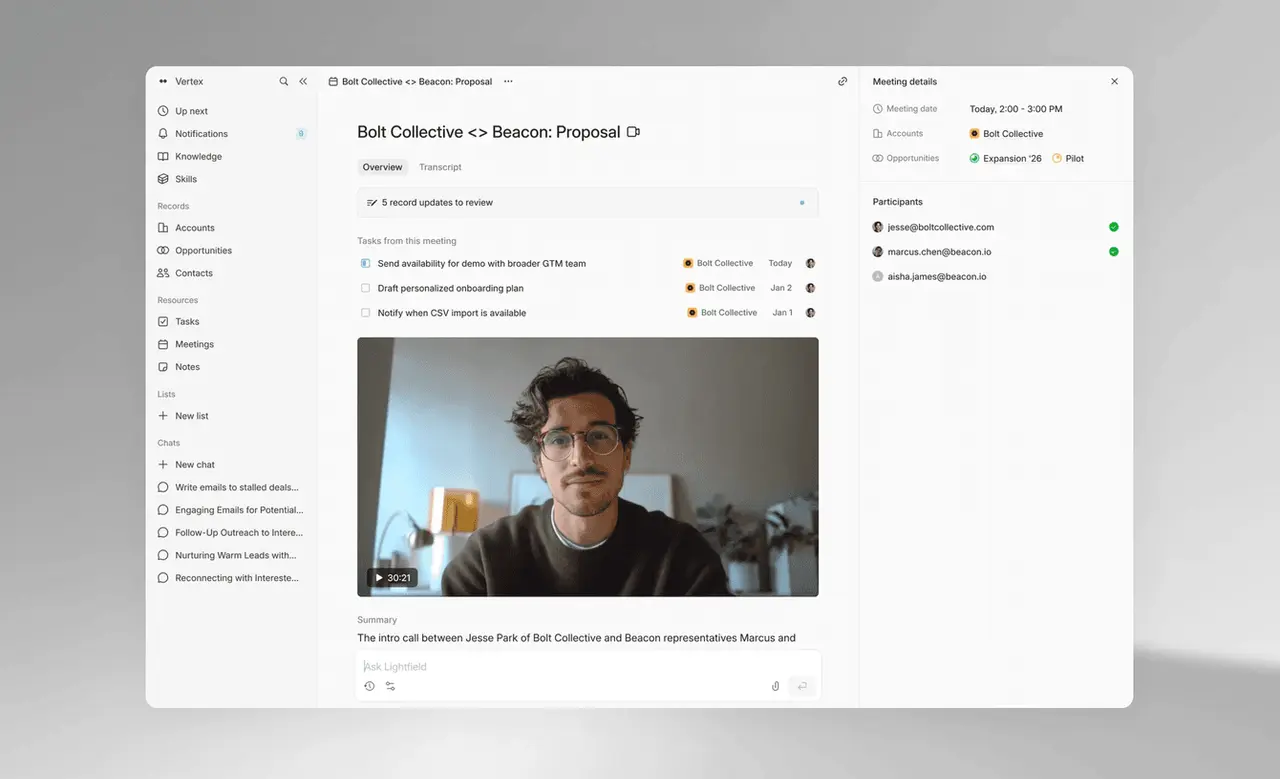
Lightfield's technical foundation rests on a temporal context graph that captures the why behind every deal
1
. This flexible data model requires no configuration, builds itself from emails and calls in minutes, and adapts to businesses without requiring schema changes1
. The platform features a self-updating record system that autonomously ingests customer interactions across email, calendars, Slack and LinkedIn2
. Keith Peiris explained that AI agents fail not because models don't work, but because "the data they're being asked to work with is incomplete and inaccurate and lacks the structure agents need to properly comprehend it"2
.
Source: SiliconANGLE
Related Stories



World Model Architecture Enables Agent and Human Collaboration
The platform creates a world model of the business by mapping customer interactions to specific accounts and deals, recording how they evolve over time
2
. Agents and humans work from the same platform through the same API1
, ensuring both operate from a shared understanding of what's true and what happens next2
. Lightfield includes built-in agents that handle updates, follow-ups, handoffs and reporting, with pricing based on work done and value delivered rather than static seat licenses1
. The system uses an agent harness that forces AI agents to work through a standardized SDK and code sandbox where activity can be monitored2
.System of Record for the Agent Era Targets Growing Companies
Andreessen Horowitz general partner Alex Rampell noted that "every platform shift produces a new system of record"
2
. Just as Salesforce defined the cloud era and HubSpot captured inbound SMB, Lightfield aims to win the AI-native generation of companies choosing their system of record for the first time1
. The platform's open architecture makes everything readable and writable through APIs, CLIs and the Model Context Protocol, simplifying automation development2
. By holding every customer conversation, Lightfield becomes the business world model that shapes what companies build next and for whom1
. The startup is actively hiring as it scales to meet demand from fast-growing companies where existing tooling is breaking1
.References
Summarized by

Navi
[1]
Related Stories
Recent Highlights



Recent Highlights
Today's Top Stories







Don’t drown in AI news. We cut through the noise - filtering, ranking and summarizing the most important AI news, breakthroughs and research daily. Follow topics that matter to you and stay ahead.


