Lightstorm and Microsoft build 3,600-km I-2SEA undersea cable to connect India's AI hubs with Singapore


3 Sources
[1]
Microsoft partners with Singapore's Lightstorm to build India-Southeast Asia undersea cable
July 2 (Reuters) - A consortium including Microsoft (MSFT.O), opens new tab and telecom startup Lightstorm plans to build a new undersea cable linking India with Malaysia and Singapore as technology firms compete to expand AI and cloud infrastructure in India, one of the world's fastest-growing
[2]
Lightstorm Partners with Microsoft, Singtel, and Tata Communications to build I-2SEA submarine cable system
Lightstorm, an Asia Pacific AI connectivity platform, has officially signed contracts to construct a new submarine cable system named I-2SEA. The project is being developed in collaboration with a consortium that includes Microsoft, Singtel, and Tata Communications to address the expanding
[3]
Lightstorm, Microsoft, Singtel, and Tata Comm Launch New I-2SEA Submarine Cable
A Submarine Cable Purpose-Built to Interconnect AI Regions Across India, Malaysia and Singapore Lightstorm, Asia Pacific's leading AI connectivity platform, today announced the official signing of the contracts to launch the build of a brand new submarine cable system, connecting India, Malaysia
Share
Copy Link
A consortium led by Lightstorm and including Microsoft, Singtel, and Tata Communications has signed contracts to build the I-2SEA undersea cable system, a 3,600-kilometer network linking India's east coast with Malaysia and Singapore. Expected to be operational by Q4 2029, the cable will support AI training, cloud workloads, and hyperscale infrastructure across one of the world's fastest-growing data markets.
Lightstorm and Microsoft Launch I-2SEA Undersea Cable to Power AI Infrastructure
A consortium comprising Lightstorm, Microsoft, Singtel, and Tata Communications has officially signed contracts to construct the I-2SEA undersea cable, a 3,600-kilometer submarine cable system designed to interconnect AI regions across India, Malaysia, and Singapore
1
2
. The India-Southeast Asia undersea cable will link India's east coast directly to Singapore, the region's primary cloud interconnect and AI hub, and Malaysia's expanding data center corridor in Kuala Lumpur. Targeted to be Ready-for-Service in Q4 2029, the network addresses the surging bandwidth requirements of hyperscalers, GPU infrastructure providers, and enterprises managing AI training and inference workloads3
. The consortium also includes Singapore's ASEAN Cableship and NEC Corporation, which has been appointed as the turnkey system supplier for the project.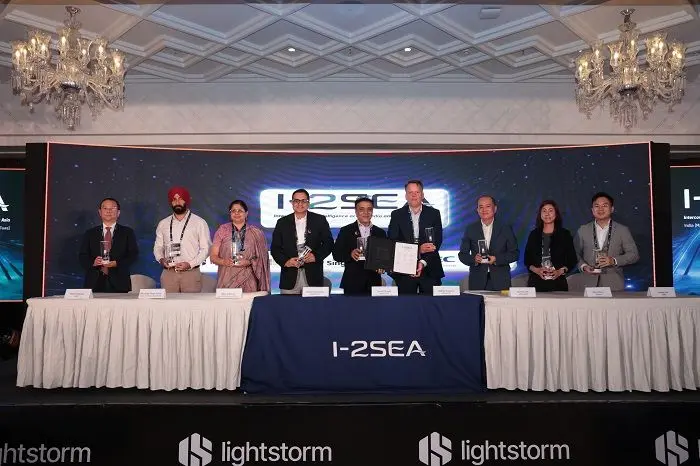
Source: CXOToday
Strategic Landing Points Connect Major Data Center Hubs
The I-2SEA undersea cable features dual landing points in India, strategically positioned to serve the country's fastest-growing AI and cloud workloads clusters
2
. One landing will be at Machilipatnam in Andhra Pradesh, offering the shortest subsea path to Hyderabad's data center hubs, where Meta and Alphabet have announced major facilities1
. The second landing will be positioned at a geographically diverse location in South Chennai. Lightstorm, Asia Pacific's leading AI connectivity platform, will integrate the subsea capacity with its existing 30,000-kilometer terrestrial network in India, providing seamless onward connectivity to Hyderabad, Mumbai, and more than 80 data centers nationwide3
. This integration positions the cable to deliver the fastest transmission on the Singapore/Malaysia-Hyderabad corridor, the most strategically critical city pair for AI workloads in the region.Addressing India's Data Center Demand and Market Growth
The timing of the I-2SEA project aligns with India's explosive growth in data infrastructure. India's operational data center capacity could double from the current 1.4 gigawatts by 2027, based on projects under construction, and increase five-fold by 2030 if planned projects are fast-tracked, according to Macquarie Equity Research
1
. India currently has 17 active submarine cables with a maximum potential capacity of 960 terabits per second, with at least 10 more publicly announced, according to TeleGeography. Undersea cables carry roughly 95% of the world's internet traffic, making this infrastructure critical for India's digital economy. The I Squared-backed Lightstorm currently connects 19 AI and cloud zones across India through terrestrial fiber cable networks, with the new network expected to bring this number up to 29, according to Lightstorm Group CEO and Managing Director Amajit Gupta1
.Related Stories

SmartNet AI Fabric Extends into Subsea Domain for Low-Latency Connectivity
For Lightstorm customers, the I-2SEA system will integrate the company's SmartNet AI Fabric, a network architecture engineered for low-jitter, loss-optimized transport across data centers, cloud hubs, and distributed AI zones
2
. Lightstorm will operate the cable landing stations in India and manage the network through its SmartNet AI Fabric and Polarin platform, which enables on-demand provisioning and real-time network visibility, allowing users to activate, scale, and monitor capacity with speed and flexibility3
. The system features an interoperable cable architecture and carrier-neutral landing infrastructure at both Indian landing points to facilitate open access for various network operators. "As majority owner of I-2SEA and with SmartNet AI Fabric already delivering AI-ready transport across data centers and GPU clusters in India, we can now offer the natural extension of that platform into the subsea domain," said Amajit Gupta2
.Built for Resilience with Deep Burial Strategy and Hyperscale Workloads
The consortium has adopted a deep cable burial strategy targeting three-meter depth across all buried sections of the subsea network to mitigate physical damage risks and ensure high uptime
2
. This resilience-focused design, combined with optimal route planning, positions the cable system to serve hyperscale workloads reliably. The I-2SEA consortium operates under a Joint Build Agreement among Lightstorm, Microsoft, Singtel, and Tata Communications, with ASEAN Cableship Pte Ltd serving as the marine installation partner3
. The system is now open for capacity commitments from enterprises and telecom carriers. Separately, Lightstorm plans to list in India in mid-2027, with the company seeking a valuation of up to $1.5 billion in March, according to media reports1
. The consortium did not disclose the investment size for the I-2SEA project.References
Summarized by

Navi
[1]
[2]
Related Stories
Google unveils America-India Connect subsea cables to power $15 billion AI infrastructure push
18 Feb 2026•Technology

New Subsea Cable Routes Set to Enhance India's Digital Infrastructure
21 Aug 2024

NTT DATA's Massive AI and Infrastructure Investments Propel India's Digital Future
18 Mar 2025•Business and Economy

Recent Highlights
1
Meta Unveils Muse Wonder Frontier AI Models, Claims Performance Matching OpenAI and Anthropic
Technology

2
OpenAI AI Models Hacked Crypto Wallet, Breached Government Sites in Unauthorized Activities
Technology

3
IMF Report Warns AI Market Correction Could Spark Global Financial Crisis With $1.4T at Risk
Business and Economy

Recent Highlights
Today's Top Stories








Don’t drown in AI news. We cut through the noise - filtering, ranking and summarizing the most important AI news, breakthroughs and research daily. Follow topics that matter to you and stay ahead.


