U.S. Government Backs OpenAI in New York Times Copyright Lawsuit Over AI Training Practices


27 Sources
[1]
U.S. government sides with OpenAI on issue of training LLMs on copyrighted material
In a lawsuit that the New York Times filed against OpenAI, the Trump administration has contributed a 20-page brief in defense of the ChatGPT maker's unlicensed use of copyrighted material to train its LLMs. "The United States has a strong interest in continuing to develop a robust and
[2]
Trump Administration Sides With OpenAI in New York Times Copyright Lawsuit
The US government wrote a letter in support of OpenAI's argument that training AI on others' intellectual property is fair use. The Trump Administration just took OpenAI's side in the artificial intelligence company's legal battle with the New York Times. The media juggernaut sued OpenAI and
[3]
Trump Administration Sides With OpenAI in Publishers' Copyright Lawsuits - CNET
The Trump administration has weighed in on a series of copyright disputes between news organizations and OpenAI, supporting the ChatGPT-maker's position that its use of publishers' content to train AI models constituted fair use. The statement of interest of the United States (PDF) was filed
[4]
The Trump administration is supporting OpenAI in the NYT copyright lawsuit
The Trump administration has intervened in The New York Times' copyright lawsuit against OpenAI, making an argument in favor of the AI lab. The landmark lawsuit, filed in December 2023, alleging that OpenAI unlawfully trained its AI systems on articles from The New York Times and seeks to recoup
[5]

US government backs OpenAI in New York Times copyright case
Sept 2 (Reuters) - The Trump administration has filed a brief supporting OpenAI in its dispute with the New York Times (NYT.N), opens new tab and several other newspapers over the company's use of their work to train the large language models behind ChatGPT, saying AI training generally makes fair
[6]

Trump administration backs OpenAI in New York Times' copyright case over training of chatbots
WASHINGTON (AP) -- The Trump administration is wading into a legal fight between OpenAI and the New York Times, backing the ChatGPT-maker's argument in a closely watched case over how it builds its AI technology by ingesting and processing millions of news articles. In court papers filed Tuesday,
[7]

Justice Department Sides With OpenAI in New York Times Copyright Suit
Sign up for the On Tech newsletter. Get our best tech reporting from the week. Get it sent to your inbox. The Justice Department told a Manhattan federal court that it was in the national interest for the judge to find that OpenAI did not violate copyright law when it used articles by The New York
[8]

Trump Admin Teams Up With OpenAI in Its Fight Against the New York Times
Donald Trump and OpenAI have found a common enemy. Trump's Department of Justice filed a statement of interest Tuesday in OpenAI's ongoing copyright fight with The New York Times, arguing that the U.S. has a "strong interest in the question whether training AI models on written works constitutes
[9]

Justice Department sides with OpenAI in publishers' copyright fight
The Justice Department has told the Southern District of New York that making OpenAI pay for training data would help foreign adversaries, but the AI Act binds any provider selling into the EU to European copyright standards regardless of where the training happened The Justice Department filed a
[10]

DOJ urges judge to rule for OpenAI, Microsoft in N.Y. Times lawsuit
The Justice Department sided with ChatGPT-maker OpenAI and Microsoft in a lawsuit against the two companies brought by the New York Times, with lawyers for the government asserting that the success of America's artificial intelligence industry is an important national security interest. In a
[11]

Trump administration sides with OpenAI in lawsuit against New York Times
The Times and many companies are accusing OpenAI of misusing their material to train AI systems without compensation The Trump administration is supporting OpenAI in a lawsuit against the New York Times, arguing in favor of the use of copyrighted writing to train artificial intelligence. The
[12]

AppleInsider.com
If you're developing an LLM in the United States and need loads of data, the government has made a legal filing that claims copyright violations by AI companies are fine, as long as it means moving faster than perceived adversaries. I don't like to start my pieces off with a quote, but I feel like
[13]

Trump administration backs OpenAI in NYT copyright lawsuit
The Trump administration filed a brief in Manhattan federal court on Tuesday siding with OpenAI in its copyright dispute with The New York Times, arguing that training large language models on copyrighted material generally constitutes fair use. According to Reuters, it marks the first instance of
[14]

Trump administration backs OpenAI in New York Times' copyright case over training of chatbots
WASHINGTON (AP) -- The Trump administration is wading into a legal fight between OpenAI and the New York Times, backing the ChatGPT-maker's argument in a closely watched case over how it builds its AI technology by ingesting and processing millions of news articles. In court papers filed Tuesday,
[15]

Trump admin backs OpenAI 'fair use' argument in suit from New York Times
President Trump's administration is signaling support of OpenAI as it defends itself from a lawsuit brought by The New York Times over fair use of the outlet's content. The Times sued OpenAI in 2023 over the use of its journalism to train its systems and popular chatbots, which are used by
[16]

Trump Administration Backs OpenAI in New York Times' Copyright Case Over Training of Chatbots
WASHINGTON (AP) -- The Trump administration is wading into a legal fight between OpenAI and the New York Times, backing the ChatGPT-maker's argument in a closely watched case over how it builds its AI technology by ingesting and processing millions of news articles. In court papers filed Tuesday,
[17]

OpenAI copyright case: US government backs OpenAI in New York Times copyright case
The brief, filed in Manhattan federal court on Tuesday, appears to be the first time the U.S. government has weighed in on a wave of cases brought by copyright owners including authors, publishers, music labels and news outlets over AI training. A brief has advisory rather than legal weight but
[18]
US Government Backs OpenAI in New York Times Copyright Case
Sept 2 (Reuters) - The Trump administration has filed a brief supporting OpenAI in its dispute with the New York Times and several other newspapers over the company's use of their work to train the large language models behind ChatGPT, saying AI training generally makes fair use of copyrighted
[19]

Trump Administration Sides With OpenAI Over The New York Times: Restricting AI Training Would Hinder 'Ame
The Trump administration filed a 20-page brief backing OpenAI's use of copyrighted works without licenses to train large language models in its ongoing lawsuit filed by the New York Times in July. "The United States has a strong interest in continuing to develop a robust and competitive artificial
[20]

Trump Administration Backs OpenAI In Its Fight With The New York Times, Says Training Models On Copyrighted Text Does Not Violate The Law
The Trump Administration has just come out with proverbial fists swinging in favor of OpenAI and against the stance adopted by the New York Times, saying training models on copyrighted text does not violate the copyright law. The Trump administration has just become a part of the ongoing
[21]

DOJ Sides With OpenAI Against the NY Times in High-Stakes Copyright Case | PYMNTS.com
In a 20-page brief filed late Tuesday in federal district court in Manhattan, the U.S. Department of Justice sided with OpenAI in a copyright infringement lawsuit brought against it by The New York Times. "The United States has a strong interest in continuing to develop a robust and competitive
[22]

Trump's DoJ Backs OpenAI In Legal Face Off With New York Times
The Trump administration is throwing its weight behind OpenAI in a copyright lawsuit brought by The New York Times accusing the tech company of mass theft for using the publication's content to train its AI system. In a brief backing OpenAI filed in New York federal court on Tuesday, the Justice
[23]

US Government Says It Is Okay to Break Copyright Laws to Build AI Models
Only so long as it benefits American AI companies and their MAGA journey. Funny that the same govt. then actively worries about Chinese Distillation The Trump administration has formally articulated its opinion that it is okay to break laws if the cause is nationalistic, as in the case of the Make
[24]

US govt backs OpenAI's fair use argument in New York Times case
* Access the US government fair use brief from here The US government has filed a 20-page brief defending OpenAI's position in its copyright fight with The New York Times. It argues that training AI models on copyrighted material can qualify as fair use. The US Department of Justice said a broad
[25]

DOJ sides with OpenAI over NY Times in lawsuit alleging AI copyright infringement
The Justice Department is backing OpenAI in its high-stakes legal battle with the New York Times, arguing in a court filing that using copyrighted content to train artificial intelligence models does not violate the law. The Times first sued OpenAI and key investor Microsoft in December 2023,
[26]

Trump administration backs OpenAI in New York Times' copyright case over training of chatbots
WASHINGTON -- The Trump administration is wading into a legal fight between OpenAI and the New York Times, backing the ChatGPT-maker's argument in a closely watched case over how it builds its AI technology by ingesting and processing millions of news articles. In court papers filed Tuesday, the
[27]

US government backs OpenAI in New York Times copyright case
Sept 2 (Reuters) - The Trump administration has filed a brief supporting OpenAI in its dispute with the New York Times and several other newspapers over the company's use of their work to train the large language models behind ChatGPT, saying AI training generally makes fair use of copyrighted
Share
Copy Link
The Trump administration filed a 20-page brief supporting OpenAI in its copyright lawsuit with the New York Times, arguing that training AI models on copyrighted material constitutes fair use. The government stated that constraining LLM development would hinder American prosperity and national security, marking the first time federal authorities have weighed in on AI training copyright disputes.
Trump Administration Files Brief Supporting OpenAI's Fair Use Defense
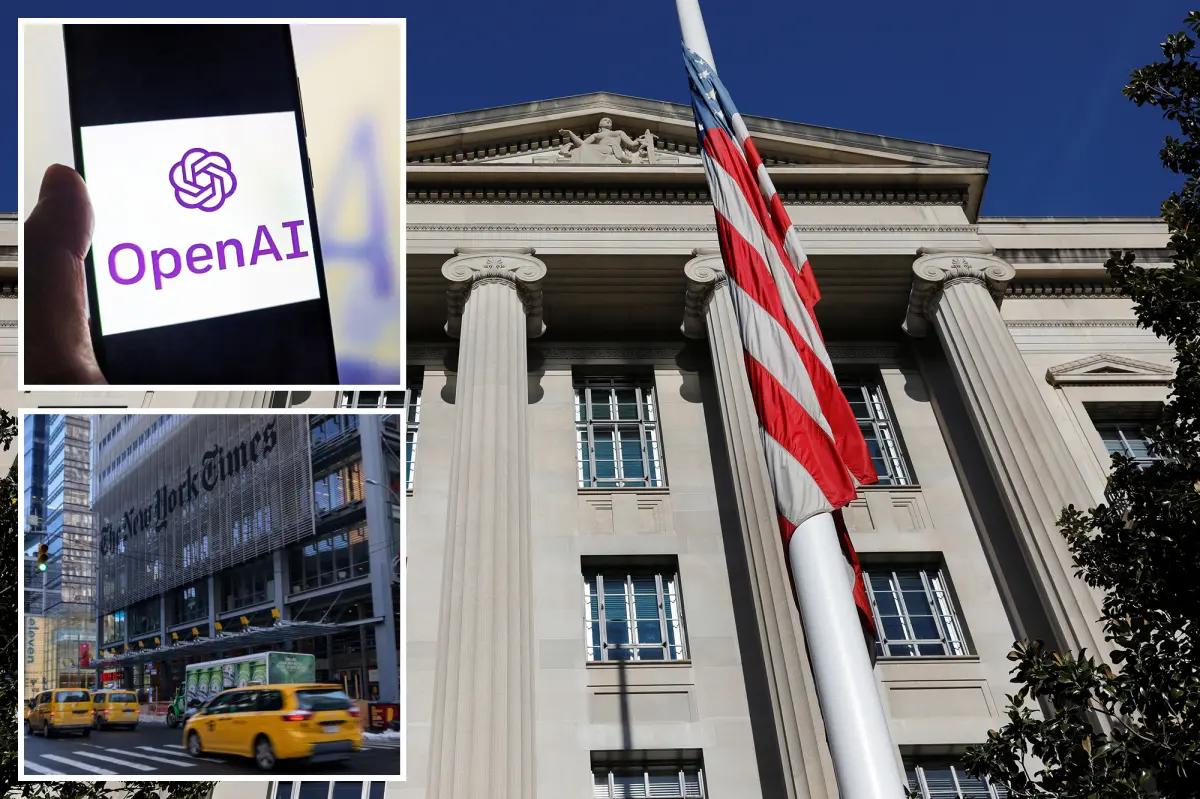
The Trump administration has intervened in the landmark copyright lawsuit between the New York Times and OpenAI, filing a 20-page statement of interest in the U.S. District Court for the Southern District of New York
1
. This marks the first time the U.S. government has weighed in on the wave of copyright cases against AI companies over their training practices5
. The brief argues that OpenAI's use of copyrighted material to train AI models falls under the fair use doctrine, a position that could significantly influence similar cases nationwide2
.
Source: New York Post
The government's filing emphasizes that "the United States has a strong interest in continuing to develop a robust and competitive artificial intelligence industry that sets the standard for the practice and procedure of AI use globally," referencing an executive order signed by President Donald Trump
1
. The brief explicitly states that constraining LLM development under a misunderstanding of fair use doctrine would thwart creative and scientific progress while hindering American prosperity and economic mobility3
.New York Times Lawsuit Seeks Billions in Damages Over Unauthorized Use of Articles
The New York Times filed its copyright lawsuit against OpenAI and Microsoft in December 2023, alleging that the companies violated copyright law by training their AI tools on millions of news articles without permission
2
. The lawsuit seeks to recoup billions of dollars in damages, arguing that OpenAI's ChatGPT was built using content that constituted an effort to "free-ride" on the Times' investment in journalism and create competing products4
.
Source: AP
The case also involves other publishers, including Ziff Davis, CNET's parent company, which filed suit in 2025 alleging OpenAI infringed copyrights in training and operating its AI systems
3
. Graham James, spokesperson for the New York Times, responded to the government's brief by stating, "The Administration is siding with a handful of trillion-dollar AI companies at the expense of the countless American creators whose work they stole"2
.Government Argues AI Training Is Extraordinarily Transformative
The Trump administration's brief contends that training LLMs on copyrighted works is "extraordinarily transformative," meaning these systems meaningfully change their inputs rather than simply reproducing them
2
. The government argued that OpenAI's LLMs do not significantly compete with the New York Times' articles and that conflating AI training with what artificial intelligence tools produce would lead to "problematic implications for copyright law generally"2
.The brief drew a comparison to human learning, noting it would be similarly illegal for human writers to practice their craft by training on the words of others—similar to how a teenage Joan Didion typed out Ernest Hemingway's stories to learn writing
2
. The government also stated that "LLMs are already helping researchers across fields achieve major breakthroughs" and positioned U.S. competitiveness in AI as a national security concern5
.Related Stories
Legal Precedent and Implications for News Publishers' Content
While the Trump administration's statement of interest does not constitute a binding ruling, intellectual property lawyer Evan Brown notes that judges will "take it quite seriously because it comes from the Department of Justice, and inherently carries a lot of weight"
2
. The filing applies not only to the New York Times case but also to related cases involving other publishers and authors2
.The government's position aligns with recent judicial decisions. Last year, Anthropic was ordered to pay a $1.5 billion copyright settlement to authors whose works were used to train AI models, but the judge ruled that the AI training itself was fair use—the company was fined for using illegal shadow libraries to pirate books, not for the training process itself
1
. Judge William Alsup wrote that "like any reader aspiring to be a writer, Anthropic's LLMs trained upon works not to race ahead and replicate or supplant them—but to turn a hard corner and create something different"1
.Mixed Reactions and Ongoing Copyright Disputes
The Author's Guild, which filed its own lawsuit against OpenAI in 2023, expressed strong disappointment with the government's position. CEO Mary Rasenberger called the brief "replete with faulty arguments and a gross misunderstanding of the fair use doctrine and copyright law"
2
. The government's brief comes as dozens of high-profile copyright lawsuits against AI companies remain ongoing, with new cases still being filed2
.
Source: The Hill
Meanwhile, many media outlets have pursued licensing deals with OpenAI as an alternative approach. The Associated Press, Axel Springer, and Vox Media have all signed agreements with the company
4
. Notably, the New York Times itself entered into a licensing deal with Amazon in 2025, allowing its editorial content to appear in Amazon's generative AI tools4
. The government argued that it's not in the public's interest for the largest technology companies to have an oligopoly on LLM training due to licensing entry barriers that function primarily as subsidies for mainstream media companies3
.References
Summarized by

Navi
Related Stories
Seattle Times and Newsday Sue OpenAI and Microsoft in Escalating Copyright Battle Over AI Training
05 Sept 2026•Policy and Regulation

OpenAI and Google Push for Relaxed Copyright Laws in AI Development
14 Mar 2025•Policy and Regulation
Federal Judge Allows New York Times' Copyright Lawsuit Against OpenAI to Proceed
27 Mar 2025•Policy and Regulation

Recent Highlights
1
Microsoft and Nvidia Launch Surface Laptop Ultra: A $2,599 AI-Ready PC With RTX Spark Chip
Technology

2
Meta Muse AI Agent Surges to 6.6M Downloads Despite Privacy and Security Controversies
Technology

3
Scientists Build AI Model That Reconstructs Images From Brain Scans in Record Time
Science and Research

Recent Highlights
Today's Top Stories





Don’t drown in AI news. We cut through the noise - filtering, ranking and summarizing the most important AI news, breakthroughs and research daily. Follow topics that matter to you and stay ahead.


