13 Sources
[1]
LinkedIn adds a button to report AI-generated 'slop'
LinkedIn is taking aim at the "AI slop" -- low-quality, artificially generated content -- filling its feed. On Thursday, the company announced that it's adding a new feature to let users click a "seems like AI slop" button when someone's post appears to have been written with AI. The move reflects a broader shift across online publishing platforms to cut back on AI content, as people have grown frustrated with the computer-written, inauthentic posts filling the web. Last week, for instance, newsletter platform Substack added a tool to help users identify when the content they're reading on its site was written by AI, through a partnership with Pangram. Meanwhile, Pangram this week announced $9 million in new funding to tackle the problems of AI content flooding the internet. The problem is also impacting new startups, as Digg had to shut down its Reddit competitor in March, saying it couldn't get a handle on the number of bots flooding its site. Internet infrastructure firm Cloudflare says the problem is just getting worse, as there is now more bot traffic on the web than human-generated requests -- a milestone that was reached faster than it had previously predicted. In a post on LinkedIn, the company's Chief Product Officer Hari Srinivasan admitted the Microsoft-owned social network is facing similar problems. "AI slop is a top priority for all of us. We really care about this. People come to LinkedIn to connect with real people and share their real perspectives, ideas, and expertise," he said. The exec explained that the new "Seems like AI slop" button is now one of several measures LinkedIn is using to reduce the amount of low-quality, AI-generated content on its platform. The company is also investing in automation defenses, where it now blocks "hundreds of thousands" of automated comment attempts daily, and millions of other automation attempts in just the past couple of months. Srinivasan said LinkedIn is also introducing new classifiers to identify if a post is AI slop or other low-quality content, which would reduce the amount of slop you'd see in suggested content recommendations from outside your network. (The button ties into this measure as it will provide a source of signal that will allow LinkedIn to tune its AI models to better identify slop.) Plus, LinkedIn will begin privately flagging in users' dashboards when people believe their content is coming off as inauthentic due to heavy use of AI. The company believes that this will help posters improve their writing, in the case that they're simply using AI technology to refine their own work, rather than when they're posting what's considered full-on "slop" content. Notably, the company is pulling its own "enhance your post" feature that had used AI to help you write. It's replacing it with a feature that proofreads your words, instead of changing your voice. Other improvements include expanding access to profile and page verification tools, and adding an option to block comments from company pages you no longer want to see, Srinivasan said.
[2]
LinkedIn Added a New Way to Report AI Slop - CNET
Katelyn is a reporter with CNET covering artificial intelligence, including chatbots, image and video generators.... Read full bio If you're tired of reading obviously AI-generated LinkedIn posts about the magic of B2B sales, there's hope: LinkedIn on Thursday released a new tool that allows you to report posts as "Seems like AI slop." AI slop is the term given to the deluge of posts, images and videos created with generative AI flooding social media like an oil spill. These posts tend to offer little value and clog up feeds. Every social media platform is struggling to hold back the tide of AI slop, and LinkedIn is certainly no exception. A recent report from research firm Pangram found that one in four long-form social media posts was AI-generated. Of those AI posts, nearly two-thirds (62%) appeared on LinkedIn. On X (formerly Twitter), nearly half of all articles contained AI writing. Now, you can report posts you're suspicious of by tapping the three dots next to a post and selecting "Seems like AI slop." 404 Media first spotted the feature. Hari Srinivasan, LinkedIn's chief product officer, shared on Thursday that the company is ramping up efforts to identify AI slop. Allowing people to report posts that seem like AI slop will help LinkedIn get better at spotting the AI-created, low-quality content. "Slop is hard to define and the definition changes; this lets us tune our models and make better feeds," Srinivasan said. It has also removed the "enhance with AI" option that appears when you are drafting a post, and will be replacing it with an option that proofreads your words without substantially rewriting them with AI. Srinivasan said LinkedIn is flagging "hundreds of thousands of automated comment attempts" and has blocked billions more attempts to use automated postings (usually with the aid of AI) across the platform.
[3]
LinkedIn actually adds a 'seems like AI slop' button
A lot of content on LinkedIn might seem like AI slop, and now, you'll be able to report those posts. As part of a series of updates to reduce the volume of AI slop on the platform, LinkedIn is introducing an actual button that lets you flag a post as something that "Seems like AI slop." The new feature is part of a broader push to reduce the volume of apparent AI slop on the platform. AI detector Pangram recently found that 41 percent of longform LinkedIn posts were flagged as being completely generated by AI, as reported by 404Media. "AI slop is a top priority for all of us," chief product officer Hari Srinivasan says in a post. "We really care about this." In addition to the button to report a post as seemingly being AI-generated, LinkedIn is also ramping up new classifiers to identify "if a post is AI-slop or generally low-quality content," which will "reduce the amount of AI slop you might see in suggested content and content from outside your network." I'm currently seeing the new report button in the three-dots menu on posts. When I click it, LinkedIn hides the post and shows a message thanking me for my feedback. The new button will help LinkedIn "tune our models and make better feeds," Srinivasan says. The company is also testing a way to show people that other users feel their posts come across as inauthentic or that they include heavy use of AI. In addition, LinkedIn is removing a feature that used AI to "enhance" a post and will replace it with a "feature that proofreads your words, but does not change your voice," according to Srinivasan.
[4]
LinkedIn realizes its users have been bathing in AI slop, offers a shower
LinkedIn has been drenching its users in AI-powered slop posts, going so far as to encourage writers to trade their own voices for a bot's by hitting the "enhance your post" button when they want to share thoughts. Enough is enough. On Thursday, the site's Chief Product Officer has announced several changes designed to rehab the platform's reputation. CPO Hari Srinivasan took to the Microsoft-owned social network following reports Thursday that LinkedIn had introduced a button for users to flag posts as AI slop. He confirmed not only that the reports are real, but that LinkedIn had additional plans as well. The "Seems like AI slop" button is being added to the ellipsis menu on LinkedIn posts now, a spokesperson told us, and will be available on all posts and comments. Srinivasan said this button will not only allow users to report posts with sentences written like this - it will also help LinkedIn refine its AI-spotting AI models to help improve user feeds. In addition, the "enhance your post" button, which used AI to tweak your wording, is being replaced by an option to have AI proofread your work while leaving your voice intact, instead of stealing it like the sea witch Ursula. There's been no shortage of scorn from The Register and elsewhere about LinkedIn's rapid decline into a slop tank filled with faux thought leadership posts and generative drivel. As far back as 2024, reports were coming out that more than half of long-form LinkedIn posts longer than 100 words were believed to be AI generated. That hasn't changed in the past two years. "AI slop is a top priority for all of us. We really care about this," Srinivasan wrote. "People come to LinkedIn to connect with real people and share their real perspectives," he said, adding that LinkedIn wants to keep it that way - or, more realistically, nudge the platform back toward its former state. Coincidentally or not, Originality.ai, the same AI detection site behind the 2024 report, released an updated scan of LinkedIn posts longer than 100 words on Thursday. According to this new report, a full 81 percent of the 5,000 posts it looked at this month were classified as likely being AI-generated. Srinivasan said it's not just users employing AI to generate slop - it's AI automating garbage posts and comments at scale, throughout the site. "Everyday we are now catching hundreds of thousands of automated comment attempts, and have blocked billions of other automation attempts (posting at scale, slop) in the last couple months alone," the LinkedIn CPO said. To that end, the professional social network is also "ramping up a series of new and improved classifiers that identify if a post is AI-slop or generally low-quality content," Srinivasan said. User analytics dashboards will also be getting a new feature that will tell posters when members flag their posts as potentially being AI, as Srinivasan said LinkedIn wants users "to get feedback from real humans on what sounds authentic - not just have an AI detector review it and get it wrong." "AI and slop are not the same thing," Srinivasan added. "Many people refine thoughts with AI, and we believe they want to know when they sound inauthentic." ®
[5]
LinkedIn is testing a 'seems like AI slop' reporting tool - Engadget
The company is also removing some of its own AI-writing features. LinkedIn is once again trying to get a handle on the vast amounts of AI slop on the platform. To do that, the company is testing a new reporting tool that let users flag potential slop and removing the "rewrite with AI" button it once promoted on every post. With the new reporting tool, users will have the ability to flag posts as "seems like AI slop." Doing so will "privately flag" via the site's analytics dashboard that others "feel your post may have come off as inauthentic or heavy use of AI," LinkedIn's Chief Product Officer Hari Srinivasan wrote in an update. The move follows an earlier update that aimed to reduce the reach of AI-generated posts on the platform. The company has since done further work to improve its detection systems, Srinivasan said, which should lead to people seeing fewer AI-generated posts recommended in their feeds. Posts that are flagged with the new reporting tool will also see reduced algorithmic reach similar to users' flagging them as "not interested," according to a LinkedIn spokesperson. The company is also recognizing its own role in perpetuating AI slop on the platform. It's removing the built-in AI writing tools that allowed users to "enhance" their posts and messages with the help of LLMs. LinkedIn is instead adding a more toned down version of the feature that "proofreads your words, but does not change your voice,' according to Srinivasan. LinkedIn's crackdown comes as the professional platform has become known as ground zero for AI slop. A recent study from AI detection company Pangram found that LinkedIn "was the most AI-saturated" social media platform with more than 40 percent of longform posts "flagged as fully AI-generated." Given the sheer amount of AI-generated material on the platform, it's unclear if these updates will be enough to change any of those trends. In addition to users who post their own AI slop, the company has seen a massive influx of automated posting thanks to AI bots. Srinivasan said LinkedIn has caught "hundreds of thousands" of automated comments and blocked billions of other attempts at automated posting within the last few months alone.
[6]
LinkedIn adds a 'Seems like AI slop' button
LinkedIn has quietly added a "Seems like AI slop" button to its post menu, letting users flag machine-written content that its own systems then learn from. It follows the platform's May crackdown on generic AI posts, and lands as one detection service estimates 41 per cent of long-form LinkedIn posts are likely AI-generated. LinkedIn has a name for the vaguely inspirational, AI-written posts clogging its feed, and now it has a button for them. The professional network has quietly added a "Seems like AI slop" option to its post menu, letting users flag content they think a machine wrote, 404 Media reported. The button sits under the three-dot menu at the top of any post. Click it, and LinkedIn responds: "Thanks for letting us know. Your feedback helps improve the feed." It then hides the post. 404 Media said it took about six seconds of scrolling to find a candidate, flagged by the spacing, emoji, bullet-point takeaways and "X is not Y" phrasing. The wording is what stands out. The button does not say "this looks AI-generated." It says "slop," a blunt piece of internet slang for low-effort machine output, now baked into the interface of a Microsoft-owned platform. Why LinkedIn is doing this The move follows the platform's May crackdown on generic AI posts, which suppressed slop from recommendations rather than removing it. The new button turns detection into a crowd-sourced signal. Every flag helps train LinkedIn's own models to spot the stuff. Hari Srinivasan, LinkedIn's chief product officer, confirmed as much in a post after the report. "AI slop is a top priority for all of us," he wrote. The company is "ramping up a series of new and improved classifiers" to identify slop, and letting members flag posts to help "tune our models and make better feeds." He added a telling caveat. "AI and slop are not the same thing," Srinivasan wrote. Many people refine their thoughts with AI, so LinkedIn will test a private nudge in a poster's analytics when their writing "may have come off as inauthentic." It is also replacing its "enhance your post" feature with a proofreader that does not change a user's voice. The scale of the problem The numbers explain the urgency. Earlier this month, 404 Media reported that the detection service Pangram estimated 41 per cent of long-form LinkedIn posts, and 30 per cent of short ones, are likely AI-generated. Search "LinkedIn AI" and you find countless guides, some hosted on LinkedIn itself, teaching people to automate their posts. The irony is doing a lot of work here. LinkedIn offers its own AI writing assistant that drafts profiles and posts for Premium subscribers. Its parent, Microsoft, is one of OpenAI's biggest backers. The company is, in effect, selling the hose and the mop at once. A wider fight against slop LinkedIn is not alone. The preprint server arXiv now bans researchers who submit AI-riddled papers, and platforms have tightened rules on mass-produced AI channels. The pressure reflects a web where bots now outnumber humans in traffic terms. Whether a report button moves the needle is another matter. Slop is, as Srinivasan admitted, hard to define, and the definition keeps shifting. But asking users to name it, out loud, is a small admission that the feed has a problem. It also shows that proving something is human is becoming its own kind of work.
[7]
LinkedIn Adds New 'Seems Like AI Slop' Button to Report All the AI Slop
If you think that most of the posts you encounter on LinkedIn sound like the same corporate drone-generated slop, it's because they are actually AI-generated. To combat that, LinkedIn users are getting a dedicated slop button so they can help mop up the mess being spewed across the internet. "We are ramping the ability for members to tell us if they believe a post or comment seems like AI slop," LinkedIn's chief product officer Hari Srinivasan said in a post on the platform. "Slop is hard to define and the definition changes; this lets us tune our models and make better feeds." The new feature will allow users to click the three-dot menu in the upper-right corner of each post to select a button labeled "Seems like AI slop." If a post is flagged as AI slop, the sharer will also be privately notified in their analytics dashboard. The new feature comes as slop takes over not just LinkedIn but pretty much the entire social media ecosystem. Srinivasan said that the LinkedIn team has already blocked billions of AI-generated posts and comments in just the last couple of months alone. Substack is also apparently having a big enough problem that CEO Chris Best announced earlier this month that it was integrating AI detection tool Pangram into its platform, in a post that fired open shots at LinkedIn and its subpar reputation. "We built the ability to do a Pangram scan into the Substack app, because we're sick of slop and we don't want substack to turn into LinkedIn," Best said in a chain of posts on X. "Platforms that reward fakeness will drive a race to the bottom. Pangram's data shows that as much 40% of long-form text on LinkedIn is generated." According to Pangram's data, which Best references, LinkedIn has the most long-form AI content out of all popular social media platforms that host long-form content. "LinkedIn posts made up a third of scanned items, yet it accounted for nearly two-thirds (62%) of all AI content we flagged," Pangram said in a blog post from earlier this month. Srinivasan's announcement on LinkedIn didn't attack Substack openly the way Best's did, but it did contain what appears to be a slight jab. "We want members to get feedback from real humans on what sounds authentic - not just have an AI detector review it and get it wrong," Srinivasan wrote. People are increasingly relying on commercial AI detection tools to catch automation attempts, but these tools are not foolproof. They can produce false positives, and considering that many of these AI detection tools themselves are also run by AI, the reasoning that got the tool to its conclusion is obscured from the user, making it harder to decide when to trust the verdict. But humans are also lackluster at discerning AI slop. A lot of the so-called telltale signs of AI-generated writing are just proper language rules (god forbid a writer likes using em dashes or colons!), and these detection tips and tools also often discriminate against non-native English speakers. Previous studies have characterized humans' ability to identify AI-generated content as practically a coin toss. On top of the "Seems like AI slop" button, Srinivasan also said that LinkedIn would be "ramping up a series of new and improved classifiers that identify if a post is AI-slop or generally low-quality content" and that the platform would be retiring its AI-driven "enhance your post" feature to replace it with an AI tool that proofreads but keeps your voice intact. Expect to see less slop in your LinkedIn feed, the executive promised.
[8]
LinkedIn Introduces a 'Seems Like AI Slop' Button
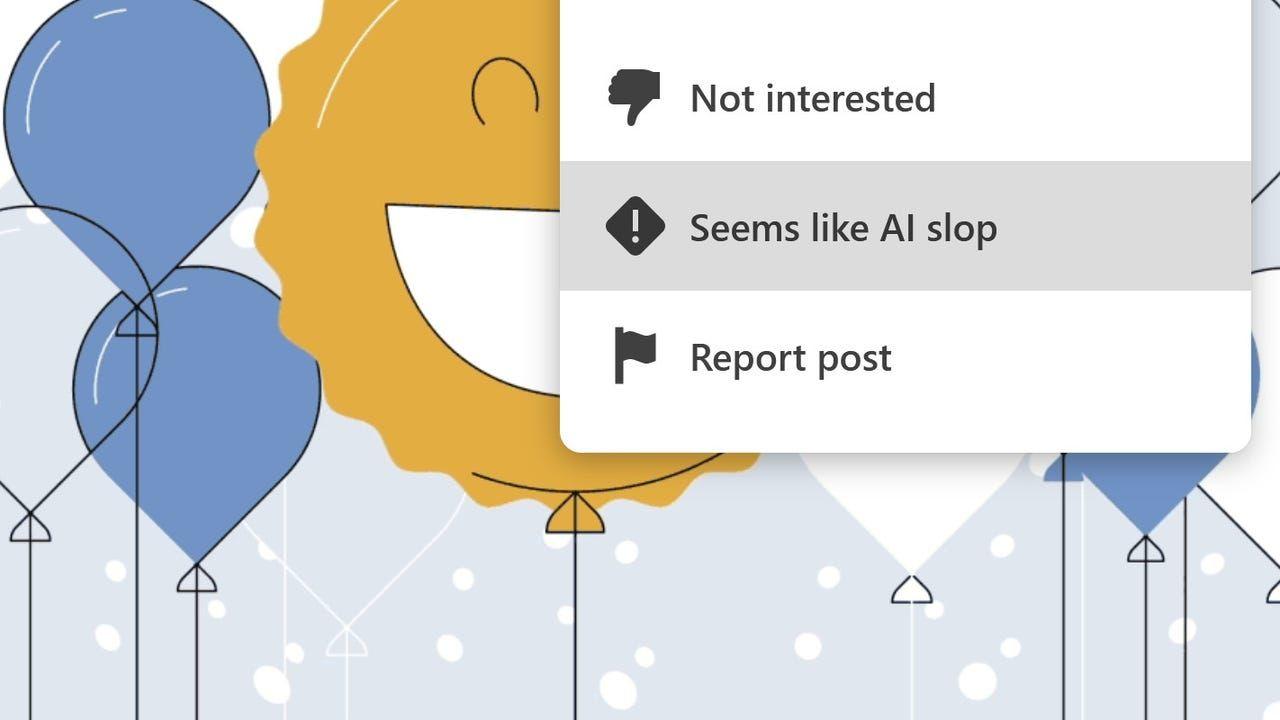
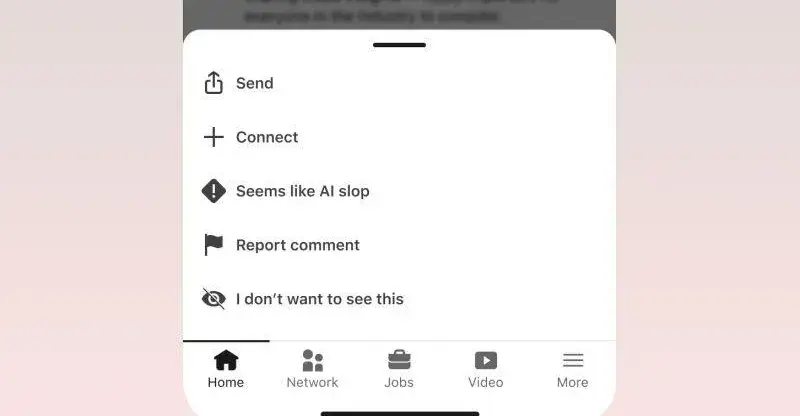
Following 404 Media's reporting on how LinkedIn is full of AI slop, the platform is giving users a chance to report it when they see it. LinkedIn, a social network awash with long AI-generated posts from executives and other corporate workers, has introduced a new button that users can click to flag if a post "seems like AI slop," according to 404 Media's own tests. If you have been anywhere near LinkedIn in the past couple of years, you have undoubtedly seen users posting blatantly AI-generated missives. Often these posts take some sort of news event, and opine on how this relates to thought leadership, or some other LinkedIn brainrot term. It's also pretty wild the button specifically uses the term "AI slop" and not, say, "It seems this was generated with AI." Here's what the button looks like, available when a user clicks on the three dots at the top of a post: I scrolled for about six seconds before finding a post that sure looked like AI slop, based on the gratuitous spacing between single sentences, lists of takeaways, emoji use, and "X is not Y" sentence construction. When I clicked the "seems like AI slop button," LinkedIn told me, "Thanks for letting us know. Your feedback helps improve the feed." It then hid the post itself. Earlier this month, 404 Media reported that AI detection service Pangram estimated 41 percent of long form posts and 30 percent of short form posts on LinkedIn are likely AI generated. (Disclosure: Pangram previously ran an advertisement on 404 Media.) If you Google "linkedin AI" or similar, there are a ton of guides -- some on LinkedIn itself -- telling people how to use AI to write their LinkedIn posts. There is of course some irony in that LinkedIn itself has generative AI features. Its AI-powered writing assistant helps people "share personalized suggestions for your profile, to help you stand out and get noticed," according to LinkedIn's website. After publication of this piece, Hari Srinivasan, chief product officer at LinkedIn, wrote their own post about the button. "AI slop is a top priority for all of us. We really care about this. People come to LinkedIn to connect with real people and share their real perspectives, ideas and expertise. Here are a few more changes to keep it that way," he wrote. The button in part will help LinkedIn tune its own models for identifying AI slop. "We are ramping up a series of new and improved classifiers that identify if a post is AI-slop or generally low-quality content. This will reduce the amount of AI slop you might see in suggested content and content from outside your network," the post said. "We are ramping the ability for members to tell us if they believe a post or comment seems like AI slop. Slop is hard to define and the definition changes; this lets us tune our models and make better feeds." Srinivasan also said LinkedIn is removing the AI-powered "enhance your post" feature with another that "proofreads your words, but does not change your voice." When previously asked for comment about the Pangram report, LinkedIn said it was taking steps to crack down on AI slop, and referred us to a policy change it made in May designed to disincentivize slop: "Professionals come to LinkedIn to hear from real people and their unique insights and perspectives. We actively work to reduce low quality, automated or generic content, and while AI can be used to beat the blank page problem, our focus is on surfacing professional conversations that help people advance their careers." Update: this piece has been updated to include a post from LinkedIn.
[9]
LinkedIn Adds Button on Every Post to Report "Seems Like AI Slop," Which Is Definitely Going to Get a Real Workout
Can't-miss innovations from the bleeding edge of science and tech Perhaps more so than any other social media platform, LinkedIn has been inundated with lazy AI-generated brainrot content. It has become the AI slop "punching bag," a repository of painful engagement bait being spewed out by an army of bots who seem at times to mainly be lobbing business platitudes at one another. Just last week, Substack CEO Chris Best took aim at the Microsoft-owned career site when he announced the launch of an AI detector feature "because we're sick of slop and we don't want Substack to turn into LinkedIn." According to AI detection company Pangram, a shocking two thirds of LinkedIn posts are showing up as being AI generated by users of its browser extension. More than 40 percent of longform posts were flagged as "fully AI-generated," according to the company. Credit where credit's due: LinkedIn has seemingly caught on to the abysmal state of its service, quietly introducing a new button that allows users to flag a post that "seems like AI slop." "Genuinely thought it was a joke until I clicked on a few posts," one user wrote in a Bluesky post after discovering the feature. It's a baffling move, but probably well intentioned. Whether LinkedIn will act on what will likely be a massive influx of flagged posts remains to be seen, however. Once flagged, the post becomes hidden to the user, but it's unclear whether somebody at LinkedIn will review it. As 404 Media points out, the inclusion of the new button is particularly surprising, because LinkedIn is simultaneously encouraging users to generate AI slop through an AI-powered writing assistant. "LinkedIn's AI-powered writing assistant will share personalized suggestions for your profile, to help you stand out and get noticed," the company's website reads. "The AI-powered suggestions are personalized based on your profile information and incorporate insights from analyzing millions of profiles." The company also started scraping user data without permission to train so-called AI "coworkers" last year, a dubious experiment that was shut down almost immediately. It's clear that the subject of AI is proving divisive in the LinkedIn c-suite. In a May 20 update, LinkedIn promised that it was looking to keep "conversations real" by keeping "AI slop" at bay. "When AI is overused, especially at scale and in an automated way, it dilutes the valuable insights that real human conversations can spark," LinkedIn executive editor Laura Lorenzetti wrote in the update. "It's ok to use AI to help you write, but your posts and comments need to represent your voice and your perspectives. The ultimate value comes from the human behind the tool." To allegedly "strengthen authenticity," LinkedIn is working on "technology systems" that "have been trained to recognize signals of AI slop," according to Lorenzetti. Judging by the latest news, it's looking to leverage its own frustrated user base to stop LinkedIn from drowning in a bot-infested sea of slop. Only time will tell if it's too late. More on LinkedIn: AI "Coworkers" Profiles Prove Too Stupid Even For LinkedIn
[10]
That cringey LinkedIn post? You can now report it as 'AI slop'
LinkedIn is pushing back against lengthy, low-quality posts generated with AI, also known as "AI slop," that users have become accustomed to seeing in their feeds. The career-building and social networking site just added a button to easily allow users to report such content for review. Now, when LinkedIn users are scrolling through posts and find one that they believe is AI, they can tap the three dots next to a post and in the menu that populates, the option "seems like AI slop" will appear. When users click the button, the post will be hidden and a message will appear that reads: "Thanks for letting us know. Your feedback helps improve the feed." After 404 Media first reported the innovation, LinkedIn's chief product officer Hari Srinivasan posted an explanation on Thursday about why it's important for the site to combat AI slop. Srinivasan wrote that the site is a place "with real people" who share their real perspectives, ideas and expertise" and said LinkedIn will make it easier than ever to flag posts that seem "inauthentic" or rely on "heavy use of AI" with the new button.
[11]
LinkedIn adds a 'seems like AI slop' report button for AI-generated posts
As part of a series of updates to reduce the volume of AI slop on the platform, LinkedIn has introduced a button that lets users flag posts as "seems like AI slop." This makes it one of the first major social platforms to give users a direct tool to push back against AI-generated content. The feature is part of a broader set of measures LinkedIn is rolling out to address what its chief product officer Hari Srinivasan called a "top priority." AI detection company Pangram found that more than 40% of long-form LinkedIn posts were flagged as fully AI-generated, with LinkedIn described as the most AI-saturated social media platform. Nearly two-thirds of all AI-generated long-form social media posts were found on LinkedIn specifically. With the new update, whenever a user clicks the new button, the flagged post disappears from their feed. LinkedIn will also privately notify posters through their account dashboard that their content may have come across as inauthentic. Srinivasan said that the goal is not to judge content but to give creators feedback from real humans rather than relying solely on automated AI detectors. The reports will also feed into LinkedIn's internal models, allowing it to better identify and reduce AI slop in suggested content and recommendations from outside users' networks. The company says it has already blocked hundreds of thousands of automated comment attempts daily and billions of other automation attempts in recent months. LinkedIn is also removing its own "Enhance with AI" post writing feature, replacing it with a lighter proofreading tool that refines spelling and grammar without rewriting a user's voice entirely. Other improvements include expanding access to profile and page verification tools and adding an option to block comments from company pages you no longer want to see.
[12]
Microsoft Lets Users Report Slop After Spending $41 Billion On AI
LinkedIn is a social networking site for professionals. It used to be quite boring, but now people have found it's a great place to try to earn business brain clout by going there and dumping AI slop. Microsoft, which purchased LinkedIn in 2016, has decided to acknowledge the scourge of the "What losing my childhood Golden Retriever to pancreatic cancer taught me about B2B sales"-style chum on the platform with a new button that flags it as AI slop. Instead of just reporting your ex-boss's posts as spam, you can now tag them with "seems like AI slop." The move comes after AI detector startup Pangram recently claimed that over 40 percent of long-form posts on LinkedIn are AI garbage. Pangram has its own problems, but the publicity forced Microsoft to reckon with something anyone who has come within three clicks of LinkedIn has known for months. "AI slop is a top priority for all of us," chief product officer Hari Srinivasan says in a post (via The Verge). "We really care about this." In a post definitely not written with the help of AI, he continued, "We are ramping the ability for members to tell us if they believe a post or comment seems like AI slop. Slop is hard to define and the definition changes; this lets us tune our models and make better feeds." One of the ironies of this whole thing is that LinkedIn had built in an "enhance your post" feature to achieve exactly this outcome of slop-ifying the platform. It's now walking that back. Just "proofreads" now. "We asked ourselves why do people post with AI anyway?" Srinivasan wrote. "The answer is LinkedIn isn't a one-word kind of place and they feel more confident running their posts through AI. We're taking this learning, removing the 'enhance your post' feature you see when you write a post or message & replacing with a feature that proofreads your words, but does not change your voice." Attempts to de-slopify LinkedIn come right as Microsoft reported $35.8 billion in profit for the quarter after spending $41 billion on capital investments, including building out its data center infrastructure to service the AI revolution everyone swears will improve our lives any day now. What does Microsoft think the AI is being used for? Surely not a bubble that's making its gaming hardware unaffordable and the broader internet unreadable in the meantime. "We need to get beyond the arguments of slop vs sophistication and develop a new equilibrium in terms of our 'theory of the mind' that accounts for humans being equipped with these new cognitive amplifier tools as we relate to each other," CEO Satya Nadella wrote back in January. "This is the product design question we need to debate and answer." Unfortunately he didn't post it on LinkedIn so there's no "seems like AI slop" button to press.
[13]
LinkedIn's New Perfectly Named 'Seems Like AI Slop' Button Won't Save PC Gaming, but It'll Certainly Help Against Bot-Generated Garbage
As if millions of "Top Voices" suddenly cried out in terror and were suddenly silenced. Social media sites are overrun with AI slop, churned out ad nauseum by increasingly ubiquitous AI tools that happen to have the lovely side effect of driving up the price of gaming hardware. At least one site has had enough, and it's... LinkedIn, of all places. LinkedIn has become practically unusable in recent months if you don't have an appetite for low-effort "thought leadership" posts that just reek of AI slop. The kind of emoji-filled viral-bait that makes you say "man, this sure seems like it was written by an AI." Well, the Microsoft-owned professional networking site today introduced a new reporting button that's marvelous in its simplicity. Now, alongside options to Save, Share, or Report a post is a new "Seems like AI slop" button. Perfect. No notes. According to a post from LinkedIn Chief Product Officer Hari Srinivasan, reporting via the button will help train LinkedIn's own AI tools to better identify AI slop. No, the irony is not lost on me. (And never mind that LinkedIn itself at one point touted its own AI-powered writing assistant. We're certainly not all trying to find the guy who did this.) Regardless, Srinivasan says the goal is to reduce the amount of AI slop people see on their feeds. There are some genuinely useful and interesting applications for AI, like improving frame rates or building NPCs that can have actual conversations, but churning out slop is not one of them. I can only hope that other social media networks follow suit. Unfortunately, even if LinkedIn (and other sites) were to ban AI content entirely, it would still likely have little impact on the total AI infrastructure buildout that has caused surging RAM prices and made gaming hardware more inaccessible than ever. But at least our feeds would be a little bit more human, and that I call a win. Bo Moore is IGN's Senior Manager of Tech. You can find him online @usebomswisely.
Share
Copy Link
LinkedIn is fighting back against the proliferation of AI-written posts with a new reporting feature. Users can now flag posts as 'seems like AI slop' while the platform removes its AI enhancement tools in favor of basic proofreading. The move comes as research shows 81% of long-form LinkedIn posts may be AI-generated.
LinkedIn has launched a direct response to the flood of AI-generated content overwhelming its platform, introducing a 'seems like AI slop' button that allows users to report AI-generated slop they encounter in their feeds
1
. The Microsoft-owned professional network announced the feature Thursday as part of a broader initiative to restore authenticity to a platform increasingly criticized for low-quality artificially generated content3
.
Source: The Verge
Chief Product Officer Hari Srinivasan acknowledged the severity of the problem in a post on the platform. "AI slop is a top priority for all of us. We really care about this. People come to LinkedIn to connect with real people and share their real perspectives, ideas, and expertise," he stated
1
. The new reporting button appears in the three-dots menu on all posts and comments, allowing users to flag content they suspect was created by generative AI4
.The timing reflects an urgent need for intervention. Recent research from AI detection firm Pangram found that 41 percent of long-form LinkedIn posts were flagged as fully AI-generated, with LinkedIn proving to be the most AI-saturated social media platform
3
. More alarmingly, an updated scan released Thursday by Originality.ai classified 81 percent of 5,000 posts examined this month as likely AI-generated4
.LinkedIn is now blocking hundreds of thousands of automated comment attempts daily and has prevented billions of automated posting attempts in recent months alone
1
. The automation defenses represent a significant technical investment as the platform battles both individual users employing AI tools and sophisticated bot networks operating at scale4
.The seems like AI slop button serves a dual purpose beyond immediate user experience improvements. User reports will provide critical signal data that LinkedIn's AI classifiers can use to better identify inauthentic content
2
. "Slop is hard to define and the definition changes; this lets us tune our models and make better feeds," Srinivasan explained2
.
Source: Fast Company
LinkedIn is also deploying improved classifiers to identify AI slop and generally low-quality content, which will reduce the visibility of such posts in suggested content recommendations from outside users' networks
1
. Posts flagged through the new reporting tool will see reduced algorithmic reach similar to content marked as "not interested"5
.Related Stories
In a notable reversal, LinkedIn is removing the enhance your post feature that previously used AI to rewrite user content
1
. The company is replacing it with an AI proofreading tool that corrects errors without substantially altering the writer's voice or style3
. This shift acknowledges LinkedIn's own role in perpetuating the proliferation of AI-written posts by actively encouraging users to let algorithms rewrite their thoughts4
.The platform will also begin privately flagging in users' analytics dashboards when other members believe their content comes across as inauthentic due to heavy AI use
1
. "AI and slop are not the same thing," Srinivasan noted. "Many people refine thoughts with AI, and we believe they want to know when they sound inauthentic"4
.
Source: Gizmodo
LinkedIn's actions mirror a wider industry reckoning with AI-generated material. Newsletter platform Substack recently partnered with Pangram to help users identify AI-written content, while Pangram secured $9 million in funding to address the internet's AI content crisis
1
. The startup Digg shut down its Reddit competitor in March after failing to control bot infiltration1
.Cloudflare reports that bot traffic now exceeds human-generated requests on the web, reaching this milestone faster than predicted
1
. Whether LinkedIn's combination of user reporting, improved detection models, and feature removals can reverse the tide remains uncertain, particularly given the scale of automation the platform faces and the economic incentives driving AI content creation.Summarized by
Navi
[1]
[3]
21 May 2026•Technology

10 Jul 2026•Entertainment and Society

23 Jun 2025•Technology

1
Technology

2
Technology

3
Science and Research