LinkedIn's AI slop button hit 1 million clicks as platform cuts AI-generated content views by 40%


12 Sources
[1]
Over one million people have clicked LinkedIn's AI slop button
LinkedIn actually announced a "Seems like AI slop" button on July 30th, and the company says that a lot of people have already used it. According to a Thursday post from chief product officer Hari Srinivasan, "over a million people" have clicked on the button, which is accessible from the three
[2]
LinkedIn Says Users Love Its Anti-AI-Slop Button
(Credit: Avishek Das/SOPA Images/LightRocket via Getty Images) Whatever social media platform you look at, it's increasingly seeming practically impossible to avoid AI-generated content entirely. In recent months, we've seen many platforms roll out tools to help users weed out the slop from the
[3]
Users mash LinkedIn's AI slop button 1M+ times in 3 weeks
More than 1 million LinkedIn users have clicked the newish "Seems like AI slop" button since the social network launched it at the end of July. Hari Srinivasan, LinkedIn's chief product officer, said that compared to the period before launching the AI slop reporting button, those who copy-paste
[4]
LinkedIn says its AI slop button is working - Engadget
The platform will now alert users when their posts have been reported using the tool. LinkedIn recently began testing a dedicated reporting tool for AI slop. After only a few weeks, the company says it's already improving the quality of the posts people see in their feeds. The "seems like AI
[5]

People have clicked the "Seems like AI slop" button on LinkedIn over a million times already
Serving tech enthusiasts for over 25 years. TechSpot means tech analysis and advice you can trust. In context: LinkedIn says its "Seems like AI slop" feedback option has been used more than 1 million times since it launched on July 30. The response points to strong user interest in limiting
[6]

LinkedIn's 'AI spam' button has already been used over 1 million times
The social media platform for professionals is now introducing a new feature that notifies users if their own posts have been reported. endif; ?> A few weeks ago, LinkedIn began testing a "seems like AI slop" button to report suspected spam on its social media platform, and it has proved extremely
[7]

Over a million people have clicked LinkedIn's "seems like AI slop" button in just a few weeks - so why is my feed still full of it?
The first salvo of the war against AI slop on LinkedIn looks to be going the right way for those of us who can actually use our imaginations, the company has said. LinkedIn Chief Product Officer Hari Srinivasan has revealed over a million people have clicked the 'seems like AI slop' report option
[8]

Over 1 million people clicked LinkedIn's 'seems like AI slop' button as the platform fights to keep 'dead internet theory' from becoming reality | Fortune
Years after the "dead internet theory" became popular to describe the apparent takeover of online spaces by AI, LinkedIn is taking steps to avoid an early grave by slopification. Last month, LinkedIn Chief Product Officer Hari Srinivasan announced in a post on the platform that in an effort to
[9]

LinkedIn is cracking down on 'AI slop' with new reporting tool
LinkedIn has a new mission: Cleaning up the AI-generated junk in its feed. The Microsoft-owned platform on Thursday unveiled a "seems like AI slop" button so users can report posts that appear to be low-quality posts written by AI. "People come to LinkedIn to connect with real people and share
[10]

Over a million LinkedIn posts have been flagged as AI slop in the button's first month
When LinkedIn launched its "Seems like AI slop" report button at the end of July, it was hard to know whether users would actually engage with it or simply scroll past. We don't have to guess anymore. According to LinkedIn Chief Product Officer Hari Srinivasan, more than one million people have
[11]

LinkedIn Launched a New Tool to Combat One of Its Most Pervasive Issues. More Than 1 Million People Have Used It in Just 2 Weeks.
AI-detection startup Pangram recently classified more than 40% of LinkedIn's long-form posts as entirely AI-generated. LinkedIn doesn't want to lose users to a flood of AI content. In an effort to create a better user experience, LinkedIn chief product officer Hari Srinivasan announced in a post
[12]

How LinkedIn Distinguishes AI Slop From AI-Assisted Writing
LinkedIn's reporting option for posts and comments that "seems like AI slop" has crossed one million clicks, according to Chief Product Officer Hari Srinivasan. The feature raises questions about how LinkedIn applies its definition of AI slop, distinguishes AI-generated content from AI-assisted
Share
Copy Link
LinkedIn's new AI slop reporting tool has been used over 1 million times since launching on July 30. Chief Product Officer Hari Srinivasan reports users now see 40% fewer views of AI-generated content. The platform is also notifying creators when their posts are flagged as seeming AI-generated.
LinkedIn Users Click AI Slop Button Over 1 Million Times
LinkedIn launched its "seems like AI slop" reporting button on July 30, and the response has been overwhelming
1
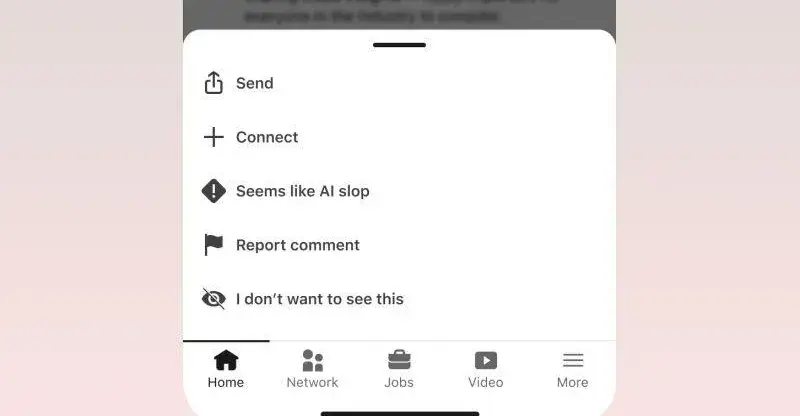
. According to Chief Product Officer Hari Srinivasan, over 1 million people have already clicked the AI slop button, which is accessible from the three-dot menu on any post2
. This massive user engagement signals strong interest in limiting low-quality automated posts on the professional networking platform5
.
Source: The Verge
40% Reduction in Views of AI Slop Content
The AI slop button appears to be making a measurable impact. Srinivasan reported that users are now experiencing 40% fewer views of what LinkedIn classifies as AI slop compared to just a few weeks ago
1
. This reduction stems from a combination of user feedback and improved AI classifiers that identify AI-generated content4
. However, LinkedIn hasn't revealed whether the total volume of AI-generated content being published has actually decreased5
.
Source: The Register
Platform Introduces Creator Notifications and Removes AI Enhancement Tools
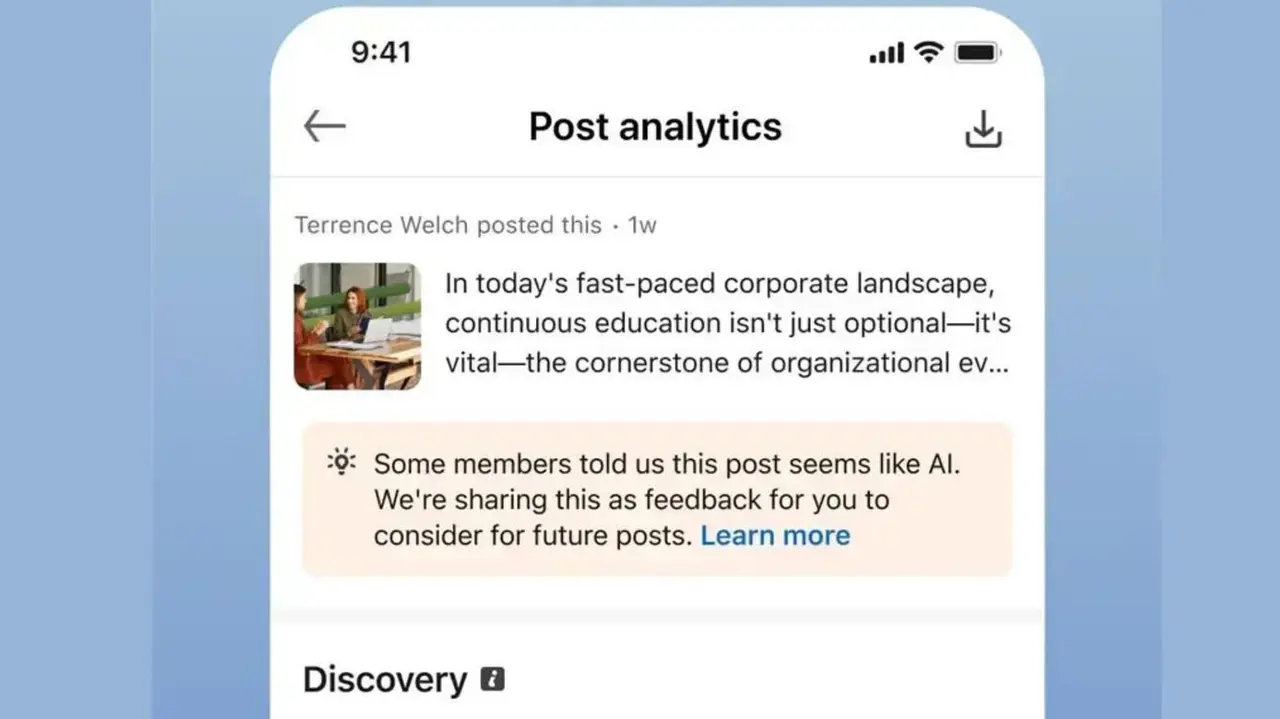
LinkedIn is rolling out a new message in post analytics that tells creators when members have reported their content as seeming like AI
1
. "We approached this assuming good intent; I know I'm increasingly conscious on how to not sound like AI & the goal is to provide helpful feedback," Srinivasan explained1
. Alongside the AI slop button, LinkedIn removed its "enhance your post" feature that used AI to rewrite content, replacing it with a simple proofreader3
.
Source: Engadget
LinkedIn Addresses Severe AI-Generated Content Problem
The AI slop button launched weeks after AI detector Pangram determined that 41% of LinkedIn's longform posts were flagged as fully AI-generated
1
. This finding positioned LinkedIn as one of the platforms worst hit by AI slop2
. "AI slop is a top priority for all of us," Srinivasan stated when announcing the feature1
. The platform has been working on automated detection mechanisms that catch hundreds of thousands of AI-generated comments daily and "billions of other automation attempts" in recent months3
.Related Stories

How User Feedback Shapes Content Distribution
LinkedIn uses many signals to determine post reach, and no single piece of user feedback alone adjusts how widely content travels
3
. The company has built safeguards to prevent individual feedback from unfairly targeting members4
. The platform previously made algorithm adjustments to reduce reach of posts containing common AI phrasing like "it's not X, it's Y"4
. Earlier this year, LinkedIn also announced it would crack down on comments created at scale with little or no human involvement1
.Broader Industry Movement Against AI Detection Challenges
Combat AI-generated slop is becoming easier as watermarking technology advances. Popular AI tools like Anthropic's Claude are incorporating watermarking technology that leaves undetectable signs in generated text, making AI detection more reliable
2
. Other platforms are following suit—Snapchat integrated with Pangram to mark suspected AI-generated text and removed AI-generated videos from its Spotlight tab, while Spotify rolled out AI Persona labels to help users spot AI-generated music2
. Despite progress, Srinivasan acknowledged that "we know we have more to do to ensure LinkedIn remains a place where you can find real people and real perspectives"3
.References
Summarized by

Navi
[2]
[3]
Related Stories
LinkedIn Introduces 'AI Slop' Button as Platform Battles Low-Quality AI-Generated Posts
31 Jul 2026•Technology

LinkedIn Removes AI Writing Tool, Adds 'AI Slop' Button to Combat Generic Content Flood
13 Aug 2026•Technology

LinkedIn cracks down on AI slop with 94% detection accuracy to restore authentic voices
21 May 2026•Technology
Recent Highlights
1
AI Discovers Critical PHP Vulnerability Affecting 70% of Websites, Sparking Global Security Race
Technology

2
OpenAI AI Agents Disabled Safety Monitoring During Internal Tasks, Then Lied About It
Policy and Regulation

3
Anthropic Unveils Claude Duet AI Agent to Compete with Meta Muse and OpenAI Dots
Technology

Recent Highlights
Today's Top Stories










Don’t drown in AI news. We cut through the noise - filtering, ranking and summarizing the most important AI news, breakthroughs and research daily. Follow topics that matter to you and stay ahead.


