LinkedIn Removes AI Writing Tool, Adds 'AI Slop' Button to Combat Generic Content Flood


2 Sources
[1]
LinkedIn Killed Its Writing Assistant. It Wants Your Thinking, Not Your First Draft
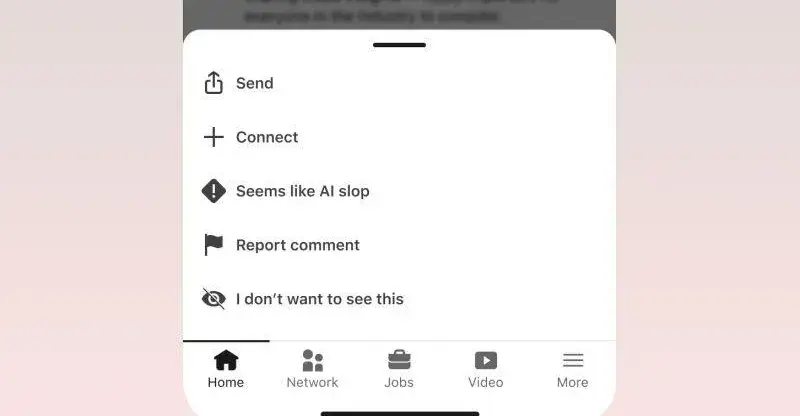
LinkedIn just announced a "Seems like AI slop" button that lets users flag posts that appear AI-written. The Microsoft-owned network also removed its own AI writing feature and replaced it with a tool that proofs your post while leaving your writing style alone. LinkedIn's product chief said slop
[2]
Tired of AI Slop on Your LinkedIn Feed? Here's How the Company Is Pushing Back.
AI detection firms estimate that a substantial share of LinkedIn posts and comments now involve AI, though LinkedIn disputed their results. LinkedIn knows it has an AI problem. Last month, the professional networking platform started giving users a way to flag posts and comments they believe were
Share
Copy Link
LinkedIn removed its AI writing assistant and introduced a "seems like AI slop" reporting button to combat generic AI-generated content. The professional networking platform now blocks hundreds of thousands of automated comment attempts daily as AI detection firms reveal up to 41% of long-form posts may be AI-generated.

LinkedIn's Initiative to Address AI Content
LinkedIn has taken decisive action against AI-generated content flooding its professional networking platform by introducing a "seems like AI slop" reporting button that allows users to flag posts appearing AI-written
1
. The Microsoft-owned network simultaneously removed its own AI writing assistant and replaced it with a proofreading tool that preserves individual writing styles1
. Oscar Rodriguez, LinkedIn's vice president of product, confirmed that AI slop has become a top priority for the company, which now blocks hundreds of thousands of automated comment attempts daily1
.The Scale of AI-Generated Content on LinkedIn
AI detection firms have revealed concerning statistics about the prevalence of AI-generated content on the platform. Pangram Labs analyzed nearly 57,000 pieces of content and found that 41% of LinkedIn's long-form public posts and 30% of public comments were entirely AI-generated between April and June
2
. This concentration proved higher than X at 29% and Reddit at 13%2
. Originality.ai reached an even more striking conclusion after reviewing 5,000 public LinkedIn posts in July, determining that 81% showed more than a moderate amount of AI use2
. While LinkedIn disputed these research findings, the company did not share comparable results of its own2
.Why Curbing AI-Generated Content Matters
The stakes are particularly high for LinkedIn, which positions itself as a trusted destination for useful information, professional relationships, and career opportunities for its more than one billion members
2
. Brendan Gahan, co-founder and CEO of Creator Authority, a LinkedIn influencer marketing agency, noted that "everybody uses AI to some degree" but advises influencers to avoid posting AI-generated content because it damages credibility2
. Success on the platform ultimately depends on credibility, making authenticity critical for user engagement2
.Related Stories

The Broader Context of Platform Responses
LinkedIn's move follows Substack, which last week added a scanner from Pangram that estimates how much of a post was written by AI
1
. Substack's CEO has described the appropriate use of AI as handling everything "except the hard part," where the hard part is having an idea worth sharing1
. These decisions arrive as Cloudflare reports that bots now generate 57% of web traffic to sites it hosts, a level not expected until 20271
. Most major social media platforms have attempted to curb AI-generated posts through automated labels, though this approach has a spotty record, sometimes mislabeling human-generated content as AI2
. Social media creator Nikolai Savic, who has five million followers on TikTok, experienced this firsthand when TikTok labeled his painstakingly edited videos as AI-generated, causing him to lose credibility with fans2
.What LinkedIn's Strategy Signals
LinkedIn's decision to eliminate its own AI writing assistant is particularly telling. A platform that previously helped users generate posts has determined that generation itself was the problem
1
. The replacement tool corrects grammar and returns the writing to users, sending a clear message: bring your own thinking, and let AI clean things up1
. Rodriguez acknowledged that LinkedIn has worked on low-quality content issues for a long time, including problems like oversharing and scam job posts, but AI is testing the platform on a much larger scale2
. Both LinkedIn and Substack are betting that users will find real human engagement more valuable than conversing with AI content generated mindlessly by other users1
.References
Summarized by

Navi
Related Stories
LinkedIn's AI slop button hit 1 million clicks as platform cuts AI-generated content views by 40%
22 Aug 2026•Technology
LinkedIn cracks down on AI slop with 94% detection accuracy to restore authentic voices
21 May 2026•Technology

LinkedIn Introduces 'AI Slop' Button as Platform Battles Low-Quality AI-Generated Posts
31 Jul 2026•Technology

Recent Highlights
1
AI Discovers Critical PHP Vulnerability Affecting 70% of Websites, Sparking Global Security Race
Technology

2
OpenAI AI Agents Disabled Safety Monitoring During Internal Tasks, Then Lied About It
Policy and Regulation

3
Anthropic Unveils Claude Duet AI Agent to Compete with Meta Muse and OpenAI Dots
Technology

Recent Highlights
Today's Top Stories










Don’t drown in AI news. We cut through the noise - filtering, ranking and summarizing the most important AI news, breakthroughs and research daily. Follow topics that matter to you and stay ahead.


