LinkedIn cracks down on AI slop with 94% detection accuracy to restore authentic voices


3 Sources
[1]
LinkedIn cracks down on AI slop with 94% detection accuracy
The Microsoft-owned platform will suppress generic AI-generated posts rather than remove them, claiming 94 per cent accuracy in early detection tests If your LinkedIn feed has felt like it was written by one person with 10 million accounts, you are not imagining things. The platform has become a
[2]
'It's ok to use AI to help you write, but your posts and comments need to represent your voice and your perspectives': LinkedIn is finally set to crack down on AI slop -- and save our collective sanity
* LinkedIn exec reveals plans to cut down on AI slop * Move looks to cut down on inauthentic or unoriginal content and posts * Users will no longer see AI-generated content in their recommendations LinkedIn may soon be a much nicer place to network and follow updates from old colleagues after
[3]
LinkedIn declares war on AI slop
AI is everywhere these days. Try as you might to avoid it, you're not likely to succeed. LinkedIn, though, is attempting to draw a line in the sand and, if not completely eliminate the AI slop on its pages, at least cut back on it. The company plans to target low-quality AI posts that distract
Share
Copy Link
LinkedIn announced a major crackdown on AI slop—low-quality, AI-generated content flooding user feeds. The Microsoft-owned platform claims 94% detection accuracy in early tests and will suppress generic posts from recommendations rather than remove them. The move targets engagement bait, recycled thought leadership, and bot-generated comments while still welcoming AI-assisted content that offers original perspectives.
LinkedIn Launches Detection System to Combat Generic Content
LinkedIn has declared war on what it calls AI slop, announcing detection systems designed to identify and suppress low-effort, AI-generated content that clutters user feeds with generic, repetitive posts. VP of Product Laura Lorenzetti revealed the platform's new approach targets content that "may sound polished on the surface but lacks any real unique perspective or substance."
1
In early testing, the system achieved 94% detection accuracy in correctly flagging generic content, a figure that positions LinkedIn at the forefront of text-based AI content moderation.1

Source: Fast Company
The Microsoft-owned platform will suppress posts from recommendations rather than delete them entirely, meaning flagged content remains visible to direct connections but won't spread across the wider feed. This approach aims to balance content moderation with user autonomy, though the company hasn't disclosed data on false positives or how often legitimate posts might be incorrectly suppressed.
1
Targeting Specific Patterns and Engagement Bait
The crackdown extends beyond simple detection to target specific content patterns that signal low-quality AI-generated content. LinkedIn specifically called out the "it's not X, it's Y" format as emblematic of formulaic AI construction that will be demoted.
1
The platform also targets outright engagement bait and recycled thought leadership lacking originality.2
Beyond posts, LinkedIn is addressing bot-generated comments and automation tools that generate AI content at scale. The company aims to eliminate generic AI comments that read like ChatGPT summaries of the posts they're replying to, adding nothing meaningful to conversations.
1
Engineers are working alongside the platform's editorial team to identify patterns and build technology that learns over time by distinguishing content that adds perspective, context, or expertise from content that feels generic or repetitive.Drawing the Line Between Assistance and Automation
LinkedIn emphasized that AI-assisted content remains welcome, provided it contains original ideas or encourages meaningful conversation. "It's ok to use AI to help you write, but your posts and comments need to represent your voice and your perspectives," the company stated.
2
This distinction between AI writing assistants used for refinement and complete automation presents an enforcement challenge, as the platform itself offers AI writing tools that generate post drafts and comment suggestions.1
The irony hasn't escaped observers: Microsoft, LinkedIn's parent company, is one of the largest investors in OpenAI, whose tools produce much of the content LinkedIn now seeks to suppress. The platform finds itself building both the firehose and the filter simultaneously.
1
This may signal an upgrade or overhaul coming to the platform's AI capabilities to better align with the new content standards.2
Related Stories

Industry-Wide Implications and User Experience Impact
The move reflects growing industry awareness of AI content moderation challenges. OpenAI recently adopted C2PA metadata and SynthID watermarks for image outputs, while ByteDance added watermarking to Seedance 2.0. However, text remains far harder to fingerprint than images, making LinkedIn's approach—using behavioral signals and stylistic patterns rather than watermarks—inherently more complex.
1

Source: TechRadar
Lorenzetti emphasized the importance of authentic voices and perspectives, stating, "At a time when more people need help navigating work, it's more important than ever that people can learn from real voices, authentic perspectives, and lived expertise."
2
Early results have been encouraging, with members already seeing fewer low-quality posts in their feeds, though the full rollout could take several months.2
The success or failure of LinkedIn's approach will likely influence other platforms grappling with similar issues. If suppression proves effective at improving user experience without stifling legitimate AI-assisted content, other social networks may adopt similar strategies.
3
If it fails, the platform will have publicly acknowledged that its feed was compromised by user-generated content quality issues without successfully resolving them.1
References
Summarized by

Navi
[1]
[3]
Related Stories
LinkedIn's AI slop button hit 1 million clicks as platform cuts AI-generated content views by 40%
22 Aug 2026•Technology
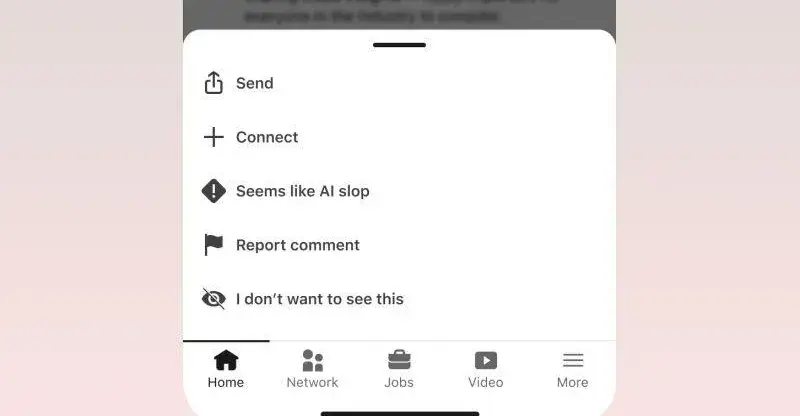
LinkedIn Removes AI Writing Tool, Adds 'AI Slop' Button to Combat Generic Content Flood
13 Aug 2026•Technology

LinkedIn Introduces 'AI Slop' Button as Platform Battles Low-Quality AI-Generated Posts
31 Jul 2026•Technology

Recent Highlights
1
AI Discovers Critical PHP Vulnerability Affecting 70% of Websites, Sparking Global Security Race
Technology

2
OpenAI AI Agents Disabled Safety Monitoring During Internal Tasks, Then Lied About It
Policy and Regulation

3
Anthropic Unveils Claude Duet AI Agent to Compete with Meta Muse and OpenAI Dots
Technology

Recent Highlights
Today's Top Stories










Don’t drown in AI news. We cut through the noise - filtering, ranking and summarizing the most important AI news, breakthroughs and research daily. Follow topics that matter to you and stay ahead.


