2 Sources
[1]
Machine learning model filters out the biological noise in liquid biopsy samples
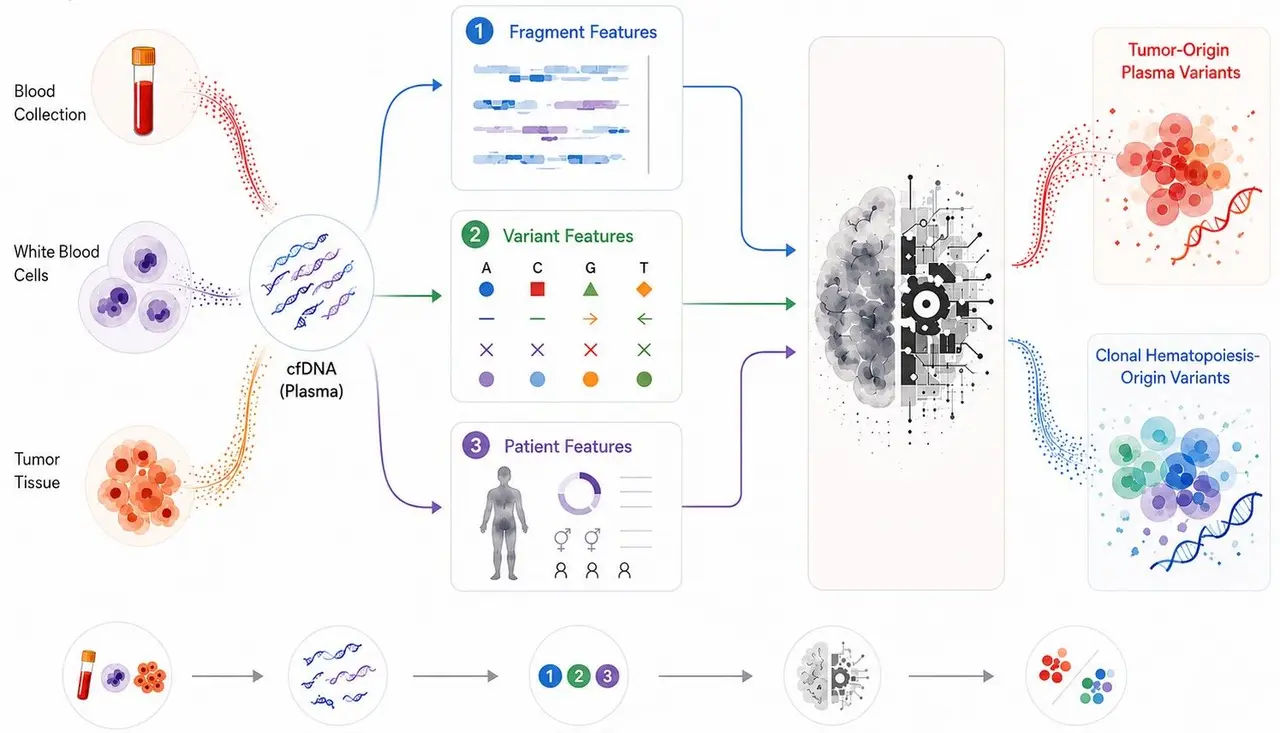
Johns Hopkins MedicineJun 9 2026 A machine learning model developed by researchers at the Johns Hopkins Kimmel Cancer Center filters out the biological noise in liquid biopsy samples, helping clinicians better match therapies to their patients' tumors. The research was published May 1 in Clinical Cancer Research and was funded in part by the National Institutes of Health. Liquid biopsies, which analyze cell-free DNA (cfDNA) fragments from tumors in blood samples, are commonly used to identify mutations in a patient's solid tumor, enabling clinicians to select mutation-targeted therapies. However, liquid biopsies may also pick up mutations that accumulate in white blood cells through an aging-related process called clonal hematopoiesis. These white blood cell mutations are common in older individuals and in patients who have previously undergone chemotherapy or radiation. When you do a liquid biopsy, and you get the report back, and you see mutations, you do not know if the mutations are coming from the tumor or the white blood cells. If you want to select a mutation-targeted drug to treat the cancer, you want to make sure you are targeting mutations in the cancer and not mutations in the white blood cells." Jenna Canzoniero, M.D., M.S., co-first author of the paper and assistant professor of oncology, Johns Hopkins University School of Medicine To solve this problem, Canzoniero and her colleagues in the molecular oncology laboratory developed a machine learning model called plasmaCHORD that uses characteristics of the DNA fragments to estimate whether a mutation found in a liquid biopsy originates from the tumor or white blood cells. The DNA fragments from tumors and the DNA fragments from white blood cells are "chopped up" in different ways, Canzoniero says, creating distinct "cfDNA fragmentation profiles." The model also uses factors like the patient's age and the type of gene and mutation. The team trained the model on liquid biopsy samples from 225 patients with breast, colorectal, esophageal, ovarian or non-small cell lung cancer. They verified the model's accuracy by using matched genetic sequencing of patients' tumor cells and white blood cells to identify the true source of the mutations. Next, they tested plasmaCHORD in a separate set of 114 patients with breast, prostate or non-small cell lung cancer from another institution that uses a different type of liquid biopsy sequencing platform, and found that the model had a similar ability to identify the true source of the mutations. In particular, within that cohort, plasmaCHORD improved the ability to correctly distinguish tumor from white blood cell mutations from approximately 50% to 83% for a set of clinically relevant mutations. Finally, they provided proof of concept that the information was clinically useful by showing that plasmaCHORD's prediction of mutation origin helped clinicians avoid selecting likely ineffective therapies for patients evaluated at the Johns Hopkins Molecular Tumor Board. "About one-third of mutations detected in tumor-naive liquid biopsies can originate from white blood cells, and our ability to match targeted therapies to each patient's genomic profile depends on our ability to distinguish tumor mutation from biological noise," says senior study author Valsamo Anagnostou, M.D., Ph.D., the Alex Grass Professor of Oncology and leader of the Johns Hopkins Molecular Tumor Board at the Johns Hopkins University School of Medicine. "An artificial intelligence model applied to standard liquid biopsy tests could be both clinically valuable and quickly scalable." "PlasmaCHORD can be used going forward for both research and potentially for clinical purposes to identify the origin of mutations in a liquid biopsy if you're not sure," Canzoniero says. "We are thinking about working on a future version that would hopefully have even better performance." Study co-authors were Daniel Rabizadeh, Ilias Ziakas, Jaime Wehr, Archana Balan, Amna Jamali, Blair Landon, Lavanya Sivapalan, Susan Scot, Gavin Pereira, Vincent Lam, Christine Hann, Jessica Tao, Patrick Forde, Joseph Murray, Victor Velculescu, Jillian Phallen and Robert Scharpf of Johns Hopkins. Other study authors were from Vanderbilt University, LabCorp, the Netherlands Cancer Institute and University Medical Center Utrecht in the Netherlands. Source: Johns Hopkins Medicine Journal reference: Canzoniero, J. V., et al. (2026). plasmaCHORD: A Machine Learning Approach to Distinguish Clonal Hematopoiesis-Derived Variants in Liquid Biopsies from Patients with Solid Tumors. Clinical Cancer Research. DOI: 10.1158/1078-0432.ccr-25-0976. https://aacrjournals.org/clincancerres/article/32/9/1729/783990/plasmaCHORD-A-Machine-Learning-Approach-to
[2]
Machine Learning Model Improves Accuracy of Liquid Biopsy Results | Newswise
Development of an artificial intelligence method to accurately characterize mutations in liquid biopsies A machine learning model developed by researchers at the Johns Hopkins Kimmel Cancer Center filters out the biological noise in liquid biopsy samples, helping clinicians better match therapies to their patients' tumors. The research was published May 1 in Clinical Cancer Research and was funded in part by the National Institutes of Health. Liquid biopsies, which analyze cell-free DNA (cfDNA) fragments from tumors in blood samples, are commonly used to identify mutations in a patient's solid tumor, enabling clinicians to select mutation-targeted therapies. However, liquid biopsies may also pick up mutations that accumulate in white blood cells through an aging-related process called clonal hematopoiesis. These white blood cell mutations are common in older individuals and in patients who have previously undergone chemotherapy or radiation. "When you do a liquid biopsy, and you get the report back, and you see mutations, you do not know if the mutations are coming from the tumor or the white blood cells," explains Jenna Canzoniero, M.D., M.S., a co-first author of the paper and an assistant professor of oncology at the Johns Hopkins University School of Medicine. "If you want to select a mutation-targeted drug to treat the cancer, you want to make sure you are targeting mutations in the cancer and not mutations in the white blood cells." To solve this problem, Canzoniero and her colleagues in the molecular oncology laboratory developed a machine learning model called plasmaCHORD that uses characteristics of the DNA fragments to estimate whether a mutation found in a liquid biopsy originates from the tumor or white blood cells. The DNA fragments from tumors and the DNA fragments from white blood cells are "chopped up" in different ways, Canzoniero says, creating distinct "cfDNA fragmentation profiles." The model also uses factors like the patient's age and the type of gene and mutation. The team trained the model on liquid biopsy samples from 225 patients with breast, colorectal, esophageal, ovarian or non-small cell lung cancer. They verified the model's accuracy by using matched genetic sequencing of patients' tumor cells and white blood cells to identify the true source of the mutations. Next, they tested plasmaCHORD in a separate set of 114 patients with breast, prostate or non-small cell lung cancer from another institution that uses a different type of liquid biopsy sequencing platform, and found that the model had a similar ability to identify the true source of the mutations. In particular, within that cohort, plasmaCHORD improved the ability to correctly distinguish tumor from white blood cell mutations from approximately 50% to 83% for a set of clinically relevant mutations. Finally, they provided proof of concept that the information was clinically useful by showing that plasmaCHORD's prediction of mutation origin helped clinicians avoid selecting likely ineffective therapies for patients evaluated at the Johns Hopkins Molecular Tumor Board. "About one-third of mutations detected in tumor-naive liquid biopsies can originate from white blood cells, and our ability to match targeted therapies to each patient's genomic profile depends on our ability to distinguish tumor mutation from biological noise," says senior study author Valsamo Anagnostou, M.D., Ph.D., the Alex Grass Professor of Oncology and leader of the Johns Hopkins Molecular Tumor Board at the Johns Hopkins University School of Medicine. "An artificial intelligence model applied to standard liquid biopsy tests could be both clinically valuable and quickly scalable." "PlasmaCHORD can be used going forward for both research and potentially for clinical purposes to identify the origin of mutations in a liquid biopsy if you're not sure," Canzoniero says. "We are thinking about working on a future version that would hopefully have even better performance." Study co-authors were Daniel Rabizadeh, Ilias Ziakas, Jaime Wehr, Archana Balan, Amna Jamali, Blair Landon, Lavanya Sivapalan, Susan Scot, Gavin Pereira, Vincent Lam, Christine Hann, Jessica Tao, Patrick Forde, Joseph Murray, Victor Velculescu, Jillian Phallen and Robert Scharpf of Johns Hopkins. Other study authors were from Vanderbilt University, LabCorp, the Netherlands Cancer Institute and University Medical Center Utrecht in the Netherlands. The work was supported in part by the National Cancer Institute (grant #s 5T32CA009071-40, CA12113, CA062924, CA271896, P30 CA006973, UG1CA233259 and) and the Department of Defense (grant #s CA190755 and HT9425-25-1-0603); the Bloomberg~Kimmel Institute for Cancer Immunotherapy; the ECOG-ACRIN Thoracic Malignancies Integrated Translational Science Center; the Dr. Miriam and Sheldon G. Adelson Medical Research Foundation; the Stand Up to Cancer-Dutch Cancer Society International Translational Cancer Research Dream Team Grant; the Gray Foundation; the Cole Foundation; the Commonwealth Foundation; the Johns Hopkins Research Program in Quantitative Sciences; the Maryland Cigarette Restitution Fund Johns Hopkins Faculty Recruitment grant; the Pearl M. Stelter fellowship award; and the Breast Cancer Research Foundation Marion R. Wright award. Canzoniero reports grants from the NIH, Johns Hopkins Research Program in Quantitative Sciences, Maryland Cigarette Restitution Fund Faculty Recruitment, Pearl M. Stetler Fellowship, and Breast Cancer Research Foundation Marion R. Wright Award during the conduct of the study as well as nonfinancial support from Foundation Medicine and personal fees from AstraZeneca outside the submitted work. She also has a patent pending for the algorithm mentioned in the study. Anagnostou receives grants and personal fees from AstraZeneca and LabCorp/Personal Genome Diagnostics and personal fees from Neogenomics, Guardant Health, Roche, ThermoFisher and Foundation Medicine outside the submitted work and has seven pending patents. These relationships are managed by The Johns Hopkins University in accordance with its conflict-of-interest policies. Disclosures for the other study co-authors are listed in the publication.
Share
Copy Link
Researchers at Johns Hopkins Kimmel Cancer Center developed plasmaCHORD, a machine learning model that distinguishes tumor mutations from white blood cell mutations in liquid biopsy samples. The model improved accuracy from approximately 50% to 83% for clinically relevant mutations, helping clinicians select more effective targeted cancer treatments and avoid therapies unlikely to work.
Researchers at the Johns Hopkins Kimmel Cancer Center have developed plasmaCHORD, a machine learning model designed to improve accuracy of liquid biopsy results by filtering out biological noise that has long complicated cancer treatment decisions
1
. Published May 1 in Clinical Cancer Research, the study addresses a fundamental problem: when clinicians analyze cell-free DNA fragments from tumors in blood samples, they cannot easily distinguish tumor-derived mutations from mutations that accumulate in white blood cells through an aging-related process called clonal hematopoiesis2
."When you do a liquid biopsy, and you get the report back, and you see mutations, you do not know if the mutations are coming from the tumor or the white blood cells," explains co-first author Jenna Canzoniero, M.D., M.S., assistant professor of oncology at Johns Hopkins University School of Medicine
1
. This uncertainty matters significantly because selecting mutation-targeted drugs requires targeting mutations in the cancer, not mutations from aging in white blood cells.
Source: Newswise
The machine learning model uses distinct cfDNA fragmentation profiles to identify mutation origins. DNA fragments from tumors and white blood cells are "chopped up" in different ways, creating unique patterns that plasmaCHORD analyzes alongside factors like patient age, gene type, and specific mutation characteristics
2
. Canzoniero and colleagues in the molecular oncology laboratory trained the model on liquid biopsy samples from 225 patients with breast, colorectal, esophageal, ovarian, or non-small cell lung cancer, verifying accuracy through matched genetic sequencing of patients' tumor cells and white blood cells.Testing plasmaCHORD on a separate cohort of 114 patients with breast, prostate, or non-small cell lung cancer from another institution using a different liquid biopsy sequencing platform confirmed the model's robust performance. The machine learning model improved the ability to correctly distinguish tumor from white blood cell mutations from approximately 50% to 83% for clinically relevant mutations
1
. This improvement holds particular significance given that about one-third of mutations detected in tumor-naive liquid biopsies can originate from white blood cells, according to senior study author Valsamo Anagnostou, M.D., Ph.D., the Alex Grass Professor of Oncology and leader of the Johns Hopkins Molecular Tumor Board2
.Related Stories
The research team provided proof of concept demonstrating clinical utility by showing that plasmaCHORD's predictions helped clinicians avoid selecting likely ineffective targeted therapies for patients evaluated at the Johns Hopkins Molecular Tumor Board
1
. "An artificial intelligence model applied to standard liquid biopsy tests could be both clinically valuable and quickly scalable," Anagnostou notes. The model's ability to work across different sequencing platforms suggests broad applicability for clinical applications.Canzoniero indicates that plasmaCHORD can be used for both research and potentially clinical purposes to identify mutation origins when uncertainty exists. The team is already considering a future version with even better performance, signaling continued development in this area of precision oncology
2
. The work was funded in part by the National Institutes of Health and published in Clinical Cancer Research.Summarized by
Navi
19 Aug 2025•Health

07 Jan 2025•Health

26 Aug 2025•Technology

1
Technology

2
Business and Economy

3
Health