Mayo Clinic's AI Tool Achieves 93.4% Accuracy in Skin Cancer Detection, Transforming Biopsy Decisions


4 Sources
[1]
AI scoring tool may guide skin biopsy decision
Mayo Clinic researchers have found that an artificial intelligence (AI) tool may provide dermatologists with additional information to help assess whether skin lesions are cancerous and inform their clinical decisions about whether to biopsy or monitor them, according to a study published in Mayo
[2]
AI tool may support dermatologists in assessing skin lesions for cancer risk
Mayo Clinic researchers have found that an artificial intelligence (AI) tool may provide dermatologists with additional information to help assess whether skin lesions are cancerous and inform their clinical decisions about whether to biopsy or monitor them, according to a study published in Mayo
[3]
AI tool may support dermatologists in assessing skin lesions for cancer risk | Newswise
ROCHESTER, Minn. -- Mayo Clinic researchers have found that an artificial intelligence (AI) tool may provide dermatologists with additional information to help assess whether skin lesions are cancerous and inform their clinical decisions about whether to biopsy or monitor them, according to a study
[4]
AI Tool Helps Doctors Spot Skin Cancer
By Dennis Thompson HealthDay ReporterTUESDAY, Oct. 27, 2026 (HealthDay News) -- Is that brown spot a sign of aging, or is it skin cancer? A new AI tool promises to help doctors suss out skin cancers, researchers reported Oct. 22 in the journal Mayo Clinic Proceedings. The tool, called Dermoscopy
Share
Copy Link
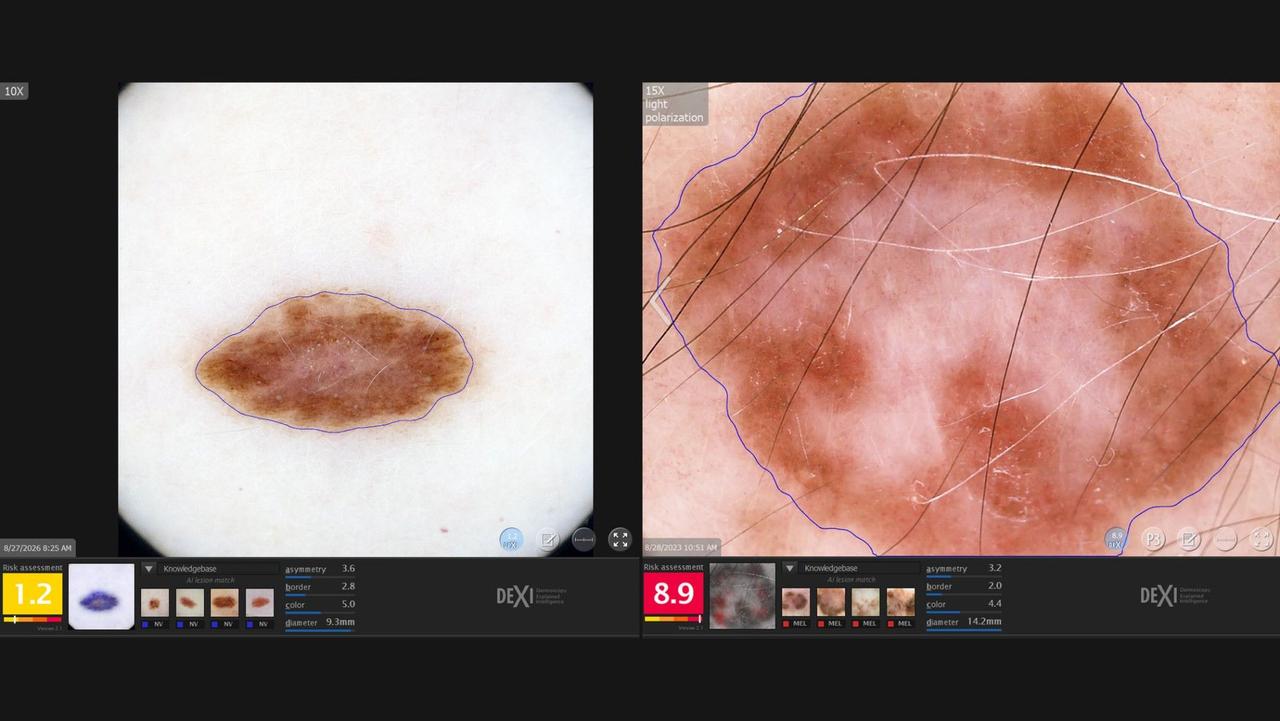
Mayo Clinic researchers developed DEXI, an AI scoring tool that correctly identifies 93.4% of cancerous skin lesions and 75% of noncancerous ones. The deep-learning model assigns risk scores from 0.0 to 10.0, with a threshold of 3.0 guiding dermatologists on whether to biopsy or monitor lesions, though it requires integration with clinical judgment.
Mayo Clinic Introduces DEXI to Support Skin Cancer Detection
Mayo Clinic researchers have developed an AI tool called Dermoscopy Explainable Intelligence (DEXI) that may help dermatologists assess whether skin lesions are cancerous and inform their clinical decisions about whether to perform a biopsy or continue monitoring
1
2
. Published in Mayo Clinic Proceedings, the study demonstrates how this AI scoring tool provides dermatologists with additional data points for assessing skin lesions for cancer risk. DEXI functions as part of an advanced imaging system that captures and tracks skin lesions over time, assigning each lesion a score from 0.0 to 10.0 based on image characteristics associated with cancer risk3
.
Source: Newswise
High Accuracy Rates in Identifying Cancerous Lesions
The retrospective study analyzed 261 lesions from 178 patients who underwent total-body photography, sequential digital dermoscopy imaging, and subsequent biopsy
1
. Using a threshold of 3.0—meaning a score of 3.0 or higher was considered positive for potential skin cancer—DEXI correctly identified 93.4% of cancerous lesions and 75% of noncancerous lesions4
. The average DEXI risk score was 2.5 for noncancerous lesions, compared with 7.8 for nonmelanoma skin cancers and 6.0 for melanomas2
. This significant difference in scores between cancerous and noncancerous lesions led researchers to identify 3.0 as a potential threshold that could inform the skin biopsy decision process.Deep-Learning Model Trained on Extensive Image Dataset
DEXI represents a sophisticated deep-learning model trained on more than 66,000 annotated dermoscopy images
3
. Beyond assigning a cancer risk score, the tool employs explainable AI to indicate which image features contributed to its assessment. It identifies specific characteristics such as asymmetry, border irregularities, and color variations that factor into the final score1
. This transparency gives dermatologists insight into the AI's reasoning process, allowing them to understand why a particular lesion received its score and incorporate that information into their clinical judgment.Practical Application in Clinical Settings
Dr. Jenny Link, a dermatologist at Mayo Clinic and the study's lead author, explained the practical value of having a validated threshold: "Prior to the study, I would review a patient's DEXI score, but I wouldn't know exactly what to do with the number. Now I can confidently use the score as another piece of data to inform my clinical judgment on whether I recommend a biopsy or monitoring"
2
. This AI-assisted dermatological diagnostics approach provides dermatologists with quantifiable data to support their decision-making process when evaluating suspicious skin lesions.
Source: News-Medical
Related Stories
Limitations and Need for Clinical Integration
Despite its promising performance, researchers identified several limitations that underscore why DEXI should complement rather than replace clinical expertise. The tool does not account for patient-specific factors such as age, medications, and history of melanoma
4
. Additionally, DEXI proved less effective at evaluating severely atypical nevi, or skin moles, and early evolving melanomas1
. Dr. Link emphasized that "the score must be interpreted alongside clinical findings and patient-specific factors, and the tool requires further validation and refinement"3
.Future Implications for Dermatology Practice
The development of DEXI signals a shift toward more data-driven approaches in dermatology, where AI tools augment rather than replace physician expertise. As dermatologists face the challenge of distinguishing between benign age spots and potentially dangerous skin cancer, tools like DEXI offer a systematic way to identify skin cancer risks while reducing unnecessary biopsies. The threshold of 3.0 provides a concrete benchmark that can standardize some aspects of cancer risk assessment across different clinical settings. However, the tool's current limitations with certain lesion types and patient factors suggest that ongoing refinement will be necessary before it can be widely deployed. Watch for future studies that address these gaps and validate DEXI's performance across more diverse patient populations and lesion types.
References
Summarized by

Navi
[1]
[4]
Related Stories
AI Model Rivals Dermatologists in Assessing Skin Cancer Aggressiveness
13 Sept 2025•Health

AI System MEL-IA Automates Classification of Skin Lesions in Hospital Workflows
06 Oct 2026•Health

AI Model Achieves 94.49% Accuracy in Skin Cancer Detection, Promising Early Diagnosis Breakthrough
21 Dec 2024•Health

Recent Highlights


Recent Highlights
Today's Top Stories





Don’t drown in AI news. We cut through the noise - filtering, ranking and summarizing the most important AI news, breakthroughs and research daily. Follow topics that matter to you and stay ahead.


