3 Sources
[1]
Meta to start testing AI subscription services, with cheapest plan at $7.99 a month
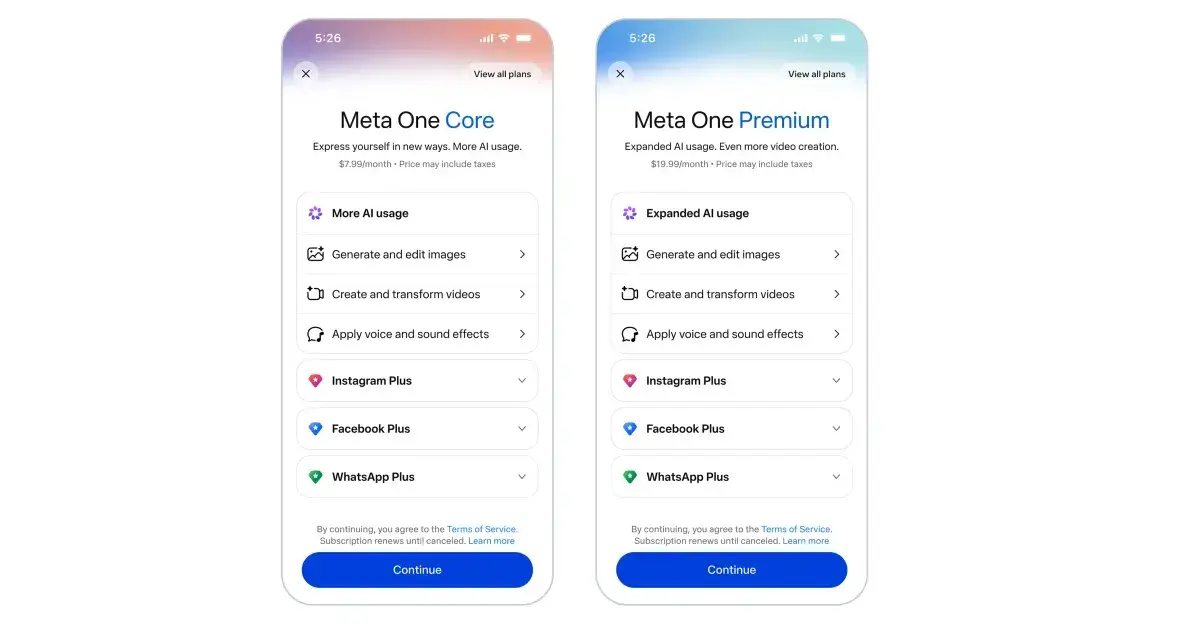
Mark Zuckerberg, chief executive officer of Meta Platforms Inc., wears a pair of Meta Ray-Ban Display AI glasses during the Meta Connect event in Menlo Park, California, US, on Wednesday, Sept. 17, 2025. Meta plans to charge users for artificial intelligence features for the first time as the company seeks a revenue stream for the AI era beyond advertisements. The subscriptions will be for the Meta AI app and website, and represent the latest move by Meta as it seeks to compete with the likes of OpenAI, Anthropic and Google Gemini. Naomi Gleit, the head of product at Meta, revealed the subscription testing in an Instagram video, announcing that the plans "give people who use Meta AI more to work with, more capacity, bigger, more complex requests, and more room to create for businesses and creators." Meta One Plus will cost $7.99 a month while the Meta One Premium plan sells for $19.99 a month, the company confirmed. The more expensive version offers users additional computing capacity to produce more comprehensive responses and other advanced features. The company will continue to provide a free version of the app and site. "We're offering premium tools that allow you to enhance presence, supercharge content, automate tasks, and protect your brand," Gleit said in the post. "We're also thinking about how to bring this all together in a way that makes sense." TechCrunch was first to report on the pricing. Meta said it will begin testing its Meta AI plans next month in Singapore, Guatemala and Bolivia. The company released a standalone Meta AI app in April of last year, and CEO Mark Zuckerberg said a month later that as Meta AI improves, the company could offer "a subscription service so that people can pay to use more compute." Last month, Meta debuted its first major AI model since the costly hiring of Scale AI's Alexandr Wang in June. Dubbed Muse Spark and originally code-named Avocado, the AI model is the first from the company's new Muse series developed by Meta Superintelligence Labs, the AI unit led by Wang, who joined the company as part of its $14.3 billion investment in Scale AI, where he was CEO.
[2]
Meta sells AI subscriptions while OpenAI and xAI walk into the ad business
Meta's $7.99-and-$19.99 chatbot tiers and OpenAI's push into advertising mark the moment the AI revenue-model question becomes a cross-cutting collision. Meta's decision to begin selling consumer subscriptions to its Meta AI chatbot at $7.99 and $19.99 a month, announced on Tuesday, lands at exactly the moment OpenAI and xAI are visibly moving the other way: into the advertising business. The crossover defines the next phase of the AI revenue-model debate. The two largest consumer-AI products of the past three years are now walking into each other's businesses, and neither is doing so from a position of obvious strategic comfort. Meta's position is the more straightforward of the two. The company derives almost all of its $165bn annual revenue from advertising on Facebook, Instagram and WhatsApp. Adding a $7.99/$19.99 subscription tier for Meta AI is a hedge against the structural risk that consumer attention shifts toward AI chatbots that Meta does not yet monetise effectively. The new Meta One subscription bundle, in which the AI tier sits, is a defensive product first and a growth product second. At a 5% conversion rate of the company's existing Meta AI user base to the $7.99 tier, the subscription business would produce roughly $4.8bn in annual revenue, a useful number but small against the $30bn-plus Meta now spends annually on AI infrastructure. The OpenAI move in the other direction is harder to read. The company has spent five years building the consumer-AI category on the premise that ChatGPT subscriptions ($20/month for Plus, $200/month for Pro) and enterprise contracts would be enough to justify the operating costs. OpenAI now reportedly targets $2.5bn in advertising revenue in 2026 and is publicly aiming for $100bn annually by 2030. The advertising integration is in testing inside ChatGPT and Search. The strategic logic is clear: 15 million paid subscribers, while impressive, is the floor of what ChatGPT's 700-million-weekly-active-user base could in principle generate. Advertising is the only way to monetise the gap. The xAI move is the most aggressive of the three. Elon Musk has been visibly integrating Grok into X's advertising stack, and the broader monetisation playbook he has been describing in recent earnings calls leans heavily on selling AI-augmented advertising to existing X advertisers rather than competing for subscription dollars against a OpenAI consumer business that already has structural advantages. xAI's commercial logic is, on Musk's framing, that X's existing advertising machinery can be the distribution layer for monetised AI features in ways that pure-play AI labs cannot replicate. What makes Thursday's framing interesting is the implied corporate-strategy diagnosis. Meta is moving toward subscriptions because its core business is too dependent on advertising. OpenAI and xAI are moving toward advertising because their core business is too dependent on subscriptions. The two camps are converging on a hybrid revenue mix that none of them found purely on its own, but the strategic discomfort is genuine on both sides. Meta's AI subscription business will face the question of whether $7.99 is enough to differentiate from the free ChatGPT base; OpenAI's advertising business will face the question of whether the product's user trust survives the integration of monetised content. The investor backdrop matters too. Meta is under pressure to show a return on the hundreds of billions of dollars it has committed to AI infrastructure; the subscription product is the company's way of giving public-equity holders a near-term revenue layer to point to. OpenAI is under pressure to justify the valuation reached in its most recent secondary rounds; the advertising business is the company's way of expanding the revenue base beyond the ceiling pure subscription pricing can produce. xAI is under pressure to demonstrate that the SpaceX-IPO-adjacent valuation it has accrued is supportable; advertising is the most direct monetisation lever Musk controls. The next 12 months of conversion data will indicate which side of the convergence pays off harder. Meta launched its subscriptions in Singapore, Guatemala, and Bolivia first, with broader rollout planned through the back half of 2026. OpenAI's advertising programmes are still in testing. xAI's monetised Grok features are partly live inside X already.
[3]
Meta launches AI chatbot subscriptions at $7.99 and $19.99
The company that cut 8,000 jobs to fund AI infrastructure is now selling AI subscriptions at half the price of ChatGPT Plus, rolling out first in Singapore, Guatemala, and Bolivia Meta is selling subscriptions to its AI chatbot for the first time, introducing two paid tiers that put it in direct competition with OpenAI and Google for consumer AI revenue. Meta One Plus costs $7.99 per month and Meta One Premium costs $19.99 per month. Both tiers give users expanded access to image generation, video creation, and extended reasoning capabilities that will be capped for free users. The subscriptions are rolling out initially in Singapore, Guatemala, and Bolivia, with plans to expand to more countries. Meta AI will remain free for casual use, but users who generate images and videos frequently or rely on the chatbot's more compute-intensive reasoning features will eventually hit usage limits that only paid subscribers can exceed. The pricing is deliberate. Meta One Premium at $19.99 matches the price of ChatGPT Plus and Google AI Pro almost exactly. Meta One Plus at $7.99 undercuts both by more than half, creating an entry point that neither OpenAI nor Google currently offers at that level. The bet is that users who already spend time inside Instagram, WhatsApp, and Facebook will pay a fraction of what they would pay for a standalone AI product because Meta AI is embedded in apps they already use. The AI subscriptions are part of a broader subscription rollout across Meta's product family. Instagram Plus and Facebook Plus cost $3.99 per month, while WhatsApp Plus costs $2.99 per month. These app-specific subscriptions offer features like profile customisation, enhanced reactions, and story analytics. Users who buy a Meta AI subscription also get access to all app-specific subscription features, creating a bundle incentive. For businesses and creators, Meta is launching Meta One Essential at $14.99 per month and Meta One Advanced at $49.99 per month. The higher tier includes access to human support for Instagram and Facebook pages, a feature that has been one of the most persistent complaints from small businesses using Meta's platforms. Getting a human being to respond when something goes wrong on your business page has historically been nearly impossible, and Meta is now charging $49.99 a month for the privilege. The timing is not subtle. Meta reported $56.3 billion in revenue for Q1 2026, virtually all of it from advertising. Non-advertising revenue, a category that includes subscriptions, hardware, and other products, came in at $1.29 billion. That means everything Meta earns outside of ads, including Ray-Ban Meta smart glasses, Quest headsets, and any existing subscription products, represents about 2.3% of total revenue. Meanwhile, Meta has raised its capital expenditure guidance for 2026 to between $125 billion and $145 billion, up from the $115 billion to $135 billion range it gave just one quarter earlier. Mark Zuckerberg has pledged to spend at least $600 billion on AI infrastructure over the next several years, and the company is building a data centre in Louisiana that will reportedly cost at least $200 billion. Meta cut 8,000 jobs in May to help fund this infrastructure push, with Zuckerberg framing the trade-off explicitly: the company is shifting spending from people to compute. Investors have been pressing Zuckerberg to show that this spending will generate returns beyond advertising improvements. When Meta raised its capex forecast during April earnings, shares dropped as investors questioned whether the AI bet was getting too expensive. Meta's stock jumped more than 3% on the subscription announcement, suggesting that Wall Street sees paid AI products as a credible path to offsetting at least some of the infrastructure cost. The question is whether AI chatbot subscriptions can move the needle for a company generating $55 billion in advertising revenue per quarter. Meta AI has roughly 1 billion monthly active users, according to the company's most recent disclosures. If even 5% of those users converted to the $7.99 tier, that would generate roughly $4.8 billion in annual subscription revenue. At the $19.99 tier, the same conversion rate would yield about $12 billion. Those numbers would be meaningful, but the conversion rates are speculative. OpenAI, which has been selling ChatGPT Plus for over three years, has reportedly reached around 15 million paying subscribers. Google has not disclosed Gemini subscriber numbers. The challenge for Meta is that its AI chatbot is embedded in social media apps rather than positioned as a standalone productivity tool, which may limit the willingness of users to pay for features they associate with free platforms. Helen Ma, Meta's head of subscriptions, told Bloomberg that the company plans to expand all subscription tiers globally and sell access to AI agents alongside these offerings in the future. That last point is significant. Meta has been investing heavily in AI infrastructure, including a $27 billion deal with Nebius, and the long-term plan appears to extend beyond a chatbot into autonomous AI agents that can perform tasks on behalf of users and businesses. The subscription programme has been rebranded under the Meta One umbrella, creating a tiered structure that ranges from $2.99 for basic WhatsApp features to $49.99 for business support. The naming convention suggests Meta is building a subscription platform, not just selling add-ons to existing products. If the AI agent vision materialises, Meta One could become the billing layer for an ecosystem of AI-powered services that span consumer, creator, and enterprise use cases. For now, the immediate impact is modest. Even if the subscription rollout succeeds beyond Singapore, Guatemala, and Bolivia, it will take years before subscription revenue represents a significant percentage of Meta's business. But the symbolic importance is real. Zuckerberg has been telling employees and investors that AI is Meta's future. Charging money for it is the first concrete step toward proving that claim.
Share
Copy Link
Meta introduces its first paid AI subscription tiers at $7.99 and $19.99 per month, undercutting ChatGPT Plus while seeking new revenue beyond its $165 billion advertising business. The move comes as the company raises AI infrastructure spending to $125-$145 billion for 2026. Initial testing begins in Singapore, Guatemala, and Bolivia next month.
Meta is launching AI subscription services for the first time, marking a strategic shift as the company attempts to diversify revenue streams beyond its advertising-dominated business model. The Meta AI subscription services include two consumer tiers: Meta One Plus at $7.99 per month and Meta One Premium at $19.99 per month
1
. Naomi Gleit, Meta's head of product, announced the plans in an Instagram video, emphasizing that the subscriptions "give people who use Meta AI more to work with, more capacity, bigger, more complex requests, and more room to create for businesses and creators"1
. The company will begin testing next month in Singapore, Guatemala, and Bolivia, while maintaining a free version of the Meta AI app and website1
.The pricing structure positions Meta to compete with other major AI players while leveraging its existing user base across Facebook, Instagram, and WhatsApp. Meta One Premium at $19.99 matches ChatGPT Plus and Google AI Pro pricing exactly, while Meta One Plus at $7.99 undercuts both competitors by more than half
3
. Both tiers provide expanded access to image generation, video creation, and advanced reasoning capabilities that will be capped for free users3
. For businesses and creators, Meta is also launching Meta One Essential at $14.99 per month and Meta One Advanced at $49.99 per month, with the higher tier including access to human support for Instagram and Facebook pages3
.The decision to monetize Meta AI comes as the company faces mounting investor pressure to justify its massive AI infrastructure investments. Meta reported $56.3 billion in revenue for Q1 2026, with virtually all coming from advertising, while non-advertising revenue represented only 2.3% of total revenue at $1.29 billion
3
. The company has raised its capital expenditure guidance for 2026 to between $125 billion and $145 billion, up from the previous $115 billion to $135 billion range3
. CEO Mark Zuckerberg has pledged to spend at least $600 billion on AI infrastructure over the next several years, and Meta cut 8,000 jobs in May to help fund this infrastructure push3
. Meta's stock jumped more than 3% on the subscription announcement, suggesting investors view paid AI products as a credible path to offsetting infrastructure costs3
.The AI chatbot subscriptions represent a broader collision of revenue strategies in the AI industry. While Meta moves toward subscriptions to reduce dependence on its $165 billion annual advertising business, OpenAI and xAI are simultaneously moving into the advertising business
2
. OpenAI now reportedly targets $2.5 billion in advertising revenue in 2026 and aims for $100 billion annually by 2030, with advertising integration currently testing inside ChatGPT and Search2
. This crossover defines the next phase of the AI revenue-model debate, with the two largest consumer-AI products walking into each other's businesses from positions of strategic uncertainty2
.Related Stories
The financial impact depends heavily on conversion rates among Meta AI's roughly 1 billion monthly active users. At a 5% conversion rate to the $7.99 tier, the AI subscription business would generate approximately $4.8 billion in annual revenue—a useful number but small against the $30 billion-plus Meta now spends annually on AI infrastructure
2
. OpenAI, which has been selling ChatGPT Plus for over three years, has reportedly reached around 15 million paying subscribers3
. The challenge for Meta is that its AI chatbot is embedded in social media apps rather than positioned as a standalone productivity tool, which may limit user willingness to pay for features they associate with free platforms3
.Meta's subscription push coincides with recent AI model developments. Last month, the company debuted Muse Spark, its first major AI model since hiring Scale AI's Alexandr Wang in June for $14.3 billion
1
. The model is the first from Meta's new Muse series developed by Meta Superintelligence Labs, the AI unit led by Wang1
. Helen Ma, Meta's head of subscriptions, indicated the company plans to expand all subscription tiers globally and sell access to AI agents alongside these offerings in the future3
. The next 12 months of conversion data will determine which side of the revenue-model convergence pays off, with Meta's broader rollout planned through the back half of 20262
.Summarized by
Navi
[3]
01 May 2025•Business and Economy

29 Jul 2025•Business and Economy

27 Jan 2026•Technology

1
Policy and Regulation

2
Science and Research

3
Technology