Meta Joins Sierra, Walmart, and Stripe to Launch Personal Agent Protocol for AI Agents


8 Sources
[1]
Meta is helping to develop an AI agent protocol "that defines how personal agents interact with businesses.
Here's the high-level idea of the Personal Agent Protocol, according to a blog post from the AI company Sierra: The principle behind the Personal Agent Protocol we're building is that consumers decide what access to give their personal agents, and companies set parameters for what those agents can
[2]
Meta joins with group of companies to tame 'chaos' of doing business with AI bots
* Walmart, Meta and OpenAI Chairman Bret Taylor's startup Sierra are building a set of tech standards to make it easier to do business with AI bots. * As Meta's Muse and other buzzy AI agents like Instinct see a boom in popularity, some companies have struggled to figure out what's happening
[3]
Meta Wants to Write the Industry Standards for Safe Agentic Commerce, Report Says
Meta is reportedly teaming up with Walmart, Stripe, and enterprise AI startup Sierra to publish a set of standards for how AI agents should interact with businesses online. Called a "personal agent protocol," the standards will reportedly help companies distinguish authorized personal agent
[4]
Sierra announces Personal Agent Protocol, an open standard for personal AI agents
Personal Agent Protocol is built on OAuth, lets a business decide whether an agent reaches it through a website, an API or an agent of its own, and arrives with Stripe and Shopify as partners, both of which have already joined a rival protocol run by Visa Sierra and Meta are developing Personal
[5]

Meta, Walmart, Stripe launch open standard for AI agents
The personal agent protocol aims to let businesses verify whether they're dealing with an AI bot or a human customer Meta $META, Walmart $WMT, Stripe, and enterprise AI startup Sierra are publishing an open standard they call a "personal agent protocol," designed to govern how AI agents interact
[6]

Meta teams up with Bret Taylor's Sierra Technologies on new standards for AI agent commerce
Meta teams up with Bret Taylor's Sierra Technologies on new standards for AI agent commerce Meta Platforms Inc. is partnering with Walmart Inc., Stripe Inc. and the enterprise artificial intelligence firm Sierra Technologies Inc. on the creation of new standards that will define how autonomous AI
[7]

Meta and Sierra's Poppy Lets Customers Set Limits for AI Agents | PYMNTS.com
Companies are left with two choices. They can block the agent or let it act with the customer's full access. Amazon chose to block. It cut off Meta's Muse agent in September, PYMNTS reported Sept. 21. Now, Meta and Sierra are offering a third option. Sierra is building the Personal Agent
[8]
Meta and Sierra Build Standard for How Personal Agents Interact With Businesses | PYMNTS.com
Set to be published by the end of the month, the Personal Agent Protocol will handle authentication, will allow consumers to decide what access to give their personal agents, and will allow companies to set boundaries for what personal agents can do through their websites, APIs or company agents,
Share
Copy Link
Meta, Walmart, Stripe, and enterprise AI startup Sierra are developing the Personal Agent Protocol—an open standard defining how AI agents authenticate with businesses and what actions they can perform. Led by Bret Taylor, OpenAI Chairman and Sierra co-founder, the initiative addresses growing chaos as companies struggle to distinguish AI bots from human customers.
Meta and Sierra Unveil Personal Agent Protocol for Standardized AI Agent-Business Interactions
Meta is collaborating with Walmart, Stripe, and enterprise AI startup Sierra to develop the Personal Agent Protocol, an open standard for personal AI agents that defines how these AI agents interact with businesses online
1
2
. The protocol, led by Bret Taylor—Sierra co-founder and OpenAI Chairman—addresses a critical gap in agentic commerce: businesses currently lack reliable methods to verify whether they're dealing with AI agents or human customers2
. "It is kind of chaos until such a standard exists," Taylor told CNBC2
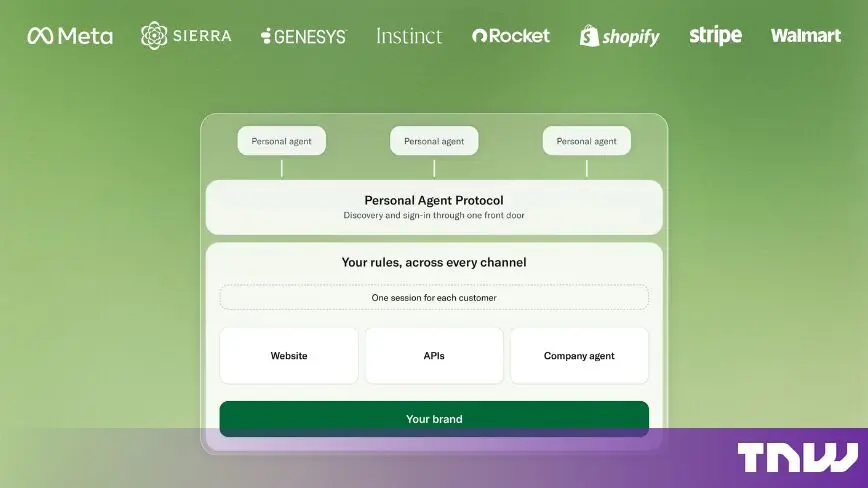
. Additional partners developing the protocol include Genesys, Instinct, Rocket, and Shopify, with a v0.1 specification expected later this month1
4
.
Source: The Next Web
How Authentication and Secure AI Agent Interactions Work Under the Protocol
The Personal Agent Protocol is built on OAuth, establishing secure AI agent interactions through a session-based system that carries across channels
4
. AI agents can begin as guests to check inventory or return policies, but once customers sign in, they decide whether to grant read-only or write access to their personal agents4
. This AI agent authentication mechanism gives businesses visibility into what personal agents are doing on their platforms while protecting customer data2
. David Singleton, head of Meta Superintelligence Labs and former Stripe technology chief, emphasized the security dimension: "In order for agents to work well, customers need to share credit card and personal information, and the new standard creates some level of visibility and control"2
. Companies retain control over how AI agents access their services—through existing websites, APIs using standards like MCP and OpenAPI, or through an agent of their own1
4
.
Source: PYMNTS
Meta Muse Drives Urgency for Industry Standards Amid Privacy Concerns
The protocol arrives roughly one month after Meta launched Meta Muse, a personal AI agent that soared to the top of Apple's App Store and now has millions of users in the U.S. with rapid growth
2
. Singleton said users rely on Muse for everyday tasks like "signing their kids up for classes, finding and buying the best gifts, scheduling that dentist appointment that you have been putting off for six months"2
. However, privacy concerns have emerged. Amazon blocked Meta's agents over website scraping worries, and Amazon also sued Perplexity in November, alleging the startup concealed its AI agents to continue scraping Amazon's website without approval2
. A 404 Media report claimed Meta engineers worked overtime to patch severe security vulnerabilities before Muse's launch, and researchers have identified ongoing security and privacy issues3
. Wired reported that Muse creates and updates "a page for every person in the user's life" hourly, raising additional privacy concerns3
.Related Stories

Competing Standards and Future Adoption by OpenAI and Anthropic
While OpenAI and Anthropic aren't currently participating, Taylor said he expects the AI giants to join and would be "really disappointed" if competitors didn't adopt the open standard for personal AI agents
2
5
. The Personal Agent Protocol faces competition from Visa's Trusted Agent Protocol, which Microsoft, Stripe, Shopify, and Worldpay joined in June to enable agents to buy from approximately 175 million merchants4
. Notably, Stripe and Shopify now participate in both protocols4
. Taylor compared the protocol to signing into websites with Google or Facebook credentials—authentication technology he developed as Facebook's tech chief—and Singleton likened it to email: "It works great because it is a standard that everyone can use to talk to each other"2
5
. The initial specification lists payments as a future extension rather than part of the first release, with push notifications and detailed permissions also planned for future work4
. Citigroup estimated that Muse could generate upwards of $27 billion in revenue before the end of the decade as it becomes "the front door to the internet" for online shopping3
.References
Summarized by

Navi
[1]
Related Stories
AI Agents Transform Payments Landscape as Meta Clashes With Amazon Over Autonomous Shopping
03 Oct 2026•Technology
Meta Muse AI Agent Surges to 6.6M Downloads Despite Privacy and Security Controversies
06 Oct 2026•Technology

Meta Unveils Business AI: Revolutionizing Customer Service and Ad Personalization
02 Oct 2025•Business and Economy

Recent Highlights



Recent Highlights
Today's Top Stories


Don’t drown in AI news. We cut through the noise - filtering, ranking and summarizing the most important AI news, breakthroughs and research daily. Follow topics that matter to you and stay ahead.


