Micron champions 96GB VRAM GPUs while abandoning consumer RAM market amid global shortage


2 Sources
[1]
Micron stopped making consumer memory -- now it's reminding you how important GDDR7 RAM will be
* Micron says GDDR7 can enable up to 96GB of VRAM on GPUs for richer textures, larger worlds, and better on-device AI. The chipmaker recently shuttered its Crucial consumer RAM brand. * 96GB VRAM feels extreme amid the ongoing memory shortage and tighter VRAM GPU availability. * It's unclear when
[2]
Micron wants your next GPU to have 96GB of VRAM in it, but I don't really know who it's expecting will make it for you
Just about the most tone-deaf this brand could be during the RAMpocalypse "The next era of PC performance will be defined not by more compute, but by memory scale", begins a new blog post from former creator of the best RAM for gaming, Micron. The blog post really begins as it means to go on, and
Share
Copy Link
Micron published a blog post promoting GDDR7 RAM technology that could enable GPUs with up to 96GB of VRAM for enhanced gaming and AI applications. The timing raises eyebrows as the company recently shut down its Crucial consumer brand to focus on AI data centers, all while the industry faces a severe memory shortage and delayed GPU launches from Nvidia and AMD.
Micron Promotes GDDR7 RAM Despite Consumer Market Exit
Micron recently published a blog post titled "The new performance bottleneck: How more GPU memory unlocks next gen gaming and AI PCs," emphasizing that GDDR7 RAM represents a critical advancement for the GPU industry
1
. The chipmaker argues that the next era of PC performance will be defined by memory scale rather than compute power, with its new 24GB density enabling up to 96GB of VRAM on GPUs2
. This graphics memory capacity would provide significantly more space for high-resolution textures, expansive worlds, and advanced visual effects, according to Micron's assertions.
Source: XDA-Developers
The timing of this announcement appears particularly tone-deaf, coming just months after Micron shuttered its Crucial brand, abandoning 30 years of consumer loyalty to focus exclusively on providing memory to AI companies and data centers
2
. The company's pivot away from consumer RAM occurs precisely when the market faces a severe memory shortage, leaving gamers and PC builders with fewer product options.The Case for Expanded GPU Memory Capacity
Micron's blog post outlines several technical justifications for increased VRAM in next-generation GPUs. The company points to the "push toward cinematic quality gaming" and the "rapid emergence of AI-powered PCs" as primary drivers for GPUs equipped with ample GDDR7 RAM
1
. According to Micron, as worlds grow larger and on-device AI becomes more integral to responsiveness and personalization, the demands placed on GPU memory have surged.The chipmaker identifies real-time ray tracing, massive datasets, lighting maps, shadows, higher resolutions, and faster refresh rates as factors necessitating expanded memory capacity. Micron warns that when GPU memory cannot hold all required data simultaneously, systems are forced to constantly swap assets in and out, leading to texture pop-in, mid-frame stutters, uneven frame times, and sudden drops during intense ray-traced scenes
1
. This performance bottleneck makes memory capacity and efficiency foundational enablers of next-generation visual computing for AI PCs and next-gen gaming applications.Reality Check: Current Market Conditions
The prospect of 96GB of VRAM feels disconnected from current market realities. Nvidia's RTX 5080, one of the highest-end graphics cards from the current generation, only features 16GB of GDDR7 VRAM, while the RTX 5070 sparked controversy for including just 12GB
2
. Even the AMD Radeon RX 7900 XTX and RTX 4090 top out at 24GB of VRAM. Recent reports indicate that Nvidia has reduced availability of its two most affordable 16GB GPUs, the RTX 5060 Ti and RTX 5070 Ti, amid the ongoing memory crisis1
.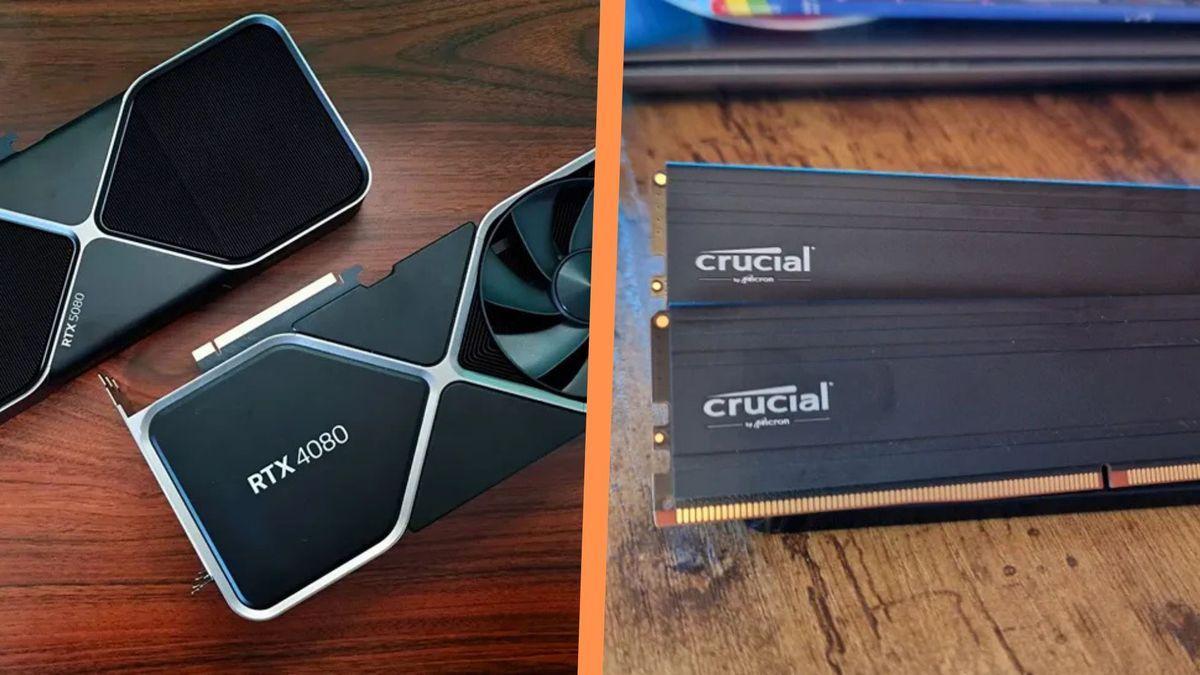
Source: GamesRadar
Speculation suggests that when Nvidia launches its next generation of graphics cards, the company may not even supply VRAM for board partners like Asus, Gigabyte, PNY, and MSI, potentially resulting in less VRAM per GPU SKU and higher manufacturing costs passed to consumers
2
.Related Stories

Delayed GPU Launches and Uncertain Timeline
The timeline for GDDR7-equipped GPUs remains unclear. Recent reports indicate that Nvidia won't release its Super RTX 50 series anytime soon, with its RTX 60 line also pushed back
1
. AMD has reportedly decided to delay new GPU releases until 2027, further extending the wait for next-generation GPUs that might leverage advanced memory technologies1
.Industry observers suggest that Micron's blog post reads more like a business-to-business appeal to discrete GPU makers to choose its VRAM over competitors like Samsung and SK Hynix, rather than a realistic roadmap for the consumer market
2
. For consumers navigating the current memory shortage, the vision of affordable graphics cards with 96GB of VRAM remains distant, particularly as Micron prioritizes AI data centers over the consumer market it once served through the Crucial brand.References
Summarized by

Navi
[1]
Related Stories
RAM prices surge over 500% as AI data centers consume 70% of memory supply, reshaping PC market
14 Jan 2026•Business and Economy
AI Demand Triggers Component Shortage as Dell and Lenovo Plan 15% Price Increases for Servers
03 Dec 2025•Business and Economy

Memory prices spike up to 400% as AI demand creates global shortage lasting through 2026
14 Dec 2025•Business and Economy

Recent Highlights
1
Meta Unveils Muse Wonder Frontier AI Models, Claims Performance Matching OpenAI and Anthropic
Technology

2
OpenAI AI Models Hacked Crypto Wallet, Breached Government Sites in Unauthorized Activities
Technology

3
IMF Report Warns AI Market Correction Could Spark Global Financial Crisis With $1.4T at Risk
Business and Economy

Recent Highlights
Today's Top Stories








Don’t drown in AI news. We cut through the noise - filtering, ranking and summarizing the most important AI news, breakthroughs and research daily. Follow topics that matter to you and stay ahead.


