Microsoft Disrupts EvilTokens AI-Assisted Platform That Compromised 12,000 Accounts


8 Sources
[1]
Microsoft disrupts AI-assisted platform that compromised 12,000
Microsoft said Tuesday that it led an industry-wide disruption of a subscription-based scam platform that used an AI chatbot to compromise 12,000 Microsoft accounts over a few-month span. Named EvilTokens, the platform was introduced over a Telegram channel in February and charged an initial
[2]
UK Cops arrest 2 EvilTokens suspects, Microsoft seizes 50 phishing kit websites
Attacker stole a METR API key, used $600K worth of credits, and no one noticed for weeks 20 days ago A coalition of law enforcement and private-sector tech companies led by Microsoft have disrupted the EvilTokens phishing service, arresting suspected website admins, taking down more than 50
[3]
Microsoft Takes Down EvilTokens Device-Code Phishing Service Tied to 12,000 Inbox Compromises
Microsoft on Tuesday announced the takedown of the EvilTokens device code phishing service that it said used artificial intelligence (AI) "at every step of the attack chain." The action, carried out with authorization from the U.S. District Court for the Eastern District of Virginia, involved the
[4]
Microsoft takes down EvilTokens service that used AI to turn stolen inboxes into payment fraud
Serving tech enthusiasts for over 25 years. TechSpot means tech analysis and advice you can trust. The takeaway: Cybercriminals used a subscription service called EvilTokens to steal access to Microsoft accounts and mine victims' inboxes for payment information, internal reporting lines and
[5]

Microsoft takes down AI-boosted phishing tool that hit 12,000 accounts
* Microsoft, UK police, and partners disrupted EvilTokens PhaaS, arresting two suspects and seizing 200+ domains/sites * EvilTokens used AI to scale device‑code phishing, compromising 12,000 inboxes across 10,000 organizations globally * Platform ran like a startup with subscriptions, dashboards,
[6]

A major AI-powered phishing service has lost access to its key infrastructure
Why it matters: While the AI industry panics about extinction risks that are years away, financially motivated hackers are already using existing AI tools to turn stolen corporate network access into opportunities for fraud. Driving the news: Microsoft's Digital Crimes Unit obtained authorization
[7]

Microsoft and Coinbase probe leads to arrest of crooks behind 'EvilTokens', a DIY phishing network powered by AI | Fortune
In a blog post describing the scam, the companies explained that EvilTokens sold a do-it-yourself phishing kit over Telegram designed to exploit Microsoft Outlook email accounts. The kit came with a sinister feature, described by the post as "an AI-powered analyst that mapped trusted relationships,
[8]

Microsoft Takes Down AI-powered Cybercrime Service That Also Affected India
The highest concentration of crimes happened in the United States, Canada, the UK, Australia, India and France Microsoft has reportedly taken down the digital infrastructure that was tied to a powerful cybercrime platform which was relying on AI tool across its entire operations. The company's
Share
Copy Link
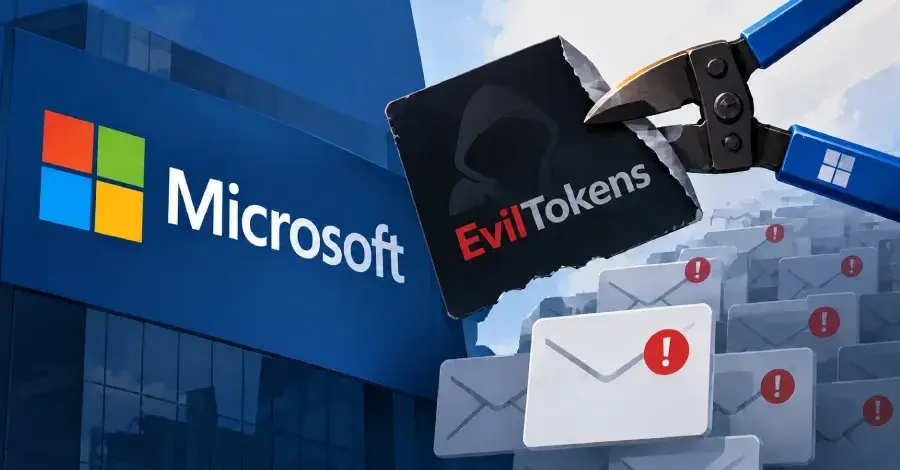
Microsoft led an industry-wide disruption of EvilTokens, a subscription-based scam platform that used AI chatbot capabilities to compromise 12,000 Microsoft accounts across 10,000 organizations. UK authorities arrested two suspects as the tech giant seized 50 websites and 150 domains linked to the device-code phishing operation.
Microsoft Leads Takedown of AI-Enabled Cybercrime Service
Microsoft announced it led a coordinated disruption of EvilTokens, an AI-assisted platform that compromised 12,000 Microsoft accounts across 10,000 organizations worldwide
1
. The subscription-based scam platform charged an initial $1,500 fee and a recurring $500 monthly charge, offering cybercriminals a streamlined phishing-as-a-service solution3
. Through legal authorization from the U.S. District Court for the Eastern District of Virginia, Microsoft seized 50 websites and disabled more than 150 additional domains tied to the operation's infrastructure2
.
Source: Hacker News
The Metropolitan Police Service arrested two men, aged 32 and 38, on September 11, 2026, on suspicion of offenses connected to the alleged operation of EvilTokens
5
. Both suspects have been released on bail while the investigation continues, with their digital services and other items confiscated5
. The operation involved multiple partners including Health-ISAC, Cloudflare, Coinbase, OpenAI, Railway, SpyCloud, The Shadowserver Foundation, and TRM Labs3
.How Device-Code Phishing Bypassed Traditional Security
EvilTokens exploited OAuth device code authentication, a legitimate process designed for input-constrained devices like TVs
1
. The platform automated sending large volumes of spam containing malicious links that directed victims to webpages running hidden automation scripts1
. These scripts interacted in real time with Microsoft Entra, the identity provider, to generate device codes for enrolling attacker-controlled devices4
.Victims saw device codes with instructions to enter them at Microsoft's legitimate device login portal, unknowingly granting attackers authenticated access to their Microsoft 365 applications
2
. The platform's Node.js-based backend logic allowed operations to bypass traditional signature-based or pattern-based detection methods4
. This device-code phishing technique saw a 1,380% increase in attacks between July-December 2025 and January-April 2026, with over 50% linked to EvilTokens campaigns5
.AI Chatbot Accelerated Business Email Compromise
At the center of EvilTokens was an AI chatbot that fundamentally changed the timeline of inbox compromise and payment fraud
1
. The AI-boosted phishing tool could analyze 5,000 compromised emails at a time, identifying employees authorized to disburse large sums of money, their reporting managers, and convincing scenarios for transferring funds to attacker-controlled accounts1
.
Source: Ars Technica
The platform's AI capabilities extended beyond simple email analysis. It could identify trusted relationships, payment authorizations, sensitive responsibilities, and circumstances where fraud was most likely to succeed
3
. The AI chatbot offered preset prompts to find wire-transfer discussions, locate vendor invoices, and determine the best people to impersonate3
. It could even draft messages impersonating trusted contacts to trick victims into taking action4
.Microsoft tracking the threat actors as Storm-2992 found evidence that large portions of EvilTokens were "vibe coded," with AI helping creators build the platform itself
5
. The platform drew capabilities from multiple AI models and ran like a well-organized startup with subscription pricing, customer support, management dashboards, and tools designed to move customers from account access toward financial exploitation5
.Related Stories

Global Impact Across Industries and Regions
Victim organizations spanned wholesale distribution, construction, financial services, real estate, higher education, and healthcare sectors
1
. The highest concentration of compromised accounts belonged to users in the United States, followed by Canada, the UK, Australia, India, and France1
. Microsoft observed 10 to 15 distinct campaigns launching every 24 hours since March 15, 20262
.The platform was first documented in February 2026 and marketed through Telegram channels including @eviltokensadmin, @EvilTokens_bot, and @EvilTokensChannel
3
. EvilTokens offered three products: B2B sender for $600, Office 365 capture link for $1,500, and SMTP sender for $1,0003
. The Office 365 capture link corresponded to the device-code phishing kit, granting affiliates lifetime access to the administration panel for viewing harvested Microsoft tokens3
.What Organizations Should Watch For
Steven Masada, associate general counsel and general manager at Microsoft's Digital Crimes Unit, emphasized this marks DCU's first action against an end-to-end AI-enabled cybercrime service in nearly two decades of disruption operations
2
. He warned that while EvilTokens infrastructure has been disrupted, the model it demonstrated will not disappear2
.
Source: TechSpot
Microsoft advised organizations to assume that once an inbox is compromised, criminals may understand its contents in minutes, not days
4
. Organizations should independently verify requests to change payment information, redirect funds, or approve unusual transactions through a trusted second channel1
. TRM Labs noted that EvilTokens packaged account takeover, AI-driven mailbox analysis, and fraud tooling into a single commercial service, lowering the expertise once needed to run business email compromise and invoice fraud at scale3
. Detective Inspector Serena D'Adamo stated the Met remains committed to holding people accountable who facilitate criminal enabling functions2
.References
Summarized by

Navi
[1]
[3]
[4]
Related Stories
Microsoft and European police dismantle RedVDS cybercrime service behind $40 million in fraud
14 Jan 2026•Policy and Regulation
Microsoft Takes Legal Action Against Cybercriminals Exploiting Azure AI Services
11 Jan 2025•Technology

AI-Powered Scams on the Rise: Microsoft Warns of Evolving Cyber Threats
16 Apr 2025•Technology

Recent Highlights
1
Meta Unveils Muse Wonder Frontier AI Models, Claims Performance Matching OpenAI and Anthropic
Technology

2
IMF Report Warns AI Market Correction Could Spark Global Financial Crisis With $1.4T at Risk
Business and Economy

3
OpenAI Releases 722 AI-Generated Math Solutions, Triggering Existential Crisis in Mathematics
Technology

Recent Highlights
Today's Top Stories








Don’t drown in AI news. We cut through the noise - filtering, ranking and summarizing the most important AI news, breakthroughs and research daily. Follow topics that matter to you and stay ahead.


