MIT's FLEX Platform Teaches Robots to Understand Underlying Intent in Natural Language Commands


2 Sources
[1]
AI-assisted learning platform helps robots reason beyond literal commands
The new approach, known as FLEX, could lead to more intuitive, interactive household and assistive robots. Humans are intuitive by nature. We can sense meaning beyond the literal words that we encounter. Now, a new artificial intelligence-assisted learning platform developed by MIT engineers is
[2]
FLEX approach helps robots reason beyond literal commands
Humans are intuitive by nature. We can sense meaning beyond the literal words that we encounter. Now, a new artificial intelligence-assisted learning platform developed by MIT engineers is enabling robots to read larger meaning into a human's natural language commands. In a study to be presented
Share
Copy Link
MIT and NYU researchers unveiled FLEX, an AI-assisted learning platform that enables robots to reason beyond literal commands. Using large language models, FLEX helps household robots and assistive robots interpret natural language commands and understand underlying human intentions. The platform was demonstrated at the Conference on Robot Learning 2026, showing how robots can grasp contextual reasoning without explicit instructions.

MIT and NYU Introduce FLEX for Advanced Robot Learning
Researchers from MIT and NYU have developed FLEX, a flexible feature-editing pipeline that enables robots to reason beyond literal commands and interpret natural language commands with deeper understanding
1
2
. The AI-assisted learning platform, presented at the Conference on Robot Learning 2026 in Austin, Texas, represents a shift in how household robots and assistive robots process human communication.Led by Andreea Bobu, assistant professor of aeronautics and astronautics at MIT, the research team includes Nathan Dennler from MIT's Computer Science and Artificial Intelligence Laboratory (CSAIL), Audrey Lee, and Ilia Sucholutsky from NYU
1
. The CLEAR Lab at MIT, headed by Bobu, focuses on developing autonomous agents that work for, with, and around people.How FLEX Enables Contextual Reasoning in Robots
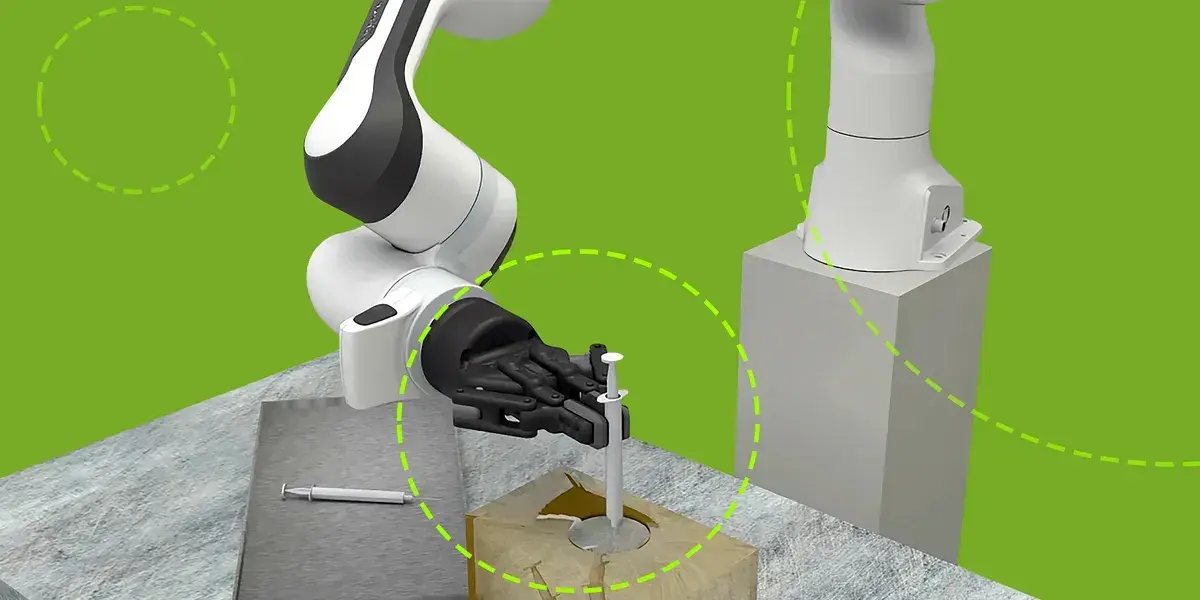
FLEX incorporates large language models (LLMs) to help robots understand the underlying intentions behind natural language commands. In simulated demonstrations, when a person instructs a robotic arm moving a coffee cup to "Don't spill on the laptop," the robot uses contextual reasoning to avoid all electronics, including a nearby phone, without explicit instruction
1
2
."LLMs have seen so many texts from the internet," explains Dennler. "People might have written about, 'Oh, my phone dropped in the water and now it doesn't work,' or 'I spilled coffee on my computer and now it doesn't work.' So LLMs pick up on the idea that liquids plus devices leads to things not working"
1
. This capability allows robots to draw larger generalizations from limited human input.Three-Step Process for Enhanced Motion-Planning
FLEX operates through a three-step process that transforms how robots interpret commands. The first step, "Add," instructs robots to incorporate new features into their environmental awareness based on natural language commands
1
2
. When moving a bowling ball, if a person says "Don't drop it on my mug," the robot adds the mug to its avoidance list and updates its motion-planning accordingly.This approach addresses a critical challenge in robot learning. "Robots use math to do their trajectory planning. But we can't expect a consumer to learn to do this math in order to tell a robot what to do," says Dennler. "Instead of having to get people to learn how to use a robot in a specific way, the goal is to interact with the robot through natural language"
2
.Related Stories


Advancing Natural Language Integration in Robotics
The robotics community has pursued various strategies to incorporate natural language into robot learning pipelines, including clarifying task goals, redirecting trajectories, and updating safety parameters. However, existing methods primarily tell robots how to physically perform tasks. FLEX extends beyond these approaches by enabling robots to interpret underlying, unspecified human preferences from limited natural language commands
1
2
."The idea is that there is some higher-level intention behind the words that you say," Dennler explains. "People naturally get this. But you have to carefully explain that to a robot, which takes time and effort. FLEX gives you an interface of communication with a robot to say, 'When people say this, they mean that'"
1
. This capability could make assistive robots and household robots more intuitive and interactive for everyday users.References
Summarized by

Navi
[2]
Related Stories
Recent Highlights


Recent Highlights
Today's Top Stories








Don’t drown in AI news. We cut through the noise - filtering, ranking and summarizing the most important AI news, breakthroughs and research daily. Follow topics that matter to you and stay ahead.


