NASA's ERNEST rover travels 16 miles autonomously, reaching speeds 10x faster than Perseverance


2 Sources
[1]
NASA Testing Advanced Capabilities for Moon, Mars Rovers
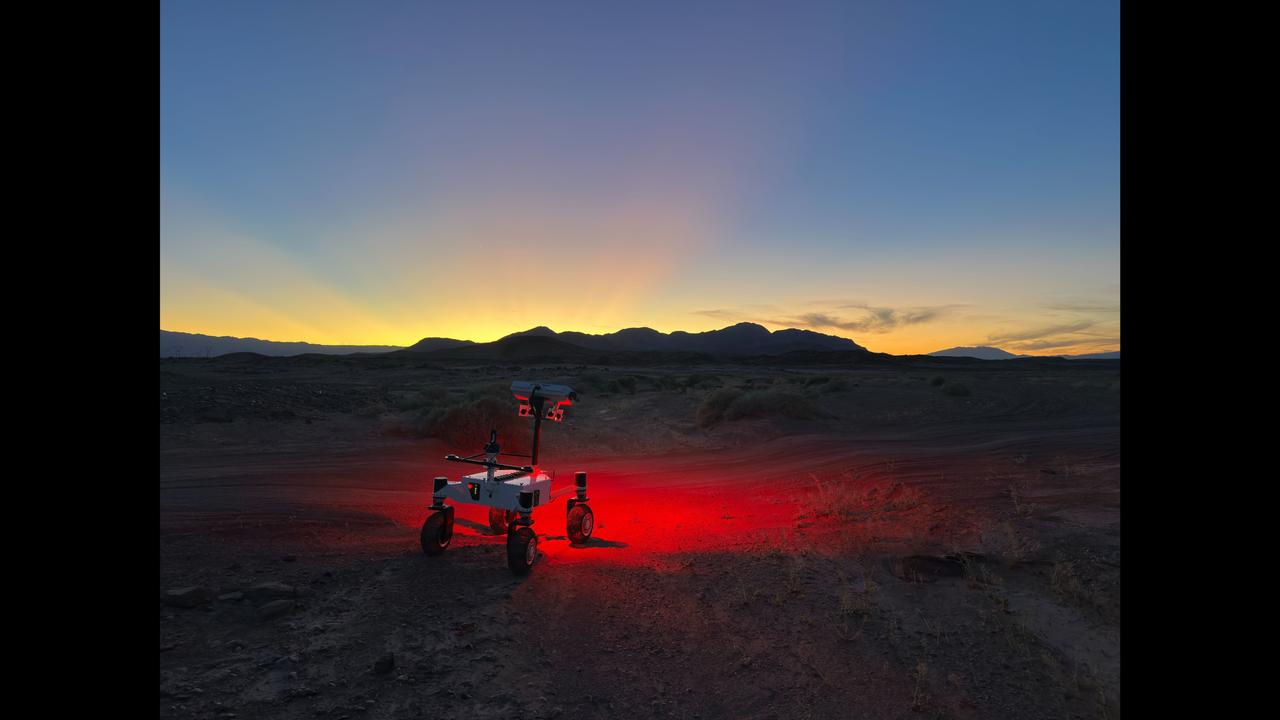
On a bleak stretch of the Colorado Desert in Southern California, a compact four-wheeled rover recently trundled about 16 miles (26 kilometers) with minimal intervention from the team of engineers trailing it. Called ERNEST (Exploration Rover for Navigating Extreme Sloped Terrain), this prototype
[2]
Meet ERNEST, NASA's Next-Generation Rover Designed to Be Faster and Tougher
During a recent field test in the Colorado desert, a four-wheeled rover traveled across 16 miles (25 kilometers) in a little over a day and a half, lifting its mesh wheels to drive over obstacles in the rough terrain using enhanced decision-making capabilities. ERNEST, short for Exploration Rover
Share
Copy Link
NASA tested ERNEST, a compact four-wheeled prototype rover, across 16 miles of California desert terrain with minimal human intervention. The next-generation rover prototype achieved speeds up to 0.6 mph—ten times faster than current Mars rovers—while demonstrating advanced robotic autonomy and the ability to lift its wheels over obstacles that would stop Curiosity and Perseverance.
NASA Rover ERNEST Completes Autonomous Desert Trial
NASA's Jet Propulsion Laboratory recently completed a significant field test in the Colorado Desert of Southern California, where a compact four-wheeled rover named ERNEST traveled approximately 16 miles (26 kilometers) with minimal human intervention. Standing for Exploration Rover for Navigating Extreme Sloped Terrain, this next-generation rover prototype represents a major advance in both mobility and decision-making capabilities for future Moon and Mars exploration missions
1
2
.At just 4 feet (1.2 meters) long, ERNEST achieved speeds up to 0.6 mph (1 kph) during 37 hours of driving across seven days of intermittent testing in March. This performance marks an order of magnitude above the top speed that Curiosity and Perseverance can navigate, signaling a transformative shift in how quickly rovers could traverse challenging lunar and Martian landscapes
1
. "You could do a science road trip across the Moon -- or Mars -- with this vehicle," said James Keane, a JPL planetary scientist working on lunar missions2
.
Source: NASA
Advanced Active Suspension Enables Terrain Adaptation
Unlike previous Mars rovers that rely on the passive rocker-bogie suspension system used since Sojourner in 1997, ERNEST features an active suspension that manages weight distribution among its wheels. Two powered joints in front articulate a gimbal, allowing the rover to employ different gaits including squirming, wheel-walking, and obstacle-climbing. With four steerable wheels, ERNEST can drive in any direction, including sideways, and can lift each of its mesh wheels to traverse challenging landscapes that would halt six-wheeled rovers
1
."We started by postulating that we could do better in designing a planetary surface robotic mobility system," explained Hari Nayar, a JPL principal technologist leading the ERNEST team. "While the rocker-bogie system has been very successful over the past 30 years, there's been a lot of research in that time on mobility and understanding terrain interaction"
2
. A clutch mechanism allows ERNEST to switch between active and passive suspension modes, optimizing for either terrain capability or energy efficiency as needed1
.AI-Powered Reinforcement Learning Drives Autonomous Navigation
The development team equipped ERNEST with advanced robotic autonomy using AI-powered reinforcement learning, where the robot learns by interacting with its environment. JPL's Dynamics and Real-Time Simulation Laboratory created a high-fidelity virtual testing environment that replicates the rover's behavior, fed with data from actual hardware responses to various terrain types. Running on a high-performance computing cluster, the team completed thousands of hours of simulations over single weekends
1
.After months of virtual training, engineers tested the autonomous algorithms in JPL's Mars Yard, an outdoor terrain proving ground featuring sand ripples, rubble piles, steps, and steep slopes. The rover successfully maneuvered the obstacle avoidance course independently. During the desert field test, ERNEST was even evaluated in complete darkness to assess performance during lunar dusk and dawn when shadows are long
2
.Related Stories


Implications for Future Space Exploration Missions
"This testing is helping us refine the mobility hardware and autonomy software to navigate extreme distances across a wide range of terrain and lighting conditions anticipated on the Moon," said Issa Nesnas, a principal technologist at JPL who led the recent testing as head of autonomy for a NASA mission concept for a potential future long-range lunar rover
1
. Nesnas' team is using ERNEST to demonstrate the feasibility of building a rover twice the prototype's size capable of long-distance Moon missions.The technology could enable access to previously inaccessible areas of the Red Planet or the Moon, where scientific discoveries await in extreme terrain. Before arriving at the current design, the team built two earlier prototypes, each about 2 feet (0.6 meters) long, testing 11 active suspension configurations in a trailer filled with lunar regolith simulant over several months
1
. The hardware was completed in September 2024, with autonomous capabilities added through subsequent AI training.For missions requiring higher speeds and much greater mileage than current rovers can accomplish, ERNEST's demonstrated capabilities suggest that future lunar and Martian exploration could cover significantly more ground, accessing diverse geological features and conducting comprehensive regional surveys that would take years with existing technology.
References
Summarized by

Navi
Related Stories
Recent Highlights
1
Meta Unveils Muse Wonder Frontier AI Models, Claims Performance Matching OpenAI and Anthropic
Technology

2
IMF Report Warns AI Market Correction Could Spark Global Financial Crisis With $1.4T at Risk
Business and Economy

3
OpenAI Releases 722 AI-Generated Math Solutions, Triggering Existential Crisis in Mathematics
Technology

Recent Highlights
Today's Top Stories












Don’t drown in AI news. We cut through the noise - filtering, ranking and summarizing the most important AI news, breakthroughs and research daily. Follow topics that matter to you and stay ahead.


