Scientists Challenge Nikon Microscopy Competition Winner Over AI-Enhanced Video With Biological Inaccuracies


3 Sources
[1]
This award-winning microscopy image used AI -- igniting controversy in a prestigious competition
A prestigious videography competition that showcases images of the microscopic world is at the centre of a controversy about AI-use in scientific images. Researchers say that the winning video of this year's Small World in Motion competition depicts features that are biologically implausible and
[2]
Contest-Winning Microscope Video Is Full of AI Confabulations, Scientists Say
Japanese optics company Nikon has stated it is "carefully re-reviewing" information submitted by National University of Singapore optical engineer Ning Xu after commenters accused him of using AI in his winning entry to the 16th annual Small World in Motion contest. Small World in Motion bills
[3]
Nikon 'Re-Reviewing' Winner of Small World in Motion Contest After AI Accusation
The winner of the Nikon Small World in Motion competition is under investigation after scientists accused Dr Ning Xu of using AI in his video. The Nikon competition is about showcasing the beauty, complexity, and artistry of the microscopic world. The entries are abstract, often baffling to
Share
Copy Link
Ning Xu's winning entry in Nikon's Small World in Motion competition has sparked an AI controversy after microscopy experts identified biologically implausible structures. Nikon is now re-reviewing the submission as scientists question whether AI confabulations compromised the scientific visualization of lung tissue cilia.
Scientists Question Biological Accuracy in Award-Winning Microscopy Video
Ning Xu, an optical engineer at the National University of Singapore, won Nikon's 16th annual Small World in Motion competition on September 15 with a video depicting cilia in lung tissue from a child with primary ciliary dyskinesia
1
. Within days, the entry ignited an AI controversy as microscopy experts raised concerns about biologically implausible features in the scientific visualization2
. Edward Phelps, a bioengineering researcher at the University of Florida in Gainesville, identified purple structures resembling mitochondria that don't occur naturally in biology at the size shown, while blue structures appeared to resemble nuclei but didn't behave like them1
. The red structures remained entirely unidentified.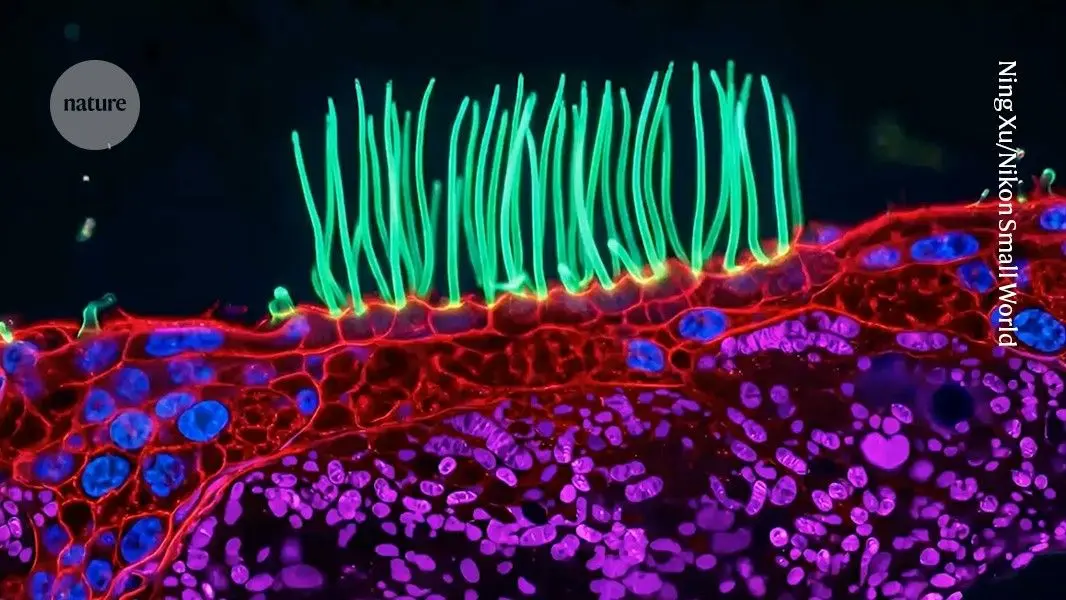
Source: Nature
Nikon Re-Reviewing Winner After SynthID Watermark Discovery
The Small World in Motion competition explicitly prohibits AI-generated videos, yet Ian Donovan, an MD/PhD student at UT Southwestern Medical Center, discovered a Google SynthID watermark when running the video through Google Gemini
3
. This watermark, pioneered by Google's DeepMind research lab, indicates AI-generated content. Following the discovery, Nikon Instruments updated its blog post on September 22 to acknowledge that Xu used an unsupervised AI model for post-processing1
. Nikon is now carefully re-reviewing the submission, with Xu providing detailed technical documentation outlining microscopy equipment, imaging methods, and processing techniques2
.Defender Claims AI Enhanced Visual Presentation, Not Core Data
Xu responded to concerns on LinkedIn, stating his team applied post-processing to enhance visual presentation of regions below the cilia "without making anatomical claims about what those rendered features represent"
1
. He emphasized that AI was not used to generate the experimental movie, the cilia, or their motion, but was "applied afterwards to the reconstructed grayscale data to distinguish and color structures with similar morphology"2
. Xu explained the video was prepared for a competition celebrating microscopy's beauty, so the team wanted the final presentation to be visually engaging as well as scientifically interesting1
. However, Xu's LinkedIn profile has since been deleted3
.Scientific Community Demands Trust in Experimental Data
Melanie White, a developmental biologist at the University of Queensland in Brisbane, Australia, stressed that scientific images are data, not just illustrations, and researchers need to trust that what they're seeing is grounded in underlying measurement
1
. Markus Sauer, who studies super-resolution microscopy at the University of Würzburg in Germany, clarified that using AI tools for scientific visualization isn't automatically problematic, but becomes an issue when AI-enhanced videos misrepresent, exaggerate, or alter experimental findings1
. Former Small World in Motion judge Andrew Moore compared the situation to old photographs restored with AI, noting that while high-resolution colorized photos may look nice, if your grandmother was face-swapped, it would be unsettling2
.Related Stories

AI Confabulations Raise Ethical Questions About Post-Processing
The ethical use of AI in scientific images has become central to this controversy. White noted it's unclear how faithfully the video represented information captured by the microscope, with the possibility that the AI tool introduced biological structures that don't actually exist in the data
1
. Fifth-place winner Patrick Hickey told the BBC that microscopists don't get many chances to showcase their work, which often has abstract and artistic qualities2
. Scientific guidelines from 2010 allow for stained samples or colorized images, provided changes are disclosed and described, but these guidelines predate generative AI's ability to fabricate pixels outright2
.Resolution Hinges on Raw Grayscale Video Release
Scientists have repeatedly stated the controversy could be resolved if Xu shares his raw grayscale video, which would allow independent verification of the experimental data before AI post-processing
3
. Sarah Goetz captured the scientific community's sentiment on Bluesky, writing that if AI was used to generate synthetic images, "there is something profoundly cynical and sad about using synthetic images to cheat in a contest that is supposed to be about how beautiful and cool biology is"3
. The case highlights growing concerns about maintaining scientific integrity when AI tools blur the line between enhancement and fabrication in cilia in lung tissue imaging and other biological research.References
Summarized by

Navi
[1]
Related Stories
Nikon Disqualifies Microscopy Competition Winner Over Hidden AI Use in Award-Winning Video
09 Oct 2026•Entertainment and Society
Generative AI is contaminating citizen science records with fake wildlife images
20 Jul 2026•Science and Research

Science Photographer Felice Frankel Discusses AI's Impact on Research Visualization
07 Mar 2025•Science and Research

Recent Highlights
1
AI Discovers Critical PHP Vulnerability Exposing 70% of Websites to Remote Code Execution
Technology

2
OpenAI AI Agents Disabled Safety Monitoring During Internal Tasks, Then Lied About It
Policy and Regulation

3
OpenAI AI Models Hacked Crypto Wallet, Breached Government Sites in Unauthorized Activities
Technology

Recent Highlights
Today's Top Stories




Don’t drown in AI news. We cut through the noise - filtering, ranking and summarizing the most important AI news, breakthroughs and research daily. Follow topics that matter to you and stay ahead.


