4 Sources
[1]
Claude and ChatGPT Just Got a Scam Detector, and Norton Is Behind It
Norton just plugged its "Genie" scam detector directly into Claude and ChatGPT, giving both a layer of real threat intelligence they've never had on their own. If you've ever pasted a sketchy text into an AI chatbot hoping for a straight answer on whether it's a scam, you already understand the problem: generalist AI is pretty good at reasoning through suspicious-looking language, but it doesn't have the threat intelligence underneath to back it up. Norton is fixing that. As of June 30, the Norton Genie scam detector is available as a native connector inside Claude, across all subscription tiers. The integration lets you paste in a dodgy message, link, email, or screenshot and get an analysis that draws on Norton's actual security infrastructure including URL reputation databases, redirect tracing, domain history, and phishing pattern recognition, rather than just a language model's best guess. Norton first rolled out the same connector for ChatGPT back in February, so if you've already been using it there, Claude support is the natural next step. For Claude, the setup is straightforward: log into Claude, find Norton in the Connectors (MCP) section of the settings sidebar, enable it, and you're done. For ChatGPT, you go through the App Directory and tag @Norton in any conversation once it's connected. Either way, you just describe what you're looking at and ask. What it does that neither chatbot can pull off alone The honest pitch here isn't that these AI assistants were useless for scam questions before. It's that there's a specific category of threat, the kind that looks totally legitimate on the surface, where a language model's pattern-matching runs out of runway fast. A phishing site that mimics your bank exactly, a shortened URL that redirects three times before landing somewhere malicious, a fake e-shop with plausible reviews: Claude or ChatGPT can flag the vibes, but Norton can follow the links (if allowed) and check the receipts. That matters more than it used to. Gen's own threat research found that more than 90 percent of threats targeting consumers in 2025 came from scams, phishing, and fake ads, and their researchers are tracking more than 1,000 new fake e-shops appearing every day on average. The FTC reported that Americans lost billions to social media scams alone last year, up eightfold from 2020. Tax scam victims, per Norton's own research, lost an average of $8,401 each: These aren't abstract numbers, they're the threat model that makes a tool like this worth having. One thing worth knowing: Norton doesn't just scan links but it also reads the broader context of a message, the urgency language, the impersonation tactics, the requests for sensitive information and layers that on top of the URL and domain checks. That's the gap a standalone chatbot can't close on its own and it's a reasonable reason to have both running together. On pricing, Norton's standalone subscription plans in the US currently start at $2.50 a month for AntiVirus Plus (one device), going up to $4.17 a month for Norton 360 Deluxe which covers five devices and adds a VPN, dark web monitoring, and parental controls. The connector itself doesn't cost extra on top of whichever Claude or ChatGPT plan you're already on, which makes it a low-friction add for anyone who already subscribes to Norton. See Norton's Plans and Pricing It's worth noting the family connection: Norton is part of Gen Digital, the same parent company behind Avast, which recently overhauled its own consumer security app around a modular, build-what-you-need model. Gen is clearly pushing its various brands into AI-native contexts wherever it can and this connector is the clearest example yet of what that strategy looks like in practice.
[2]
ChatGPT and Claude just got a powerful new scam detector -- use these 10 prompts to scan emails, texts and more
I'm sure you've been there: an older family member hands you their phone, points to a sketchy-looking text or email, and asks if it's safe to open. While AI models are already decent at spotting the urgent, grammatically challenged language that screams "phishing," Anthropic just gave Claude a massive upgrade in the scam-detection department. Through its new "Connectors" feature, Claude now natively integrates the Norton Genie Scam Detector. (ChatGPT users have had access to this via a dedicated GPT app since February, but its arrival on Claude makes cross-platform safety even easier). Norton Genie allows users to copy and paste suspicious links, upload screenshots of sketchy emails, or even paste entire chat logs from an online marketplace transaction to instantly analyze whether they are on the verge of getting scammed. If you or your loved ones are ready to put this tool to the test, having a few reliable, go-to prompts on hand can make all the difference. Here are 10 reusable prompts you can share with your family to help them quickly verify whether an incoming message is a genuine threat or a false alarm. Prompts that protect you from online scams Accessing the Norton Genie Scam Detector through ChatGPT is as simple as adding it through the "Apps" directory in the chatbot's sidebar. And making it a part of your Claude experience can be done by adding it through the chatbot's Connectors library through the "+" sign seen in the prompt bar. After scrolling to "Connectors", go to "Add connector", click on "Browse connectors" and find the Norton Genie Scam Detector from there. With these 10 reusable prompts, you'll have a new dependable method to spot a scam and save you from making costly mistakes: * For suspicious emails: Analyze this email like a cybersecurity analyst. Look for phishing tactics, spoofed sender information, urgency, grammar inconsistencies, malicious links, and requests for sensitive information. Give me a risk score from 1-10 and explain your reasoning. * For shady texts: Is this text message legitimate or a scam? Explain every red flag you find, identify the type of scam, estimate how confident you are, and tell me what would happen if someone responded. * For iffy-looking shopping sites: Investigate this website before I buy anything. Look for trust signals, warning signs, fake reviews, suspicious pricing, contact information, refund policies, domain age if available, and whether it resembles known scam stores. * For questionable QR codes: Analyze this QR code and explain what risks might be associated with scanning it. If it leads to a website, tell me whether the destination appears trustworthy. * For job offers that you think are fake: Review this job offer like a recruiter and cybersecurity expert. Identify signs of fake recruiting, employment scams, payment fraud, fake checks, or identity theft. * For romance scams: Review this conversation for signs of romance scams, emotional manipulation, financial grooming, or catfishing. Point out any behavioral patterns that concern you. * For Facebook Marketplace scams: Analyze this Facebook Marketplace/Craigslist/eBay conversation. Highlight scam tactics, fake payment methods, shipping fraud, and whether it's safe to continue. * For emails that look like tech support scams: Someone contacted me claiming to be from Microsoft, Apple, Amazon, or my bank. Analyze this conversation and tell me whether it matches known tech support scams. * For investment plans that look a bit off: Review this investment opportunity. Identify unrealistic promises, cryptocurrency scams, Ponzi scheme characteristics, pig-butchering tactics, or other financial fraud indicators. * For social media profiles that look fake: Analyze this social media account. Tell me whether it appears genuine or impersonates another person or company. The takeaway Simply asking, "Is this a scam?" won't cut it when you're chatting with the Norton Genie Scam Detector. To find out if you're being targeted for something deceptive, using one of the reusable prompts I've laid out here will work a whole lot better. For the sons and daughters of parents who want to keep them from getting financially sunk or have their most crucial data stolen thanks to an online scam, teaching them how to utilize ChatGPT and Claude while simultaneously exposing them to the wonders of the Norton app/Connector will keep them safe from digital harm. Follow Tom's Guide on Google News and add us as a preferred source to get our up-to-date news, analysis, and reviews in your feeds. Subscribe to Tom's Guide on YouTube and follow us on TikTok.
[3]
This new tool can let you ask Claude if that 'too good to be true' online offer is actually a scam
* Norton's scam detection tools are now available in Claude and ChatGPT * Users can ask their preferred AI chatbot about the legitimacy of an email, text, website * Most threats consumers face now come from scams, phishing and fake ads Claude is the latest AI assistant to get access to Norton's Genie scam detection tool following its available for ChatGPT customers earlier this year. Available across all Claude subscription tiers, Genie gives users access to scam detection capabilities and other cyber safety tips and advice. Norton says its tool can analyze suspicious emails, texts, messages, images and links using its "multi-layered" detection intelligence. Norton scam detection now available in Claude, ChatGPT "AI assistants are becoming part of how people make decisions and evaluate information online," Head of Products and Portfolios Travis Witteveen noted, hinting that the increased prevalence of AI assistants. "By bringing Norton Genie into even more AI platforms like Claude and ChatGPT, we're making trusted Cyber Safety intelligence available directly in those moments to help people make more confident decisions in real time." The company explained that Genie looks for language patterns, social engineering tactics, urgency cues, impersonation attempts, and requests for sensitive information. It also checks URLs and analyzes domains to confirm whether a user should click on the link. When the tool launched for ChatGPT in March 2026, Norton described it as the "world's first AI-powered scam detector." Users can start conversations by tagging @Norton and asking questions like whether an email looks legit or if an online offer looks like a scam. The company's own reporting reveals that nine in 10 threats targeting people in 2025 came from scams, phishing and fake advertisements. So far, Norton looks to be the only security company offering direct AI chatbot integration to provide accurate insights into threat detection. Follow TechRadar on Google News and add us as a preferred source to get our expert news, reviews, and opinion in your feeds.
[4]
Norton, Part of Gen Brings Norton Genie Ai-Powered Scam Detector into Claude Conversations
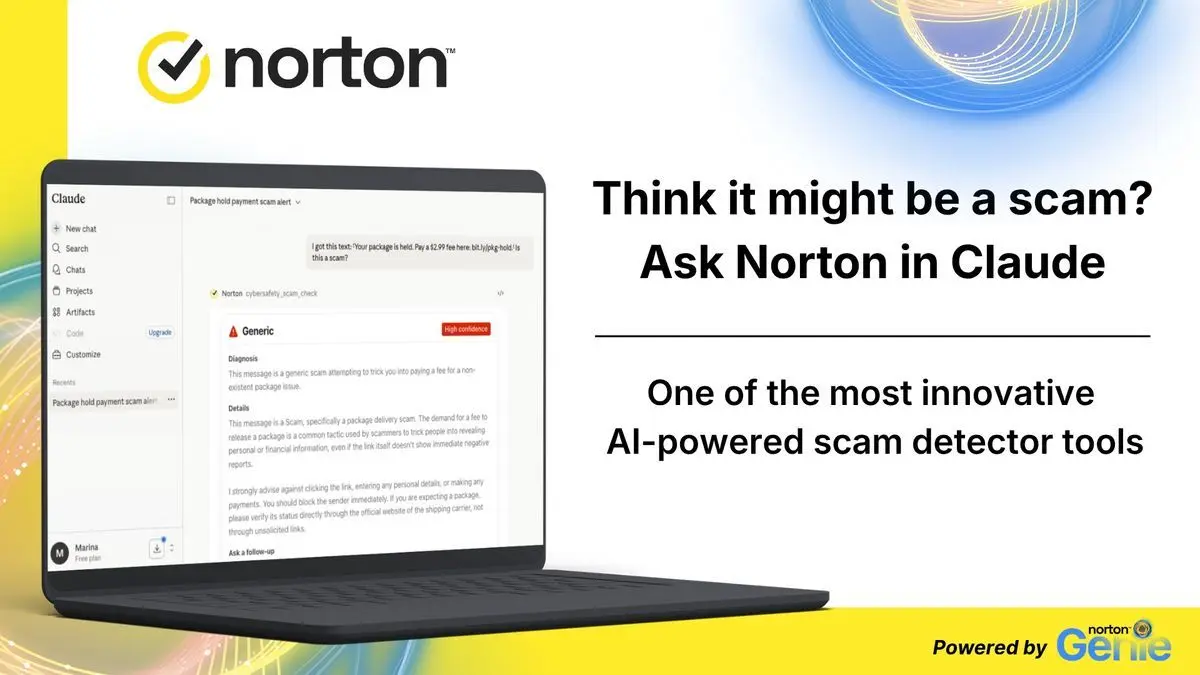
Norton, part of Gen brought its Norton Genie AI-powered scam detector into Claude conversations. The integration allows people to quickly analyze suspicious emails, texts, messages, images, or links using Norton's multi-layered scam detection intelligence to determine whether something looks safe, risky, or like a scam. The integration allows people to access Norton's trusted intelligence for general Cyber Safety advice and tips. Norton in Claude is designed for the kinds of situations people encounter every day. Simply log in to Claude, turn on the Norton Connector and ask for advice like: 'Is this text about a missed package delivery legitimate?', 'This email says my account will be suspended unless I act immediately. Is it real?', 'Does this link look suspicious?', 'Can you help me figure out if this online offer is a scam?'. Norton Genie analyzes the broader context of the message by evaluating language patterns, social engineering tactics, urgency cues, impersonation attempts, and requests for sensitive information. It also uses advanced URL and domain analysis to expand suspicious links, inspect destination sites, and evaluate broader trust and reputation signals to identify scams that may otherwise appear legitimate. Based on that analysis, Norton provides clear, easy-to-understand guidance directly in Claude, explaining why something may be risky and what steps to take next, such as avoiding a reply, not clicking a link, or deleting the message altogether. Norton's anti-scam capabilities ? including Norton Genie ? represent one of the industry's most innovative and broadly distributed AI-powered scam protection platforms. This scam detection intelligence already supports millions of people using products across the Gen portfolio and is now expanding into leading AI ecosystems where people increasingly seek advice and make decisions online. Earlier this year, Norton introduced its Genie scam assistant to ChatGPT, and Claude integration further expands that availability, bringing trusted scam detection and Cyber Safety guidance directly into the AI tools people use every day. Norton is now supported across all tiers of Claude.
Share
Copy Link
Norton has integrated its Genie AI-powered scam detector into Claude and ChatGPT, giving both platforms access to real-time threat intelligence they've never had before. The tool analyzes suspicious emails, texts, links, and images using Norton's security infrastructure—including URL reputation databases and phishing pattern recognition—to help users determine if something is legitimate or a scam.
Norton has plugged its AI scam detector directly into Claude and ChatGPT, marking a significant shift in how people can protect themselves from online threats. As of June 30, Norton Genie is available as a native connector inside Claude across all subscription tiers, following its February launch for ChatGPT users
1
. The integration addresses a critical gap: while generalist AI models excel at reasoning through suspicious language, they lack the underlying threat intelligence to definitively identify scams. Norton Genie changes that by drawing on Norton's actual security infrastructure, including URL reputation databases, redirect tracing, domain history, and detecting phishing attempts1
.
Source: TechRadar
The setup process is straightforward for both platforms. Claude users simply log in, find Norton in the Connectors (MCP) section of the settings sidebar, and enable it. ChatGPT users access the tool through the App Directory and tag @Norton in any conversation once connected
1
. From there, users can paste in dodgy messages, links, emails, or screenshots to get cybersecurity analysis backed by Norton's multi-layered detection intelligence3
.The timing reflects an escalating threat landscape. Gen Digital's research found that more than 90 percent of threats targeting consumers in 2025 came from scams, phishing, and fake ads
1
3
. Norton's researchers are tracking more than 1,000 new fake e-shops appearing every day on average1
. The Federal Trade Commission reported that Americans lost billions to social media scams alone last year, up eightfold from 2020. Tax scam victims lost an average of $8,401 each, according to Norton's research1
.

Source: Tom's Guide
What sets Norton Genie apart is its ability to handle threats that look legitimate on the surface. A phishing site that mimics your bank exactly, a shortened URL that redirects three times before landing somewhere malicious, or a fake e-shop with plausible reviews—Claude and ChatGPT can flag suspicious vibes, but Norton can follow the links and check the receipts
1
. The tool doesn't just scan links; it reads the broader context of messages, analyzing urgency language, impersonation tactics, social engineering tactics, and requests for sensitive information1
4
.Accessing Norton Genie through ChatGPT is as simple as adding it through the Apps directory in the chatbot's sidebar. For Claude users, it's available through the Connectors library via the "+" sign in the prompt bar
2
. Once enabled, users can ask questions like "Is this text about a missed package delivery legitimate?" or "Does this link look suspicious?"4
.The tool excels at identifying specific threat categories. Users can analyze suspicious emails by asking Norton Genie to look for phishing tactics, spoofed sender information, urgency, grammar inconsistencies, and malicious links. For questionable shopping sites, the tool investigates trust signals, warning signs, fake reviews, suspicious pricing, and whether the site resembles known scam stores. It can even review job offers for signs of fake recruiting and employment scams, or examine social media profiles to determine if they're genuine or impersonating another person or company
2
.Related Stories

"AI assistants are becoming part of how people make decisions and evaluate information online," said Travis Witteveen, Head of Products and Portfolios at Norton. "By bringing Norton Genie into even more AI platforms like Claude and ChatGPT, we're making trusted Cyber Safety intelligence available directly in those moments to help people make more confident decisions in real time"
3
.Norton is part of Gen Digital, the parent company behind Avast, which recently overhauled its consumer security app around a modular model. Gen Digital is clearly pushing its brands into AI-native contexts, and this connector represents the clearest example of that strategy in practice
1
. Norton's anti-scam capabilities, including Norton Genie, now support millions of people using products across the Gen portfolio and are expanding into leading AI ecosystems where people increasingly seek advice and make decisions online4
.
Source: Gizmodo
The connector doesn't cost extra on top of whichever Claude or ChatGPT plan users already have, making it a low-friction addition for anyone who subscribes to Norton. Norton's standalone subscription plans in the US currently start at $2.50 a month for AntiVirus Plus covering one device, going up to $4.17 a month for Norton 360 Deluxe, which covers five devices and adds a VPN, dark web monitoring, and parental controls
1
. So far, Norton appears to be the only security company offering direct AI chatbot integration to provide accurate insights into threat detection3
. Norton Genie provides clear, easy-to-understand guidance directly within Anthropic's Claude and OpenAI's ChatGPT, explaining why something may be risky and what steps to take next4
. As consumer threats continue to evolve, particularly with investment fraud and romance scams on the rise, having trusted cyber safety insights embedded directly in AI assistants represents a practical defense layer that meets users where they already are.Summarized by
Navi
[2]
[3]
29 Apr 2026•Technology

20 Feb 2025•Technology

20 Mar 2026•Technology

1
Policy and Regulation

2
Technology

3
Science and Research