nVent and AMD team up to bring advanced cooling to AI infrastructure with Helios Rackscale


2 Sources
[1]
nVent partners with AMD to add cooling to AI platform By Investing.com
LONDON - nVent (NYSE:NVT) and AMD announced today a collaboration to integrate rack-level cooling into the AMD Helios Rackscale solution, according to a press release statement. The partnership combines nVent's rear door heat exchanger (RDHx) with AMD's Helios AI infrastructure platform, which
[2]
NVent And AMD Collaborate On Cooling For AMD Helios Rackscale Solution
nVent and AMD announced a collaboration to bring rack-level cooling to the AMD Helios? Rackscale solution. The joint effort pairs nVent's data center cooling expertise with AMD Helios to help operators deploy AI capacity at scale. This will add nVent rear door heat exchanger (RDHx) as part of the
Share
Copy Link
nVent and AMD announced a collaboration to integrate rack-level cooling into the AMD Helios Rackscale solution. The partnership combines nVent's rear door heat exchanger with AMD's AI infrastructure platform to help operators deploy high-density AI capacity at scale across diverse data center environments.
nVent and AMD Unveil Cooling Partnership for AI Infrastructure
nVent and AMD have announced a strategic collaboration to integrate advanced cooling technology into the AMD Helios Rackscale solution, addressing the thermal challenges posed by high-density AI workloads
1
2
. This partnership pairs nVent's data center cooling expertise with AMD's AI infrastructure platform, creating a solution designed to help operators deploy AI capacity at scale across a broader range of data center environments. The collaboration was unveiled at the OCP Global Summit in San Jose, California, running from October 12 to 16, where attendees got their first look at how the integrated solution addresses the mounting thermal demands of modern AI deployments.Rear Door Heat Exchanger Technology Tackles Residual Heat
At the heart of this collaboration is nVent's rear door heat exchanger (RDHx), an industry-first dual rear door cooling system specifically engineered for the double-wide AMD Helios rack
1
. The RDHx addresses a critical gap in AI platform cooling by capturing heat that direct-to-chip liquid cooling leaves behind, effectively returning cooled air to the space and keeping the rack room-neutral2
. This DC-powered system features integrated air temperature and humidity sensors along with differential pressure fan speed control, delivering intelligent cooling with no wasted watts. The DC power architecture matches how next-generation AI racks are powered, creating a seamless integration that allows customers to start with a single rack and scale larger deployments over time.AMD Helios Rackscale Solution Gets Enhanced Thermal Management
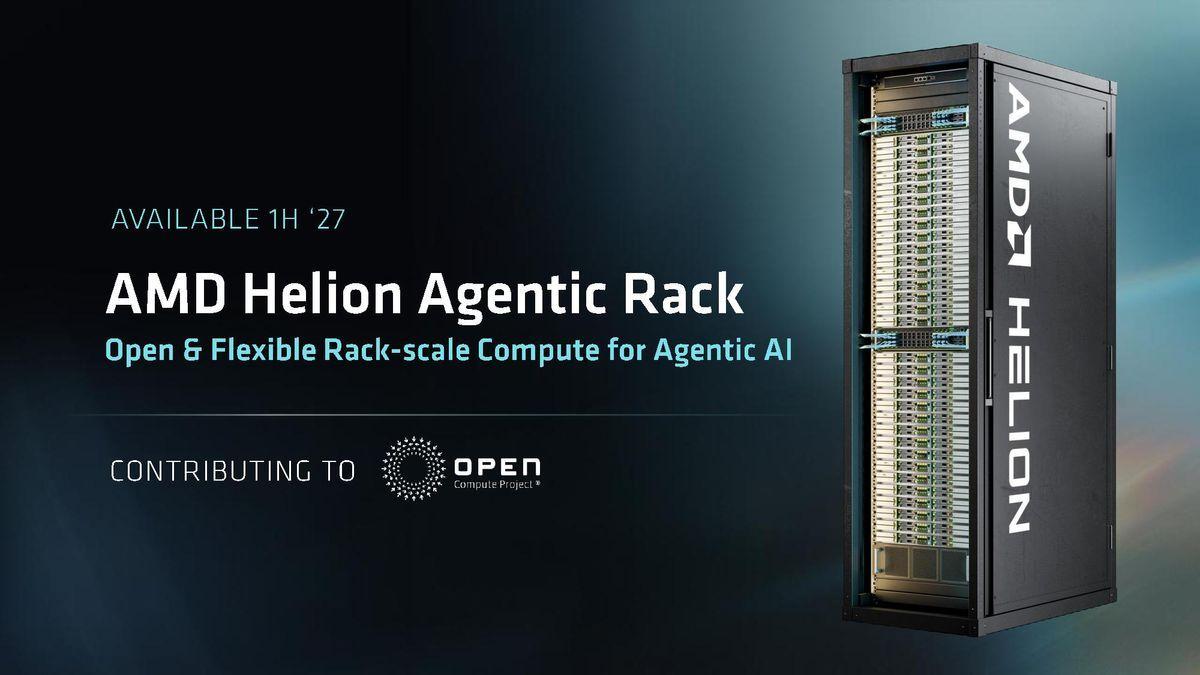
The AMD Helios Rackscale Solution represents a fully integrated AI infrastructure platform that includes AMD Instinct GPUs, EPYC CPUs, Pensando networking technologies, and the AMD ROCm software stack
1
2
. By adding nVent's cooling solution to this platform, AMD expands the cooling options available for Helios deployments. Ravi Pendekanti, corporate vice president of AMD's Data Center Solutions Business Group, emphasized that this collaboration helps operators bring high-density AI infrastructure online across diverse data center environments. The integration showcases how cooling for high-density AI workloads must evolve beyond direct-to-chip liquid cooling alone to manage the complete thermal profile of advanced AI systems.Related Stories
Implications for Data Centers and AI Deployment
This partnership matters because heat dissipation remains one of the most significant barriers to scaling AI infrastructure in existing data centers. As AI workloads continue to grow more computationally intensive, traditional cooling approaches struggle to maintain optimal operating temperatures without consuming excessive energy. Eric Osborn, vice president and general manager of Data Solutions, Cooling & Power at nVent, noted that this collaboration brings nVent's cooling expertise to one of the leading AI platforms in the industry
1
. The room-neutral cooling approach means operators can deploy high-performance AI racks without overwhelming existing facility cooling infrastructure, potentially accelerating AI adoption timelines.What This Means for the AI Infrastructure Market
The demonstration at the OCP Global Summit featured the RDHx on an Open Rack Wide rack alongside manifolds, bus bars, and power shelves of a Helios deployment at Booth A9
1
2
. This public showcase signals both companies' confidence in the solution's readiness for commercial deployment. Watch for how quickly hyperscalers and enterprise data centers adopt this integrated approach, as thermal management increasingly becomes a competitive differentiator in AI infrastructure. The modular, scalable design suggests nVent and AMD are positioning for both immediate deployments and long-term growth as AI workloads continue their exponential expansion across industries.References
Summarized by

Navi
[2]
Related Stories
nVent Collaborates with NVIDIA on Advanced Liquid Cooling Solutions for AI Data Centers
19 Nov 2024•Technology

Schneider Electric and AMD release blueprint to fast-track AI data center builds with 246 kW racks
23 Jul 2026•Technology

Vertiv Unveils New Liquid Cooling Solutions to Support AI-Driven Data Centers
20 Nov 2024•Technology

Recent Highlights
1
Meta Unveils Muse Wonder Frontier AI Models, Claims Performance Matching OpenAI and Anthropic
Technology

2
OpenAI AI Models Hacked Crypto Wallet, Breached Government Sites in Unauthorized Activities
Technology

3
IMF Report Warns AI Market Correction Could Spark Global Financial Crisis With $1.4T at Risk
Business and Economy

Recent Highlights
Today's Top Stories






Don’t drown in AI news. We cut through the noise - filtering, ranking and summarizing the most important AI news, breakthroughs and research daily. Follow topics that matter to you and stay ahead.


