Nvidia and Kioxia Collaborate on Revolutionary 100 Million IOPS SSD for AI Servers


4 Sources
[1]
Nvidia and Kioxia target 100 million IOPS SSD in 2027 -- 33 times more than existing drives for exclusive use in AI servers
Kioxia is working with Nvidia to build a solid-state drive that would deliver 100 million random IOPS already in 2027, the company said at a news conference earlier this month, Nikkei reports. Nvidia reportedly plans to use a couple of such SSDs -- totalling a whopping 200 million IOPS -- attached
[2]
Kioxia-Nvidia project aims for SSD performance 33 times higher than today's top drives
Serving tech enthusiasts for over 25 years. TechSpot means tech analysis and advice you can trust. Forward-looking: The collaboration between Kioxia and Nvidia marks another step forward for AI data center infrastructure. By pushing toward SSDs capable of 100 million IOPS - dramatically higher
[3]
NVIDIA rumored to team with KIOXIA to make new SSDs that are 100x faster for AI workloads
TL;DR: NVIDIA and KIOXIA plan to co-develop ultra-fast SSDs with nearly 100x faster read speeds by 2027, targeting AI servers to partially replace HBM as GPU memory expanders. This innovation leverages PCIe 7.0 and addresses growing AI-driven NAND demand, projected to reach 34% of the market by
[4]
NVIDIA Reportedly Partnering With Kioxia to Produce SSDs Up to 100x Faster Than Standard Models, Designed for AI Workloads
NVIDIA and its partners are pushing towards the next phase of 'AI memory,' and based on a new report, Kioxia plans to develop commercial SSDs that will be 100x faster than traditional ones. Well, it seems like NVIDIA is eying a replacement for HBM technology and is apparently looking towards
Share
Copy Link
Nvidia and Kioxia are partnering to develop ultra-fast SSDs capable of 100 million IOPS by 2027, specifically designed for AI workloads. This breakthrough could potentially replace HBM as GPU memory expanders and revolutionize data center infrastructure.
Nvidia and Kioxia's Ambitious SSD Project
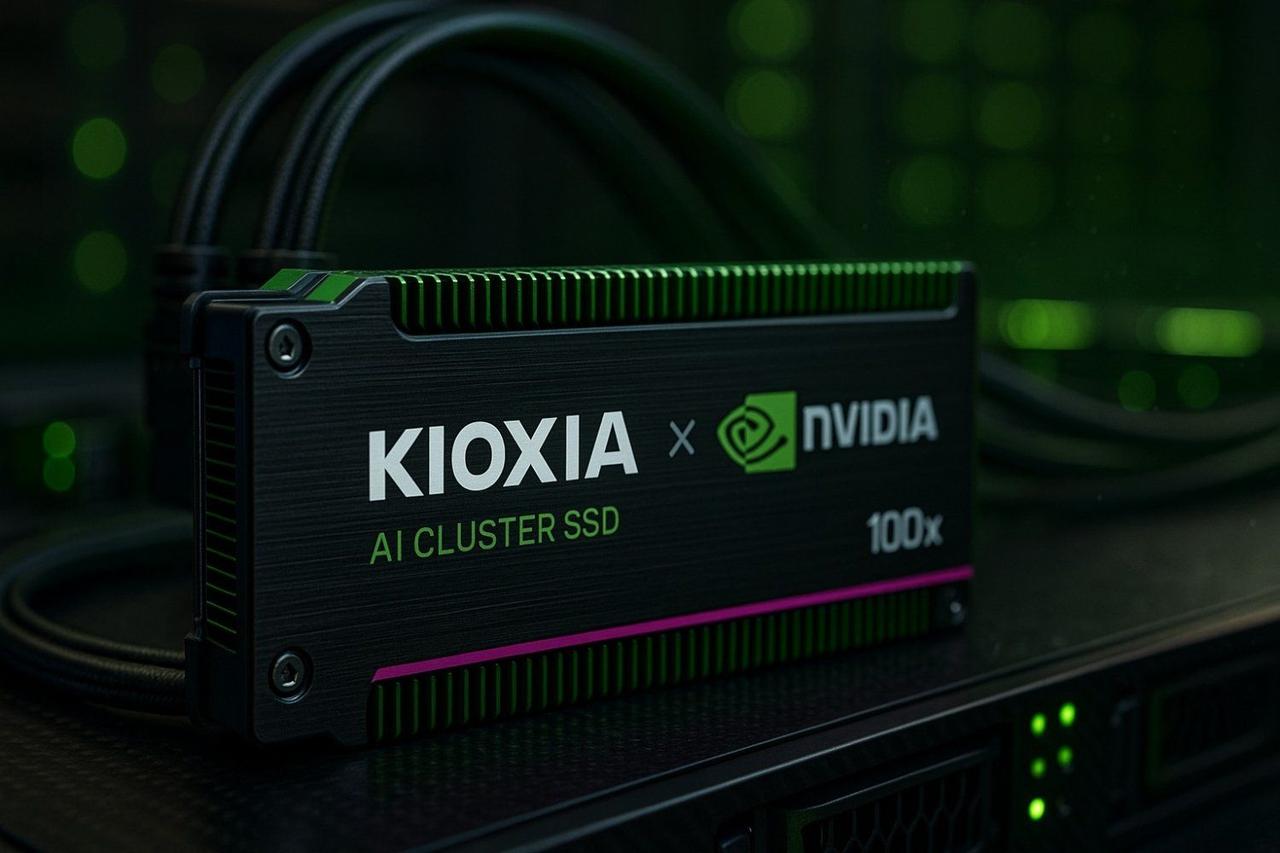
Nvidia and Kioxia are joining forces to develop a groundbreaking solid-state drive (SSD) that promises to deliver an astounding 100 million random IOPS by 2027
1
. This collaboration aims to create storage solutions that are 33 times faster than existing high-end drives, which currently peak at around 3 million IOPS2
.
Source: TweakTown
Revolutionizing AI Server Infrastructure
The primary goal of this project is to address one of the most significant bottlenecks in training and deploying massive AI models: data movement. These ultra-fast SSDs are designed exclusively for use in AI servers, where they will be directly connected to Nvidia's GPUs using a peer-to-peer mode
1
. This direct connection allows for much faster data transfer between storage and compute resources, a crucial advantage for large-scale AI models that rely on frequent, small, random data reads2
.Technological Innovations
To achieve this unprecedented performance, Kioxia is exploring several cutting-edge technologies:

Source: Wccftech
-
XL-Flash: A proprietary SLC NAND memory type engineered for high endurance, low latency, and strong performance. XL-Flash supports up to 16 planes within a NAND die, compared to the 3 to 6 planes typical in consumer-grade 3D NAND
2
. -
High Bandwidth Flash (HBF): This emerging technology packs up to 16 NAND devices and a logic die into a single stack, interconnected using TSVs and microbumps. HBF layers use proven NAND memory cells organized in multiple arrays to achieve a very high level of parallelism and performance
1
.
PCIe 7.0 and Future Prospects
The new SSDs are projected to use the forthcoming PCIe 7.0 interface, which supports high-speed, peer-to-peer GPU communication
2
. Nvidia's ambitious target is to achieve 200 million IOPS using a two-SSD configuration3
.Related Stories

Impact on AI and Data Centers
This breakthrough could potentially redefine how data centers are built, upend competitive dynamics in cloud and enterprise storage, and set new expectations for the entire hardware stack
2
. The new SSDs might partially replace HBM as GPU memory expanders, addressing the growing AI-driven NAND demand, which is projected to reach 34% of the market by 20293
.
Source: TechSpot
Challenges and Future Development
While the potential of these new SSDs is immense, there are significant challenges to overcome. Achieving perfect linear scaling across loads of NAND devices is not feasible, and real-world performance is limited by various factors such as channel bandwidth, multi-plane constraints, and firmware
1
. As the project progresses, Kioxia and Nvidia will need to address these challenges to bring their revolutionary SSD to market by 2027.References
Summarized by

Navi
[1]
[3]
Related Stories
Recent Highlights
1
Meta Unveils Muse Wonder Frontier AI Models, Claims Performance Matching OpenAI and Anthropic
Technology

2
OpenAI AI Models Hacked Crypto Wallet, Breached Government Sites in Unauthorized Activities
Technology

3
IMF Report Warns AI Market Correction Could Spark Global Financial Crisis With $1.4T at Risk
Business and Economy

Recent Highlights
Today's Top Stories








Don’t drown in AI news. We cut through the noise - filtering, ranking and summarizing the most important AI news, breakthroughs and research daily. Follow topics that matter to you and stay ahead.


