Kioxia Unveils PCIe 6.0 SSDs Targeting 10 Million IOPS for AI Workloads


6 Sources
[1]
Kioxia GP1 PCIe 6.0 XL-Flash SSD Targets 100 Million Random-Read IOPS
Kioxia has announced the GP1, an enterprise PCIe 6.0 SSD designed to act as a high-speed capacity extension for GPU memory. The drive uses second-generation XL-Flash, Kioxia's low-latency storage-class memory. It supports 512-byte access granularity rather than relying exclusively on the larger
[2]
KIOXIA showcases next-gen PCIe 6.0 NVMe SSDs at Future of Memory and Storage
FMS 2026, aka the Future of Memory and Storage, is taking place this week from August 4 through to 6 in Santa Clara, California. As the inventor of flash memory and a leader in storage technology, KIOXIA will be on hand to showcase the next generation of PCIe 6.0 NVMe SSD storage built for
[3]
Kioxia NX1 PCIe 5.0 SSD Adds Direct Liquid Cooling
Kioxia has announced the NX1, an E1.S PCIe 5.0 NVMe SSD family designed for hyperscale and GPU-equipped AI servers. It is Kioxia's first SSD line officially designed to work with cold-plate direct liquid cooling. The NX1 succeeds the XD8 and introduces a new Kioxia controller alongside
[4]
KIOXIA's new GP1 Series PCIe 6.0 SSDs unlock 10 million random read IOPS
IOPS (Input/Output Operations Per Second) is an important metric for determining the performance you can expect from storage, with random read IOPS referring to how a storage device handles non-sequential read operations. This is increasingly important for modern AI workloads that deal with large
[5]
KIOXIA introduces the first PCIe 6.0 CM10 enterprise SSDs, up to 92% faster than PCIe 5.0
Today, KIOXIA has announced its new CM10 Series SSDs, which represent its first PCIe 6.0 enterprise SSDs built for demanding AI workloads like inference and Key Value (KV) cache. The KIOXIA CM10 Series also sports the company's latest BiCS FLASH generation 10 TLC flash memory technology that
[6]
KIOXIA's next-gen NX1 Series SSDs for AI deliver close to 40% more performance with support for direct liquid cooling
KIOXIA has announced its next-generation E1.S form-factor SSDs for AI and hyperscale environments with the new NX1 Series. Built for data center environments and cutting-edge workloads, the NX1 Series represents a new era for E1.S PCIe 5.0 NVMe data center SSDs as they're the first to support
Share
Copy Link
Kioxia announced three new enterprise SSD series at Future of Memory and Storage 2026: the GP1 with 10 million random read IOPS, the CM10 with 92% faster sequential reads, and the NX1 with direct liquid cooling. All target AI infrastructure and GPU-accessible storage.

Kioxia Introduces Three Enterprise SSD Series for AI Infrastructure
Kioxia unveiled three new Kioxia SSD families designed specifically for AI workloads at the Future of Memory and Storage conference in Santa Clara, California. The GP1 Series, CM10 Series, and NX1 represent the company's push into next-generation PCIe 6.0 NVMe SSDs and advanced cooling solutions for high-performance AI servers.
1
2
According to Scott Nelson, Executive Vice President and Chief Marketing Officer for KIOXIA America, Inc., "AI is rapidly evolving across every industry, and memory is at the center of that transformation."2
GP1 Series Delivers 10 Million Random Read IOPS for GPU Direct Access
The GP1 Series represents Kioxia's attempt to bridge the AI memory wall by acting as high-speed capacity extension for GPU memory. Using second-generation XL-Flash storage-class memory, the GP1 delivers approximately 10 million random read IOPS in its initial architecture.
1
4
Future generations target scaling toward 100 million IOPS, though this represents a long-term goal rather than current performance.1
The drives support 512-byte access granularity and reach endurance ratings of 50 drive writes per day, placing them far above ordinary read-intensive enterprise SSDs.1
Neville Ichhaporia, senior vice president and general manager of the SSD business unit at KIOXIA America, explained: "The AI memory wall is a critical challenge for our industry to solve on the way to growing the scale and capability of AI deployment. KIOXIA's XL-FLASH is uniquely positioned to deliver the extremely high performance and low-latency data access needed to support GPUs as a memory extension tier."
4
The GP1 Series will be available in E3.S and E1.S 9.5 mm/15 mm form factors, with support for cold-plate liquid cooling. Evaluation samples are expected by the end of 2026.4
CM10 Series Achieves 92% Performance Gain With BiCS FLASH Generation 10
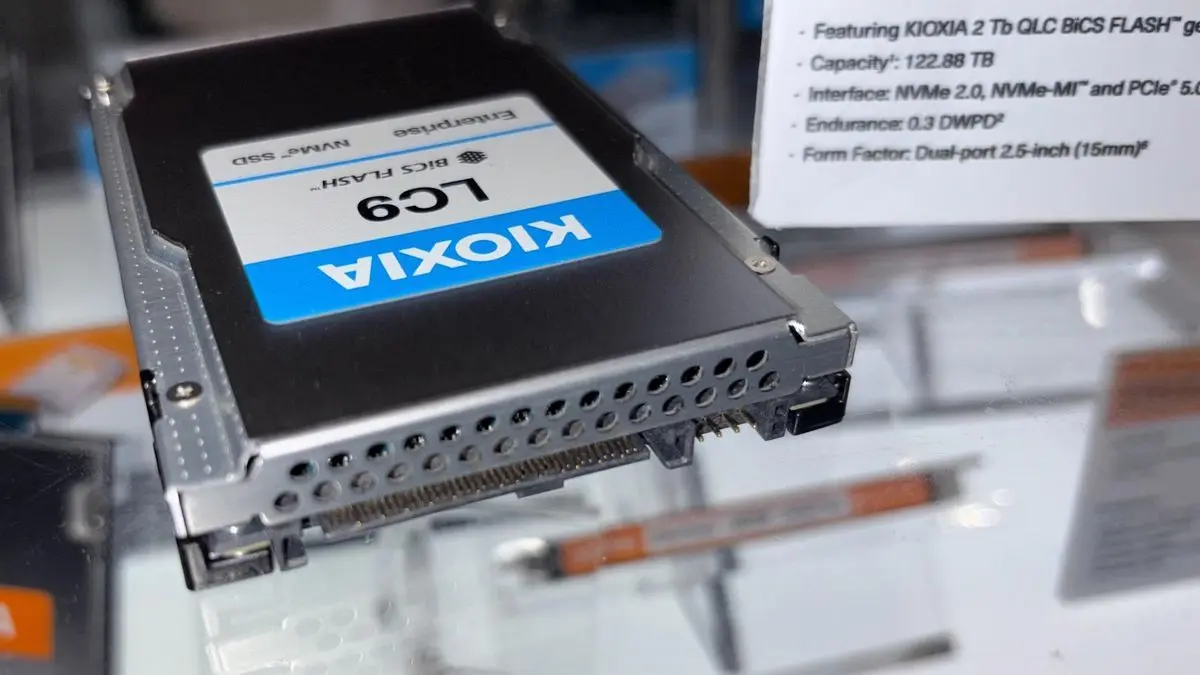
The CM10 Series marks Kioxia's first PCIe 6.0 enterprise SSDs built for AI inference and Key Value cache workloads. These drives feature BiCS FLASH generation 10 TLC NAND with 332 stacked layers, achieving the highest bit density and smallest chip size for 1Tb products.
5
Compared to the previous-generation CM9 Series PCIe SSD, the CM10 delivers 92% higher sequential read performance and approximately 85% higher random read performance.2
5
The CM10 Series supports NVIDIA CMX context memory storage, expanding GPU memory on NVIDIA Rubin for AI inference.
5
Capacities range from 1.60 TB to 61.44 TB, with read-intensive (1 DWPD) and mixed-use (3 DWPD) options. The drives are available in E3.S, E1.S, and 2.5-inch form factors, with E3.S and E1.S 9.5mm variants supporting direct cold-plate liquid cooling alongside traditional air cooling.5
The CM10 Series is NVMe 2.1 and OCP Datacenter NVMe SSD Specification 2.7 compliant.5
Related Stories
NX1 Series Brings Direct Liquid Cooling to PCIe 5.0 Storage
The NX1 represents Kioxia's first SSD line officially designed for cold-plate direct liquid cooling, addressing thermal challenges in GPU-equipped AI servers.
3
This E1.S PCIe 5.0 NVMe SSD family succeeds the XD8 and introduces a new Kioxia controller alongside eighth-generation BiCS Flash TLC NAND using CMOS directly Bonded to Array architecture.3
Kioxia claims sequential-write performance is up to 38% higher than the previous XD8, with random writes improving by as much as 20%.
3
The 9.5mm E1.S version operates under conventional airflow or connects to cold plates, while the thicker 15mm variant relies on air cooling. Capacities for one-drive-write-per-day models range from 1.92TB to 15.36TB.3
The NX1 supports the OCP Datacenter NVMe SSD Specification 2.6 and Flexible Data Placement, which lets software organize data to reduce internal write amplification and garbage collection.
3
Direct liquid cooling becomes relevant as GPUs, CPUs and networking components increasingly consume most server airflow and thermal capacity. Extending the liquid loop to storage enables denser systems while reducing dependence on high-speed fans.3
Samples are already shipping to select hyperscale customers.3
What This Means for AI Infrastructure Development
These three product lines address different layers of storage for the AI Era. The GP1 Series tackles the High Bandwidth Memory cost barrier by providing GPU direct access at significantly lower cost per gigabyte than expanding HBM or DRAM capacity.
4
The CM10 Series focuses on AI inference workloads where sequential and random read performance directly impact response times. The NX1 addresses thermal constraints in dense AI infrastructure.Kioxia's approach reflects broader industry recognition that storage must evolve beyond traditional block storage paradigms. The GP1's 512-byte access granularity and extremely high random read IOPS position it as a memory tier rather than conventional storage.
1
Watch for how software stacks adapt to leverage these capabilities, particularly in placing colder data on flash while reserving expensive memory for actively processed information. The technologies developed for enterprise AI infrastructure may eventually influence workstation and high-performance consumer SSDs.3
References
Summarized by

Navi
Related Stories
Recent Highlights



Recent Highlights
Today's Top Stories









Don’t drown in AI news. We cut through the noise - filtering, ranking and summarizing the most important AI news, breakthroughs and research daily. Follow topics that matter to you and stay ahead.


