3 Sources
[1]
Nvidia B300 servers sell for $1 million in China, nearly double the US price
Prices have surged from roughly 4 million yuan late last year to 7 million yuan ($1 million) today, driven by the Supermicro co-founder's arrest, tighter enforcement, and voracious demand from Chinese AI companies unwilling to hold restricted hardware on their own books. NVIDIA's B300 AI servers are now selling in China for approximately 7 million yuan, roughly $1 million per unit, nearly double their US list price of around $550,000, according to Reuters, which cited four industry sources. The near-doubling from around 4 million yuan late last year reflects a scarcity premium that has intensified sharply since early 2026, as a crackdown on chip smuggling closed the grey-market supply channel that had been a critical workaround for Chinese companies unable to purchase Nvidia hardware through official channels. Rental prices for B300 servers in China have also surged alongside sale prices, with short-term contracts reportedly reaching as high as 190,000 yuan per month, a figure that underlines the extremity of compute scarcity. Chinese technology companies are scrambling for the hardware needed to monetise their AI models and compete on inference efficiency, the cost of generating tokens, the basic unit of AI text output, as commercial AI deployment accelerates. Many are deliberately structuring arrangements to avoid holding Nvidia hardware directly on their balance sheets, fearing exposure to US sanctions. The inflection point in the price surge traces directly to the arrest of Yih-Shyan 'Wally' Liaw, co-founder of Supermicro, on 19 March 2026. US federal prosecutors unsealed an indictment alleging that Liaw, Supermicro's Taiwan general manager Ruei-Tsang Chang, and contractor Ting-Wei Sun conspired to divert roughly $2.5 billion in Supermicro servers, containing Nvidia's export-controlled Blackwell-class AI chips, to Chinese buyers via a Southeast Asian pass-through company. The scheme involved swapping serial numbers using heat guns, fabricating paperwork, and using fake replica servers to deceive government auditors. Liaw and Sun subsequently pleaded not guilty; Chang remains a fugitive. Supermicro's shares fell 33% on the day the indictment was unsealed, erasing more than $6 billion in market capitalisation. Liaw resigned from the board immediately. The prosecution is the highest-profile enforcement action yet under the AI chip export control regime the US has been tightening since 2022, and its effect on grey market supply appears to have been immediate: the arrest signalled to the broader network of brokers, logistics companies, and intermediaries that the enforcement risk had materially increased, sharply reducing the volume of hardware being diverted through unofficial channels. NVIDIA has publicly distanced itself from the grey market supply chain, stating that the B300 is restricted from sale in China and that partners must comply strictly with export rules. The company has incorporated export compliance features into its chips, though the extent to which these can be defeated or circumvented has not been publicly established. The B300 scarcity compounds a separate restriction that hit Chinese AI companies in early 2025. On 9 April 2025, the US government informed Nvidia that it required a licence to export its H20 chips, the China-specific GPU Nvidia had designed to comply with earlier export control rules, to the Chinese market. NVIDIA took a $4.5 billion charge in Q1 FY2026 on excess H20 inventory and purchase obligations, and was unable to ship an additional $2.5 billion of H20 revenue that quarter. The H20 had been Chinese companies' primary access point for compliant Nvidia GPU hardware; its restriction eliminated that option. The combined effect, H20 restricted, B300 grey market disrupted, domestic Chinese AI accelerators not yet competitive with Nvidia's highest-end systems for frontier model training, has produced the scarcity premium now reflected in the B300 price. Chinese tech giants are reported to be particularly focused on B300 hardware for inference workloads, generating AI outputs at scale, where per-token cost is the defining competitive metric. The current price dynamic is unfolding against an escalating policy backdrop. Last week, the US House Foreign Affairs Committee advanced the MATCH Act on 22 April in what lawmakers described as the largest semiconductor export control markup in congressional history. The bill would require the Netherlands and Japan to align their own chip equipment restrictions with US rules, cutting off ASML's remaining China sales and banning the servicing of already-installed machines. If enacted, it would further constrain China's ability to manufacture advanced chips domestically and deepen its dependence on restricted foreign hardware. China's Ministry of Commerce has warned the legislation would 'severely disrupt' global supply chains. For Chinese AI companies, the message embedded in the B300 price is simple: advanced AI compute will only get more expensive and harder to obtain through any channel. The $1 million price point is not a market equilibrium. It is the cost of urgency in a market where the alternative, falling behind on AI inference economics, is considered more expensive still.
[2]
Nvidia's Forbidden Fruit: China Buyers Pay $1 Million Per Server - NVIDIA (NASDAQ:NVDA)
Nvidia's Forbidden Fruit: Chinese Buyers Shell Out $1M Per B300 Server NVDA stock is moving. See the chart and price action here. Double The U.S. Price Tag The B300 is fetching about 7 million yuan (roughly $1 million) per server in China, the report said, versus around $550,000 in the U.S., where prices have crept up from about $500,000 late last year. In China, prices were closer to 4 million yuan late last year before the squeeze took hold. Watch the video here on Benzinga's YouTube channel: Buyers priced out of an outright purchase are turning to rentals, which Reuters said are running as high as 190,000 yuan a month on one-year contracts. Each B300 server houses eight GPUs and carries 288 GB of high-bandwidth memory, with Reuters describing it as one of the most powerful options on the market for AI inference workloads. Nvidia and partners including Super Micro Computer Inc. (NASDAQ:SMCI) began shipments last September. Smuggling Crackdown Tightens The Screws The B300 is not officially sold in China. Nvidia told Reuters its partners are required to follow strict compliance rules and warned that diverted hardware will not get company support. "As systems become increasingly large and complex, unlawful diversion is a recipe for failure," Nvidia said in a statement to Reuters. The gray market has thinned since U.S. prosecutors in March charged Yih-Shyan "Wally" Liaw, a co-founder of Nvidia partner Supermicro, the report said. Adding to the supply tension: Nvidia's H200 chips, cleared for export by both Washington and Beijing, still haven't made it into Chinese data centers as the two sides spar over the terms of the deal. China's AI Demand Is Exploding The price spike is colliding with a sharp jump in Chinese AI usage. Reuters cited a Morgan Stanley note showing Chinese AI models accounted for 32% of global token usage in March 2026, up from 5% a year earlier -- a shift the bank attributed to gains in coding and agentic capabilities. Nvidia's China Market Share Even with the export wall, Nvidia still holds about 55% of China's AI chip market, per the Reuters report -- a notable share given its top products technically aren't supposed to be sold there. Advanced Micro Devices (NASDAQ:AMD) sits at just 4%, while Huawei Technologies and other domestic chipmakers are angling to use the disruption to chip away at Nvidia's lead. Photo: Shutterstock This content was partially produced with the help of AI tools and was reviewed and published by Benzinga editors. Market News and Data brought to you by Benzinga APIs To add Benzinga News as your preferred source on Google, click here.
[3]
Prices of Nvidia's B300 server at $1 million in China on US curbs, sources say
BEIJING, April 30 (Reuters) - Strong demand for AI computing equipment in China has nearly doubled prices for Nvidia's B300 servers to about 7 million yuan ($1 million) each, industry sources said, as a crackdown on chip smuggling dries up black-market supply. Prices of Nvidia's most advanced and powerful server, critical for artificial intelligence tasks, have climbed since early this year, but rose sharply after the grey market, a key supply channel, came under pressure, the four sources said. The price surge is also being driven by robust computing demand from Chinese technology companies, even as many avoid holding Nvidia hardware directly on their books for fear of exposure to U.S. sanctions, the sources said. They spoke on condition of anonymity as the matter is a sensitive one. Reuters is the first to report the million-dollar price tag. Responding to questions from Reuters, Nvidia said the B300 was restricted from sale in China, and its partners needed to be committed to strict compliance. "As systems become increasingly large and complex, unlawful diversion is a recipe for failure," it warned in a statement. "Nvidia does not provide any service or support for such systems, and the enforcement mechanisms are rigorous and effective." SCARCITY PREMIUM DRIVEN BY TIGHTER U.S. CURBS ON EXPORTS A B300 server, which houses eight B300 GPUs, is priced at about $550,000 in the United States, up from around $500,000 late last year, two of the sources said. The near-doubling of prices in China, from about 4 million yuan late last year, reflects a scarcity premium driven by tighter U.S. curbs on exports. It comes as Chinese tech giants scramble for the most cost-efficient hardware for generating tokens, the basic units of text processed by an AI model, to monetise their models and computing infrastructure. The scarcity followed U.S. authorities' March prosecution of Yih-Shyan "Wally" Liaw, a co-founder of Nvidia partner Supermicro, the sources added. Some companies finding the price rise has put purchases out of reach are instead exploring options for rentals, which have risen as high as 190,000 yuan a month on a one-year short-term contract. Chinese AI models nearly tripled their share of global token usage to 32% in March 2026 from 5% a year earlier, driven by advances in coding and agentic capabilities, Morgan Stanley said in a note. MiniMax, Zhipu and Alibaba's Qwen each reported token usage rising as much as six to seven folds in February and March compared with December, the U.S. investment bank said. AMONG THE MOST POWERFUL FOR AI INFERENCE TASKS Nvidia's B300, packed with 288 GB of high-bandwidth memory, delivers 14 petaFLOPS of computing power at FP4 precision, ranking it among the most powerful chips available for AI inference tasks. Nvidia and partners, such as Supermicro, began shipping the chip last September. Uncertainty surrounding exports of H200 chips have also fuelled the recent surge in the price of B300. Despite receiving approvals from both governments for exports, the H200 has yet to be shipped to China as the two sides remain at odds over the conditions governing its sale. Tech giant Huawei and other Chinese AI chipmakers have moved to exploit this disagreement, as they seek to erode Nvidia's market-leading share of 55% in China, where competitor AMD has a share of 4%. (Reporting by Che Pan and Liam Mo; Editing by Anne Marie Roantree and Clarence Fernandez)
Share
Copy Link
Nvidia's B300 AI servers are selling for approximately $1 million in China, nearly double their US price of $550,000. The dramatic price surge stems from intensified US export restrictions and a crackdown on grey market chip smuggling following the arrest of Supermicro's co-founder, creating acute scarcity as Chinese AI companies scramble for advanced computing hardware.
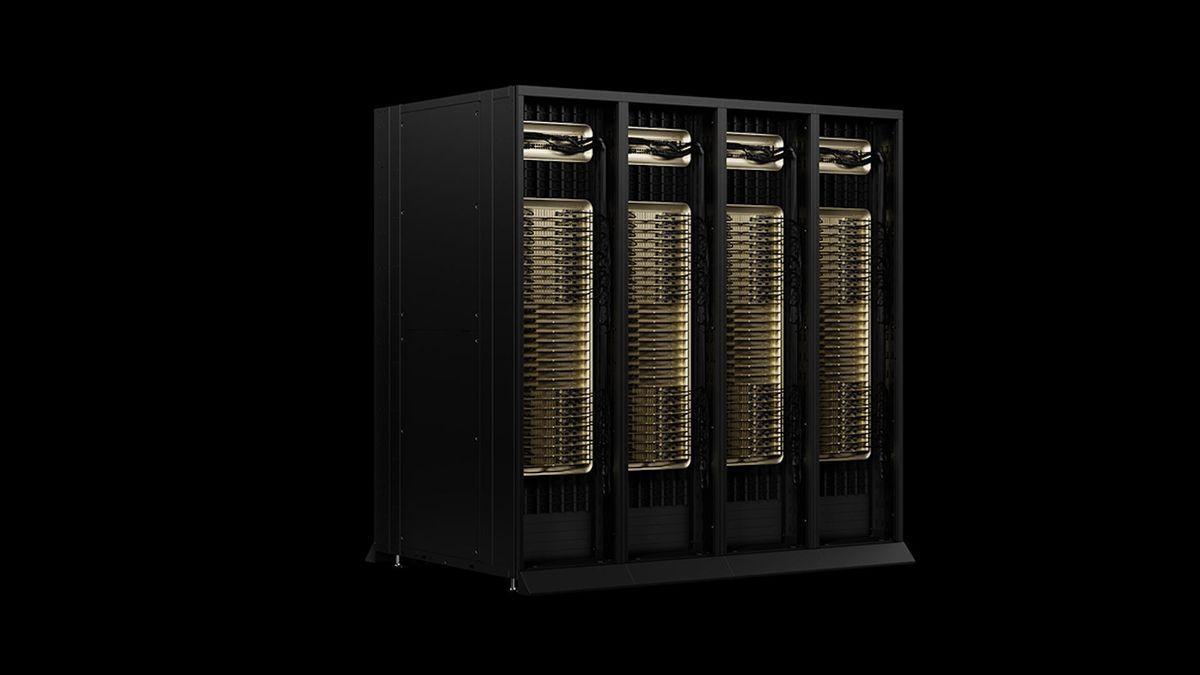
Nvidia B300 servers are now fetching approximately 7 million yuan, roughly $1 million per unit, in China, nearly double their US list price of around $550,000, according to industry sources
1
3
. This represents a dramatic escalation from approximately 4 million yuan late last year, reflecting a scarcity premium driven by tighter US export restrictions and the near-collapse of grey market chip smuggling channels that Chinese AI companies had relied upon1
.
Source: Benzinga
The B300, packed with 288 GB of high-bandwidth memory and delivering 14 petaFLOPS of computing power at FP4 precision, ranks among the most powerful options available for AI inference workloads
3
. Each server houses eight B300 GPUs and is critical for Chinese technology companies scrambling to monetize their AI models and compete on inference efficiency, the cost of generating tokens, the basic unit of AI text output1
.The inflection point in the price surge traces directly to the arrest of Yih-Shyan 'Wally' Liaw, co-founder of Supermicro, on March 19, 2026
1
. US federal prosecutors unsealed an indictment alleging that Liaw, Supermicro's Taiwan general manager Ruei-Tsang Chang, and contractor Ting-Wei Sun conspired to divert roughly $2.5 billion in Supermicro servers containing Nvidia's export-controlled Blackwell-class AI chips to Chinese buyers via a Southeast Asian pass-through company1
.The scheme involved swapping serial numbers using heat guns, fabricating paperwork, and using fake replica servers to deceive government auditors
1
. Supermicro's shares fell 33% on the day the indictment was unsealed, erasing more than $6 billion in market capitalization1
. This prosecution represents the highest-profile enforcement action yet under the AI chip export control regime the US has been tightening since 2022, and its effect on grey market supply appears to have been immediate1
.Rental prices for B300 servers in China have surged alongside sale prices, with short-term contracts reportedly reaching as high as 190,000 yuan per month on one-year contracts
1
3
. Many Chinese AI companies are deliberately structuring arrangements to avoid holding Nvidia hardware directly on their balance sheets, fearing exposure to US sanctions1
3
.The demand surge reflects explosive growth in Chinese AI usage. Chinese AI models accounted for 32% of global token usage in March 2026, up from 5% a year earlier, driven by advances in coding and agentic capabilities, according to Morgan Stanley
2
3
. MiniMax, Zhipu, and Alibaba's Qwen each reported token usage rising as much as six to seven-fold in February and March compared with December3
.The B300 scarcity compounds a separate restriction that hit Chinese AI companies in early 2025. On April 9, 2025, the US government informed Nvidia that it required a license to export its H20 chips, the China-specific GPU Nvidia had designed to comply with earlier export control rules, to the Chinese market
1
. Nvidia took a $4.5 billion charge in Q1 FY2026 on excess H20 inventory and purchase obligations, and was unable to ship an additional $2.5 billion of H20 revenue that quarter1
.The H20 had been Chinese companies' primary access point for compliant Nvidia GPU hardware; its restriction eliminated that option
1
. Despite receiving approvals from both governments for exports of H200 chips, the hardware has yet to be shipped to China as the two sides remain at odds over the conditions governing its sale3
.Related Stories

Nvidia has publicly distanced itself from the grey market supply chain, stating that the B300 is restricted from sale in China and that partners must comply strictly with export rules
1
2
. "As systems become increasingly large and complex, unlawful diversion is a recipe for failure," Nvidia warned, noting that diverted hardware will not receive company support3
.Source: Market Screener
The current price dynamic unfolds against an escalating policy backdrop. Last week, the US House Foreign Affairs Committee advanced the MATCH Act on April 22 in what lawmakers described as the largest semiconductor export control markup in congressional history
1
. The bill would require the Netherlands and Japan to align their own chip equipment restrictions with US rules, cutting off ASML's remaining China sales and banning the servicing of already-installed machines1
.Even with export restrictions, Nvidia still holds about 55% of China's AI chip market, a notable share given its top products technically aren't supposed to be sold there
2
3
. Advanced Micro Devices sits at just 4%, while Huawei Technologies and other domestic chipmakers are angling to use the disruption to chip away at Nvidia's lead2
3
.The combined effect of H20 chips being restricted, the B300 grey market being disrupted, and domestic Chinese AI accelerators not yet competitive with Nvidia's highest-end systems for frontier model training has produced the scarcity premium now reflected in advanced AI hardware pricing
1
. As AI compute scarcity intensifies and supply chains face mounting pressure from geopolitical tensions, Chinese tech companies face difficult choices between paying extreme premiums, accepting inferior domestic alternatives, or restructuring operations to work within tightening constraints.Summarized by
Navi
1
Health

2
Technology

3
Policy and Regulation