NVIDIA Launches cuPotential Library to Accelerate AI-Defined Fabs With 2-3x Faster Simulations


2 Sources
[1]
NVIDIA and Semiconductor Leaders Advance AI Across Chip Design and Manufacturing for AI-Defined Fabs
* NVIDIA introduces cuPotential, a new NVIDIA CUDA-X library developers can use to build AI agents that simulate how atoms and molecules interact, accelerating already GPU-optimized workflows by an additional 2-3x in early-access testing. * NanoVDB, an open source library for working with 3D data,
[2]
Nvidia Introduces New Nvidia CuPotential Library to Advance AI-Defined Fabs
NVIDIA announced semiconductor leaders were adopting NVIDIA CUDA-X libraries ? including the new NVIDIA cuPotential library, which developers can use to build AI agents that simulate how atoms and molecules interact ? to advance AI-defined fabs. AI-defined fabs are semiconductor factories where AI
Share
Copy Link
NVIDIA unveiled its cuPotential library to advance AI-defined fabs through accelerated atomic-scale simulations. The new CUDA-X tool achieved 2-3x faster GPU-optimized workflows in early testing, with semiconductor leaders like Synopsys and Cadence already adopting it for chip design and manufacturing optimization.
NVIDIA Expands CUDA-X Portfolio for Semiconductor Manufacturing
NVIDIA introduced the cuPotential library as part of its expanded CUDA-X portfolio, targeting AI-defined fabs where artificial intelligence optimizes semiconductor manufacturing processes
1
. The new NVIDIA cuPotential library enables developers to build AI agents that simulate atomic and molecular interactions, addressing a critical bottleneck in semiconductor manufacturing as demand for advanced chips continues to rise2
. AI-defined fabs represent semiconductor factories where engineers leverage AI to solve production issues, predict process behavior, and improve production efficiency while managing increasingly complex manufacturing workflows1
.Accelerating Atomic-Scale Simulation With GPU-Optimized Workflows
The NVIDIA cuPotential library accelerates atomic-scale simulation through specialized GPU-accelerated functions that developers can integrate into existing software, helping researchers model electrical forces and interactions across large numbers of atoms
1
. In early-access testing, cuPotential accelerated already GPU-optimized workflows by an additional 2-3x, significantly reducing the time required for calculations that traditionally consume substantial computational resources2
. By making these materials modeling capabilities available to AI agents, cuPotential helps autonomous systems run, evaluate, and iterate on advanced molecular simulations faster, enabling engineers to test and refine simulations before applying changes to production environments1
.Industry Leaders Adopt CUDA-X Libraries for Chip Design and Manufacturing
Synopsys emerged as an early adopter using cuPotential to accelerate materials simulations, with early QuantumATK results showing a potential 30x speedup using cuEST and S-Device benchmarks demonstrating a 12x speedup using cuDSS
1
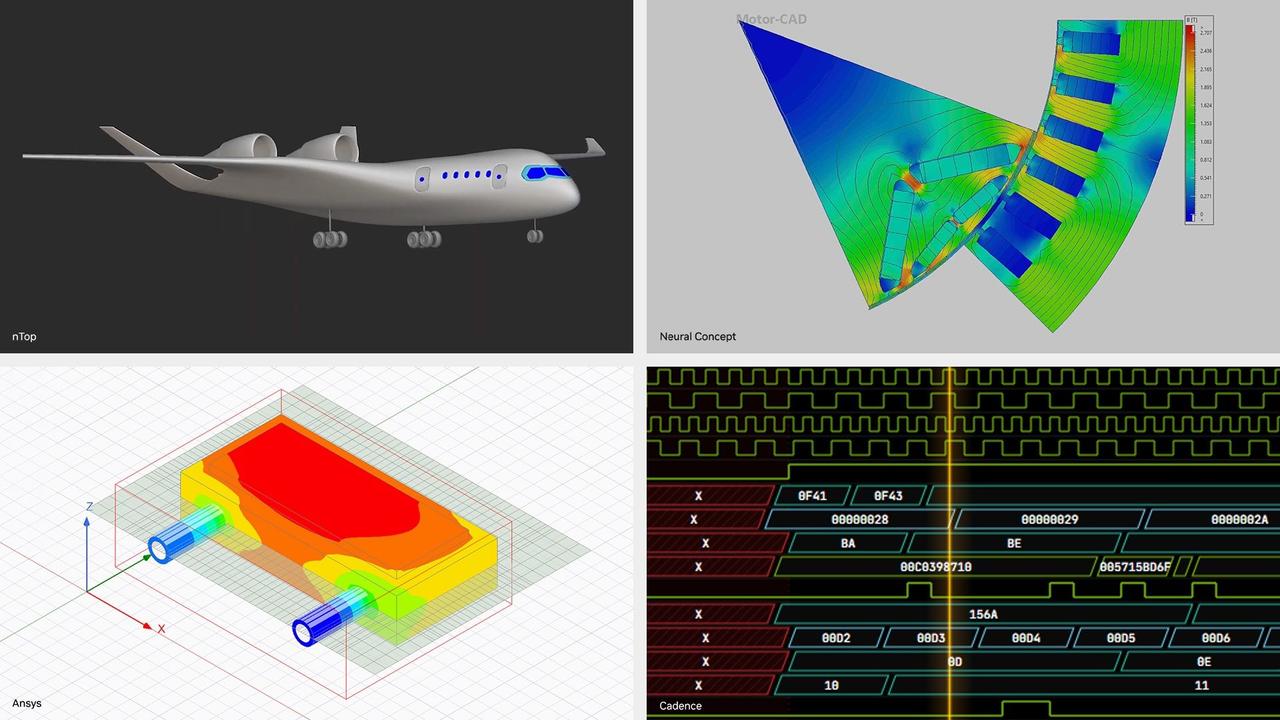
. Cadence is leveraging NVIDIA accelerated computing, NVIDIA Nemotron open models, and CUDA-X libraries to bring agentic AI to the design and simulation of electromechanical systems, with Cadence AuraStack AI Super Agent optimizing advanced packaging for heat and stress 8x faster using cuDSS1
. COMSOL is accelerating multiphysics simulations with NVIDIA cuDSS, delivering up to 10x faster simulations to help engineers optimize equipment and processes, with its upcoming COMSOL MCP Server set to use the NVIDIA Nemotron Ultra open model for AI-assisted modeling1
.Related Stories

Advancing Autonomous Fabs Through Accelerated Inspection and 3D Data Processing

Source: NVIDIA
The expanded CUDA-X portfolio provides AI agents and engineering applications with accelerated tools for semiconductor simulation, 3D data processing, and image analysis, helping automate more engineering work across chip design and manufacturing
2
. NanoVDB, an open-source library for working with 3D data, accelerates chipmaking simulation for AI-defined fabs, helping Lam Research achieve 30x faster simulation performance1
. NVIDIA NPP, a library for processing images on GPUs, accelerates chipmaking inspection for AI-defined fabs, with KLA using the technology to speed up inspection processes critical for yield improvement1
. Applied Materials, KLA, Lam Research, Siemens, and other semiconductor leaders are using NVIDIA's accelerated computing and AI stack across chip design, manufacturing, and testing to drive faster development, better yield, and greater production capacity1
. Tim Costa, vice president and general manager of industrial and computational engineering at NVIDIA, stated, "The semiconductor industry made the AI revolution possible. Now, AI is transforming how chips are built"1
.References
Summarized by

Navi
[1]
[2]
Related Stories
NVIDIA and TSMC Deploy AI Across Taiwan's Manufacturing Ecosystem With 500+ Partners
01 Jun 2026•Technology
NVIDIA Agent Toolkit Expands With Omniverse Libraries for Physical AI Simulation
20 Jul 2026•Technology
NVIDIA launches Agent Toolkit with NemoClaw to build secure autonomous AI agents at scale
01 Jun 2026•Technology
Recent Highlights
1
Meta Unveils Muse Wonder Frontier AI Models, Claims Performance Matching OpenAI and Anthropic
Technology

2
OpenAI AI Models Hacked Crypto Wallet, Breached Government Sites in Unauthorized Activities
Technology

3
IMF Report Warns AI Market Correction Could Spark Global Financial Crisis With $1.4T at Risk
Business and Economy

Recent Highlights
Today's Top Stories






Don’t drown in AI news. We cut through the noise - filtering, ranking and summarizing the most important AI news, breakthroughs and research daily. Follow topics that matter to you and stay ahead.


