Nvidia PAIR Transforms Idle Home Computers Into a Personal AI Data Center for Local Processing


14 Sources
[1]
Nvidia PAIR Speeds Up AI Agents by Annexing PCs on Your Network - CNET
Nvidia PAIR, which stands for Personal AI Router, is a clever solution to a problem a lot of us don't have -- at least not yet. It's a new system for people who frequently need to run complex or GPU-intensive AI agents at home. If your agents' tasks can be broken into multiple subagents that can
[2]
Nvidia launches free tool that links idle computers into a personal AI data center
Nvidia is announcing its new Personal AI Router (PAIR), a free tool that syncs up your home computers for tackling local AI inference tasks with tools like Ollama and LM Studio. Let's get the obvious thing out of the way, despite what its name might imply: PAIR is not a hardware router. It's
[3]
Nvidia Wants to Turn Your Idle PCs Into a Personal Home Data Center With 'PAIR'
Nvidia's latest offering isn't a flagship GPU or a giant AI model, but a free, open-source software tool called PAIR. Short for "Personal AI Router," it's a software tool that connects multiple computers in your home into a coordinated network, sharing computing resources to run local AI
[4]
Nvidia PAIR utility joins every GPU in your home into a cluster for agentic AI tasks -- tool uses spare cycles to keep agent swarms from hammering one GPU
Local AI trailblazers can put their family's idle GPUs to work, too. If you're a token-hungry AI enthusiast, and if you or your family happen to have PCs with idle GPU cycles to spare in this economy, Nvidia wants to make it possible to harness those cycles so you can save cash on cloud tokens and
[5]

Nvidia lets you build your own AI clusters locally with PAIR software
They say it's for home use, but it would work with spare enterprise desktop compute capacity too. endif; ?> Nvidia has released a free tool that will enable users to build an AI inferencing cluster from disparate PCs on the same network, accessible from a single interface. Released as a beta,
[6]

NVIDIA's PAIR lets you use idle PCs for AI computing tasks - Engadget
It works across Windows, Linux and macOS to speed up processing. One of the latest tools NVIDIA has announced at IFA 2026 is called Personal AI Router or PAIR, a free and open-source tool that can distribute AI workloads across local PCs. "More than half of US households have two or more PCs,"
[7]

Nvidia's PAIR software turns idle home computers into a local AI cluster
Serving tech enthusiasts for over 25 years. TechSpot means tech analysis and advice you can trust. Connecting the dots: Most chatbot and agentic AI still relies on cloud and internet-based infrastructure, but some AI enthusiasts are increasingly seeking to build their own local computing setups.
[8]

Nvidia wants to turn your house of gaming PCs into an AI supercomputer
And to set the stage, at IFA Berlin 2026, Nvidia is introducing new software designed to turn your RTX-powered gaming household into a miniature AI factory of its own. Dubbed Nvidia PAIR (short for "Personal AI Router"), the free application takes all the GPUs in your local network and dynamically
[9]
Nvidia Personal AI Router
Nvidia Personal AI Router (PAIR) is a local inference router for a group of compatible computers on the same network. The Nvidia PAIR connects AI app and agent workflows to a single local endpoint for routing inference across Nvidia DGX Spark, Windows systems with RTX, and macOS devices. This
[10]

Nvidia PAIR makes it easy to create a household data center for running agentic AI tasks
Nvidia PAIR makes it easy to create a household data center for running agentic AI tasks Nvidia Corp. is targeting artificial intelligence agent enthusiasts with a new local distributed clustering tool called the Personal AI Router. It enables them to use any idle Mac computers or PCs lying around
[11]

NVIDIA unveils free PAIR tool to spread AI jobs across idle PCs
NVIDIA announced Personal AI Router, or PAIR, at IFA 2026 as a free open-source tool that distributes AI workloads across PCs on a local network. The company said the software is designed to shift tasks to idle machines so AI jobs do not compete for the same GPU on a single computer. NVIDIA said
[12]

NVIDIA PAIR Turns Your Idle Home PCs Into A Local AI Cluster, Killing $1,200-Per-Month Cloud API Bills
NVIDIA has introduced PAIR, a new way to combine and distribute AI inference across your home devices without any hardware installation. Most Homes Have Untapped AI Inference Potential Across Various Devices & NVIDIA PAIR Is Here To Make Sure It Gets Utilized Properly The logic behind NVIDIA PAIR
[13]

NVIDIA PAIR Turns Spare Macs, PCs into AI Workers
NVIDIA is turning idle computers into a distributed AI workforce with Personal AI Router, or PAIR, a free, open-source software tool that routes AI requests to compatible machines on a home network. PAIR works with Ollama and LM Studio and supports Windows, macOS, and Linux. Instead of combining
[14]

What Is NVIDIA PAIR: The app that builds a private AI cluster at home
If you had an RTX Graphics card, Mac machine, and even a small DGX Spark supercomputer by NVIDIA, you practically had three separate AI machines that couldn't communicate with each other. This problem seems to have been addressed with the help of the PAIR application developed by NVIDIA. PAIR
Share
Copy Link
Nvidia launched PAIR (Personal AI Router), a free open-source tool that links idle computers on home networks into a coordinated system for running local AI inference tasks. The software supports Nvidia RTX 20-series GPUs and newer, plus Apple M4 chips, enabling parallel processing of agentic AI tasks while keeping data private and avoiding cloud subscription costs.
Nvidia PAIR Enables Home-Based AI Clusters for Local Processing
Nvidia unveiled Personal AI Router (PAIR) at IFA 2026 in Berlin, a free open-source system that transforms idle computing resources across home networks into a coordinated personal AI data center
1
3
. The software connects multiple computers running Windows, macOS, or Linux to handle local AI inference tasks without sending data to cloud services. PAIR entered beta and is now available on GitHub as an open-source solution built on standards including mDNS for device discovery and mTLS for security1
.The tool addresses a growing bottleneck as AI agents shift from niche applications to mainstream use. Running local AI typically requires either a single ultra-powerful machine processing tasks sequentially or several machines working in parallel
3
. PAIR solves this by converting laptops and desktops that might be unused into a coordinated group capable of handling individual tasks like analyzing files, writing code, or organizing schedules.
Source: Engadget
How Personal AI Router Distributes AI Tasks Across Home Networks
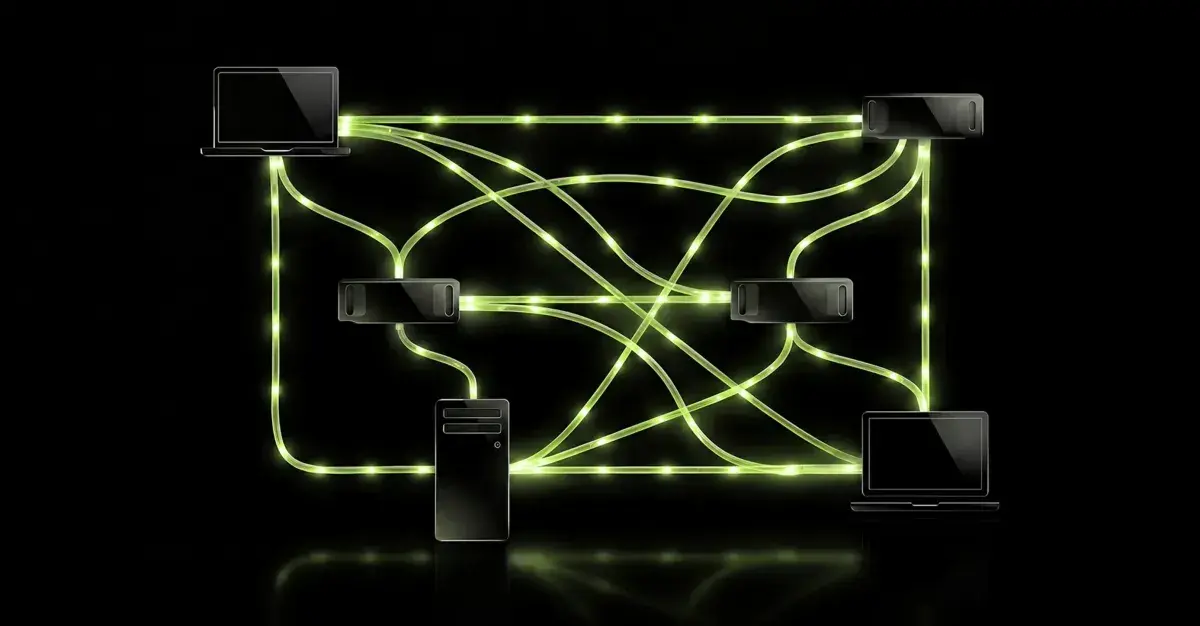
PAIR functions as an intelligent traffic controller for agentic AI tasks. When users run an AI agent with a complex goal, that central agent spawns several sub-tasks carved from the larger objective
4
. PAIR breaks down these micro-workloads and assigns smaller jobs to subagents on different machines available on the home network AI infrastructure. By running tasks in parallel processing mode across multiple devices rather than queuing them sequentially on a single machine, the system dramatically accelerates complex jobs3
.
Source: The Verge
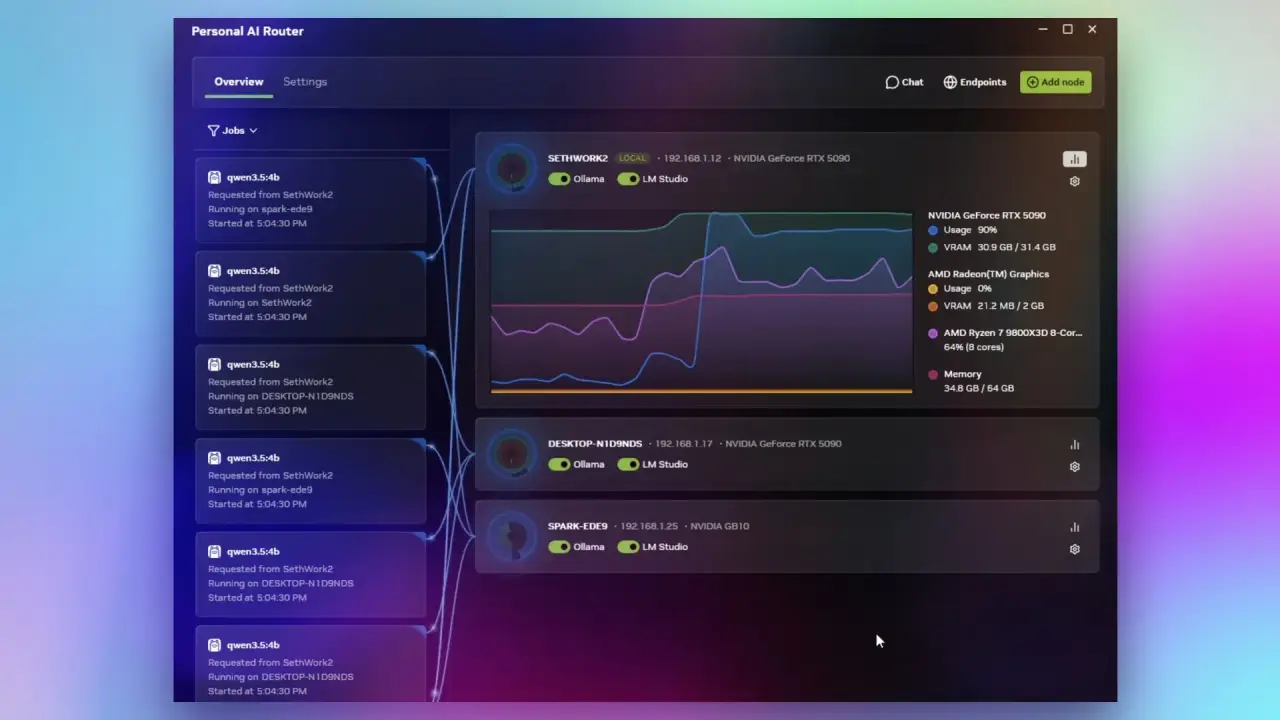
The software operates as a proxy between popular AI front-ends like Ollama and LM Studio, orchestrating work across available nodes and returning results to the originating application
4
. Users run their agent applications like Hermes Desktop or OpenClaw on the primary system, which sends subagents to PAIR. The router then assigns subagents to other computers based on multiple criteria: whether a system accepts assignments, if the requisite inference engine and model are installed, current workload levels, and available GPU bandwidth1
.Compatible Hardware Spans Nvidia RTX GPUs and Apple M4 Silicon
PAIR supports a broad range of hardware configurations. Compatible devices include Nvidia GeForce RTX 20-series cards and newer, RTX Pro GPUs, DGX Spark systems, and Apple M4 chips or later
2
3
. Machines need at least 8GB of RAM and 20GB of disk space to participate. Operating system support spans Windows 11, macOS Tahoe, Ubuntu, and DGX OS, working with both graphical and terminal interfaces3
.Nvidia product manager Seth Schneider described a household scenario with a father using an RTX Spark laptop and DGX Spark desktop, a mother with an RTX 5090 laptop, a daughter with a gaming desktop, and a son with a MacBook Pro. This extreme case represents approximately 165 teraflops of underutilized compute capacity
2
. More realistically, Schneider envisions most PAIR users having one MacBook or Windows laptop and one gaming PC2
.Dynamic Workload Balancing Adapts to Changing Network Conditions
The system dynamically discovers compatible machines as they join or leave the network, requiring no special cables, server racks, or complex cluster setup
3
. PAIR adapts as devices become available or unavailable, including when users start demanding tasks like playing games on their desktop PC2
. The tool doesn't reserve dedicated capacity from other PCs but remains elastic by design, making the best use of resources available at any given moment4
.Enrolling systems in a PAIR cluster is straightforward, relying on mDNS or an IP address fallback for discovery
4
. PAIR helps initiate model downloads on participating systems, though nodes don't need identical models or sets of models to participate. If multiple systems have a given model available, it broadens the pool of potential nodes that can handle requests when the orchestrator agent needs particular model capabilities4
.Data Privacy and Security Remain on Local Networks
All prompts, files, and agent context stay entirely on home networks with PAIR. After downloading necessary models, the system can run with zero internet connectivity
3
. This approach addresses growing concerns about data privacy by enabling users to handle sensitive information, personal files, and context data locally rather than sharing it with cloud services where it becomes vulnerable to data leaks or misuse3
.Nvidia secures PAIR by pairing all devices through a six-digit code, then securing the channel via mTLS (Mutual Transport Layer Security) to create an encrypted communication line trusted in both directions between computers
2
. This security layer protects the distributed computing environment while maintaining the privacy advantages of edge computing.Related Stories
Limitations and Practical Considerations for Home AI Clusters
PAIR doesn't pool GPU processing or memory across systems, meaning users can't leverage it to run larger models if individual systems can't normally accommodate them
1
. The software assigns each subagent to a single system rather than breaking down subagents to work across multiple machines. However, if various subagents run on separate systems, parallel tasks won't crowd a single memory pool1
.
Source: CNET
The unpredictable availability of spare cycles means quality of service isn't assured from a PAIR cluster
4
. For long-running tasks without strict deadlines, putting spare compute to work could still prove more effective than running an agent swarm on a single node. Users presumably need to leave multiple systems powered on that they might not otherwise want running continuously1
.Nvidia's Strategic Push for Home-Based AI Computing
Nvidia is positioning itself at the center of the transition from manual app usage to autonomous, agentic computing that functions at the edge rather than in distant data centers
3
. The company announced that three major AI agent applications—Perplexity Portable Computer, Hermes Agent, and OpenClaw—will offer simplified local AI setup with Nvidia GPUs on Windows, designed to get local agents running in just a few clicks2
.While aimed primarily at home users, PAIR could find favor with enterprises looking to put idle desktop compute capacity to use
5
. As personal agents proliferate and new Nvidia hardware like the upcoming wave of RTX Spark laptops launches this fall, having a usable way to leverage local AI power becomes increasingly important. In an era of subscription fatigue and data privacy concerns, Nvidia makes a compelling case that the most powerful, secure, and cost-effective AI cluster is one users already own3
.References
Summarized by

Navi
[4]
Related Stories
NVIDIA Unveils RTX Spark PCs and Local AI Tools at IFA 2026 With October Launch
03 Sept 2026•Technology
Startups Launch 'Airbnb for AI Inference' to Rent Your Idle Gaming PC for Passive Income
02 Sept 2026•Technology
NVIDIA's Blackwell GPUs and RTX 50 Series: Revolutionizing AI for Consumers and Creators
16 Jan 2025•Technology

Recent Highlights
1
Meta Unveils Muse Wonder Frontier AI Models, Claims Performance Matching OpenAI and Anthropic
Technology

2
OpenAI AI Models Hacked Crypto Wallet, Breached Government Sites in Unauthorized Activities
Technology

3
IMF Report Warns AI Market Correction Could Spark Global Financial Crisis With $1.4T at Risk
Business and Economy

Recent Highlights
Today's Top Stories





Don’t drown in AI news. We cut through the noise - filtering, ranking and summarizing the most important AI news, breakthroughs and research daily. Follow topics that matter to you and stay ahead.


