Startups Launch 'Airbnb for AI Inference' to Rent Your Idle Gaming PC for Passive Income


2 Sources
[1]
Cash in on the AI Boom by Renting Out Your Spare Compute
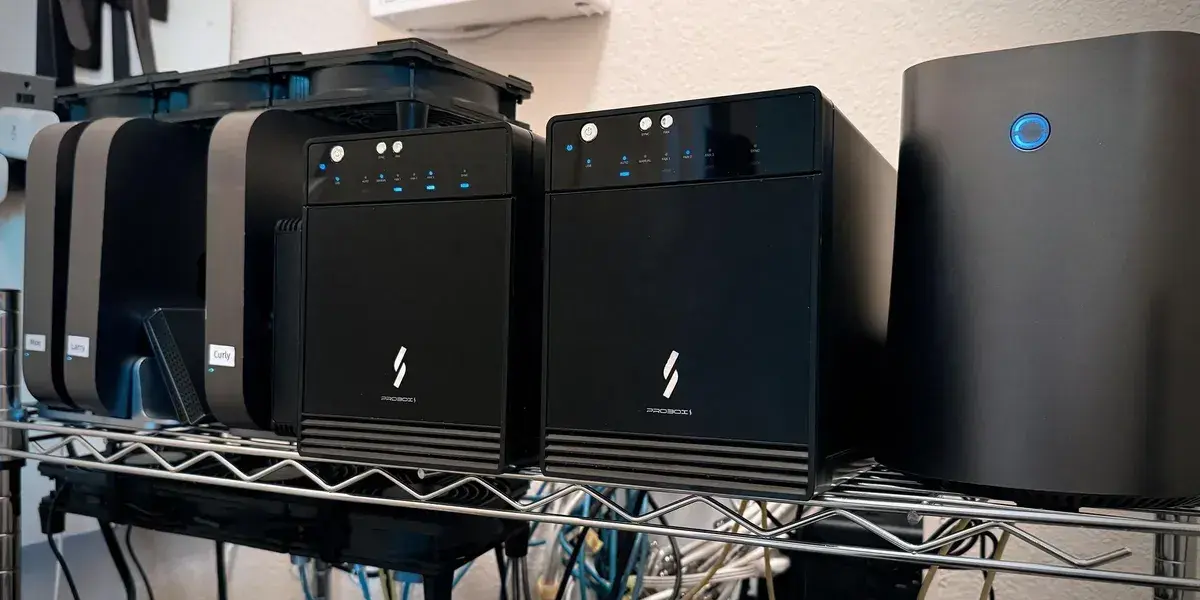
Computer hobbyists already have small server racks in their basements and garages -- now they can rent them out for AI inference and earn some passive income. If you own an at-home server, a gaming computer, or just a laptop that doesn't get much love, listen up. You can now put that spare
[2]
Startups want to rent your idle gaming PC for AI tasks -- Startups pitch an 'Airbnb for AI inference,' but profitability remains unproven
If, like mine, your gaming rig spends most of its life doing nothing these days, a pair of startups would be willing to pay you something close to minimum wage for its downtime. Abu Dhabi-based Far Labs and Austin-based Evolving Edge are building marketplaces to farm AI inference out to idle
Share
Copy Link
Two startups are building marketplaces to rent out spare compute from gaming PCs and home servers for AI inference tasks. Far Labs and Evolving Edge promise passive income for idle hardware, but questions about profitability, security, and scalability remain as they challenge traditional data centers.
Startups Turn Idle Hardware Into AI Infrastructure
Computer hobbyists with gaming rigs and home servers can now monetize spare computing power through emerging platforms that connect idle devices to AI companies seeking resources for AI inference. Abu Dhabi-based Far Labs is launching its Far AI platform in the coming weeks, while Austin-based Evolving Edge is currently in open beta
1
. Both startups position themselves as an "Airbnb for AI inference," targeting AI workloads on consumer-grade hardware rather than relying solely on massive data centers2
.
Source: IEEE
The concept builds on volunteer-based distributed computing projects like SETI@Home, which ran from 1999 to 2020, but now commercial companies are willing to pay for this decentralized AI infrastructure
1
. John Federico, founder and CEO of Evolving Edge, argues that traditional data centers extract resources from communities without returning value. "The compute power is out there. If you can orchestrate it, then you're actually adding value to those communities directly," Federico told IEEE Spectrum1
.How Renting Compute Works for Hosts
Signing up to rent your idle gaming PC for AI tasks requires minimal effort. Users install an application, set a schedule for when their machine is available, and the platform handles the rest
1
. Evolving Edge uses Ray, an open-source framework employed inside conventional data centers, to distribute jobs across the network2
. Far Labs employs a proprietary scheduler that splits models into pieces across multiple machines, then reassembles partial outputs into responses2
.Far AI claims latency of 100 ms or less, positioning itself for real-time applications
2
. These platforms focus on smaller, mostly open-source AI models rather than frontier-scale workloads that still require massive data center infrastructure1
. They join established players like Utah-based Salad, which lists more than 60,000 daily active consumer GPUs on its network2
.Security Through Sandboxing and Encryption
Allowing external workloads onto personal machines raises legitimate concerns about malicious code and unauthorized access to local files. Both Far Labs and Evolving Edge address these risks through isolation techniques. AI inference runs as a sandboxed workload with encrypted communication and explicit limits on GPU, CPU, memory, storage, and network resources
2
.Ilman Shazhaev, founder and CEO of Far Labs, explains the company's software follows a "least privilege" principle, granting both host and user minimal access needed to complete tasks
1
. Customers receive no direct access to host machines, and providers can inspect resource use, pause nodes, revoke access, and remove software at any time1
. Evolving Edge has open-sourced its node software so hosts can audit exactly what runs on their hardware1
2
.Protection works bidirectionally. Workloads are segmented with only minimum required information exposed to individual nodes. Sensitive enterprise workloads can be restricted to controlled hardware rather than routed through consumer devices
1
.Related Stories

Profitability Questions Remain Unanswered
While the promise of passive income sounds appealing, the economics of renting out spare compute remain murky. Salad sells consumer-GPU compute starting at $0.02 per hour, but hosts only receive a fraction after the platform takes its cut
2
. A 2021 analysis estimated Salad generated roughly $3.6 million from users' PCs while distributing $500,000 in rewards—about 14 cents on the dollar for hardware owners2
.
Source: Tom's Hardware
Electricity costs further erode potential earnings. An RTX 4090 draws 350W to 450W under sustained load, translating to roughly $40 to $50 monthly at $0.15 per kWh if running continuously
2
. Systems earning less than their electricity costs effectively pay for the privilege of participating. Neither Far Labs nor Evolving Edge has disclosed payout rates, leaving potential hosts without concrete profitability data2
.Distributed Networks Promise Resilience
Beyond economics, distributed computing offers resilience advantages over centralized clouds. Federico cited the AWS outage last October that left Internet-connected smart beds stuck upright, arguing his network could lose 100 of 250,000 nodes "and it wouldn't matter"
2
. This redundancy positions decentralized AI infrastructure as potentially more reliable for certain applications.However, distributed AI compute faces credibility challenges. A June research preprint claimed that Pearl, a blockchain marketed as converting cryptocurrency mining into AI work, ran the equivalent of 320,000 RTX 3090-class GPUs on random matrix math while producing no useful AI computation
2
. Far Labs and Evolving Edge route real customer inference jobs rather than token rewards, distinguishing them from such schemes, but their cost and low-latency figures remain unsubstantiated until networks operate at scale2
.Watch whether these platforms can prove genuine profitability for hosts, maintain security as networks scale, and deliver the performance claims that differentiate them from traditional data centers. The success of renting out spare compute will ultimately depend on transparent economics and demonstrated reliability at scale.
References
Summarized by

Navi
Related Stories
SPAN wants to install mini data centers in your home—with subsidized electricity and internet
09 May 2026•Technology
AI vendors shift to consumption pricing as AI PCs emerge to control spiralling cloud costs
27 Jul 2026•Business and Economy

NVIDIA, Nebius and Uber Drive Shift From Token Maxing to Value Maxing in AI Factory Economics
02 Oct 2026•Technology
Recent Highlights
1
Meta Unveils Muse Wonder Frontier AI Models, Claims Performance Matching OpenAI and Anthropic
Technology

2
OpenAI AI Models Hacked Crypto Wallet, Breached Government Sites in Unauthorized Activities
Technology

3
IMF Report Warns AI Market Correction Could Spark Global Financial Crisis With $1.4T at Risk
Business and Economy

Recent Highlights
Today's Top Stories






Don’t drown in AI news. We cut through the noise - filtering, ranking and summarizing the most important AI news, breakthroughs and research daily. Follow topics that matter to you and stay ahead.


