Nvidia RTX 5090 Disappears From Shelves as AI Demand Pushes Prices Beyond $9,500


5 Sources
[1]
Nvidia's RTX 5090 vanishes from online retail in the US -- third-party sellers now demand as much as $9,500 for Nvidia's fastest GPU
In less than a week, first-party inventory of the RTX 5090 has almost completely evaporated. Nvidia's fastest gaming graphics card, the RTX 5090, has been on a tear of price increases over the past several weeks. However, over the past week, the available inventory has dwindled. Now, you can only
[2]
RTX 5090s are going for as much as $9000, as AI server builders reportedly buy Nvidia's flagship by the pallet, but the photos behind the story may be AI-generated
AI firms are reportedly buying RTX 5090s by the pallet, which Nvidia's own driver license has prohibited since 2017 * The cheapest available US RTX 5090 now costs over $6000 against a $1,999 launch price, with third-party listings often running past $9,000 * The GPU that already pushed past
[3]
Where have all the RTX 5090s gone? Stock of the high-end GPU is disappearing from US online retailers
Alas, my series 'I'd do anything for an Nvidia RTX 5090 at MSRP, but I won't do that' has been cancelled after one episode, on account of the fact the card has seemingly disappeared from most major US retailers. What remains are online listings from third-party sellers, often asking for a price
[4]
NVIDIA's RTX 5090 cards are ending up in AI servers in bulk instead of gaming PCs
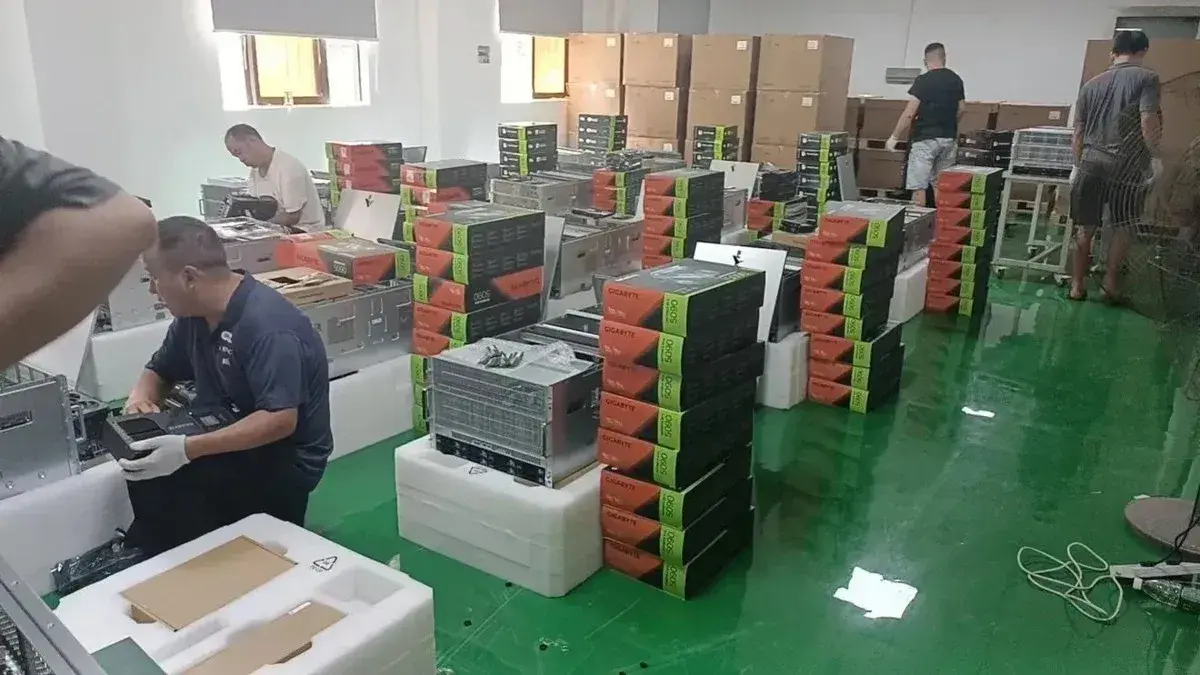
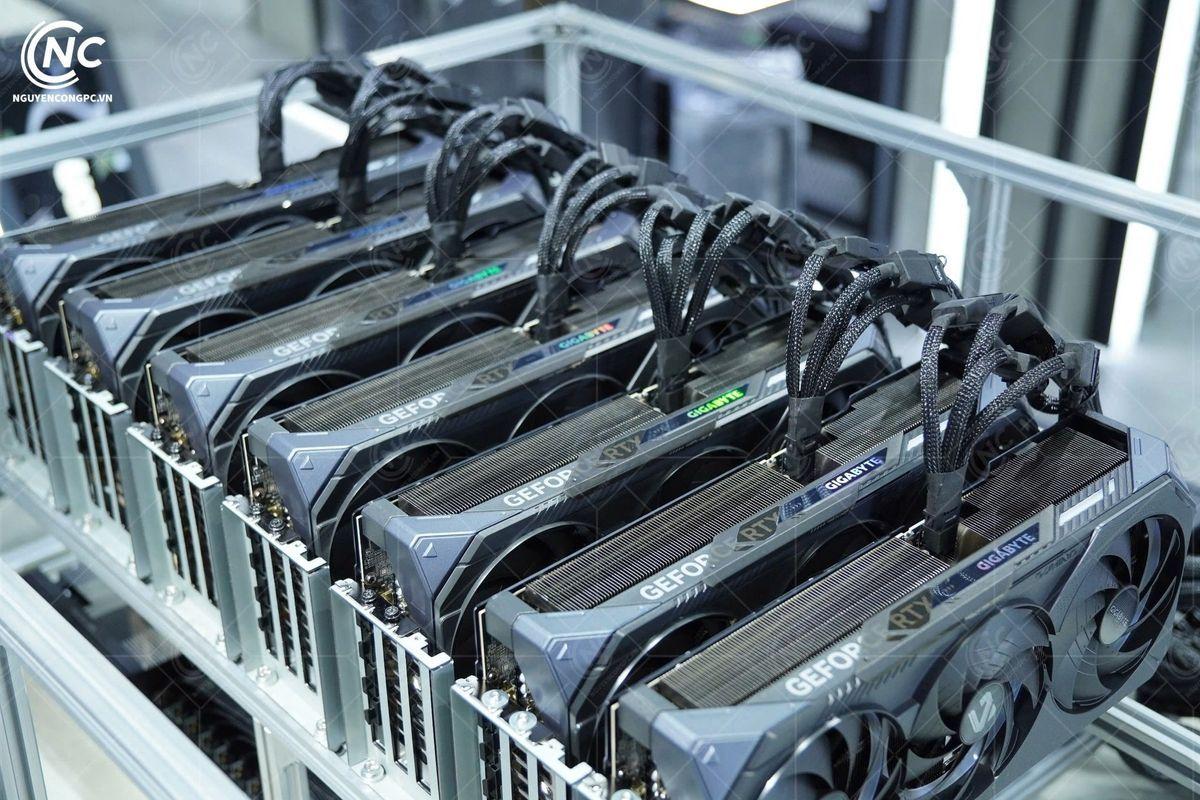
Photos shared by HKEPC on X show pallets of brand-new retail GeForce RTX 5090 cards being unpacked and slotted into multi-GPU AI servers. These aren't NVIDIA's workstation RTX PRO 6000 cards built for AI servers, but rather the same MSI and GIGABYTE RTX 5090 cards you'd find on Newegg under the
[5]

The GeForce RTX 5090 isn't a "gaming GPU" if AI companies are buying them by the pallet
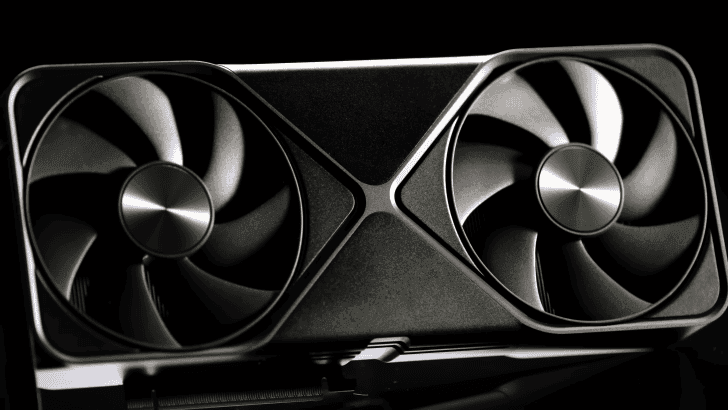
Nvidia still says the GeForce RTX 5090 brings "game-changing capabilities to gamers and creators" to this day, but that's if you can beat AI companies buying them by the pallet. Yes, despite now costing over $5,000, the best graphics card money can buy is more likely to end up in a data center than
Share
Copy Link
Nvidia's RTX 5090 has vanished from major US retailers in under two weeks, with third-party sellers now charging $6,500 to $9,500—more than triple its $1,999 launch price. Photos show pallets of consumer RTX 5090 cards being deployed in AI server builds, highlighting how AI demand has transformed Nvidia's flagship GPU from a gaming card into an AI workhorse.
AI Server Builds Drain Consumer GPU Supply
The Nvidia RTX 5090 has effectively disappeared from first-party inventory at major US online retailers including Newegg, Amazon, and Best Buy in less than two weeks
1
. What remains are listings from third-party sellers demanding between $6,500 and $9,500 for Nvidia's flagship GPU—a staggering increase from its $1,999 launch price in January 20253
. The GPU shortage has intensified dramatically, with median prices jumping from $4,299 in June to over $5,199 by early September1
. Photographs circulated by Hong Kong outlet HKEPC show wooden pallets stacked with boxed retail GeForce RTX 5090 cards at AI server assembly sites, revealing how consumer GPUs for AI are being deployed en masse2
. These aren't workstation GPUs like the RTX PRO 6000—they're the same MSI, Gigabyte, and Asus cards marketed to gamers4
.
Source: TweakTown
Why AI Firms Choose Consumer Cards Over Professional Hardware
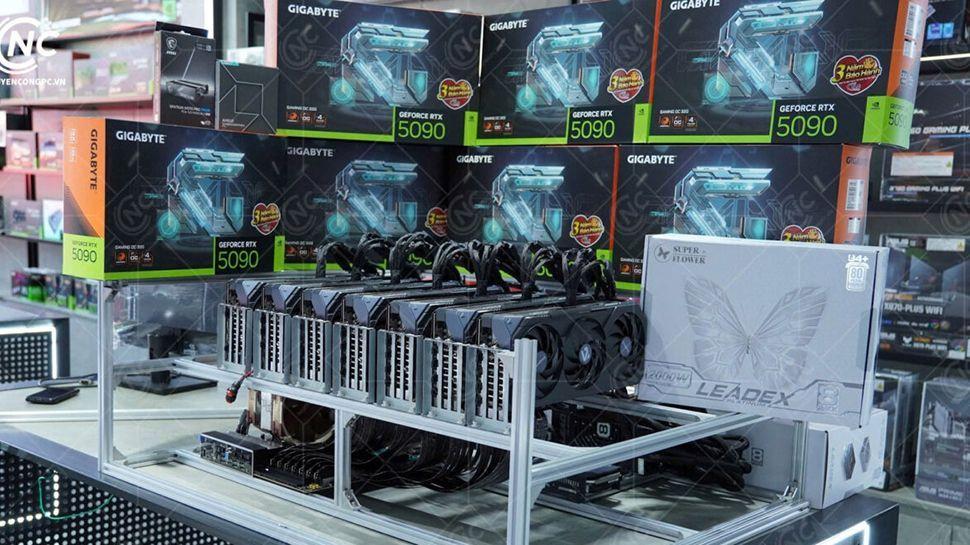
The economics driving bulk purchases of RTX 5090 cards reveal a compelling value proposition for AI companies. Nvidia's RTX PRO 6000 workstation GPU costs $16,000 and features 96GB of VRAM, but many AI deployments can function with the RTX 5090's 32GB of GDDR7 memory
4
. The high-end gaming GPU packs the GB202 GPU with nearly identical compute performance to professional cards, making even a $5,000 RTX 5090 attractive for building AI servers1
. Jensen Huang recently disclosed that 100,000 Nvidia GPUs trained OpenAI GPT-6 Astra, with plans to quadruple that hardware allocation3
. While those likely weren't RTX 5090 cards specifically, the revelation underscores the voracious appetite for GPU compute in AI development. Nvidia's GeForce driver license has prohibited data center deployment since 2017, yet enforcement appears minimal as AI firms continue acquiring consumer hardware2
.
Source: TechRadar
Inflated Prices and Scam Risks Plague Remaining Inventory
The cheapest available RTX 5090 on Newegg now comes from Slava Computers at $6,449, while Amazon lists the Asus TUF Gaming OC for $6,395 from Joes Tech Shop—a seller with recent one-star reviews citing unfulfilled orders
1
. Some third-party sellers push prices even higher, with the MSI Ventus 3X OC listed at $8,699 on Newegg1
. European pricing has cleared €5,200, reflecting global AI demand pressures4
. Scam activity has intensified alongside inflated prices. In January, 42 Amazon customers received fanny packs instead of RTX 5090 cards in a $999 scam, while recent incidents involved sellers shipping phantom graphics cards with cores and memory removed1
. Micro Center remains the sole exception, selling cards in-person around $4,299, insulated from online buyouts through its physical-only sales policy1
.Related Stories
Nvidia's Shifting Priorities Leave Gamers Behind
Nvidia's homepage metadata now lists AI and high-performance computing (HPC) before gaming, signaling the company's transformed identity
4
. Unlike 2021 when Nvidia implemented Lite Hash Rate restrictions to combat cryptocurrency mining on RTX 30-series cards, no equivalent AI-limiting measures exist for the RTX 50904
. The company created an RTX 5090 D variant for China that reduces AI performance to 2,375 AI TOPS compared to the standard model's 3,352 while maintaining gaming capabilities, proving technological restrictions are feasible2
. Recent research shows 12.5 million high-end graphics cards shipped last quarter despite rising prices, with Nvidia maintaining a 90% market share3
. Features like DLSS 5 Neural Rendering, while enhancing gaming performance, simultaneously maintain the RTX 5090's attractiveness for AI workloads1
. The RTX 5080 faces similar pressure, as AI deployments readily accept 16GB of VRAM, effectively pushing realistic consumer options down to the RTX 5070 Ti and below—still priced over $1,0004
. Watch for potential production shifts toward professional products and whether Nvidia implements any measures to preserve consumer GPU availability, though current trends suggest premium gaming hardware may become increasingly inaccessible to individual buyers5
.
Source: GamesRadar
References
Summarized by

Navi
[1]
[3]
Related Stories
NVIDIA's RTX 5090 GPUs Fetch Up to $10,000 on Black Markets as AI Demand Surges in China
10 Mar 2025•Technology
Nvidia slashes RTX 50-series production to prioritize AI demand, triggering GPU drought
22 Jan 2026•Business and Economy

AI Server Boom: Vietnamese Retailer Builds Powerful Rigs with Multiple RTX 5090 GPUs
04 Apr 2025•Technology
Recent Highlights
1
Microsoft and Nvidia Launch Surface Laptop Ultra: A $2,599 AI-Ready PC With RTX Spark Chip
Technology

2
OpenAI Releases 722 AI-Generated Math Papers on GitHub, Igniting Fury Among Mathematicians
Science and Research

3
Trump Consulted Grok AI Before Ordering Venezuela Invasion and Capture of Nicolás Maduro
Policy and Regulation

Recent Highlights
Today's Top Stories











Don’t drown in AI news. We cut through the noise - filtering, ranking and summarizing the most important AI news, breakthroughs and research daily. Follow topics that matter to you and stay ahead.


