18 Sources
[1]
Jensen Huang says 'every edge device will become autonomous' -- Nvidia maps one computing pattern from the cloud to robotics
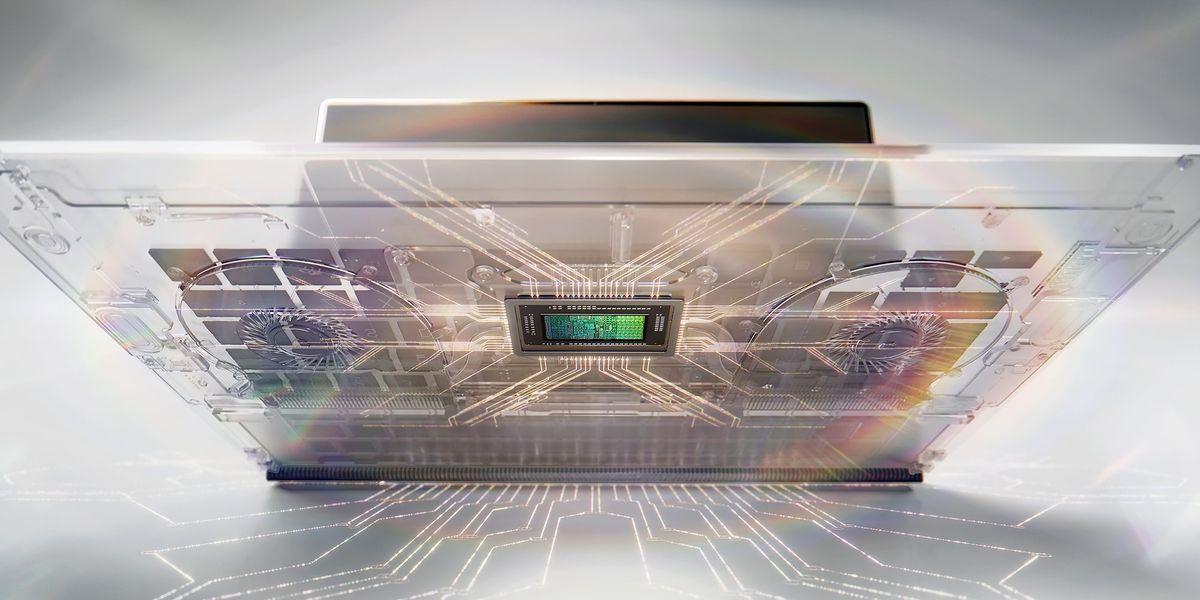
At Computex, the Nvidia CEO tied the cloud, the PC, the car, and the humanoid to one agentic blueprint. When not being spotted at night markets or meeting crowds of adoring fans, the hardware industry's biggest celebrity, Nvidia CEO Jensen Huang, spent most of his time at Computex this week making the case that computing as we know it is collapsing into one repeatable pattern built for AI agents; a blueprint that now runs across the cloud, the PC, the car, and the robot. "There's a new computing pattern," the Nvidia CEO told reporters at a press gaggle the day after his GTC Taipei keynote, describing an agent architecture he calls a harness that orchestrates reasoning, memory, and tool use the same way whether it sits in a data center or a laptop. He tied that claim to every product Nvidia detailed at the show, from the Vera data-center CPU now in full production to RTX Spark, its first Windows PC platform, shipping in laptops this fall. One pattern, every machine Huang told the room that he repeats the same keynote structure on purpose. "Every time I give you a keynote, it's like Top Gun 17, and it's exactly the same architecture," he said, "because I want you to know that the future of computing is this." The pattern begins with training and inference in the cloud and pushes outward to everything else: "Every edge device will become autonomous. Every edge device will have agentic systems." He ran that blueprint through self-driving cars, humanoid robots, Nokia base stations, and imaging satellites, casting each as the same agent profile on different hardware. Curiously, the self-driving car got quite a bit of airtime, with Huang describing Nvidia's Alpamayo driving stack as a system that reasons in language rather than reacting to images, one that could read a "skill file" and watch a tutorial video to operate unfamiliar machinery the way a person would. "That's how autonomous vehicles are going to work in the future," he said. "It's essentially that agentic computing pattern with a physical AI model." A CPU that generates tokens, not cores Vera, on the data center side, is an 88-core Arm processor that Nvidia is now in full production with, pitching it as a chip built for agents rather than human users. "We built Vera for agents to use," Huang said. "Until six months ago, there were no agents, so that's the definition of a $0 billion market." A hyperscale CPU piles on cores because humans lease them by the hundred, where an agent, Huang argued, "doesn't want to rent the CPU core, the agent wants to generate tokens." That pushed Nvidia toward single-thread speed and memory bandwidth over core count, and Huang claimed Vera offers the largest step up in single-threaded performance he has seen "in 25 years." His reasoning ties back to latency: "Humans are more patient than agents. Agents, they're working at nanosecond scale, not second scale." Nvidia claims 1.8 times faster task completion than x86 and a 1.5 times instructions-per-clock gain over its Grace predecessor, with a 256-chip liquid-cooled Vera rack it says reaches six times the throughput of a conventional CPU rack. The chip ships on the back of nearly 2.5 million Grace units sold, and Anthropic, OpenAI, xAI, ByteDance, CoreWeave, and Oracle are named as early customers. CFO Colette Kress told investors on Nvidia's latest earnings call that the company sees "nearly $20 billion in total CPU revenue this year". Phoronix's first public Vera benchmarks in May measured it roughly 10% ahead of AMD's 64-core EPYC 9575F and about 55% ahead of Intel's 128-core Xeon 6980P across selected Linux workloads. Nvidia ran those tests on pre-production silicon at its own headquarters, limited them to workloads it considers relevant, and, by Phoronix's account, switched off CPU power and frequency monitoring for the session. Reinventing the PC after 40 years As for RTX Spark, Huang says that it's the first real rethink of the PC in four decades. "We have an opportunity after 40 years to go reinvent it for the age of AI," he said, predicting the machine shifts "from your PC being a tool to now really your PC being your system." He pushed even further: "Your laptop is going to be your R2-D2." The top RTX Spark part, internally N1X, pairs a 20-core Arm CPU built by MediaTek (10 Cortex-X925 performance cores and 10 Cortex-A725 efficiency cores) with a Blackwell GPU carrying 6,144 CUDA cores, up to 128GB of LPDDR5X unified memory, and a 600 GB/s NVLink-C2C link, all on TSMC's 3nm node. Huang justified these specs with the same impatience he applied to Vera, arguing that an agent driving the machine won't wait, so the software it touches, from Adobe to Blender, "cannot be slow." The platform is launching in a market that Qualcomm had effectively dominated until its Windows on Arm exclusivity with Microsoft lapsed. Fall 2026 laptops are confirmed from Microsoft, Dell, HP, ASUS, Lenovo, and MSI, with Acer and Gigabyte to follow, and Nvidia says anti-cheat engines, including Easy Anti-Cheat and Denuvo, run natively on the chip. Asked why Nvidia would enter a low-margin business it has steered clear of for years, Huang said, "We don't really have to choose. The real question is, can we make a contribution?" Vera's 88 cores are Nvidia's own custom Olympus design, its first ground-up server core since the Denver and Carmel projects, while RTX Spark's 20 cores are Arm's off-the-shelf Cortex reference designs licensed through MediaTek, one of them already a generation old. Huang's "same pattern everywhere" runs, at the silicon level, on two different CPUs. When asked whether the Olympus cores would come to Windows PCs, Huang declined to commit. "Our preference is to use off-the-shelf cores whenever we can, because Arm also builds good cores," he said, adding that Olympus was pushed toward single-thread speed in a way standard many-core Arm parts weren't: "We wanted to push single-threaded performance as far as we could push it." The first PC chip using Nvidia's own cores isn't expected until 2028. Meanwhile, Morgan Stanley estimates Vera at around $5,000 per socket inside a vertically integrated rack. What about memory? DRAM contract prices have climbed sharply through 2026 as makers divert wafers to high-bandwidth memory, and Nvidia remains short of supply even as it locks in capacity, by Huang's own account: "We have enough supply for very robust growth. However, we are supply constrained." "One of the best ways to improve memory use is to use extremely, extremely low precision," Huang said, pointing to NVFP4, Nvidia's 4-bit floating-point format that scales between four, eight, 16, and 32 bits and roughly doubles the parameters that fit in a given memory pool, the trick that lets RTX Spark hold larger models in its 128GB. He paired it with neural texture compression that cuts game texture memory by up to eight times in Nvidia's demos. At SK hynix's booth during the show, Huang signed an HBM4E wafer with the words "Please Make More."
[2]
Nvidia's RTX Spark is a developer's dream, but AMD's Ryzen AI Max+ is what most people actually need for local AI
Richard is the PC Hardware Lead at XDA and has been covering the technology industry for almost two decades. He's been building PCs since young, and when not creating content, you can often find him inside a chassis somewhere. Computex has been quite the wild ride this year. We've had new RAM be announced amid incredible supply constraints, intensified demand from data centers, and obscene pricing on consumer kits. There has also been quite a stir within the AI community with Nvidia rolling out RTX Spark, a new Windows-on-Arm platform built with Microsoft aimed at running local AI agents. Qualcomm isn't the only Arm kid on the Windows block anymore, but while Nvidia is excellent at creating an ecosystem and working with developers, it can obscure what most people will actually require local inferencing to do. Think about it. Just how large a large language model (LLM) do we actually require to have running on a laptop, let alone a desktop PC? I'm comfortably running a 7B model on a mini PC and enjoying the prompting and responses with specific models, even going as far as to help me with some coding. It fits my needs entirely. Would increased performance be welcomed? Absolutely. I miss running models on my RTX 4060 Ti with 16 GB of VRAM, but I barely utilized it, and I doubt I'd do the same with an Nvidia RTX Spark-enabled laptop. I much prefer to have AI running in the cloud, so I can access it from anywhere. Nvidia's RTX Spark is a flex, nothing more I remain skeptical whether it will sell well enough Even if you're a hobbyist running 35B models from home, it's likely you won't need an entire agentic AI OS stack. So long as you have ample memory, a decent enough token speed, privacy, and a stable enough environment for running all your prompts, that's all you really need from a local AI deployment. It's why AMD isn't particularly worried just yet with its own Ryzen AI offerings. The company is most certainly keeping tabs on Nvidia since Team Green is now directly competing on the SoC front, but there's a clear distinction between the two approaches. According to Nvidia, RTX Spark PCs will feature up to 1 petaflop of AI compute with a whopping 128GB of unified memory (so it's super-fast), an integrated Blackwell RTX GPU with more than 6,000 CUDA cores, fifth-gen Tensor Cores, and a 20-core CPU connected over NVLink-C2C. All that means these PCs should be absolute monsters at specific tasks. AI, gaming, and content generation. Essentially, anything that can leverage all that high-speed and advanced technology within the SoC will see the RTX Spark platform utterly decimate the competition. But it feels a lot like the GeForce RTX 5090. If everything holds out at launch, a top-spec RTX Spark PC should be able to run a 120B-parameter LLM with up to a million token context, which is huge compared to local CPU and GPU-bound agent deployments. The system is slated to be able to render 90GB 3D scenes, edit 12K video (because 8K isn't impressively far out already), and generate 4K AI video, with the ability to play modern games at 1440p and 100 frames-per-second (FPS). DLSS will help a lot there, but it's a serious platform that should command quite the price tag. So, Nvidia isn't really building an AI chip, but more of a complete package. An RTX Spark PC will be a developer box, gaming laptop, local agent platform, and rendering powerhouse for Windows on Arm. All of Nvidia's other technologies will be fully utilized to make this reality, including CUDA, TensorRT, DLSS 4.5, OptiX, Reflex, and G-SYNC. Honestly, it's bloody impressive and something I had to read through a couple of times. Nvidia is going all-out with RTX Spark. But that's just the thing. People are already suffering from the prices of hardware today. How is anyone going to afford such a PC? Nvidia's RTX Spark will "reinvent the PC," giving Windows on Arm the huge boost it deserves It already has a home in a powerful new laptop. Posts By Simon Batt AMD is going about it differently Unified platform with quantization AMD has been testing its latest Ryzen AI Max+ chipset using ROCm, Ollama, and Qwen 3.5 models. Because the CPU and GPU within these chips share the same physical memory pool, similarly to how Nvidia is doing it with RTX Spark, it's actually pretty good at running local agents, especially when it's paired with 128GB of RAM. AMD itself used quantization with Qwen 3.5 to achieve 29.84 tok/s with a dense 9B model, 42.04 tok/s with a 35B MoE model, and 8.59 tok/s with a 122B MoE model. That's impressive enough and perfectly usable. This was a combination of the CPU and GPU, both loaded. I see Nvidia optimizing for the edge case, only to market it as the mainstream later on. It's vital to point out just how much faster the 35B model was compared to the 9B model, thanks to just 3B parameters being available per token within the MoE architecture. Improved models, quantization, and memory residency are king when it comes to powering these agents. It's not really about whether this system can win a TOPS competition and break world records, but how best a model can fit, can it stay adequately fed with memory, and can I tolerate the latency with each response? I personally find anything north of 20 tok/s to be perfectly acceptable. Once again, I see Nvidia optimizing for the edge case, only to market it as the mainstream later on. The average PC users like you and I aren't going to be rendering 100GB scenes with a 120B model kitted out with an obscenely large context. We're summarising, getting help with coding apps, making lightweight apps, working with home automation, transcription, classification, or general queries and research. These are tasks that don't require a lot of computing power. It's how and why AMD can place Ryzen AI Max+ as the better choice for those who don't need an overkill system. 6 reasons to pick Intel or AMD for your next GPU instead of Nvidia's RTX 50 series Nvidia's RTX 50 series might be hot right now, but there are enough reasons to consider an AMD and Intel GPU Posts 4 By Tanveer Singh Nvidia still has CUDA ... and Arm It's an uphill struggle for AMD Regardless of how Nvidia and AMD are positioning their own SoC solutions, there's no denying just how far ahead CUDA is. It's the default mental model for GPU acceleration, and all of this (and more) is coming with RTX Spark. But AMD is making moves with ROCm 7.2 rolled out with support for Ryzen AI 400-series processors on both Linux and Windows. Local AI is becoming increasingly tool-led, as we've covered right here on XDA. People don't care about TOPS. They want to know how well Ollama, llama.cpp, LM Studio, and ComfyUI run with decent models. Get the newsletter for smart AI PC buying insight Subscribe to the newsletter for clear, practical analysis of AI PC ecosystems: side-by-side comparisons, real-world tradeoffs between RTX Spark, Ryzen AI and local LLM setups, and buying-minded guidance to inform your hardware choices. Get Updates By subscribing, you agree to receive newsletter and marketing emails, and accept our Terms of Use and Privacy Policy. You can unsubscribe anytime. On the flip side, for Nvidia, it's using Arm. While Windows on Arm has come a long way and even Valve is working to bring Steam to the architecture, x86 is still where it's at for most tasks. Nvidia does have plenty of vendors looking to release their own RTX Spark platform, and AMD has a strong history with x86 Linux and Windows experience with integrated Radeon graphics and unified memory. While AMD wants to evolve the PC into an actual AI PC, Nvidia is almost rolling out a new class of PC. Both are valid approaches, but only time will tell how effective they are. 5 ways the PC hardware landscape has transformed in the last 5 years The PC hardware space looks a lot different than it did just 5 years ago Posts 2 By Tanveer Singh RTX Spark could well be the future It seems like Nvidia is betting on the future of AI. RTX Spark could seed the ecosystem for local agents the same way Nvidia used RTX to launch ray tracing and DLSS. I noted how Nvidia's RTX Spark could appear as overkill here, but it could well become mainstream one day. But for now, most people who dabble with LLMs seem to focus more on usable speeds, workflows, and affordable systems. So it's not which platform is outright better and can perform the best in a demo, but more so what will offer the best value for PC users in 2026.
[3]
Jensen Huang says Nvidia wants to 'reinvent the single most important tool of humanity' with RTX Spark -- Nvidia CEO touts support of 'literally every computer maker in the world' for its agentic AI PC platform
During a press Q&A held at Computex 2026 this morning, Nvidia CEO Jensen Huang hosted a wide-ranging discussion of why the company is entering the PC market with its just-announced RTX Spark platform, and what it stands to gain by introducing an all-new chip into the already crowded personal computing space. In a response to a question posed by analyst Ryan Shrout, Huang said that the decision to develop and introduce a new PC platform with RTX Spark isn't fundamentally about business concerns like the potential margins involved, and that "we don't really have to choose between solving one problem or another." Huang repeatedly emphasized that computing at every scale, from the PC to the data center, is undergoing a fundamental shift from a world where systems sit and wait for us to use them to an agentic loop where they'll autonomously work to complete tasks for us by running AI agents and models that can call tools and use Windows and applications themselves. Vera Rubin is the architecture for that shift at data center scale, and RTX Spark is the engine for powering that loop for the PC. Huang envisions an RTX Spark-powered future where he'll just talk to agents running on his PC via WhatsApp, and they'll get things done for him and communicate the results of that work back to him. "Tell me that's not R2-D2. Tell me that's not robotics. Tell me that's not cool." He says the company is driving this shift because it has "a chance to reinvent the single most important instrument, the single most important tool of humanity" with RTX Spark PCs, and "we're not going to sit around and not let it get done." He further elaborated that Nvidia sees the opportunity to make a significant contribution to personal computing's future with RTX Spark, to solve a hard problem, and to do it "insanely well." The ultimate question, as Huang sees it, is "Can we create something the world would love?" Although the highly integrated CPU and GPU and unified memory architecture of RTX Spark might look broadly similar to Apple Silicon, Huang dismissed the idea that the company is trying to compete with Apple and products powered by its M-series chips. He says that Apple has a "world-class silicon roadmap," and that it's building those chips in service of the needs of its own unique device, hardware, OS, and application ecosystem. He says that Nvidia's goal is to "reinvent the PC," and that its focus is "100% on Windows." Huang also tried to assuage concerns about Nvidia's long-term commitment to the RTX Spark platform, given the relative lack of purchase that other Windows on Arm devices have achieved in the market thus far. Huang said that "once we start a new product line, once we start a new software image, we support it for as long as we shall live." He cited the long-lived Nvidia Shield TV platform as an example of how the company "takes great care" of the software of its devices, and he says that will be true for RTX Spark devices, as well. He asserts that the software stack for RTX Spark "is likely the best software stack provided ever, and the software stack defines the experience of the user these days." He says those stacks are the reason why GeForce, Quadro, and RTX Pro products are already "deeply loved," because "we take care of the software." Huang also touted the breadth of hardware companies that have signed up to make Spark systems as a vote of confidence in the future of the platform. Referring to the laptops on stage with him from Asus, Lenovo, Dell, MSI, Microsoft, and HP, he boasted that "this is literally every computer maker in the world," and "we have never seen anything like it. No new product, no new chip has ever been launched where this much of the world's computer ecosystem signed up." Beyond the laptops and desktops Nvidia and its partners have already announced, Huang also notes that the RTX Superchip is the SoC formerly known as N1X, and that it has a second, smaller chip called N1 yet to be detailed. He also described N2 and N3 Spark chips for future systems that will power future AI PCs, a commitment he first revealed during his Monday Computex keynote. Huang said, "We're going to expand our family... We're going to expand the footprint of this architecture, and we're going to extend this architecture for a very long time." Follow Tom's Hardware on Google News, or add us as a preferred source, to get our latest news, analysis, & reviews in your feeds.
[4]
Nvidia's new PC chips represent CEO Huang's bid to win at every layer of AI stack
Analysts see Nvidia moving beyond the data center and to the so-called edge, as smaller devices become capable of running AI workloads without tapping the cloud. As important as Nvidia has become to the tech industry, its entire run-up in recent years has been tied to the data center. Now the chipmaker is going after the PC market, and Wall Street is recognizing the threat it poses. During a keynote address at Taiwan's Computex conference on Monday, Nvidia CEO Jensen Huang said his company, along with Microsoft, is going to "reinvent the PC." Nvidia's plan to build system-on-chips, or SoCs, for PCs sent shares of Advanced Micro Devices, Intel and Qualcomm downward. It's the latest sign of Nvidia moving beyond the data center for artificial intelligence and to the so-called edge, where smaller devices like phones or computers run advanced AI models on their installed chips without tapping the cloud. "Nvidia getting into the space is Jensen recognizing that he wants to own every bit of the AI stack in some shape," said IDC analyst Tom Mainelli. While makers of PC central processing units, or CPUs, and mobile phone chips sank on Monday, Nvidia's stock popped more than 6%. With a market cap of about $5.4 trillion, Nvidia is worth more than any company on the planet, and is almost $1 trillion above its closest U.S. peer. Nvidia is officially entering the PC market with a chip called RTX Spark, which is a joint effort with Taiwan's MediaTek. The RTX Spark, which Huang also referred to as the N1X, debuts later this year on a fresh line of Windows PCs from Microsoft, Dell, HP, ASUS, Lenovo and MSI. "This reinvention of the computer is as big of a deal as the reinvention of the phone into what we now know as the smartphone," Huang said, pointing to the fact agentic AI will run across all new computers. Nvidia has a major balance sheet advantage and has all the momentum in the world. But that doesn't mean it's going to be easy to crack a market that has historically been controlled by the duopoly of Intel and AMD. Additionally, Qualcomm has introduced new SoCs for Windows laptops in the past two years, and Apple, which has about 9% of the PC market, started making its own processors in 2020. Nvidia's rise has been fueled by selling systems based around the data center graphics processing unit, or GPU, which is better suited for running cutting-edge AI models with unlimited power, cooling and space. As chips become powerful enough to perform AI at the edge, Nvidia is racing to get there. "All AI computing, regardless where it is, that's the prize," said chip analyst Patrick Moorhead. "Jensen is not going to be happy if they just get data center or data center and auto. They want everything on the edge." Financially, the PC is just a blip for Nvidia, at least in the near term. Creative Strategies analyst Ben Bajarin estimated on Monday that Nvidia's networking business alone -- which reported about $15 billion in sales in the most recent quarter -- will be at least 20 times the size of Nvidia's PC business. Total data center revenue in the latest quarter topped $75 billion. Intel's client computing group, mostly comprised of PC chip sales, reported $32.2 billion in revenue for all of 2025. "PC for Nvidia is highly underpenetrated, so this is the start of an attempt to gain share for an edge story," Bajarin said. Jay Goldberg, an analyst at Seaport Research Partners, wrote in a note he doesn't expect material numbers from Nvidia's PC chips "any time soon." He has a sell rating on the stock. It's also far from the high-growth market that Nvidia's been leading since generative AI took off in late 2022. Market researcher IDC estimates that 296 million PC chips were shipped in 2025, increasing for the first time in three years, but still well below the pandemic-era peak of 361 million in 2021. Nvidia could sell 10 million PC chips over the next two years, Moorhead said. The "AI PC," a concept introduced by Microsoft and its PC partners in 2024, hasn't sparked much of a revival, due to a lack of new software and Microsoft's challenges with its Copilot technology. But some analysts say Nvidia's prowess in AI could bring a different level of enthusiasm and credibility. "Nvidia's not the first to do it," Mainelli said. "But because they bring the GPU chops and because so much of AI in the cloud is built on Nvidia, the fact they're pushing this out to the device is pretty interesting." Nvidia's RTX Spark chips will pair the company's cutting-edge Blackwell GPU with a MediaTek CPU on the same SoC. It will also have a feature called unified memory, which allows the CPU and GPU to access the same memory on a single SoC, eliminating a major AI bottleneck and allowing the chip to run bigger and more capable AI models. In revealing the chip, Huang connected the technology to one of the hottest trends in Silicon Valley: AI agents. Every developer is seemingly obsessed with their ability to run agents like OpenClaw or Hermes Agent in the background to become much more productive. Huang suggested that those kinds of agents might run perfectly well locally, where they'll be cheaper than in the cloud. "Look how beautiful it is -- this agent could run 24/7, meter free," Huang said, holding up a small Nvidia-based computer from MSI. "No meter anxiety." Nvidia's announcement is also the latest sign of the power of Arm. For decades, CPUs have been built on the x86 instruction sets pioneered by Intel in the 1970s and AMD a couple decades later. Arm's alternative power-efficient architecture went mainstream when Apple adopted it for the first iPhone in 2007. Then Amazon popularized Arm-based chips for data centers when it announced its in-house Graviton processor in 2018. Nvidia tried to buy Arm for $40 billion in 2020 in a preview of its SoC ambitions. The deal was spiked by regulators. Cloud rivals Google and Microsoft followed Amazon with their own custom Arm CPUs for data centers. Now the entire CPU market is having a resurgence as mass AI adoption shifts from call-and-answer chatbots to task-oriented agentic apps. The overall market for CPUs is exploding into what Huang says will be a $200 billion industry. Within the CPU renaissance, a flurry of companies have been switching from x86 to Arm. Apple ended a 15-year reliance on Intel x86 chips in 2023, and now uses its own Arm-based processors for its computers. The latest MacBooks released in March come with a higher price tag and Apple's latest M5 CPU. Arm unveiled its first in-house CPU in March, with Meta, OpenAI, Cloudflare and SAP as early customers. AMD is also reportedly working toward an Arm-based PC chip. Nvidia's RTX Spark chips are likely to show up first in pricey computers, with budget options coming down the road. Nvidia-powered computers with AI features from companies like Adobe and Microsoft could be the first laptops in years to give Apple's MacBooks significant competition in the premium category. "This is the closest thing to take on the MacBook Pro for the Windows ecosystem," Moorhead said. Choose CNBC as your preferred source on Google and never miss a moment from the most trusted name in business news.
[5]
AMD welcomes Nvidia to the local AI PC race, points to Gorgon Halo's 192GB memory advantage
Serving tech enthusiasts for over 25 years. TechSpot means tech analysis and advice you can trust. Winners & losers: Nvidia's latest move into AI-focused PCs sets up a more direct clash with AMD and underscores the growing importance chipmakers are placing on local AI performance. With the debut of RTX Spark at Computex 2026, Nvidia is betting that tightly integrated systems - pairing Arm CPUs, Blackwell GPUs, and large pools of unified memory - will define the next generation of high-end client devices. AMD, which has already been moving in that direction with its Strix Halo chips, does not appear rattled. If anything, the company's executives are portraying Nvidia's arrival as long overdue. "I'm really excited that Nvidia has joined the game. You know, we were the only game in town for almost two years now, and the large local memory is becoming super critical in the agentic AI [workloads]," said Rahul Tikoo, senior vice president and general manager of AMD's client business. "I'm actually happy to see Nvidia join the race for these great products." At the center of the competition is a new class of systems: machines designed to run increasingly complex AI workloads locally, with a much greater emphasis on memory capacity than traditional PCs. Nvidia's RTX Spark scales up to 128GB of unified memory, a figure AMD says it already matches with Strix Halo. Tikoo pointed to those overlaps when comparing the two approaches. "I'm actually curious about what [Nvidia has] done, but when I look at their specs, their specs are 128 gigs of local memory. We've done it on Strix Halo. Their specs are a 20-core CPU. We have a 16-core / 32-thread CPU in here," he said. "So, if you just compare the specs, I don't see... now, Gorgon Halo, which is coming out in Q3, is going to be a better product." That next chip, Gorgon Halo, is expected to push memory even further, supporting up to 192GB of unified memory while retaining Zen 5 CPU cores and RDNA 3.5 graphics. For developers working with large language models or demanding agentic AI workloads, that additional headroom could prove valuable. Even so, raw specifications are only part of the equation, especially in a market where software ecosystems tend to lock users in. That is where Nvidia has long held an advantage with CUDA, though AMD argues that the gap has narrowed. "If you asked me the same question like three years ago, I would be, yeah, that really matters. I think that matters less at this point," AMD chief software officer Andrej Zdravkovic told Tom's Hardware. "Nvidia has created a phenomenal ecosystem around CUDA, and our advantage is that ROCm is, from a developer point of view, extremely easy to use... the shift from one to another is easy, and the only challenge is if your application ends up using some of the specific commands that Nvidia has and we don't, and the other way around." Zdravkovic was less measured when discussing hardware choices for developers, adding, "At this point in time... I mean, you're just wrong if you don't get a Strix Halo notebook." The comment shows how aggressively AMD is trying to position its platform with developers, even as Nvidia expands its reach into the same space. There's also a broader industry angle to Nvidia's move. Rather than simply dividing the market, the company's entry could help expand it. Tikoo suggested that having both AMD and Nvidia pursuing similar ideas could accelerate adoption across the industry. He said Nvidia's arrival helps legitimize the category and should speed its development, adding that competition between the two companies will build momentum not only in cloud infrastructure but also in bringing AI capabilities more fully to Windows PCs. For now, however, these systems are likely to remain niche. Early RTX Spark configurations are expected to top out at 128GB of unified memory and carry price tags in the several-thousand-dollar range, putting them squarely in the hands of developers and advanced users. Lower-end configurations are planned, but they are unlikely to define the initial rollout. Timing could make the competition more immediate. AMD says Gorgon Halo will arrive in the third quarter, while Nvidia is targeting a fall launch for RTX Spark. As those systems reach the market, the real test will be not just their hardware capabilities, but how effectively each company can translate that power into developer-friendly platforms for running AI workloads locally.
[6]
NVIDIA Levels Up Local AI Agents Across RTX PCs and DGX Spark
RTX Spark -- a new beginning for PCs -- announced at GTC Taipei at COMPUTEX, along with NVIDIA OpenShell bringing secure agents to Windows with 2x inference performance on llama.cpp; plus, Adobe rebuilds its apps with performance and memory enhancements, and Blender adds NVIDIA DLSS 4.5 Ray Reconstruction. Personal agents are exploding in popularity, with open source projects like OpenClaw and Hermes seeing rapid adoption by AI developer communities on GitHub. Built to adapt to individual preferences and workflows, these agents can interact with applications, generate content, automate repetitive processes and manage multi-step tasks -- all while running locally on device. Today at NVIDIA GTC Taipei at COMPUTEX, NVIDIA unveiled NVIDIA RTX Spark -- a new class of Windows PCs purpose-built for personal agents -- alongside a wave of updates that expand local agents across the broader NVIDIA RTX and DGX ecosystems. Running agents securely and privately requires hardware that's up to the task. RTX Spark's 1 petaflop of AI compute and 128GB of unified memory can meet the computing demand of on-device agents, offering a new class of computer that goes from tool to teammate. Designed for AI, creating and gaming, RTX Spark brings NVIDIA's 30 years of technology innovation to slim Windows laptops with all-day battery life and ultraefficient desktop PCs. NVIDIA's partnership with Windows scales from personal to enterprise solutions. Also introduced at the show was NVIDIA DGX Station for Windows, the ultimate AI deskside supercomputer for professionals, bringing a data-center-class GPU and CPU for inference in a desktop system equipped with Windows for manageability, security and compatibility. Other announcements include: * The NVIDIA OpenShell runtime is coming to Windows, built on Microsoft's new security primitives for agents -- providing developers an easy-to-deploy package for secure, on-device agents. Hermes Agent and OpenClaw will also integrate OpenShell and the Microsoft security primitives into their new Windows applications. * The NVIDIA NemoClaw blueprint is expanding across NVIDIA's full local AI lineup -- GeForce RTX, RTX PRO, RTX and DGX Spark, and DGX Station -- with new streamlined installers and support for Hermes Agent. * 2x inference performance on top agentic models with multi-token prediction in llama.cpp and vLLM, as well as new multi-GPU optimizations for llama.cpp and ComfyUI. * H Company is releasing computer-use tools -- including new models and an upcoming desktop agent harness -- optimized for RTX and DGX PCs. * Adobe is rearchitecting its Photoshop and Premiere apps, Blender is adding NVIDIA DLSS 4.5 Ray Reconstruction, and NVIDIA unveiled RTX Video Frame Generation, which will be coming to ComfyUI. All these updates arrive this fall with RTX Spark. * The NVIDIA Broadcast 2.2 update brings Studio Voice feature optimizations and Elgato Stream Deck support. NVIDIA Project G-Assist also adds Stream Deck integration. Local Agentic AI: Personal, Private and Fast on Windows RTX PCs Broad agent adoption has been limited by the inability to run agents securely and privately on users' primary PCs. NVIDIA and Microsoft are partnering to address this challenge by delivering a robust, secure Windows platform for on-device agents. The collaboration begins with a strong foundation -- new Windows security primitives and the NVIDIA OpenShell runtime -- to ensure agents run safely and under full user control. The new Windows primitives deliver identity, containment, policy and end-to-end security capabilities to build and run agents natively. NVIDIA OpenShell provides additional policy capabilities for the user to define what agents can and cannot do, the ability to intelligently route queries to local models based on the user's privacy policies, and the ability to disguise personal information in queries sent to cloud models. This robust security and privacy layer is being adopted by leading agent developers such as Hermes Agent and OpenClaw in their new Windows apps. These new apps will make it easy and secure for users to access powerful on-device agents that can execute tasks in Windows applications, reason through cross-app workflows, generate images and video, code plug-ins and apps, and semantically search local files. Powering agents on local devices requires both robust security and performant hardware. RTX Spark features up to 1 petaflop of AI compute and 128GB of unified memory to meet the processing demands of on-device agents. NVIDIA is also accelerating the local open model ecosystem these agents rely on. NVIDIA collaborated with the llama.cpp community to enable features and optimizations such as multi-token prediction (MTP) -- a speculative decoding technique where a smaller draft model proposes multiple tokens at a time that the target model verifies in a single pass. This coupled with other optimizations such as programmatic dependent launch delivers 2x performance on Qwen 3.6 and 3.5 27B, and a 1.6x performance boost on Qwen 3.6 and 3.5 35B. These updates are available via the llama.cpp webUI and LM Studio. For AI enthusiasts running multi-GPU rigs, NVIDIA collaborated with the open source community to enhance two of the most popular local AI tools: * llama.cpp adds tensor parallelism for up to 2x memory and 1.8x compute on two equivalent GPUs. * ComfyUI gains a new classifier-free guidance method for up to 2x performance on two equivalent GPUs, plus the option to split model chains across GPUs to take advantage of the combined memory. NVIDIA is also expanding agent capabilities with H Company. H Company's computer-use harness lets agents navigate a PC by seeing the screen and operating a mouse and keyboard just like a user, even in apps with no application programming interfaces, and is coming soon to RTX and DGX PCs with local model support. NVIDIA has collaborated with H Company to quantize its state-of-the-art Holo Computer Use models, as well as accelerate its harness -- driving a 2x speedup on NVIDIA GPUs while reducing memory consumption by 35%. The models are available for download now, and the Holo Desktop app will be available soon. Agent Optimizations for Linux For developers who need always-accessible local agents, NVIDIA DGX Spark is the most capable personal agent AI computer for developers who need a Linux environment -- unifying large memory, fast compute and compatibility with the NVIDIA CUDA ecosystem. This month's DGX Spark OS release brings the most streamlined out-of-the-box experience with a streamlined NemoClaw installer, along with faster inference on the top agentic models. NemoClaw is now available for all NVIDIA RTX and DGX PCs on Linux and the Windows Subsystem for Linux. Safely deploy local agents on Linux with new streamlined installers, delivering automatic sandboxing and added support for Hermes Agent. NVIDIA has collaborated with vLLM to optimize inference for agents, with optimizations in vLLM and new optimized NVFP4 checkpoints for Qwen 3.6 35B. The updates deliver 2.6x performance on DGX Spark compared with the previously available NVFP4 checkpoints from Unsloth, and include kernel improvements as well as mixed precision, and CUDA Graph support for MTP. Read the vLLM blog for a full walkthrough of serving NVFP4 mixture-of-expers models on DGX Spark -- from unified memory tuning to a working NVIDIA Nemotron 3 Super reference setup. Delivering Powerful Creative Experiences With Adobe NVIDIA is partnering with Adobe to rearchitect Adobe Premiere and Photoshop for RTX Spark. Firefly-powered Generative Fill in Photoshop and Generative Extend in Premiere are among the hundreds of accelerated tools that deliver creative power, precision and control. RTX Spark takes these capabilities further, delivering up to 2x faster AI, editing, coloring and effects across creative workflows. Adobe Premiere will feature a new video pipeline that taps into RTX Spark's unified memory, Blackwell GPU and TensorRT software, delivering real-time performance for editing and color correction, GPU-accelerated AI performance and more efficient rendering of complex timelines. In addition, Adobe's Substance 3D Painter and Stager will run natively on RTX Spark for smoother and more responsive 3D texturing and scene creation workflows. Adobe's next-generation Photoshop engine will be optimized for GPU-accelerated compositing, enabling live filters, high dynamic range and modern natural brushing. The AI-native pipeline is built to harness the full power of RTX Spark, including TensorRT. Adobe will further extend Premiere and Photoshop to allow users to create, edit and design with Windows agents, providing creators with a collaborative teammate to accelerate their workflows. Updates to Adobe's creative apps like Premiere, Photoshop and Substance are expected to start rolling out alongside RTX Spark availability. New Tools and App Updates for Creators New NVIDIA platform updates and partner app optimizations are rolling out across the broader RTX ecosystem -- some shipping today and others arriving with RTX Spark this fall. NVIDIA Broadcast 2.2 graduates Studio Voice -- an AI feature that makes any microphone sound studio-quality -- out of beta starting today. Studio Voice now runs on GeForce RTX 3060 GPUs and above with improved performance. The application also gets Elgato Stream Deck integration and configurable keyboard shortcuts. Project G-Assist also adds Stream Deck support via the Elgato MCP Server, letting users enable AI assistant capabilities for their stream setup. In addition, Blender Cycles is integrating DLSS 4.5 Ray Reconstruction as a new denoiser, turning the path-tracing viewport into an interactive, real-time viewer. This lets 3D artists navigate around a scene while seeing near-final render quality, transforming the lighting and look-development workflow. The update will be released with Blender 5.3 this fall, alongside RTX Spark. Also launching with RTX Spark, RTX Video Frame Generation is a new AI effect that doubles or quadruples video frame rate in real time -- ideal for enhancing the 15-20 frames-per-second (fps) outputs that AI models typically generate. It arrives as a Python wheel and a ComfyUI node, letting AI artists generate videos faster at low fps and then interpolate up to smooth playback rates. #ICYMI: The Latest From RTX AI Garage 🪐 Read the full NVIDIA RTX Spark announcement for details on the superchip, NVIDIA's work with Windows on agents, and partner laptop and small desktops. 💻ASUS ProArt creator laptops now ship with Black Forest Labs' FLUX.2 Klein 4B -- a distilled image model preinstalled through the MuseTree app, optimized with the NVFP4 format and NVIDIA TensorRT for RTX software development kit. Creators get an up to 2.5x speedup and 560% memory reduction, with the first-run experience going straight from unbox to generating images locally -- no model downloads or ComfyUI setup required. 🎬 The NVIDIA AI for Media software development kit is introducing updates, including new LipSync NVIDIA NIM microservices optimized for French, German and Spanish. The Active Speaker Detection NIM microservice also adds multi-camera support with cross-video speaker correlation. 🤖 Check out the latest RTX AI Garage blog post on Hermes Agent and self-improving AI on RTX PCs and DGX Spark. See notice regarding software product information.
[7]
AMD shipped Nvidia's new AI laptop over a year ago, and the software is finally catching up
Following Nvidia's reveal of its RTX Spark laptops, I attended an AMD and HP roundtable at Computex. A fellow reporter asked Rahul Tikoo of AMD and Jim Nottingham of HP, two Vice Presidents at their respective companies, whether they welcomed the new competitor. After all, both companies have been pitching small machines that run big AI models locally for quite a while now. And Nvidia had just tossed its own hat into the ring. In response, Tikoo stood and gestured toward the HP-made and AMD-powered products scattered across the desk in front of us. He picked up the HP Strix Halo mini PC on the table, held it out for the room to see, and turned to Nottingham to ask a simple question: "Jim, when did you launch this system?" Nottingham's reply was short, though accompanied by a slight grin -- "CES 2025." Tikoo, still standing, slowly repeated Nottingham's answer, before looking around and grabbing another HP-made laptop from the table. Turning back to Nottingham, Tikoo was now mirroring his grin: "And this product, Jim -- when did you launch it?" At this stage it was fairly clear what Tikoo's point was going to be. "Two months later. February or March 2025," came the reply. Tikoo, handing the laptop over to us at the table before returning to his seat, circled back to the original question, answering it with a smile. "We have 35 products with Strix Halo in market," he said. "Welcome, Nvidia, to the modern compute journey." AMD, clearly, has confidence, and it's not hard to see why from the outside looking in. After all, we don't have pricing details for the RTX Spark, hands-on experiences have been guided, and the chip itself won't ship until later this year. Tikoo, to his credit, also said he's genuinely interested in seeing what Nvidia has specifically worked on and what it has achieved, but he was confident that Gorgon Halo (a Strix Halo refresh) would be a better product when it arrives in Q3. That same reporter who asked whether AMD welcomed a new competitor asked about the one thing most would say Nvidia has a clear advantage in: the software stack. After all, CUDA is the reason "just buy Nvidia" is a genuinely successful strategy, and ROCm, AMD's alternative, has historically lacked many of the features developers need for local AI deployment and development. AMD has come a long way, and while it still isn't CUDA, saying that you can't do local AI on AMD would be inaccurate these days. The response to that stack question was more nuanced, but the short form is this: AMD is working on it, and as someone who's been running ROCm for a while on a 7900 XTX, the old assumptions about AMD and local AI are quickly going stale. AMD has been selling this class of machine since early 2025 Nvidia is late to the party Nvidia's RTX Spark is the GB10 essentially relaunched for laptops and small Windows PCs. It already powers the DGX Spark desktop, which is something that company CEO Jensen Huang himself confirmed when he tied the consumer N1 and N1X chips to the same design. It pairs a 20-core Arm "Grace" CPU with a Blackwell GPU carrying 6,144 CUDA cores, scales from 16GB up to 128GB of unified memory, and quotes up to 300 GB/s of bandwidth with a claimed 1 PFLOP of FP4 compute. It was announced at Computex, it ships in the fall, and Nvidia hasn't put a price on it beyond saying it targets the premium end. AMD's equivalent has been on sale for over a year. The Ryzen AI Max+ 395, codename Strix Halo, packs 16 Zen 5 cores and 32 threads alongside a 40-CU RDNA 3.5 iGPU and up to 128GB of unified memory, with as much as 96GB of that addressable as VRAM. It turned up in laptops like HP's ZBook Ultra G1a in early 2025 and in a wave of mini-PCs not long after. That's the lineup Tikoo was pointing to when he asked Nottingham about those products. At this year's Computex, AMD also launched a turnkey rival to Nvidia's DGX Spark, the Ryzen AI Halo developer mini-PC. It's a Strix Halo machine with 128GB of memory that runs models up to 200 billion parameters, boots both Windows 11 and Linux, and opens for pre-orders this month at a price of $3,999. The price is targeted as well, as it's the same figure Nvidia charged for the DGX Spark before the company later increased it to $4,699. By AMD's own telling, the hardware isn't really the point of the Halo. Tikoo describes it as an exercise in making the software layer disappear, with ROCm, PyTorch, and a handful of models preinstalled and held in what he called a best-known configuration. AMD ships it as a Ryzen AI Developer Center, with AI playbooks on the machine and available for download, validated model packages so things run on first launch, and a commitment to re-qualify the whole stack every month so it keeps working as the underlying pieces shift. Setting up something like OpenClaw can eat a whole weekend even when you know what you're doing, Tikoo said, and the box exists to give you that weekend back. The spec sheets are close Basically the same specs on paper On the spec sheet the two sit close. Both top out at 128GB of unified memory, and Nvidia's 20-core Arm CPU lines up against AMD's 16-core, 32-thread x86 part. AMD's next step, Gorgon Halo, will push that to 192GB and 300-billion-parameter models in the third quarter. The bottom of Nvidia's range is also relevant here, as its configurations will begin at 16GB of RAM. When asked whether AMD had anything for buyers who don't want a $4,000 machine, the answer was pretty simple: you can already buy that today, thanks to the cheaper Ryzen AI 300 and 400 chips that already cover the lighter end. Nvidia does hold some paper advantages. Its 300 GB/s of memory bandwidth just about surpasses AMD's 256 GB/s theoretical ceiling. As well, the Blackwell GPU with its FP4 tensor hardware should give it a lead on raw compute and prompt processing, which is the part of inference that decides how long you wait for the first token. There's a caveat to that 300 GB/s number, by the way: the GB10 was also said to be a chip with 300 GB/s memory bandwidth at Hot Chips last year, though in actuality, it ended up being 273 GB/s. On the desktop side, the math already favors AMD before the laptop fight even begins. The Ryzen AI Halo dev box is costly (though currently cheaper than the DGX Spark), but a 128GB Strix Halo mini-PC like GMKtec's EVO-X2 sells for around $3,300, and Framework's Desktop starts around the same, too. You pay the $700 additional premium for the validated, qualified software stack rather than the silicon, which is exactly the friction Tikoo says that box exists to remove. ROCm has quietly become usable for the software people actually run PyTorch and co work now Tikoo answered a question on AMD's stack with a proclamation that ROCm has come a long way, that open source is AMD's "bet," and that "open source is the way to go." Tikoo is right on that point, as ROCm is no longer a simple project bolted onto the side of the AI ecosystem. PyTorch is probably the best demonstration of that. PyTorch 2.9 brought ROCm into its experimental wheel-variant work, making installation less awkward with compatible tooling, but the more important parts are what's happened since. 2.11 added device-side assertions and TopK/radix-select optimizations for AMD GPUs, and 2.12 added expandable memory segments, rocSHMEM symmetric memory collectives, and FlexAttention pipelining. The framework that sits under a huge amount of modern AI work now treats AMD as an actual accelerator target, rather than a community workaround. HIP is what closes some of the remaining distance. On a ROCm build of PyTorch, much of the familiar torch.cuda API still exists, but those calls execute through HIP on AMD GPUs rather than through CUDA on Nvidia hardware. In day-to-day use, it means a lot of PyTorch code written with CUDA assumptions can run on AMD hardware without being rewritten around a separate AMD-specific API. The rest of the local inference toolkit has followed. llama.cpp has both Vulkan and ROCm backends, and Ollama, LM Studio, and ComfyUI all run on AMD now. On Strix Halo, Vulkan is often the easiest path and, in many llama.cpp-style setups, can be faster for token generation, while ROCm tends to matter more for prompt processing, long-context behavior, Flash Attention, rocWMMA, and anything that benefits from AMD's HIP compute stack. Which backend wins depends on the model, context length, quantization, and app, but the important part is that there's now a choice. Two years ago, this was a weekend of repeated compilations, testing, measurements, and hope. Now, much of it just installs and works. The version situation has improved too. ROCm 7.2.4 is the latest Linux-side quality release focused on inference performance and stability for Instinct GPUs, while AMD's Radeon and Ryzen documentation separately lists ROCm 7.2.1 support for Radeon RX 9000, select RX 7000 cards, and Ryzen AI Max, AI 300, and select AI 400 APUs. Windows is now part of AMD's ROCm story for consumer hardware, especially around PyTorch, even if Linux remains the broader and more mature target. I have been running ROCm long enough to remember when a 7900 XTX meant manually building half the stack and accepting that some of it would never work. That card and the hardware around it sit on the official support list today. "You need CUDA" is increasingly becoming less relevant as time goes on, and that's fantastic to see. ROCm still trails CUDA in specific ways But it's less of a problem that you might think None of that makes ROCm equal to CUDA, but AMD is refreshingly aware of that. When I asked Tikoo what gaps still needed filling, the first thing he named was sandboxing for new agentic use cases. "That's one of the things we want to address quickly," he said. Deals Save on AI-ready Laptops and Mini-PC Deals Now Score deep discounts on AI-capable laptops, compact mini‑PCs, and desktop workstations -- plus savings on memory, SSDs, docks, and productivity subscriptions. Explore Computers & Work Setup deals to compare offers, upgrade performance, and keep more cash in your budget. Deals Explore Computers & Work Setup Deals The bigger one, though, was what he called getting "day-zero on the endpoints." The goal is to make ROCm development for AMD's data-center Instinct cards "100% usable" on endpoint integrated-graphics solutions, meaning the iGPUs in machines like Strix Halo. "So we keep increasing that library," he said. It is a candid answer, because it gets at the gap AMD still has to close: ROCm is much better than it used to be, but AMD still needs more of that data-center software work to carry cleanly down to consumer and integrated graphics. The NPU has the same problem, just with a different software stack. "When you want performance you go to the GPU, but when you want efficiency you go to the NPU," Tikoo said. That means AMD needs an ISV library for NPU use cases too, and he called that "a big focus." Historically, AMD has struggled with that kind of software parity. Flash Attention on ROCm has often lagged behind, and Strix Halo has already exposed the sort of edge case that still makes ROCm feel less mature, with PyTorch Flash Attention failing on gfx1151 in some builds. Quantization libraries like bitsandbytes are no longer CUDA-only in the way they once were, but they are still a good example of the problem: CUDA is the default path, and AMD support tends to arrive later, with more caveats, and after more work from AMD, maintainers, and users. Training is the weakest story of all, although that's changing too. Zyphra's ZAYA1-8B was trained on AMD Instinct MI300X clusters, which is an important milestone for AMD to cross. The company describes it as the first large-scale MoE foundation model trained entirely on AMD Instinct MI300X GPUs, AMD Pensando networking, and ROCm. It's impressive, but read between the lines: we're several years into the LLM craze, and if that kind of run can still be newsworthy, it tells you how CUDA-first the training world remains. The broader ecosystem also moves CUDA-first. New models? CUDA first. AI software packages? CUDA first. ROCm eventually arrives, but usually with a delay, and often with more rough edges than the Nvidia path. Ollama, for example, still has a habit on Strix Halo of timing out while it hunts for the GPU and quietly dropping to the CPU. None of that's a dealbreaker if you don't mind tinkering, but you'll hit problems a CUDA user never would. The hardware itself can be another hurdle for AMD. Nvidia's Tensor Cores and CUDA libraries remain the reference point for the low-precision matrix math these workloads lean on, especially once you get into FP8, FP4, and the fast prompt-processing path reviewers will be watching closely. If Nvidia's laptop turns out to be faster at prompt processing once consumers get hold of it by the end of the year, I won't be too surprised. With all of that said, ROCm is good enough to stop being the reason not to buy AMD. It's not good enough to call it CUDA, but for an enthusiast running local LLMs on a Strix Halo machine, PyTorch with llama.cpp or Ollama or LM Studio is a supported, working path. As are many of the local AI workloads you'd want to run, such as ComfyUI. The software gap that used to justify ignoring AMD has shrunk to a list much smaller than you'd think. While Nvidia may well ship something excellent in the fall, you can buy AMD's version today and run it, which is more than you can say for Nvidia's machine trapped behind glass with no promises when it comes to pricing.
[8]
I spoke to Nvidia CEO Jensen Huang about RTX Spark -- he is 'willing to work' on an RTX gaming handheld, N2X and N3X are already planned and the chip is 'more like R2D2' than a laptop CPU
So in case you've been living under a rock, Nvidia just changed the face of consumer computing with RTX Spark -- a new all-in-one chip that Team Green aims to "reinvent the PC" with. It's a bold mission and I wanted to know more, so I talked to CEO Jensen Huang about it in a Q&A at Computex 2026. What does reinventing the PC actually look like? What does the future of this silicon look like? How does Huang fancy his chances against Apple silicon? And could we see Nvidia take this, pair it with its gaming handheld expertise with Nintendo Switch chipsets, and make a PC handheld? It was a long conversation, so grab a cuppa and find out what he had to say! Jensen wants to turn your PC into R2-D2 I think the most fascinating part of this talk came down to the grand vision of where Huang and Nvidia see the world of computing going. You've already heard about the want to reinvent the PC with agents, but he goes into more detail here. "I believe that today, the computer sits there waiting for us to use it. In the future, when we leave it, we'll be talking with it all the time," Huang expanded. "I'll be chatting with my agent on WhatsApp. It'll be talking back to me. It'll even call me! "That is the personal computer of the future. Tell me that's not R2-D2. Tell me that's not robotics. Tell me that's not cool." And looking back to Nvidia's keen interest and investment in OpenClaw and innovating upon it for themselves suggests just how this vision comes together. Agentic AI via the cloud is slow, whereas with the right-trained model built locally into Windows, this could be a breeze. That is what RTX Spark is capable of. That being said, Huang did acknowledge that the transition will be tricky, when asked the question about whether this should even be called a PC at all. Nvidia and Microsoft want to keep the foundational experience familiar, and make RTX Spark systems "100% awesome at everything you expect the PC to do," so you can "go on that journey at your own pace" with the agentic side of things. The roadmap has already been set To clear up any confusion, Huang was quick to confirm that N1X is RTX Spark, saying, "N1X was the project code name." But he went a little further into the family plans for the architecture, and its future too! "N2X and N3X are already planned, and N1X is called N1X because it has a smaller version called N1. We're going to expand our family. We're going to extend this architecture for a very long time. And pointing back to Nvidia's historical track record of taking care of its software over a long term, users can expect to keep their RTX Spark systems in their homes for 5-10 years. "Just like my home theater system," Huang compared in probably one of the more humorous comparisons to home computing I've heard. But this puts it right in line with what kind of longevity you can expect from Apple Silicon products. Speaking of... RTX Spark vs Apple Silicon In group Q&As like this, it's best to make friends with the person next to you to double up on what you want to know. Shout-out to Arsh Garwal for stating the fact that RTX Spark is "basically entering Apple Silicon's home turf," and asking Huang what winning looks like for Nvidia in comparison. "Apple's ecosystem is excellent as you know, and they have a world-class silicon roadmap. But that's not our focus," Huang responded. "Our focus is to reinvent the PC. Windows is of course improving, but the basic architecture of a PC has largely been the same now for about 40 years, and we want to reinvent it." Of course, this is a subtle dodge of the question here, as Huang talks about how Apple has the ecosystem advantage (which it really does). But it goes to show the focused mission going on here. Can Nvidia have its own Nintendo Switch now? I got the chance to ask Huang a question about gaming -- specifically handheld gaming. Besides the goal to "reinvent the PC" with Microsoft, this is an Arm chip that has the same graphical capabilities of an RTX 5070 notebook card, while being much more power-efficient. Nvidia claims you can get 100 fps in Indiana Jones at 1440p, and with it being the full Team Green silicon, you've got access to all that DLSS 4.5 goodness with dynamic multi-frame generation. On top of that, Nvidia's silicon is inside arguably the best-selling gaming handheld in the Nintendo Switch and Switch 2. And with Intel Arc G3 taking PC handhelds to the next generation of performance with its beasty integrated GPU and XeSS 3 AI trickery, it got me thinking. So I asked him whether he envisions a future where some form of this RTX Spark silicon comes to a gaming handheld. "If somebody wants to do it, we'll work with them on it," Huang responded. "But right now, we're really focused on doing something that is just such a big deal -- reinventing the PC after 40 years." Understandable given the lofty goals, but he goes on. I'll just put the transcript here and analyze afterwards, as he touches on a lot of details. "This is such a gigantic project. We worked with hundreds of people that worked inside the company for years now. Remember all of these applications in the Windows world and x86 world, we have to prove that they work fantastically. And all the games, they have to have anti-cheat turned on. All of that stuff is really really hard. There's a reason why today's PCs are so fragmented -- that things that are great for Adobe aren't great for gaming, or things that are great for gaming aren't great for AI. The world has a very hard time uniting that into one platform, and we felt that we had the ability to do that from a technology perspective, from a software architecture perspective, and an ecosystem reach. And over the course of the last couple years between us and MediaTek, all the PC OEMs and Microsoft, you're going to hear more about it later today [at Computex]. I mean, just the mountain of people just so that we could reshape this computer to get it ready for Agentic AI." Now, there's a whole lot of talk about the bigger mission here, and it's clear that while Nvidia is willing to work on handheld gaming, that's not the key focus here. But he does hint at some clear hurdles here, such as making sure this is an all-in-one platform that works great across everything. Specifically calling out anti-cheat compatibility is an interesting side point. When speaking with Team Green separate of this Q&A, the team did say that native Arm anti-cheat is "one of the biggest challenges," and that they are "working with developers to bring support for major anti-cheats like Easy Anti‑Cheat, BattlEye, and Denuvo among others." And since it's my birthday today, he decided to do something nice for me, as you can see! Why now? It's a fair question. We heard about Nvidia entering the laptop silicon space for years and with the can getting kicked down the road every time, I honestly thought it would just subside. Plus, if we're being real, the vast majority of Nvidia's money comes from its data center business. So why now? "We don't really have to choose. The real question is can we make a contribution? If it's only marginal, we won't do it," Huang responded. "If you get the chance to reinvent the single most important tool for humanity, and reinvent it in the age of AI, we're not going to sit around and not get it done" With physical AI only being "only a couple of years away," he believes having a laptop primed for this will be critical to the future of computing as a whole. It's a big bet, and the next few years will show whether it pays off. Follow Tom's Guide on Google News and add us as a preferred source to get our up-to-date news, analysis, and reviews in your feeds. Subscribe to Tom's Guide on YouTube and follow us on TikTok. Finally, you can visit our dedicated Tom's Guide Savings Squad hub for expert help on getting the best products for less.
[9]
AI is now useful": Nvidia CEO Jensen Huang thinks a new era for AI is here - and its partnership with Microsoft could be key for achieving it
Nvidia and Microsoft are getting even cozier as CEOs host love-in * Nvidia CEO Jensen Huang drops into Microsoft Build 2026 keynote * Now AI is "actually useful", it's even more exciting, he says * Nvidia's new RTX Spark chip will power future Windows 11 laptops, including the new Surface RTX Spark Dev Box Nvidia CEO Jensen Huang has claimed the AI age has turned a major corner, with the benefits now being seen by more and more workers across the world. Speaking via video link at Microsoft Build 2026 as a guest spot in Satya Nadella's opening keynote, Huang built on his company's recent Computex 2026 announcements by revealing more on how the two firms are going to be working together. But it was the increasing ubiquity of AI technology in offices and homes that caused Huang to make his most interesting statement. AI convergence The theme of Nadella's keynote was "unmetered intelligence", and a very tired-sounding Huang (who was speaking from Computex 2026 in Taipei at 1am local time - possibly why he wasn't wearing his trademark leather jacket) praised the relationship between Microsoft's software and Nvidia's hardware to unlock this new world. "We've been working for a decade and a half together, getting ready for, really, what happened in the last several months," Huang said. "All of a sudden, because of agentic systems, the convergence of these rules, AI is now useful." "It's clear that agentic systems are useful, that it's doing productive work, and also tokens are now profitable as a result," Huang said. Huang's speech came shortly after Nvidia announced its new Arm-based laptop chip at Computex 2026 in a bid to take on the likes of not just Intel and AMD, but also hardware makers such as Apple. Nvidia's new RTX Spark chip will power future Windows 11 laptops, including the new Surface RTX Spark Dev Box, unveiled by Nadella at Microsoft Build. The new device, designed specifically for AI developers will offer a ridiculous-sounding 1 petaflop of AI compute alongside 128 GB of unified memory capable of running up to 120B parameter models locally. "This all started about three years ago," Huang revealed, "we were talking about how we could build a new class of PCs that's incredible for designers and creators, for AI, and be one of these systems has the processing capability, but also the software stack integrated...and here we are, we've built an incredible new chip, supported by all this software you created for Windows." "We now essentially have the ability to have an autonomous agent running on the PC...the PC evolved from being an incredible tool...the idea that I could be travelling, and I can text my PC and ask it to get some coding done, and it would fire up the tools, and make the modifications I told it to do...my PC became an assistant!" "The idea that the PC evolved from a personal computer to a personal PC, is just so exciting, and to see it come to life, and actually do that, I'm super excited by that." Follow TechRadar on Google News and add us as a preferred source to get our expert news, reviews, and opinion in your feeds.
[10]
NVIDIA and Microsoft Reinvent Windows PCs for the Age of Personal AI
RTX Spark -- a 1-Petaflop Superchip, the Full CUDA and RTX Ecosystem, and Windows-Native Agents -- a New Beginning for Personal Computers * NVIDIA RTX Spark powers the world's first Windows PCs purpose-built for personal agents, featuring 1 petaflop of AI performance, industry-leading power efficiency, full-stack NVIDIA AI and graphics technology, and up to 128GB of unified memory. * NVIDIA and Microsoft collaborate to deliver a native Windows experience for personal agents, including new security primitives and NVIDIA OpenShell to run agents securely on primary devices. * RTX Spark lets creators, AI developers and gamers render ultralarge 90GB+ 3D scenes, edit 12K 4:2:2 video, generate 4K AI videos, run 120B-parameter LLMs with up to 1 million tokens context using agents locally, and play AAA games at 1440p and over 100 frames per second. * Adobe is rearchitecting Photoshop and Premiere from the ground up for RTX Spark to deliver 2x faster AI and graphics performance. * RTX Spark-powered slim Windows laptops with all-day battery life and premium displays, as well as compact desktop PCs available this fall from ASUS, Dell, HP, Lenovo, Microsoft Surface and MSI, with models from Acer and GIGABYTE to follow. NVIDIA GTC Taipei -- NVIDIA today unveiled NVIDIA RTX Spark™, a new superchip that reinvents Windows PCs for the era of personal AI agents -- offering a new class of computer that moves from tool to teammate. Designed for AI, creating and gaming, RTX Spark brings together 30 years of NVIDIA innovation -- including NVIDIA CUDA®, NVIDIA RTX™, DLSS, FP4, NVIDIA TensorRT™, NVIDIA OptiX™, Reflex and G-SYNC® -- to slim Windows laptops with all-day battery life and small, ultraefficient desktop PCs. "The PC is being reinvented," said Jensen Huang, founder and CEO of NVIDIA. "For forty years, you launched apps. Click. Type. With RTX Spark and Microsoft Windows, you ask -- and the PC does the work. RTX Spark brings everything NVIDIA has built -- CUDA, RTX, our AI platform -- into a single superchip. Local agents. Frontier models. Creative workflows. RTX games. All on a laptop. This is the new PC. The personal AI computer." The RTX Spark superchip features an NVIDIA Blackwell RTX GPU with 6,144 CUDA cores and fifth-generation Tensor Cores with FP4 precision, connected via the NVIDIA NVLink®-C2C chip-to-chip interconnect to a high-performance, 20-core NVIDIA Grace™ CPU. MediaTek, a market leader in Arm-based system-on-a-chip designs, collaborated with NVIDIA on the custom CPU design, contributing to its best-in-class power efficiency, performance and connectivity. Purpose-Built for Personal Agents AI agents have reached an inflection point, with open source projects such as OpenClaw and Hermes Agent achieving record-breaking numbers on developer networks like GitHub and OpenRouter. Yet broad adoption has been limited by the inability to run agents securely and privately on users' primary PCs. NVIDIA and Microsoft are partnering to address this challenge by delivering a robust, secure Windows platform for on-device agents. The collaboration begins with a strong foundation -- new Windows security primitives and the NVIDIA OpenShell™ runtime -- to ensure agents run safely and under full user control. The new Windows primitives deliver identity, containment, policy and end-to-end security capabilities to build and run agents natively. NVIDIA OpenShell provides additional policy capabilities for the user to define what agents can and cannot do, the ability to intelligently route queries to local models based on the user's privacy policies, and the ability to disguise personal information in queries sent to cloud models. This robust security and privacy layer is being adopted by leading agent developers such as Hermes Agent and OpenClaw in their new Windows apps. These new apps will make it easy and secure for users to access powerful on-device agents that can execute tasks in Windows applications, reason through cross-app workflows, generate images and video, code plug-ins and apps, and semantically search local files. "We are strong supporters of deploying agents like OpenClaw securely into the Windows ecosystem," said Vincent Koc, chief architect at the OpenClaw Foundation. "Running solutions like OpenShell and the Microsoft security primitives on RTX Spark will enable users to leverage a fully integrated stack for private, personal agents running on device." Powering agents on local devices requires both robust security and performant hardware. RTX Spark features up to 1 petaflop of AI compute and 128GB of unified memory to meet the processing demands of on-device agents. "At Nous, we expect tasks to increasingly run on device as personal agents like our Hermes Agent become more capable and ubiquitous," said Dillon Rolnick, CEO of Nous Research. "RTX Spark and NVIDIA OpenShell give Hermes users a powerful and secure environment for agents to run and work alongside you. You realize you're buying a full-fledged assistant, not a typical laptop." From this foundation, NVIDIA and Microsoft's collaboration will expand to new RTX Spark-powered Windows agent experiences accessible from the Windows taskbar user interface. "Our goal is to deliver unmetered intelligence to every home and every desk with Windows," said Satya Nadella, chairman and CEO of Microsoft. "RTX Spark marks a real breakthrough towards that vision." Full-Stack RTX Creating and Gaming RTX Spark delivers the full NVIDIA AI and graphics technology stack to creators, AI developers and gamers. Users can render ultralarge 90GB 3D scenes with OptiX and DLSS, edit 12K 4:2:2 video with the NVIDIA Blackwell decoder, run 120-billion-parameter large language models with 1 million tokens context, and play AAA games at 1440p resolution and over 100 frames per second with ray tracing, DLSS and Reflex. In addition to support for existing technologies, RTX Spark will power new RTX capabilities, including DLSS 4.5 Ray Reconstruction featuring a second-generation transformer model -- coming to Blender 5.3 and dozens of games -- and RTX Video with 4x Frame Generation, coming to ComfyUI. RTX technology boosts performance, enhances image quality and adds powerful AI features in over 1,000 games and applications. Over 100 Windows software providers such as Adobe, Blackmagic Design, Blender, CapCut, ComfyUI and OTOY, and game developers such as KRAFTON, NetEase, Remedy Entertainment, Riot Games and XBOX are embracing the new RTX Spark platform. * "Blackmagic Design and NVIDIA have accelerated video production for many years," said Grant Petty, CEO of Blackmagic Design. "Portable, lightweight RTX Spark laptops with fantastic battery life are going to help our customers take the next leap in on-the-go production." * "Rendering is entering a new era where path tracing, AI and real-time workflows are converging into powerful new neural media artist tools," said Jules Urbach, CEO of OTOY. "Our work with NVIDIA to bring OTOY Octane with Render Network support to RTX Spark will deliver a new class of portable systems for creators." * "The combination of RTX Spark's processing capabilities and large unified memory will make it one of the best-performing laptops to run diffusion models," said Yannik Marek, cofounder and creator of ComfyUI. "ComfyUI users can now run highly complex, multimodal workflows and generate ultra-high-resolution images and videos with unprecedented speed on a portable device." * "RTX Spark laptops change the game by multiplying the amount of context processing and putting it directly into a beautiful, portable chassis," said Georgi Gerganov, founder of llama.cpp. "Highly optimized models running locally through llama.cpp with RTX Spark's AI performance will unleash the next wave of personal, private agents." * "We worked closely with NVIDIA to support a great gaming experience and are excited to expand access to XBOX on RTX Spark devices, making it easy for players to discover and play with XBOX on PC," said Jason Ronald, vice president of Next Generation at XBOX. * "RTX Spark allows even more gamers to experience NetEase titles like 'NARAKA: BLADEPOINT' on ultrathin, high-performance laptops the way the developers intended," said Long Cheng, senior vice president of Thunderfire BU at NetEase. * "Remedy is looking forward to bringing its games together with NVIDIA to these stunning new RTX Spark laptops," said Mika Vehkala, chief technology officer of Remedy Entertainment. Delivering Powerful Creative Experiences NVIDIA is partnering with Adobe to rearchitect Adobe Premiere and Photoshop for RTX Spark. Firefly-powered Generative Fill in Photoshop and Generative Extend in Premiere are among the hundreds of accelerated tools that deliver creative power, precision and control. RTX Spark takes these capabilities further, delivering up to 2x faster AI, editing, coloring and effects across creative workflows. "The best creative work in the world happens in Adobe tools from Adobe Firefly to Photoshop and Premiere, and the expansion of our partnership with NVIDIA and Microsoft will make those experiences faster and more powerful than ever," said Shantanu Narayen, chair and CEO of Adobe. "Together, we are building AI-native creative experiences for RTX Spark that deliver the performance, intelligence and responsiveness people need to create at the pace of their ambition." Adobe Premiere will feature a new video pipeline that taps into RTX Spark's unified memory, Blackwell GPU and TensorRT software, delivering real-time performance for editing and color correction, GPU-accelerated AI performance and more efficient rendering of complex timelines. In addition, Adobe's Substance 3D Painter and Stager will run natively on RTX Spark for smoother and more responsive 3D texturing and scene creation workflows. Adobe's next-generation Photoshop engine will be optimized for GPU-accelerated compositing, enabling live filters, high dynamic range and modern natural brushing. The AI-native pipeline is built to harness the full power of RTX Spark, including TensorRT. Adobe will further extend Premiere and Photoshop to allow users to create, edit and design with Windows agents, providing creators with a collaborative teammate to accelerate their workflows. Updates to Adobe's creative apps like Premiere, Photoshop and Substance are expected to start rolling out alongside RTX Spark availability. Premium Designs in All Sizes Engineered to be as slim as 14 millimeters and as light as three pounds, RTX Spark laptops will be available in 14- to 16-inch sizes and feature precision-machined aluminum chassis that blends durability with a clean, modern design. Color-accurate tandem OLED displays with NVIDIA G-SYNC technology provide stunning visuals for creative work and immersive gaming. Small, ultraefficient RTX Spark desktops are built for agents, creative workloads, gaming and everyday productivity. Major hardware makers are rallying around RTX Spark, with many designs already in development. * "The next generation of PCs must be powerful, intelligent, mobile and beautifully designed," said Jonney Shih, chairman of ASUS. "With RTX Spark, ASUS has the platform to build systems that define the future of personal computing." * "Creators shouldn't have to choose between portability and performance," said Michael Dell, chairman and CEO of Dell Technologies. "With RTX Spark, Dell is delivering RTX performance and massive unified memory in the XPS 16 Creator Edition, a laptop built for people who demand the most from their hardware." * "Developers and creators demand uncompromising performance wherever they work in the agentic AI era," said Bruce Broussard, interim CEO of HP Inc. "Our upcoming HP OmniBooks powered by NVIDIA will be one of the thinnest RTX Spark laptops, combining NVIDIA's RTX performance, the breadth of the Windows ecosystem and the efficiency of unified memory to deliver unprecedented portable power for agentic developers." * "The NVIDIA RTX Spark represents an exciting leap forward for AI-native computing," said Yuanqing Yang, chairman and CEO of Lenovo. "Our long-standing partnership with NVIDIA continues to turn breakthrough innovation into real-world impact. With Lenovo's engineering and design expertise, global scale and comprehensive AI device portfolio, we are delivering a whole new level of AI experiences to creators, gamers and AI developers together, offering more choices to customers to build smarter AI for all." * "For users who want AI acceleration, advanced content creation and strong gaming performance in a single device, RTX Spark is a compelling new platform," said Jeans Huang, CEO of MSI. "It has enabled MSI to redefine what a compact, efficient PC can deliver." * "Surface has always exemplified the best of what a Windows PC can be. With Surface Laptop Ultra, we're bringing that focus to creators, developers and engineers who need serious performance in a device that is thoughtfully designed, portable and deeply connected to the Windows tools and platform they count on," said Brett Ostrum, corporate vice president of Surface at Microsoft. "Our work with NVIDIA will deliver a Surface built for the way ambitious work gets done." NVIDIA and Microsoft's collaboration to deliver agents in the Windows experience extends from personal to frontier agents with NVIDIA DGX Station™ for Windows -- scaling the Blackwell architecture to enterprise developers by putting an AI supercomputer for running agents deskside. Availability RTX Spark laptops and compact desktops will be available this fall from leading manufacturers including ASUS, Dell, HP, Lenovo, Microsoft Surface and MSI, with models from Acer and GIGABYTE to follow. Tune in to the keynote at Microsoft Build, running June 2-3, to learn more about Windows agent capabilities for developers, including new Windows security and containment primitives and NVIDIA OpenShell. Watch Huang's keynote and learn more at NVIDIA GTC Taipei.
[11]
Now You Gotta Buy a Second Computer Just for Your AI Agent, Nvidia Declares
Can't-miss innovations from the bleeding edge of science and tech While gamers beg for cheaper GPUs, and consumers at large yearn for affordable devices amid constant chip shortages, Nvidia is giving the people what they really want: laptops primarily designed for running AI agents. On Monday, CEO Jensen Huang unveiled a new family of consumer PC chips, called the RTX Spark, designed for handling intense AI workloads. It's a CPU and GPU rolled into one -- like the processors that power modern Macbooks -- and will be used in a new line of Windows computers that are "purpose-built for personal agents," to use the wording of a company release. Huang did not shy away from grand proclamations. At the annual Nvidia GTC event in Taiwan, he claimed RTX Spark was "the most efficient PC chip ever built," extolled the new agent-focused design as "reinventing the personal computer," and claimed that an RTX Spark PC "literally runs everything the world has ever created." "Plus, it now runs agents," he added. Audacious statements are par for the course for AI companies, but the pivot towards providing the hardware for personal agents raises heaps of questions. How big is the market for these laptops, and will they age like milk if agents go out of fashion? Based on what Nvidia is teasing, they won't be cheap. Mark Aevermann, Nvidia's senior director of product development, said that the PCs will target "creators, AI developers and gamers" and will be priced at the premium end of the market, per The Wall Street Journal. The epic specs of the flagship version of its chip bear that out, boasting 20 CPU cores, 6,144 GPU cores, and 128 gigabytes of unified memory. All this power enables it to run AI agents with 120 billion parameters, Nvidia claims. You can bet that a laptop with such a powerful chip will cost several thousand dollars at the very least, though Nvidia says it will offer cheaper, less powerful versions. And while AI agents are popular, especially in coding professions, it remains dubious just how many power users are out there demanding beefy machines to run AI models locally. Nonetheless, Huang imagines that in ten years, consumers will have "AI supercomputers in your house, running agents and assistants" connected to everything from your TV, security cameras, to dishwashers, per the Financial Times. Skepticism may abound, but Huang's has seemingly got all the major Windows PC manufacturers on board -- to wit, Asus, Dell, Lenovo, HP, and MSI. Microsoft is also joining the pack by launching a new RTX Spark laptop called the Surface Laptop Ultra. If there's another takeaway, it's that running AI agents is getting awfully expensive. Companies and individual developers are finding themselves stuck with exorbitant usage fees from using agentic tools like Claude Code. And perhaps that's not surprising, since the preferred way to use them is to run multiple at a time in the background, each handling separate tasks. But now, if you want to be among the truly AI agent elite who walk around with their laptops half open, you should spend even more than you already do -- on an Nvidia one.
[12]
'Tell me that's not R2D2. Tell me that's not robotics': Jensen Huang thinks the future of personal computing is letting AI agents run your PC
If you are aware of AI, you are likely also aware of the word 'agentic'. Effectively, as AI gets more powerful, it is supposed to run your tasks autonomously with less oversight, and Nvidia CEO Jensen Huang thinks that is the future of personal computing. In a Q&A at Computex 2026 attended by PC Gamer, Huang was asked why Nvidia decided to get involved in the laptop market now. With the official unveiling of its SoC chip, RTX Spark, Nvidia is ready to enter the gaming laptop space, but with the memory crisis ongoing (and Nvidia already doing phenomenally well with AI), one would assume the profit margins aren't as high in this area. He said, "The real question is, can we make a contribution? If we can't make a contribution, and it's a marginal contribution, we won't do it. Can we help reinvent the PC?" He continued, "If you get a chance to reinvent the single most important instrument, the single most important tool of humanity, what you and I grew up with [that] defined just about everything about our lives, and we have an opportunity after 40 years to go reinvent it for the age of AI." Yeah, it's probably no big shock that the company that owes its sudden explosion into being the most valuable company in the world to AI also thinks that AI is the future. Huang told us that Nvidia still builds graphics cards, "and we do it insanely well, and we still do it insanely well today." He mentioned Nvidia's history in the personal computing market and noted the RTX Spark took three years and collaboration with Microsoft and MediaTek, plus hundreds of people, to get where it is today. Huang said that personal computers in the future will not be ones that only react when you actually use them. He said, "In the future, when we leave it, you know what, we're talking with it all the time. I'll be chatting, you know, in WhatsApp with my agent, and it's doing stuff. And my agents are going to have names, and they're on my WhatsApp, and we're just chatting all the time. I'll be talking to it, and it's going to be talking back; it'll call me." Huang excitedly told the press, "That is the personal computer future. Tell me that's not R2D2. Tell me that's not robotics. Tell me that's not cool." Eh, I think that's not cool, and I certainly don't want my PC running autonomously. Ignoring the environmental costs of AI, the effect on the personal PC market, and even the Microsoft co-authored paper that suggested regular generative AI use leaves users with a "diminished skill for independent problem-solving", I simply don't like the privacy implications of leaving all your data in the hands of the black box that is generative AI. Huang does think that it will be widely adopted, anyway. "We're going to redefine how people think about computers." He continued, "I believe that people, many, many people, will have this at home, just like they have a car at home. Soon, the agent is going to be so valuable to you, you want it to be sitting in a nice box, sitting in a nice computer, secure, performant, something you could carry with you, something you would use for a long period of time."
[13]
Jen-Hsun says RTX Spark 'is 100% awesome at everything everybody expects the PC to do, and it can do more'
Never one to be short of hyperbole, at a press Q&A with the Nvidia CEO of course talk of the new RTX Spark SoC was on the menu. The Nvidia RTX Spark (AKA N1X) is a chip built in partnership with MediaTek, combining a custom Arm core (though quite how custom it is, I'm not sure) with an Nvidia RTX Blackwell GPU core. Connected via a super-quick NVLink connection and sharing a pool of LPDDR5x unified memory, the SoC is one of the most exciting things to come out of Computex this year, and Jen-Hsun says it is "100% awesome". While it is absolutely being aimed at gamers in some form -- though probably not in its peak, 128 GB guise -- it is also being introduced as the hardware necessary to make your laptop less of a tool and more of an R2D2, a robot assistant. But even though it is being designed to make the AI the UI, it is still just using Windows. The platform has been designed with Microsoft with Windows-on-Arm very much at the forefront of what Nvidia's doing, but that's still just a very standard Windows operating system. So maybe that itself doesn't make it feel immediately like a transformative moment. Which is why someone asked the Nvidia CEO if maybe there should be a fundamental change in the UI, or even the OS itself, to encourage people to think about using these RTX Spark devices in different ways. "The good news is that this PC is 100% awesome at everything everybody expect the PC to do," says Huang. "And it can do more. "So you can go to that journey at your own pace. I think if we were too abrupt in changing either the UX, too abrupt in changing maybe even the name and its positioning, maybe the people who believe they still need a PC might have a harder time on that journey." And it is going to be quite the journey, because as Jen-Hsun notes: "N1X has N2X and we've got N3X already planned." We've seen the roadmap, and with an RTX Spark Vera Rubin and RTX Spark Rosa Feynman on the way in 2028 and 2030 respectively there's a long way to go on that journey.
[14]
NVIDIA's latest AI chip explained: The future of AI-powered computers
NVIDIA's new AI chip reflects a shift toward computers that can actively assist users rather than simply execute commands. As AI moves onto devices, it is becoming central to how personal computing will function, enabling more automated, intent-driven interactions across everyday tasks. For decades, personal computers have advanced through improvements in speed, graphics, storage, and connectivity. While each generation delivered better performance, the fundamental relationship between users and machines remained largely unchanged: people gave instructions, and computers executed them. Artificial intelligence is beginning to reshape that dynamic. NVIDIA's latest AI-focused chip for personal computers represents more than a hardware upgrade. It reflects a broader vision in which computers evolve from passive tools into active collaborators. The announcement highlights a growing belief across the technology industry that the next era of computing will be defined not only by applications, but by intelligent systems capable of understanding intent and carrying out tasks autonomously. This shift comes as AI moves from cloud-based services to on-device experiences. Until recently, running advanced AI models required access to powerful data centers. Today, new chip architectures are making it possible to bring sophisticated AI capabilities directly to personal devices. The implications are significant. With enough AI processing power, computers could summarize documents, automate workflows, generate content, analyze information, assist with software development, and coordinate tasks across applications with minimal user intervention. Instead of navigating multiple menus and interfaces, users may increasingly interact through goals and desired outcomes. The transition mirrors earlier moments of technological change. Graphical interfaces made computers easier to use. Smartphones brought computing into everyday life. AI-powered computing could represent the next major leap by fundamentally changing how people engage with technology. For professionals, the impact may be substantial. Developers could run advanced AI models locally, designers could access powerful creative tools without depending heavily on cloud resources, and businesses could maintain greater control over privacy and security by keeping more AI processing on-device. The announcement also signals a new phase of competition within the technology sector. For years, personal computing has been defined by processor performance and battery efficiency. Increasingly, AI capability is becoming the new benchmark. Hardware companies are racing to build systems optimized for AI workloads, while software providers are redesigning products around intelligent assistance and automation. However, success will depend on more than raw performance. Consumers adopt technologies that deliver tangible value. The challenge for the industry is to move beyond technical demonstrations and create experiences that meaningfully improve productivity, creativity, and decision-making. What is becoming clear is that AI is no longer being treated as a standalone feature. It is emerging as a foundational layer of the computing experience. Whether or not any single product succeeds, the direction of the industry is evident: the next era of personal computing may be defined less by faster machines and more by smarter ones. Nominate Now for ET Most Innovative AI Awards 2026. Disclaimer Statement: This content is authored by a 3rd party. The views expressed here are that of the respective authors/ entities and do not represent the views of Economic Times (ET). ET does not guarantee, vouch for or endorse any of its contents nor is responsible for them in any manner whatsoever. Please take all steps necessary to ascertain that any information and content provided is correct, updated, and verified. ET hereby disclaims any and all warranties, express or implied, relating to the report and any content therein.
[15]
Inside NVIDIA's Four Groundbreaking AI Announcements at GTC Taipei
NVIDIA's latest announcements at GTC Taipei introduced four significant advancements in artificial intelligence, each addressing unique challenges across industries. Among these, the NeMo Neutron 3 Ultra stands out as an open source AI model featuring 550 billion parameters and using the hybrid Mamba Transformer architecture. AI Grid highlights how this model achieves five times the speed of comparable systems while cutting costs by 30%, making it a practical choice for large-scale applications like natural language processing and multimodal tasks. This focus on efficiency and adaptability underscores NVIDIA's commitment to allowing diverse AI use cases. Explore how these developments expand AI's potential, from the Vera CPU's enhanced performance for real-time inference to Cosmos 3's multimodal capabilities in robotics. You'll also gain insight into the RTX Spark chip, which brings secure, high-performance AI directly to personal devices, eliminating reliance on cloud connectivity. Whether your focus is on research, development, or deployment, these updates reveal critical opportunities to harness AI across domains. Pushing the Boundaries of AI Model Efficiency NeMo Neutron 3 Ultra The NeMo Neutron 3 Ultra is NVIDIA's newest open source AI model, boasting an unprecedented 550 billion parameters. Built on the innovative hybrid Mamba Transformer architecture, it delivers five times the speed of comparable models while reducing costs by 30%. This means faster training times and lower computational expenses, making it an ideal solution for large-scale AI applications. Key features of NeMo Neutron 3 Ultra include: * Customizable architecture to address specific needs across diverse industries. * Support for a wide range of AI tasks, including natural language processing, computer vision and multimodal applications. * Open source access to foster collaboration and innovation within the AI community. By prioritizing adaptability and collaboration, this model enables developers to explore new possibilities in AI applications, from advanced research to real-world deployment. Vera CPU: Empowering the Next Generation of AI Agents As AI agents become increasingly central to modern workflows, NVIDIA's Vera CPU is designed to meet the growing computational demands of these systems. Featuring 88 Olympus cores and support for LPDDR5X memory, Vera delivers 1.88 times the performance of traditional x86 CPUs, making sure faster and more efficient processing of AI workloads. What sets Vera apart? * Advanced prefetching capabilities for superior data handling and reduced latency. * Seamless integration with GPUs to enable high-bandwidth AI operations. * Optimized performance for tasks such as real-time inference and large-scale data processing. For developers, Vera represents a significant leap forward, allowing the creation of more powerful and efficient AI-driven applications. Its design ensures that AI agents can operate with greater speed and precision, unlocking new opportunities in automation and intelligent systems. Enhance your knowledge on NVIDIA AI by exploring a selection of articles and guides on the subject. Cosmos 3: A Versatile Multimodal AI Model for Robotics NVIDIA's Cosmos 3 is a new AI model tailored specifically for robotics and physical systems. As a multimodal model, it processes diverse data types, images, videos, sound and text, within a unified framework. This capability allows it to perform prediction, reasoning and action generation seamlessly, making it a fantastic tool for robotics. Cosmos 3 is available in two distinct versions: * Nano: A lightweight model optimized for resource-constrained environments, making sure efficiency without compromising functionality. * Super: A high-accuracy model designed for demanding applications requiring precision and reliability. Both versions are open source, providing access to weights, training scripts and datasets. Whether you are developing autonomous robots or physical AI systems, Cosmos 3 offers the tools needed to innovate and overcome limitations in robotics development. RTX Spark: Redefining Personal Computing with AI The RTX Spark chip represents NVIDIA's bold vision for the future of personal computing. By integrating the Blackwell RTX GPU with the Grace CPU, this chip delivers an astonishing 1 petaflop of AI performance and 128GB of unified memory. This combination enables you to run AI agents locally on your device, eliminating the need for constant cloud connectivity. Key benefits of RTX Spark include: * Secure, high-performance AI capabilities directly on personal devices, making sure privacy and reliability. * Applications spanning productivity, creativity and entertainment, offering versatile use cases for professionals and consumers alike. * Collaboration with Microsoft to set new standards for personal computing, enhancing user experiences across platforms. For both professionals and everyday users, RTX Spark introduces a new era of secure, high-performance computing tailored to the demands of modern AI applications. Its ability to operate independently of the cloud ensures greater flexibility and control over AI-driven tasks. NVIDIA's Vision for the Future of AI NVIDIA's announcements at GTC Taipei highlight its unwavering commitment to advancing artificial intelligence across multiple domains. From the customizable and efficient NeMo Neutron 3 Ultra model to the high-performance Vera CPU, the versatile Cosmos 3 AI model for robotics and the innovative RTX Spark chip for personal computing, these innovations are poised to reshape the AI landscape. By focusing on accessibility, performance and integration, NVIDIA continues to push the boundaries of what is possible in artificial intelligence. Whether you are building innovative applications or exploring AI's potential, these advancements provide the tools and technologies to help you achieve your goals. Media Credit: TheAIGRID Disclosure: Some of our articles include affiliate links. If you buy something through one of these links, Geeky Gadgets may earn an affiliate commission. Learn about our Disclosure Policy.
[16]
Jensen Huang Uses Computex 2026 To Showcase Nvidia's Next AI Push
Nvidia CEO Jensen Huang once again grabbed the spotlight at Computex 2026, outlining his company's next phase of AI infrastructure and computing. Nvidia stole the show again at Computex 2026 with Jensen Huang delivering his keynote on GTC Taipei on the sidelines of the premier tech summit. The two-hour GTC Taipei keynote saw the Taiwanese CEO reveal several innovations as well as updates to its supply chain on its new chips. "Useful has arrived. From an industry perspective, tokens are now in extraordinary demand. Tokens are now profitable units of revenues. Because it is now profitable, the AI companies want to build a lot more tokens, generate a lot more tokens and build more AI factories. This is the reason why compute demand here in Taiwan has skyrocketed," said Huang, founder and CEO of Nvidia. "The compute pattern has changed. Everything has changed. So, the first idea is that useful AI has arrived. AI is now a profit generator. AI is now a GDP generator. Behind it is a whole new kind of computing pattern. Not just a large language model, but an agent. Today, almost everything we're going to talk about is going to be based on this," he said. Here are three key takeaways from Huang's keynote at Nvidia GTC Taipei. Vera Rubin Is In Production According to Huang, Vera Rubin is the most ambitious endeavor in the history of the company. Despite global supply chain concerns, Huang said that the Nvidia Vera Rubin platform is ramping into full production to power agentic AI factories worldwide. "Vera Rubin is in full production. The supply chain we created for Vera Rubin is twice as large as Grace Blackwell. What used to take two hours to assemble one Grace Blackwell rack now only takes 5 minutes. Not only is the capacity higher, but the throughput is also a lot faster. And we need it all to support the demand. This ecosystem is extraordinary. Millions of square feet have been put online to support Grace Blackwell and preparing now and ramping up Vera Rubin. Vera Rubin is in full production," he said. Capable of delivering Nvidia's most extensive POD-scale platform, Vera Rubin's five purpose-built racks operate as one massive AI supercomputer for agentic workloads. The platform unifies Nvidia Vera Rubin NVL72 systems, Nvidia Vera CPU, Nvidia Groq 3 LPX, Nvidia Vera BlueField-4 STX storage and Nvidia Spectrum-6 SPX Ethernet racks into a fully integrated system. "Agentic AI is a new kind of workload. One prompt can launch a thousand-step journey of reasoning, retrieval, tool use and response generation. Vera Rubin was built for this moment -- an AI factory engine that delivers intelligence at scale, with the performance, efficiency and security needed to power the next industrial revolution," he added. Nvidia RTX Spark Nvidia also unveiled a new superchip for the Windows PC for the era of personal AI agents. The Nvidia RTX Spark is designed for AI, creating and gaming in collaboration with MediaTek. The RTX Spark superchip features an Nvidia Blackwell RTX GPU with 6,144 CUDA cores and fifth-generation Tensor Cores with FP4 precision, connected via the Nvidia NVLink-C2C chip-to-chip interconnect to a high-performance, 20-core Nvidia Grace CPU. "The PC is being reinvented," said Huang. "For 40 years, you launched apps. Click. Type. With RTX Spark and Microsoft Windows, you ask -- and the PC does the work. RTX Spark brings everything Nvidia has built -- CUDA, RTX, our AI platform -- into a single superchip. Local agents. Frontier models. Creative workflows. RTX games. All on a laptop. This is the new PC. The personal AI computer." Huang is expected to share more on this with Microsoft Chair and CEO Satya Nadella. RTX Spark laptops and compact desktops will be available this fall from leading manufacturers including Asus, Dell Technologies, HP Inc., Lenovo, Microsoft Surface and MSI, with models from Acer and Gigabyte to follow. Nvidia Vera CPU Huang also announced Nvidia Vera, a CPU built for AI agents. Nvidia Vera is a new class of processor enabling 1.8X faster task completion compared with x86 CPUs to drive diverse workloads across industries, including agentic AI, reinforcement learning and data processing, generating more data center token revenue. "The economics of the AI factory is tokens, and the tokens are created here. Of course, you want to manufacture and generate as many tokens as possible. This is where you put all of your economics, and this has to not be in the way. Vera CPU has great pressure on the CPU architecture, which is the reason why we built a brand-new architecture from the ground up, a CPU the world has never seen before. We call it Vera. This is CPU for agents. All the CPUs of the past we built for humans. This CPU is built for agents," Huang said. According to Huang, Vera takes CPU performance and energy efficiency to new levels for the most demanding AI workloads in modern data centers. "AI agents will be the largest users of computing," said Huang. "Vera is the first CPU designed for that future -- built to run agentic AI at hyperscale with extraordinary performance, efficiency and programmability." The Vera CPU can also be deployed across the full AI factory -- from the stand-alone CPU infrastructure to tightly coupled accelerated systems. Vera helps AI factories deliver higher end-to-end throughput and faster time to solution for users, improving responsiveness and efficiency across training, inference and agentic execution. Other Nvidia Announcements Apart from the three big announcements, Huang also announced several other innovations including Nvidia Cosmos 3, an open world foundation model for physical AI built on a breakthrough mixture-of-transformers architecture that combines vision reasoning, world generation and action prediction in a single system. As the world's first fully open omnimodel, Cosmos 3 can natively understand and generate text, images, video, ambient sound and actions with leading physics accuracy, reducing physical AI training and evaluation cycles from months to days. Also announced was an open-source collection of physical AI agent skills and tools spanning Nvidia Omniverse, Cosmos, Alpamayo and Metropolis for robotics, autonomous vehicles, vision AI and industrial digital twins. These new physical AI skills turn complex physical AI training, evaluation and deployment workflows into repeatable, optimized and agent-executable instructions. This article originally appeared on CRN sister website CRN Asia.
[17]
NVIDIA Introduces RTX Spark PCs Built for Personal AI Agents
NVIDIA unveiled a new superchip for the world's first Windows PCs dedicated to personal AI agents, called NVIDIA RTX Spark. Its platform targets creators, AI software developers and gamers, with NVIDIA's AI, graphics and computing hardware running in 'thin clients.' says that RTX Spark offers up to 1 petaflop of AI power and up to 128GB of unified memory while maintaining the industry's highest efficiency levels. Integrating NVIDIA technologies such as CUDA, RTX, DLSS, TensorRT, OptiX, Reflex and G-SYNC, the chip offers a platform for everything from AI workloads to creative production and high-performance gaming. NVIDIA CEO said "For 40 years, you launched applications, clicked, wrote and PC did the rest. With RTX Spark, you ask, and the PC does the rest."
[18]
Jensen Huang compared future PCs with how we use phones today: It makes sense
Huang envisions PCs becoming companions like R2D2 and C3PO - personal assistants During his NVIDIA GTC keynote at Computex 2026 while showcasing the RTX Spark chip, Jensen Huang explained his vision of where personal computing is heading with an indispensable device around which our modern, digital lives revolve - the smartphone. "15-20 years ago, we used to have an idea called a phone," NVIDIA's founder and CEO told the Computex 2026 audience in Taipei. "Today, we have an idea called a PC." He pointed to the difference between the idea and how the device is being currently used by billions around the world. According to NVIDIA CEO Jensen Huang, the handheld wireless communication device we generally call smartphones now has stopped being defined by its original purpose long ago. "Today, when you think about your phone, the one thing you don't do with it is make phone calls. You do just about everything else," highlighted Huang. That is the exact transformation now coming to the good old PC, Huang argued, catalysed by the NVIDIA RTX Spark chip. Also read: NVIDIA RTX Spark brings CUDA, Blackwell and local AI agents to thin Windows laptops "Microsoft and NVIDIA are going to reinvent the PC," he declared, unveiling the first Windows laptops running on RTX Spark on stage during his keynote at Computex 2026. "Everything we've learned over 33 years distilled into one chip," Huang emphasised. Of late, for the past year or so, the feeling within consumer PC analysts was that NVIDIA may be paying more attention to their AI and enterprise datacentres market rather than churning out GPUs for PC or laptop gamers. But that obviously changes now with the RTX Spark announcement. The hardware is seemingly built to back all of Jensen Huang's rhetoric on stage at Computex 2026 during the unveiling of RTX Spark. On paper, the specs sound insane. It has a Blackwell RTX GPU with 6,144 CUDA cores, one petaflop of AI performance, a custom 20-core Grace CPU built in partnership with MediaTek, 128 gigabytes of unified memory, and what Huang called "a Windows platform for agents." The agentic angle is crucial in Huang's framing of how the PC will evolve in the future. Instead of launching applications, clicking and typing as we do on Windows PCs and laptops, NVIDIA CEO Jensen Huang's betting on that to change in the future. Because according to him, the RTX Spark allows the good old PC to run a whole new class of AI that acts on your behalf rather than waiting for your input. What does that actually look like for the person at the desk, working on their laptop or desktop PC in the near future? Here Huang used sci-fi to explain his vision. The PC of the next decade, he predicted, "is going to be completely different" from what we know it as today. "You would assist AI agent computers running in your house," he said. "And these, in time, become a lot more like R2D2 to you. It becomes more like C3PO to you." Huang and NVIDIA's promise isn't just a faster version of the PC we already know very well for the past 30-odd years. They envision a companion device that handles work autonomously, one that is increasingly delegated work than actively operated upon. This is where Huang's phone analogy makes sense. Just like no one decided their phone would become a camera, wallet or map, it just happened over time, the same is inevitable for the PC.
Share
Copy Link
Nvidia CEO Jensen Huang unveiled RTX Spark at Computex 2026, a new Windows on Arm platform designed to run autonomous AI agents locally. The chip pairs a Blackwell GPU with a MediaTek CPU and up to 128GB of unified memory, setting up a direct clash with AMD's Strix Halo and upcoming Gorgon Halo chips in the race to define local AI computing.
Nvidia CEO Jensen Huang used Computex 2026 as the launchpad for RTX Spark, a new platform the company positions as the first fundamental rethink of personal computing in four decades. Speaking at the Taiwan tech showcase, Huang framed the move as an opportunity to "reinvent the single most important tool of humanity," targeting a future where autonomous AI agents run locally on every device
1
3
.
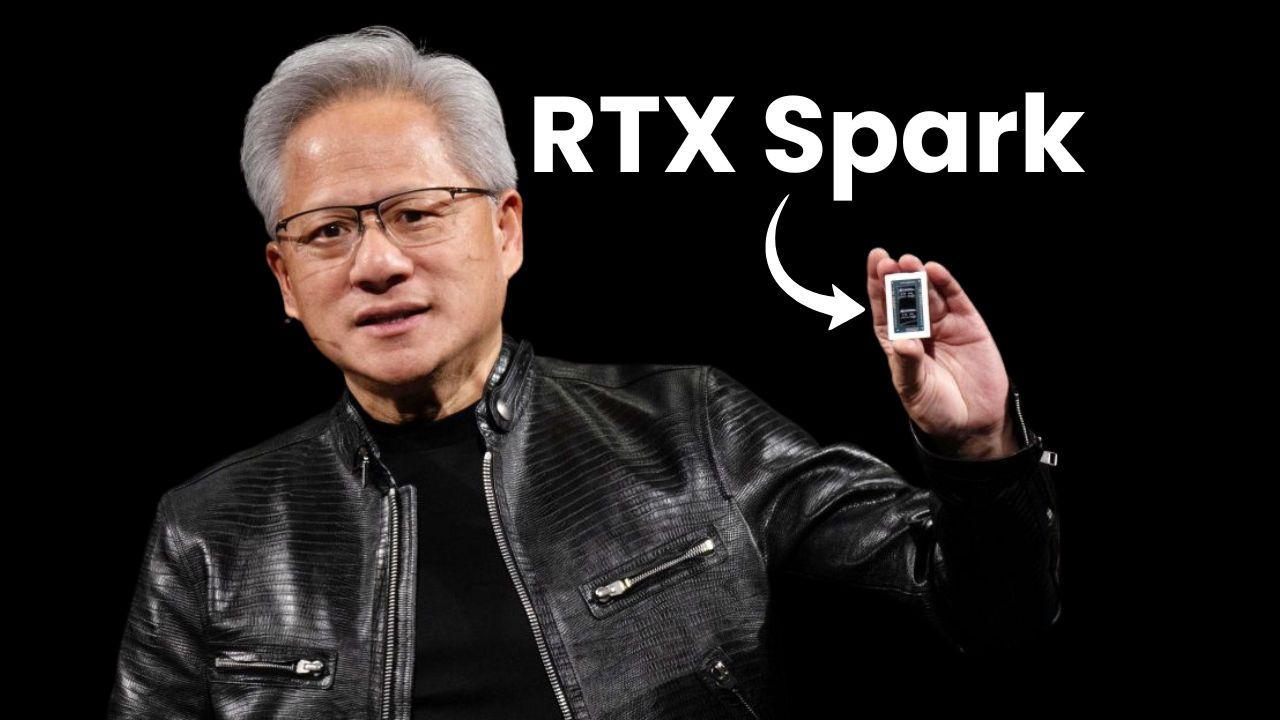
Source: Digit
The Nvidia RTX Spark platform, built in partnership with MediaTek, integrates a 20-core Arm CPU with a Blackwell GPU carrying 6,144 CUDA cores and up to 128GB of unified memory, all connected via a 600 GB/s NVLink-C2C link on TSMC's 3nm node
1
. Huang described this architecture as enabling what he calls an "agentic computing pattern" that orchestrates reasoning, memory, and tool use identically whether running in data centers or on a laptop, with the goal of shifting PCs from passive tools into active systems capable of completing tasks autonomously1
.The RTX Spark launch represents Nvidia's expansion beyond its data center dominance into edge AI, where smaller devices run AI workloads without relying on cloud infrastructure
4
. Huang emphasized that "every edge device will become autonomous," running the same agent architecture across self-driving cars, humanoid robots, Nokia base stations, and imaging satellites1
. According to IDC analyst Tom Mainelli, "Nvidia getting into the space is Jensen recognizing that he wants to own every bit of the AI stack in some shape"4
. The company's Vera CPU, an 88-core Arm processor now in full production, exemplifies this approach on the data center side, designed specifically for agents rather than human users and claiming 1.8 times faster task completion than x86 processors1
. With nearly $20 billion in projected CPU revenue this year and customers including Anthropic, OpenAI, xAI, ByteDance, CoreWeave, and Oracle, Nvidia is building momentum across the entire AI infrastructure landscape1
.The top RTX Spark configuration promises up to 1 petaflop of AI compute, capable of running a 120B-parameter large language models with up to a million token context locally
2
. The system is designed to render 90GB 3D scenes, edit 12K video, generate 4K AI video, and play modern games at 1440p and 100 frames-per-second using DLSS2
. Huang envisions users communicating with AI agents running on RTX Spark PCs through platforms like WhatsApp, with agents autonomously completing tasks and reporting results back, describing the experience as having "your laptop be your R2-D2"1
3
.
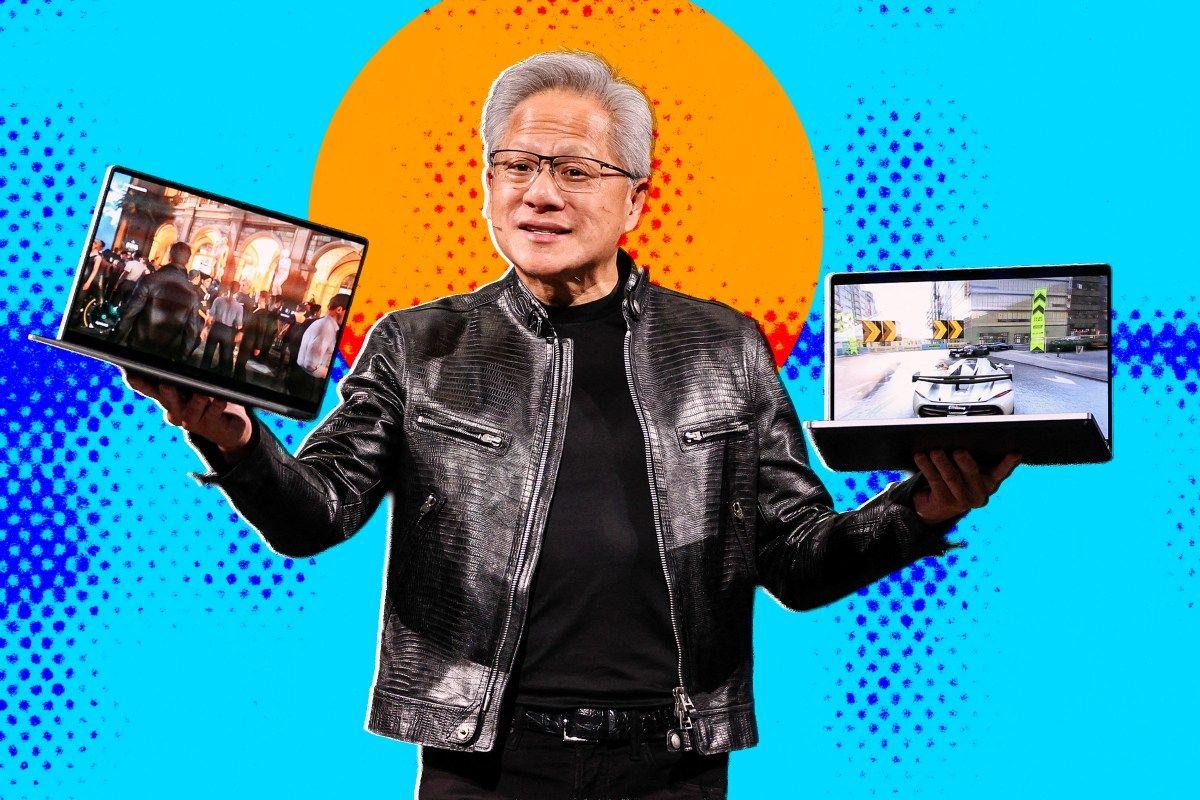
Source: Futurism
The unified memory architecture eliminates a major bottleneck in AI workloads by allowing the CPU and GPU to access the same memory pool, enabling more capable local AI models
4
. Fall 2026 laptops are confirmed from Microsoft, Dell, HP, ASUS, Lenovo, and MSI, with Acer and Gigabyte following, prompting Huang to boast that "this is literally every computer maker in the world"3
.AMD has positioned itself as welcoming competition in the local AI space, with executives suggesting Nvidia's entry validates the category AMD has been pursuing with Strix Halo chips for nearly two years
5
. Rahul Tikoo, AMD's senior vice president and general manager of client business, stated "I'm really excited that Nvidia has joined the game," noting that "large local memory is becoming super critical in the agentic AI workloads"5
. AMD's upcoming Gorgon Halo chip, expected in Q3, will support up to 192GB of unified memory with Zen 5 CPU cores and RDNA 3.5 graphics, offering a 50% memory advantage over RTX Spark's 128GB configuration5
.
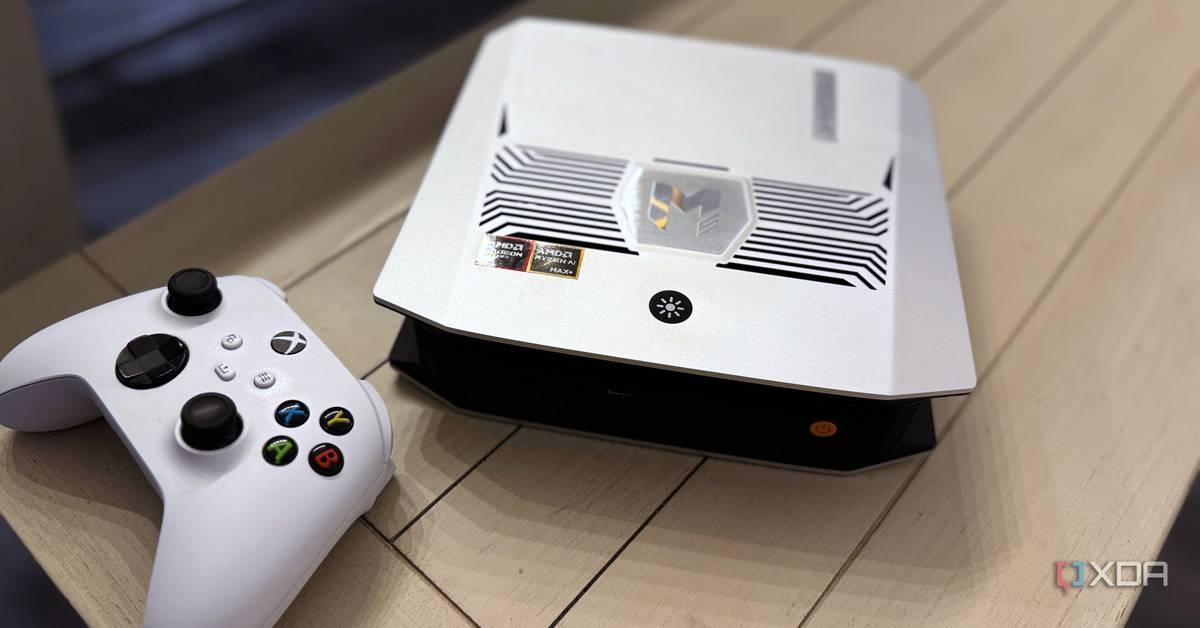
Source: XDA-Developers
The Ryzen AI Max+ has already demonstrated practical performance with quantized models, achieving 42.04 tokens per second with a 35B MoE model and 8.59 tokens per second with a 122B MoE model using ROCm and Ollama
2
. AMD's chief software officer Andrej Zdravkovic argued that CUDA's advantage has diminished, stating "the shift from one to another is easy" when comparing ROCm to CUDA5
.Related Stories
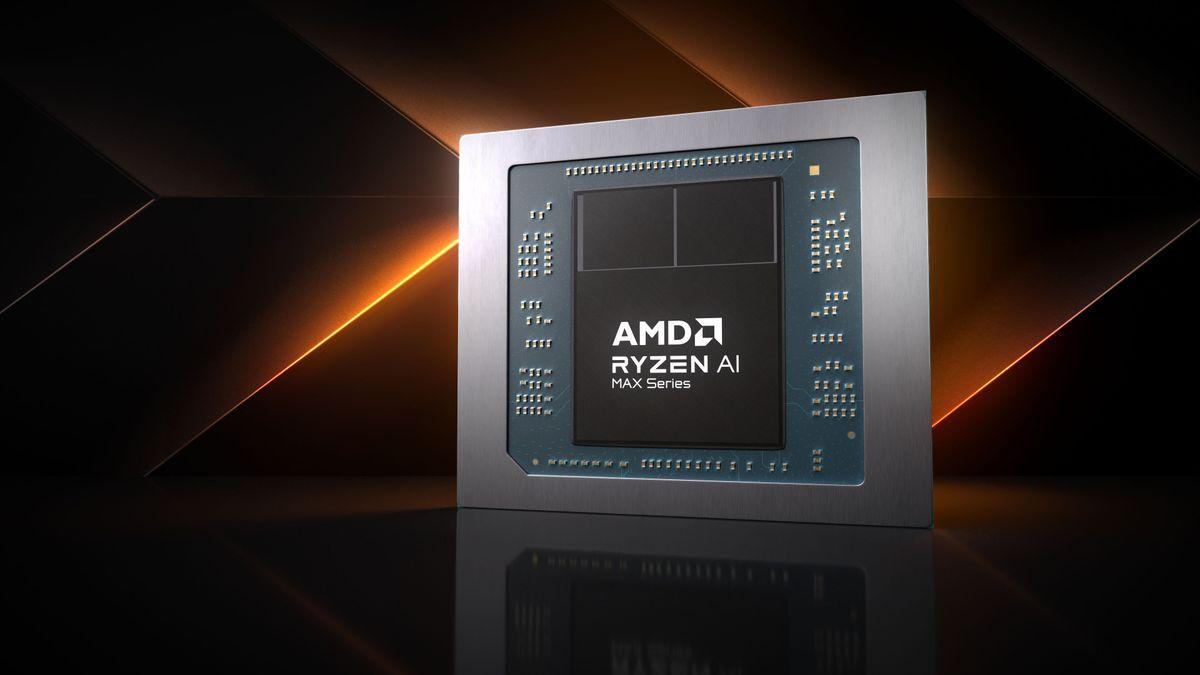
Nvidia's RTX Spark announcement triggered immediate market reactions, with shares of AMD, Intel, and Qualcomm declining while Nvidia's stock rose more than 6%, adding to its market cap of approximately $5.4 trillion
4
. The platform enters a Windows on Arm market that Qualcomm had effectively controlled until its Microsoft exclusivity lapsed, while Intel and AMD continue to dominate the broader PC processor space1
. Analysts estimate Nvidia could sell 10 million PC chips over the next two years, a modest figure compared to the 296 million PC chips shipped in 2025, but one that represents a strategic foothold in edge computing4
. Huang emphasized long-term commitment, stating "once we start a new product line, once we start a new software image, we support it for as long as we shall live," citing the Nvidia Shield TV platform as evidence of sustained support3
. The company has already committed to N2 and N3 Spark chips for future systems, alongside a smaller N1 chip yet to be detailed3
.While RTX Spark targets developer workloads and advanced use cases, questions remain about mainstream adoption and pricing. Analysts characterize these systems as "developer boxes" with price tags expected in the several-thousand-dollar range, positioning them outside typical consumer budgets
2
. Jay Goldberg of Seaport Research Partners wrote that he doesn't expect material revenue from Nvidia's PC chips "any time soon," maintaining a sell rating on the stock4
. Creative Strategies analyst Ben Bajarin estimated that Nvidia's networking business alone, which reported about $15 billion in the most recent quarter, will be at least 20 times the size of Nvidia's PC business, with total data center revenue topping $75 billion4
. The AI PC concept, introduced by Microsoft and partners in 2024, has not sparked significant market revival due to limited software and Microsoft's challenges with Copilot technology4
. However, chip analyst Patrick Moorhead suggested that "Nvidia's prowess in AI could bring a different level of enthusiasm and credibility" compared to earlier attempts4
. As both Nvidia and AMD target fall launches for their respective platforms, the competition will test whether the market for high-end local AI computing can expand beyond niche developer audiences into broader commercial adoption.Summarized by
Navi
[1]
[2]
16 Jan 2025•Technology

04 Jun 2026•Technology

02 Jun 2026•Technology

1
Startups

2
Policy and Regulation

3
Policy and Regulation