Nvidia's Nemotron for Science sends open AI agents into the lab


2 Sources
[1]
NVIDIA Introduces Nemotron for Science to Accelerate Discoveries With Agents
New Open Dataset and Post-Training Recipes Help Researchers Adapt Nemotron 3.5 Super VL for Life Sciences and Chemistry * NVIDIA Nemotron for Science brings together the Nemotron 3.5 Super VL model, scientific evaluations, a new open chemistry dataset and recipes to help researchers build
[2]
Nvidia Launches AI Platform for Science Experiments
Nvidia introduced Nemotron for Science, an open chemistry dataset and post-training recipes to help researchers build AI agents for scientific discovery. The platform is designed to help build agents that can reason through scientific problems and use specialized research tools, Nvidia said
Share
Copy Link
Nvidia has launched Nemotron for Science, an open package for building AI agents that handle chemistry and lab work. The early results come from Nvidia and its partners.
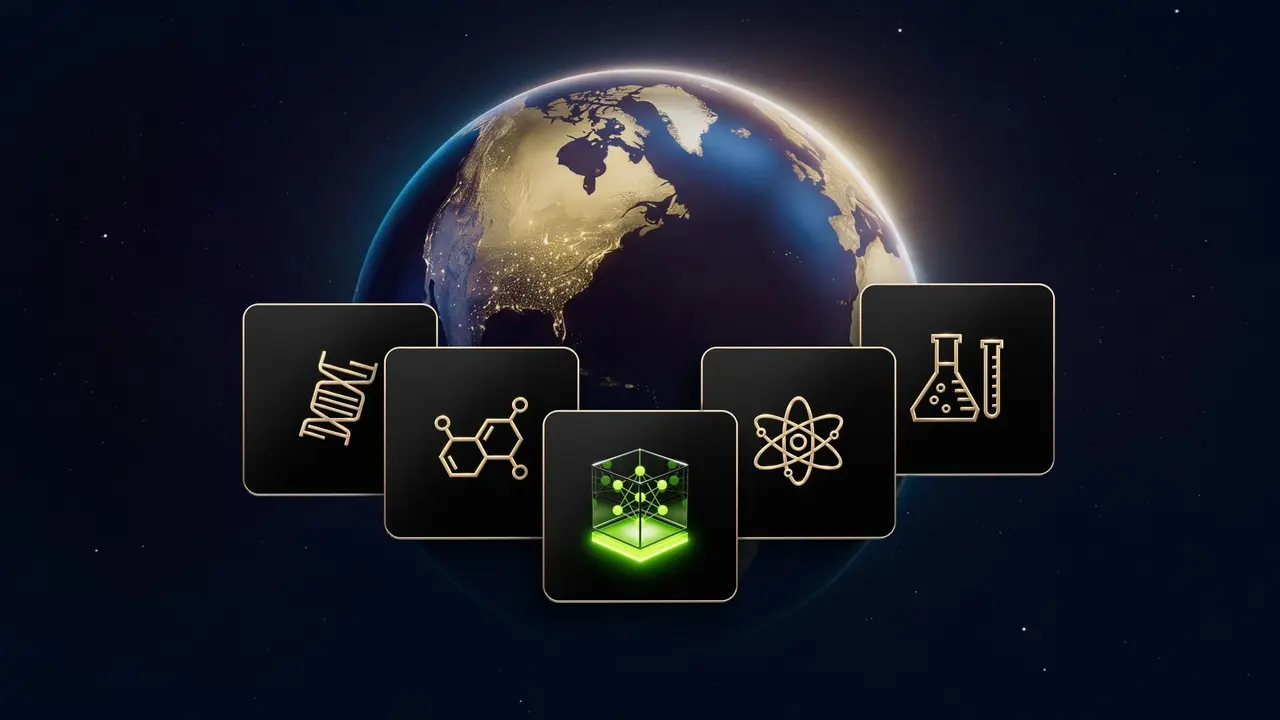
Nvidia launched Nemotron for Science on 16 November, a package that pairs its open Nemotron 3.5 Super VL model with a new chemistry dataset and recipes for building AI agents that can work through scientific problems
1
2
.
Source: NVIDIA
The release builds on the existing Nemotron 3.5 Super VL open model, adapted here for life sciences and chemistry
1
. Its open artifact is LitmusBench v0.2, a dataset of nearly 50,000 questions for training and testing language models on chemistry reasoning, drawn from molecular properties and experimental drug discovery data1
2
. The model and the dataset are on Hugging Face now, and the model was optimized to run locally on a 128GB DGX Spark system1
2
. Nvidia says accelerated computing is changing how scientists tackle hard problems, and that open models, data and recipes let them turn ideas into discoveries1
. "Nemotron for Science gives researchers open models, scientific data and post-training recipes to build specialized agents that reason through scientific problems and use CUDA-X accelerated tools to turn ideas into discoveries," said Ian Buck, the company's vice president of hyperscale and high-performance computing1
. The agents can read scientific information, write code and call computational tools1
.What the early results show
Three life sciences companies report results from post-training the model. The partners are using it to pull chemical knowledge out of data, plan experiments and design therapeutics
1
. Terray Therapeutics post-trained the model to pull reactants, products and reaction conditions out of scientific diagrams. On the RxnScribe test, the company says, it recovered about 76 percent of the annotated reactions, judged by the benchmark's matching criteria. By the company's own account, that tops previously published results on the two benchmarks1
.Lila Sciences used the model to write execution-ready protocols for its automated labs, and says it nearly matches frontier performance without extra fine-tuning
1
. On one task, synthesizing quantum dots, post-training with feedback from its labs nearly doubled accuracy, to 61 percent against GPT-6 Astra's 54 percent. The release claims that came at 10 to 20 times lower inference cost1
. Therna worked with Nvidia to post-train the model for designing mRNA therapeutics. It says the model nearly doubled its accuracy at predicting protein-expression ranges over frontier models.From desktops to supercomputers
Research institutions are picking the model up too. Argonne National Laboratory, a U.S. Department of Energy lab, is integrating Nemotron into its StructBioReasoner system, which designs and evaluates protein-based therapeutic candidates for cancer and other illnesses
1
. KTH Royal Institute of Technology built an agent that repairs broken GROMACS molecular dynamics setups. In one overnight run on a single DGX Spark it fixed 81 percent of test cases, each one checked by GROMACS itself1
.Supercomputing centers are in the picture too. Riken has put Nemotron on its Rikyu AI supercomputing platform, served through its RiVault inference gateway. Germany's Jülich Supercomputing Centre is integrating it into its own discovery agents
1
. Nvidia positions the model as spanning scales from a researcher's desktop to a supercomputing center, running on infrastructure the organizations themselves control1
. The company says the work could open new paths in critical materials, national security and cancer treatment1
.Every performance figure in the release comes from Nvidia or its partners, and no independent evaluation of them appears in the coverage
1
. Until an outside lab publishes its own numbers, the evidence for those results begins and ends with Nvidia's announcement1
.Related Stories

References
Summarized by

Navi
[2]
Related Stories
NVIDIA Launches BioNeMo Agent Toolkit to Accelerate Scientific Discovery with AI Agents
23 Jun 2026•Technology
Nvidia launches Nemotron 3 open source AI models as Meta steps back from transparency
15 Dec 2025•Technology

Nvidia launches Nemotron 3 Super with 5x throughput boost to power enterprise AI agents
11 Mar 2026•Technology
Recent Highlights


Recent Highlights
Today's Top Stories





Don’t drown in AI news. We cut through the noise - filtering, ranking and summarizing the most important AI news, breakthroughs and research daily. Follow topics that matter to you and stay ahead.


