4 Sources
[1]
NVIDIA Announces BioNeMo Agent Toolkit -- Tools for Agents to Accelerate Scientific Discovery
* Industry and research leaders including Dassault Systèmes, Databricks, Lilly, OpenAI, Schrödinger, Snowflake, the UW Medicine Institute for Protein Design and dozens others are adopting, and Anthropic and OpenAI are integrating, NVIDIA BioNeMo Agent Toolkit to bring agentic life sciences workflows to researchers and scientists. * NVIDIA BioNeMo Agent Toolkit -- including NVIDIA Nemotron, NemoClaw, OpenShell and BioNeMo -- gives agents accelerated life sciences tools spanning biology, chemistry, genomics and drug discovery. * New NVIDIA BioNeMo tools give agents the context and know-how to execute scientific computing -- improving accuracy, task completion and token efficiency. BIO -- NVIDIA today announced NVIDIA BioNeMo Agent Toolkit, which provides domain-specific tools and skills for the agentic life sciences era. Including more than a decade's worth of NVIDIA life sciences libraries, tools and open models, the toolkit enables AI agents, scientists and labs to work together by gathering evidence, reasoning across findings, running computational experiments and recommending the next best steps to accelerate discovery. It gives any agent or AI platform -- from general-purpose assistants to specialized scientific agents, software platforms and in-house biopharma systems -- the tools needed to synthesize and summarize scientific knowledge, call models, evaluate results, reason and execute next actions. The toolkit includes NVIDIA BioNeMo™ and is powered by NVIDIA NIM™ microservices, NVIDIA Parabricks, NVIDIA NeMo™ and NVIDIA Nemotron™ technologies, along with accelerated computing and skills -- providing an open and trusted foundation for agentic life sciences. More than 50 leading companies are already using it to advance scientific discovery, tapping into agent-callable skills for tasks including protein structure prediction, molecular docking, generative chemistry, genomic analysis, protein design and biomarker discovery. "Frontier models are the brains. BioNeMo is the scientific toolbox. Together, they give AI agents the skills of a PhD research assistant and the speed of a supercomputer," said Jensen Huang, founder and CEO of NVIDIA. "For the first time, researchers can build AI agents that understand scientific knowledge, use scientific tools and execute scientific workflows. This is a new way to do science -- one that can dramatically accelerate discovery across biology, chemistry, genomics and medicine." Open model and research organizations -- including the Arc Institute, Open Molecular Software Foundation and the University of Washington's Institute for Protein Design (IPD) -- are working with NVIDIA to use BioNeMo to advance frontier models and make them more accessible through agent-ready workflows. The IPD collaboration has accelerated runtimes for state-of-the-art biodesign models like RosettaFold3, resulting in 2x faster performance than the prior-generation model, and many additional applications to accelerate protein design efforts are ongoing, giving researchers tools at a scale and cost not before possible. "Every tool we've built for protein design is only as powerful as the scientists who can efficiently access it," said David Baker, professor of biochemistry at the University of Washington School of Medicine and director of the Institute for Protein Design. "The next leap in science won't come from a single discovery; it will come from the speed of iterative designs and agents that can repeatedly reason through the complexity of biology at a speed humans never could." Agent-Ready Tools and Skills for Life Sciences Life sciences is one of the world's most important scientific frontiers, with global scientific R&D reaching $3.8 trillion and annual pharmaceutical budgets approaching $300 billion. Agentic workflows can help the industry iterate faster while reducing costs and maximizing the probability of success. With the toolkit allowing developers to transform general-purpose agents into life sciences agents in minutes, researchers can run experiments faster, continuously learn from results and close the loop between hypothesis and discovery, with some companies extending this iteration into physical labs. A general-purpose agent can struggle to navigate scientific workflows efficiently, needing to infer the correct tools, inputs, outputs and biological meaning along the way. With BioNeMo Agent Toolkit, agents can call the right tools, interpret results more accurately and gain scientific insights faster and more reliably. NVIDIA is optimizing the entire BioNeMo platform by turning libraries, models and frameworks into agent-callable tools. This includes harnessing NVIDIA Agent Toolkit technologies such as NVIDIA Nemotron open models for the reasoning foundation, the NVIDIA NeMo RL library for reinforcement learning and NVIDIA NemoClaw™ blueprints for secure, private agents that can reason across tasks, call tools and interact with data continuously. NVIDIA NIM microservices help agents call models and perform tasks. The NVIDIA OpenShell™ runtime provides a controlled executable environment. The toolkit's components enable agents to complete workflows such as: * Virtual Screening: Agents can help researchers identify small-molecule drug candidates by generating and screening compounds, docking them to a target, predicting binding strength and filtering for drug-like properties. Then, the agent can output which candidates should be prioritized, compressing screening timelines from days to minutes. * Genomic Analysis and Target Discovery: Agents can help researchers transform raw sequencing data into prioritized genetic insights and biological targets. NVIDIA Parabricks accelerates alignment and variant calling, while genomic foundation models score variant effects and the agent ranks the most disease-relevant candidates for further study. * Protein Binder Design: Agents can help researchers design and validate candidates computationally before work begins, compressing traditionally labor-intensive design work. * Deep Biomedical Research: Agents connect real-world data to reasoning models to improve the efficiency and accuracy of various scientific and clinical development processes, including literature review, protocol generation, clinical trial screening and pharmacovigilance with the NVIDIA Biomedical AI-Q Research Agent. * Medical Imaging Analysis: Agents can help researchers process, segment, synthesize and reason over medical imaging data to support biomarker discovery, accelerating evidence generation across research workflows. Life Sciences Ecosystem Builds With NVIDIA BioNeMo Companies across the technology and life sciences ecosystem are using the toolkit to advance agentic workflows. Frontier labs and scientific agent builders including Anthropic, Edison Scientific, Lila Sciences, OpenAI and Owkin are integrating with BioNeMo to help agents move from answering questions to completing scientific work. NVIDIA accelerated models and analysis libraries help shorten the time from hypothesis to insight. Scientific data and workflow platforms from Benchling, Certara, Databricks, Snowflake and Seqera are using BioNeMo Agent Toolkit to connect data systems with AI-powered science. BioNeMo skills can help agents query biological and chemical datasets, prepare model-ready inputs, launch reproducible workflows, analyze outputs and return insights directly within the platforms scientists and data teams already use daily. Diagnostics and pharmaceutical companies including Lilly and Natera are using BioNeMo Agent Toolkit to scale repeatable agentic workflows across discovery, translational research and clinical insight. AI-native biology companies including Boltz, Basecamp Research, Chai Discovery, Dyno, PerturbAI and Proxima have collaborated with NVIDIA to develop tools to accelerate model-powered therapeutic design workflows. Computer-aided drug discovery software providers including Dassault Systèmes, Cadence (OpenEye) and Schrödinger are integrating the toolkit's capabilities into scientific applications used across discovery teams. Then, agents can help orchestrate molecular generation, docking and prediction, turning computer-aided design platforms into systems where researchers can ask questions, launch analyses and identify next-best actions faster. Lab instruments and automation companies including Automata, HighRes, Tecan, Thermo Fisher and autonomous data generation platform Medra are connecting systems with computational discovery powered by BioNeMo skills. AI clouds and AI infrastructure companies including Baseten, Modal and Nebius are using the toolkit to help developers build life sciences workflows as reliable hosted services. By supporting BioNeMo skills and tools through scalable application programming interfaces, managed compute and production inference environments, these companies can help move agentic biology workflows from prototypes into accessible services for researchers and enterprises. Availability BioNeMo Agent Toolkit and skills are available now through the NVIDIA developer resources page and GitHub.
[2]
Nvidia Announces Bionemo Agent Toolkit
NVIDIA announced NVIDIA BioNeMo Agent Toolkit, which provides domain-specific tools and skills for the agentic life sciences era. Including more than a decade?s worth of NVIDIA life sciences libraries, tools and open models, the toolkit enables AI agents, scientists and labs to work together by gathering evidence, reasoning across findings, running computational experiments and recommending the next best steps to accelerate discovery. It gives any agent or AI platform ? from general-purpose assistants to specialized scientific agents, software platforms and in-house biopharma systems ? the tools needed to synthesize and summarize scientific knowledge, call models, evaluate results, reason and execute next actions. The toolkit includes NVIDIA BioNeMo and is powered by NVIDIA NIM microservices, NVIDIA Parabricks, NVIDIA NeMo and NVIDIA Nemotron technologies, along with accelerated computing and skills ? providing an open and trusted foundation for agentic life sciences. More than 50 leading companies are already using it to advance scientific discovery, tapping into agent-callable skills for tasks including protein structure prediction, molecular docking, generative chemistry, genomic analysis, protein design and biomarker discovery. Open model and research organizations ? including the Arc Institute, Open Molecular Software Foundation and the University of Washington?s Institute for Protein Design ? are working with NVIDIA to use BioNeMo to advance frontier models and make them more accessible through agent-ready workflows. The IPD collaboration has accelerated runtimes for biodesign models like RosettaFold3, resulting in 2x faster performance than the prior-generation model, and many additional applications to accelerate protein design efforts are ongoing, giving researchers tools at a scale and cost not before possible. Life sciences is one of the world?s most important scientific frontiers, with global scientific R&D reaching $3,800,000 million and annual pharmaceutical budgets approaching $300,000 million. Agentic workflows can help the industry iterate faster while reducing costs and maximizing the probability of success. With the toolkit allowing developers to transform general-purpose agents into life sciences agents in minutes, researchers can run experiments faster, continuously learn from results and close the loop between hypothesis and discovery, with some companies extending this iteration into physical labs. A general-purpose agent can struggle to navigate scientific workflows efficiently, needing to infer the correct tools, inputs, outputs and biological meaning along the way. With BioNeMo Agent Toolkit, agents can call the right tools, interpret results more accurately and gain scientific insights faster and more reliably. NVIDIA is optimizing the entire BioNeMo platform by turning libraries, models and frameworks into agent-callable tools. This includes harnessing NVIDIA Agent Toolkit technologies such as NVIDIA Nemotron open models for the reasoning foundation, the NVIDIA NeMo RL library for reinforcement learning and NVIDIA NemoClaw blueprints for secure, private agents that can reason across tasks, call tools and interact with data continuously. NVIDIA NIM microservices help agents call models and perform tasks. The NVIDIA OpenShell runtime provides a controlled executable environment. The toolkit?s components enable agents to complete workflows such as: Virtual Screening: Agents can help researchers identify small-molecule drug candidates by generating and screening compounds, docking them to a target, predicting binding strength and filtering for drug-like properties. Then, the agent can output which candidates should be prioritized, compressing screening timelines from days to minutes. Genomic Analysis and Target Discovery: Agents can help researchers transform raw sequencing data into prioritized genetic insights and biological targets.
[3]
Sigmatic Sciences Integrates Nvidia Bionemo Agent Toolkit Within Sigmaticos
Sigmatic Sciences has announced integration of NVIDIA BioNeMo Agent Toolkit within SigmaticOS, strengthening its ability to deploy AI Scientists that can reason, plan, and execute across the full scientific discovery lifecycle. SigmaticOS provides a scientific operating system that transforms hundreds of AI agents into an AI Scientist capable of orchestrating data, models, software, and experiments into a single traceable workflow. SigmaticOS has leveraged NVIDIA BioNeMo and Nemotron models in production since its inception. With the release of BioNeMo Agent Toolkit, SigmaticOS further expands its ability to orchestrate biological AI models, scientific software, enterprise data, and laboratory systems within a single coordinated research environment. NVIDIA BioNeMo Agent Toolkit provides the biological AI foundation for this transformation, delivering specialized models, agent frameworks, and infrastructure designed for life sciences. SigmaticOS provides the operating system that puts those capabilities to work, connecting AI agents to the tools, data, and laboratory environments required to conduct rigorous scientific research. Through SigmaticOS, the capabilities of NVIDIA BioNeMo Agent Toolkit are orchestrated alongside more than 300 specialized scientific agents and connected across the entire discovery stack. This includes proprietary experimental data, any ELN/LIMS and laboratory automation infrastructure like Sapio Sciences, scientific literature and data resources from Elsevier, structural chemistry capabilities from the Cambridge Crystallographic Data Centre (CCDC), and advanced simulation platforms from Simulations Plus. The platform also incorporates domain-specific biological AI models from the NVIDIA BioNeMo ecosystem, including OpenFold3 and Boltz-2 for biomolecular structure prediction, RNApro for RNA structure analysis, and ReaSyn for synthesizability assessment. The result is a true lab-in-the-loop discovery system where an AI Scientist can continuously learn from experimental outcomes, refine hypotheses, and coordinate subsequent investigations. By connecting biological AI directly to scientific software and laboratory infrastructure, SigmaticOS helps researchers shorten the path from idea to experiment to insight. Sigmatic Sciences will showcase its BioNeMo-powered AI Scientist workflows at the BIO International Convention, June 22?25 in San Diego.
[4]
Simulations Plus, Inc. And NVIDIA Corporation Advance Agentic Drug Development With NVIDIA BioNeMo Agent Toolkit
Simulations Plus Inc. announced that it is building the agentic layer of Composer, its AI-native platform for model-informed drug development, using the NVIDIA BioNeMo Agent Toolkit. The initiative expands the companies? collaboration announced in May 2026, extending their work in GPU-accelerated simulation and AI-assisted modeling workflows into agentic drug development. Together, the companies are combining AI reasoning, scientific literature, validated computational engines, and scalable compute within a scientific workflow. The integration is initially focused on two areas: Composer agents are expected to leverage NVIDIA Nemotron Parse to extract and structure information from scientific literature, enabling agents to retrieve relevant evidence while maintaining provenance back to the original source. The companies are together advancing nvQSP, a collaborative development initiative focused on CUDA-optimized ordinary differential equation (ODE) solvers for quantitative systems pharmacology (QSP). By accelerating computationally intensive simulations on NVIDIA accelerated computing infrastructure, nvQSP enables scientists to explore larger parameter spaces, evaluate more hypotheses, and iterate more rapidly across complex biological systems. nvQSP builds on the companies? previously announced work to accelerate computationally intensive QSP workflows using GPU-optimized simulation technology. These capabilities are being incorporated into Composer, allowing agents to coordinate scientific workflows while remaining rooted in validated computational engines and source-based evidence. The initiative reflects Simulations Plus? strategy to connect AI reasoning, scientific knowledge, and validated computational engines within a unified environment for model-informed drug development.
Share
Copy Link
NVIDIA unveiled the BioNeMo Agent Toolkit, providing domain-specific tools for AI agents in life sciences research. The toolkit combines over a decade of NVIDIA's life sciences libraries with technologies like Nemotron and NIM microservices, enabling agents to execute complex scientific workflows. Over 50 companies, including Lilly, OpenAI, Anthropic, and Schrödinger, are already adopting the platform to accelerate drug discovery and biological research.
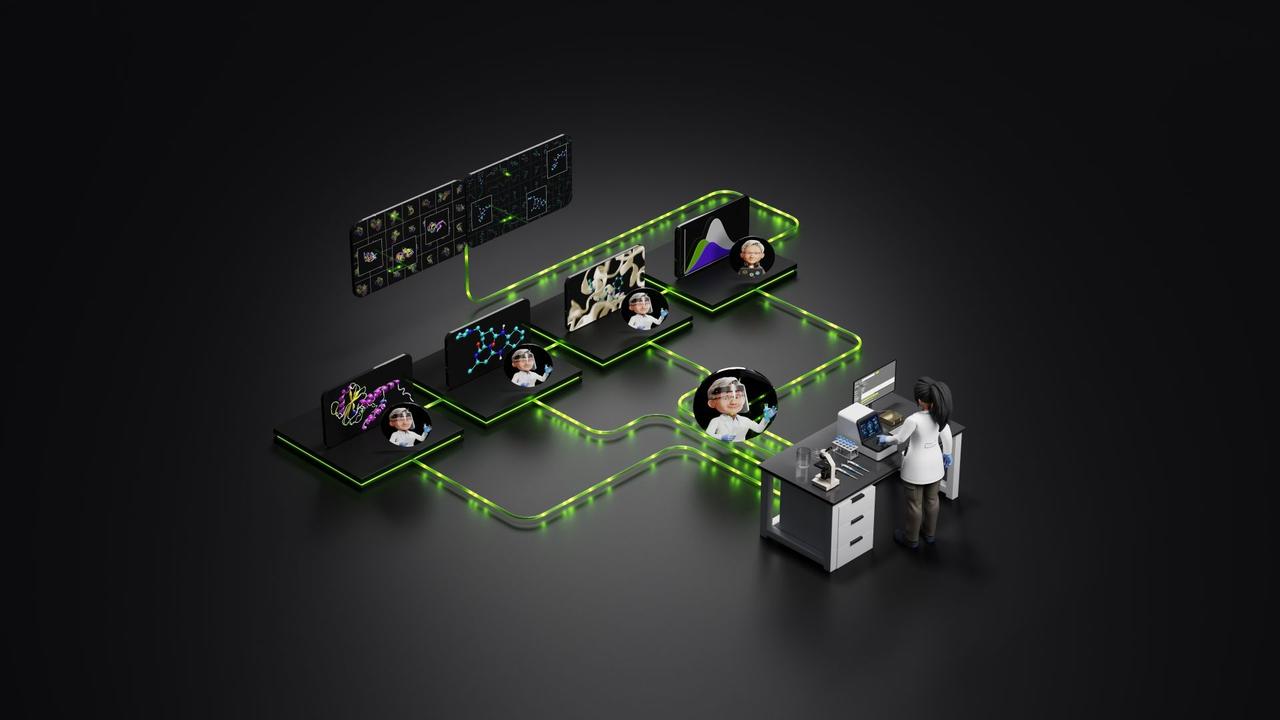
NVIDIA has announced the NVIDIA BioNeMo Agent Toolkit, a comprehensive platform designed to equip AI agents with specialized tools for accelerating scientific discovery across biology, chemistry, genomics, and drug discovery
1
. The toolkit represents more than a decade of NVIDIA's work in life sciences, bundling libraries, tools, and open models into an integrated system that enables AI agents, scientists, and laboratories to collaborate on computational experiments and evidence-based research.The platform addresses a critical challenge in scientific research: general-purpose AI agents often struggle to navigate complex scientific workflows efficiently. With the NVIDIA BioNeMo Agent Toolkit, agents gain access to agent-callable skills for protein structure prediction, molecular docking, generative chemistry, genomic analysis, protein design, and biomarker discovery
1
2
. This enables them to call the right tools, interpret results accurately, and generate scientific insights faster and more reliably than before.
Source: NVIDIA
More than 50 leading companies are already using the toolkit to advance their research capabilities. Industry and research leaders including Dassault Systèmes, Databricks, Lilly, OpenAI, Schrödinger, Snowflake, and the UW Medicine Institute for Protein Design have adopted the platform, while Anthropic and OpenAI are actively integrating it to bring agentic life sciences workflows to researchers and scientists
1
.Jensen Huang, founder and CEO of NVIDIA, emphasized the transformative potential: "Frontier models are the brains. BioNeMo is the scientific toolbox. Together, they give AI agents the skills of a PhD research assistant and the speed of a supercomputer. For the first time, researchers can build AI agents that understand scientific knowledge, use scientific tools and execute scientific workflows"
1
.The toolkit is powered by NVIDIA NIM microservices, NVIDIA Parabricks, NVIDIA NeMo, and NVIDIA Nemotron technologies, providing an open and trusted foundation for agentic life sciences
1
2
. NVIDIA is optimizing the entire BioNeMo platform by converting libraries, models, and frameworks into agent-callable tools. This includes harnessing Nemotron open models for reasoning, the NeMo RL library for reinforcement learning, and NemoClaw blueprints for secure, private agents that can reason across tasks and interact with data continuously2
.The toolkit enables agents to complete complex workflows such as virtual screening, where agents help researchers identify small-molecule drug candidates by generating and screening compounds, docking them to targets, predicting binding strength, and filtering for drug-like properties. This compresses screening timelines from days to minutes
2
. For genomic analysis and target discovery, agents can transform raw sequencing data into prioritized genetic insights and biological targets.The collaboration with the University of Washington's Institute for Protein Design (IPD) demonstrates the platform's practical impact. The partnership has accelerated runtimes for state-of-the-art biodesign models like RosettaFold3, achieving 2x faster performance than the prior-generation model
1
2
. David Baker, professor of biochemistry at the University of Washington School of Medicine and director of the Institute for Protein Design, noted: "The next leap in science won't come from a single discovery; it will come from the speed of iterative designs and agents that can repeatedly reason through the complexity of biology at a speed humans never could"1
.Sigmatic Sciences has integrated the toolkit within SigmaticOS, its scientific operating system that transforms hundreds of AI agents into an AI Scientist capable of orchestrating data, models, software, and experiments into a single traceable workflow
3
. SigmaticOS connects AI agents to more than 300 specialized scientific agents across the entire discovery stack, including proprietary experimental data, laboratory automation infrastructure, and domain-specific biological AI models from the NVIDIA BioNeMo ecosystem.Related Stories

Simulations Plus announced it is building the agentic layer of Composer, its AI-native platform for model-informed drug development, using the NVIDIA BioNeMo Agent Toolkit
4
. This initiative expands their collaboration announced in May 2026, extending work in GPU-accelerated simulation and AI-assisted modeling workflows into agentic drug development. Composer agents are expected to leverage NVIDIA Nemotron Parse to extract and structure information from scientific literature, enabling agents to retrieve relevant evidence while maintaining provenance back to the original source4
.The companies are advancing nvQSP, a collaborative development initiative focused on CUDA-optimized ordinary differential equation (ODE) solvers for quantitative systems pharmacology (QSP). By accelerating computationally intensive simulations on NVIDIA accelerated computing infrastructure, nvQSP enables scientists to explore larger parameter spaces, evaluate more hypotheses, and iterate more rapidly across complex biological systems
4
.Life sciences represents one of the world's most important scientific frontiers, with global scientific R&D reaching $3.8 trillion and annual pharmaceutical budgets approaching $300 billion
1
2
. Agentic workflows can help the industry iterate faster while reducing costs and maximizing the probability of success. With the toolkit allowing developers to transform general-purpose agents into life sciences agents in minutes, researchers can run experiments faster, continuously learn from results, and close the loop between hypothesis and discovery, with some companies extending this iteration into physical labs1
2
.The platform creates a true lab-in-the-loop discovery system where an AI Scientist can continuously learn from experimental outcomes, refine hypotheses, and coordinate subsequent investigations through AI Scientist workflows
3
. Open model and research organizations including the Arc Institute, Open Molecular Software Foundation, and the University of Washington's Institute for Protein Design are working with NVIDIA to use BioNeMo to advance frontier models and make them more accessible through agent-ready workflows1
. This collaboration between AI reasoning, scientific literature, validated computational engines, and scalable compute within scientific workflows signals a shift in how computational experiments are conducted across the pharmaceutical and biotechnology sectors.🟡 Atkinson, NE, November 28, 2023 – From local retailers to community events, the festive season is brimming with activities designed to spread cheer and support local businesses. This year, residents can look forward to a diverse range of holiday experiences right in their neighborhood.A highlight for many is the Annual Christmas Bazaar, a cherished tradition that brings together local artisans and crafters. Visitors can find unique, handmade gifts, from intricate jewelry to personalized home decor. The bazaar not only offers a chance to discover one-of-a-kind treasures but also provides a platform for small businesses to connect with the community. "It's more than just shopping; it's about celebrating the talent within our community and finding thoughtful gifts that truly mean something," says Sarah Chen, one of the event organizers.
For those looking to give back, various charity drives are underway throughout December. The "Share the Warmth" campaign is collecting coats and blankets for families in need, while the "Toy Mountain" initiative aims to provide every child with a present to open on Christmas morning. These efforts rely heavily on community generosity, and every donation, big or small, makes a significant difference. Local schools and community centers are serving as drop-off points, making it easy for everyone to contribute.
Food enthusiasts will delight in the array of festive treats available at local bakeries and cafes. Gingerbread cookies, peppermint lattes, and artisanal fruitcakes are just some of the seasonal delights on offer. Many establishments are also hosting special tasting events and workshops, allowing residents to learn how to create their own holiday confections. "There's nothing quite like the smell of fresh gingerbread to get you in the holiday spirit," says baker Tom Adams, whose cafe is hosting a gingerbread house decorating workshop next week.
The town square is set to transform into a winter wonderland, complete with dazzling light displays and a towering Christmas tree. Weekend evenings will feature carol singers and live music, adding to the enchanting atmosphere. Families can also enjoy ice skating on the temporary rink and warm up with hot chocolate from nearby vendors. The light-up ceremony for the Christmas tree, scheduled for the first Saturday of December, is expected to draw a large crowd, officially kicking off the festive season.
Summarized by
Navi
[1]
[2]
[3]
19 Nov 2024•Technology

12 Jun 2025•Health

01 Jun 2026•Technology

1
Technology

2
Policy and Regulation

3
Technology