OpenAI and Broadcom unveil Jalapeño chip to power next-generation AI inference at scale


32 Sources
[1]
OpenAI and Broadcom announce chip designed for LLM inference at scale
OpenAI, the company behind ChatGPT and Codex and the models those tools utilize, and Broadcom, an established silicon supplier, have announced a new chip called Jalapeño, designed specifically for large language model inference in data centers. The chip is intended to be deployed at large data
[2]
OpenAI unveils its first custom chip, built by Broadcom
On Wednesday, OpenAI unveiled its first custom-built inference processor, designed and manufactured in collaboration with Broadcom. Named Jalapeño, the new processor was designed specifically for the unique needs of OpenAI's inference systems. OpenAI's own AI models assisted in the development of
[3]
OpenAI reveals its first AI processor: Jalapeño
OpenAI has just revealed a new "intelligence processor" chip for AI servers made in partnership with Broadcom. The chip, called Jalapeño, is designed to power current and future large language models, according to an announcement on Wednesday. Jalapeño is an ASIC (Application-Specific Integrated
[4]
Broadcom and OpenAI unveil custom-built Jalapeño inference processor -- OpenAI's first chip is a massive reticle-sized ASIC built in an ultra-fast nine-month development cycle
OpenAI and Broadcom have introduced Jalapeño, a custom-built inference processor designed specifically for modern large language models and future agentic AI workloads, which is designed to deliver performance per watt they claim is higher than today's leading-edge hardware. OpenAI considers its
[5]

OpenAI gets chippy with Broadcom
OpenAI and Broadcom have teamed up - with a little help from some of the former's AI models - to develop the frontier model lab's very first inference chip, dubbed Jalapeño, the companies announced in a press release on Wednesday. Details of the spicily named silicon are scarce in the
[6]

Jalapeño is the first AI chip from OpenAI and Broadcom - Engadget
It's a spicy start for the AI company's move into chip production. OpenAI and Broadcom have unveiled the design for Jalapeño, their first jointly-made chip. The pair of companies announced plans to collaborate on a making a custom "AI accelerator" in October 2025. In its blog post today, OpenAI
[7]

OpenAI unveils first chip as part of Broadcom deal in effort to 'build the full stack'
OpenAI and Broadcom on Wednesday unveiled their debut custom chip, called Jalapeño, marking the ChatGPT maker's first entry into artificial intelligence silicon. The chips will be made by Broadcom and used by OpenAI for inference, the compute-intensive process of serving its AI models to users in
[8]

OpenAI Distances Itself From Nvidia With Jalapeño, Its First In-House AI Chip
OpenAI fired the starting gun for the AI race in late 2022 with the launch of ChatGPT and has since become one of the most valuable startups in the world, reaching hundreds of millions of users every day. Its success, however, has depended on a web of partnerships with other companies that make the
[9]

OpenAI's Jalapeño chip: a way out from Nvidia
OpenAI just showed off Jalapeño, its first home-grown AI chip, built with Broadcom. It is designed for inference, not training. And it is the clearest sign yet that the company most dependent on Nvidia wants a way out. OpenAI has a chip now. On Wednesday it unveiled Jalapeño, the first piece of
[10]

OpenAI's new 'Jalapeno' chip is the company's first step towards the future
It's called "Jalapeno" and the company says it offers better performance-per-watt than current state-of-the-art chips. OpenAI has today unveiled its new chip developed in collaboration with Broadcom. The chip is called "Jalapeno," and it's the company's first "Intelligence Processor." It's a key
[11]

OpenAI unveils Jalapeño chip for large-scale inference workloads
OpenAI has unveiled its first custom AI accelerator, called Jalapeño, marking the company's move into chip design as it looks to reduce the cost and improve the efficiency of running large language models (LLMs). Developed in partnership with Broadcom and Celestica, the chip is designed
[12]

OpenAI has revealed its first custom chip, and Nvidia should be worried
OpenAI has revealed its first custom chip after announcing plans nine months ago, and the Broadcom-built design promises to upturn the AI industry -- particularly for Nvidia, one of the company's most important hardware suppliers. The newly introduced Jalapeño is billed as an Intelligence
[13]

OpenAI just made its biggest move against Nvidia -- and it could make ChatGPT cheaper to run
Meet Jalepeno, the chip that might be already running GPT-5.3-Codex-Spark OpenAI has unveiled Jalapeño, its first custom-built AI processor, developed with Broadcom specifically to run the large language models that power ChatGPT. Unlike the graphics processors (GPUs) that dominate today's AI
[14]

OpenAI is copying Apple's biggest competitive advantage -- and Nvidia should be paying attention
OpenAI is taking aim at controlling the entire AI experience OpenAI's custom AI chip isn't just another attempt to loosen Nvidia's grip on AI hardware. It's the clearest sign yet that OpenAI is adopting the same vertically integrated strategy that transformed Apple over the past decade. When
[15]

OpenAI unveils first custom AI inference chip, Jalapeño, with Broadcom -- and its development was sped-up with OpenAI's own models
OpenAI and Broadcom this morning unveiled their first custom AI accelerator chip named "Jalapeño," positioning it is as a purpose-built processor for large language model (LLM) inference, rather than the more general GPUs offered by the likes of Nvidia or AMD. According to its creators, Jalapeño
[16]

OpenAI tests homegrown AI chips
Why it matters: OpenAI is joining other leading AI companies in designing its own silicon as it races to secure more computing capacity, lower costs and reduce its dependence on Nvidia. Driving the news: This first generation of chips, which are aimed at inference rather than training, were
[17]

OpenAI Turns Up the Heat With Jalapeño, Its First Custom AI Chip
The reveal follows months of reports that OpenAI was developing custom silicon to reduce reliance on Nvidia. OpenAI on Wednesday unveiled Jalapeño, its first custom artificial intelligence chip, giving a spicy name to a project that could reshape how the company powers ChatGPT and future AI
[18]
Broadcom and OpenAI debut Jalapeño Intelligence Processor, plot an Apple-like move to 'build the full stack'
The AI arms race just got a little bit spicier as Broadcom and OpenAI target Nvidia * Broadcom and OpenAI reveal custom AI chip called Jalapeño * It is the first of a family of processors designed from ground up for inference and agentic AI * Global rollout is expected in 2027 Broadcom and
[19]

OpenAI, Broadcom debut custom Jalapeño chip for AI inference
OpenAI, Broadcom debut custom Jalapeño chip for AI inference OpenAI Group PBC today revealed a custom chip called Jalapeño that it will use to power its large language models. The processor is the fruit of a collaboration with Broadcom Inc., which is no stranger to custom silicon design. The
[20]

OpenAI unveils first custom inference chip named Jalapeño
OpenAI revealed its inaugural custom-built inference processor, named Jalapeño, which was developed in collaboration with Broadcom. The processor caters specifically to the distinct requirements of OpenAI's inference systems, with the company stating that its own AI models contributed to its
[21]

OpenAI's New 'Jalapeño' AI Chip Will Power Next-Generation AI
It promises superior performance per watt compared to other solutions OpenAI on Thursday unveiled its first custom-designed artificial intelligence (AI) accelerator called Jalapeño. It has been developed in collaboration with California-based semiconductor giant Broadcom. Instead of training, the
[22]

OpenAI spices things up with Jalapeno chips: Why the Sam Altman-led AI startup is building its own processors
OpenAI said it designed the chip from scratch in nine months. Broadcom handled silicon implementation, networking, and connectivity, while Celestica developed the physical computing hardware of the chip, including its circuit board, hardware frame, and system integration. American artificial
[23]

What OpenAI's Custom Jalapeño Chip Means for the Future of AI
OpenAI's new Jalapeño chip represents a significant step in the evolution of AI hardware, designed specifically to address the computational demands of large language models (LLMs). Developed in collaboration with Broadcom, this custom chip focuses on improving the efficiency and scalability of AI
[24]

OpenAI's First Custom Chip Is As Hot As A Jalapeño For AI, As The Firm Calls It The "Best Inference Platform" for LLMs
OpenAI has just announced its first custom chip called Jalapeño, which is aimed at AI Inference workloads & produced by Broadcom. OpenAI Designed & Built Its First Custom AI Silicon, The Jalapeño Chip, For Agentic AI Today, OpenAI announced that it has built and designed its first AI chip, which
[25]
OpenAI unveils custom chip it designed with Broadcom to boost its AI infrastructure
OpenAI has unveiled its first custom AI chip, Jalapeno, developed with Broadcom to boost its infrastructure. This move aims to overcome computing power shortages and reduce reliance on Nvidia's GPUs. Designed for AI inference, the chip is comparable to Nvidia's and Google's offerings. OpenAI plans
[26]

OpenAI and Broadcom Launch Custom-built AI Chip Jalapeño to Accelerate AI Infrastructure Capabilities
Jalapeño was delivered to OpenAI CEO Sam Altman and President Greg Brockman by Broadcom President and CEO Hock Tan and President Charlie Kawwas, marking an important step in OpenAI's strategy to build the full stack behind its models and products. OpenAI and Broadcom unveiled Jalapeño, OpenAI's
[27]

OpenAI and Broadcom unveil Jalapeño Intelligence Processor for LLM workloads
OpenAI and Broadcom have announced Jalapeño, OpenAI's first Intelligence Processor. The AI accelerator is designed around OpenAI's vision for the future of large language model (LLM) inference and is the first chip in a multi-generation compute platform being developed with Broadcom and
[28]

OpenAI Unveils Custom Chip Co-Designed with Broadcom to Boost AI Infrastructure
OpenAI may have finalised deals worth billions of dollars with chipmakers ranging from Nvidia to AMD and Amazon, but the structural challenge it faced to its AI dreams finally seems to have finally paid off. The company joined hands with Broadcom to showcase its first custom AI accelerator chip
[29]

OpenAI and Broadcom unveil Jalapeño AI inference chip By Investing.com
SAN FRANCISCO and PALO ALTO, Calif. - OpenAI and Broadcom Inc. (NASDAQ:AVGO) announced today the release of Jalapeño, OpenAI's first custom AI accelerator chip designed for large language model inference, according to a press release statement. The partnership marks a significant win for Broadcom,
[30]

OpenAI, Broadcom Develop Custom Chip for AI Inference
OpenAI and Broadcom collaborated to develop a custom artificial-intelligence chip, marking the next step in the ChatGPT-parent's strategy to build out a full stack behind its models and products. The chip, called Jalapeño, was built from scratch specifically for large-language model inference,
[31]

OpenAI and Broadcom's Jalapeño: What this spicy AI chip means for NVIDIA, Qualcomm and Google
For many years now, NVIDIA has maintained an almost uncontested monopoly in the AI infrastructure market. The H100 and B200 GPUs are used to run data centers that host ChatGPT, Gemini, and all other advanced AI models that are being used. However, there is news from OpenAI which hints at a changing
[32]
OpenAI introduces its first AI chip designed for LLM workloads: Check details
OpenAI and Broadcom developed Jalapeno from the initial design to manufacturing tape-out in just nine months. OpenAI has officially introduced Jalapeno, its first custom AI chip built for large language models (LLMs) workloads. The chip has been developed in partnership with Broadcom and marks a
Share
Copy Link
OpenAI and Broadcom have announced Jalapeño, a custom AI processor designed specifically for large language model inference in data centers. The chip promises better performance per watt than current options and marks OpenAI's push toward vertical integration. With deployment planned by year-end, this move signals OpenAI's strategy to reduce dependence on Nvidia while controlling its entire AI infrastructure stack.
OpenAI and Broadcom Reveal Custom-Built Inference Processor
OpenAI and Broadcom have jointly announced Jalapeño, a custom AI processor designed exclusively for large language model inference at scale. The chip represents OpenAI's first foray into custom silicon, developed in partnership with Broadcom as the implementation and integration partner
1
. This ASIC (Application-Specific Integrated Circuit) was built from scratch based on detailed insights from OpenAI researchers, with the design process informed by OpenAI's roadmap for future models and products1
. The development cycle took just nine months from initial design to manufacturing tape-out, which OpenAI claims is the fastest ASIC development cycle ever in the high-performance semiconductor space5
.
Source: Axios
Performance Per Watt Claims and Technical Specifications
While final performance metrics remain under evaluation, OpenAI states that early testing shows the Jalapeño chip will deliver performance per watt substantially better than current state-of-the-art alternatives
1
. Broadcom CEO Hock Tan told Reuters that Jalapeño matches the performance of Nvidia's Blackwell chips and Google's Tensor Processing Units3
. The chip architecture was optimized around kernels, memory movement, networking, and serving patterns that matter most for frontier AI models4
. Engineering samples are already operating in the lab at target clock speed and power, running machine learning workloads such as GPT-5.3-Codex-Spark4
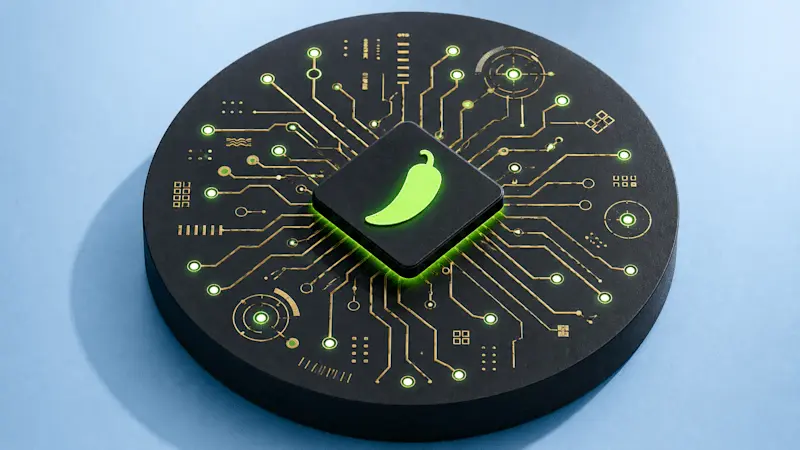
. Based on available imagery, the chip features a massive compute chiplet measuring approximately 840 mm² surrounded by six HBM modules, approaching the reticle size of EUV lithography systems4
.
Source: VentureBeat
Reducing Dependence on Nvidia Through Vertical Integration
The Jalapeño chip represents a strategic move by OpenAI to reduce its dependence on Nvidia GPUs, which are in limited supply amid a global compute crunch
1
. OpenAI president Greg Brockman explained the company's approach, stating they have been looking for specific workloads that are underserved and asking how they can build something to accelerate what's possible2
. The company hopes to ultimately own the full stack behind its models and products, from chip architecture and kernels to memory systems, networking, scheduling, deployment systems, and product experience2
. This vertical integration strategy aims to make models faster, more reliable, and more affordable for users2
.
Source: Decrypt
Purpose-Built for Inference, Not Training
Unlike general-purpose AI accelerators, the Jalapeño chip is specifically designed for inference—the process of running pre-built AI models in response to user commands—rather than training
2
. OpenAI emphasizes the chip's low operating cost when running real-time coding models, though more performance-intensive tasks like pre-training will likely still rely on Nvidia hardware2
. The architecture addresses practical bottlenecks that matter for inference at scale, including costly data movement, balance between compute and memory resources, networking efficiency, and overall behavior4
. The design aims to wed high throughput with low latency, which will be particularly useful for reasoning and agentic AI workloads4
.Related Stories

Deployment Timeline and Competitive Landscape
Both OpenAI and Broadcom claim that Jalapeño chips will be deployed in data centers by the end of 2026
1
. The chip is positioned as the first step in a multi-generation compute platform3
. OpenAI joins other tech giants like Microsoft, Meta, Amazon, and Google who have launched custom-designed AI chips to power their servers for either training or inference3
. While Broadcom has been a successful chipmaker for compute infrastructure, it has seen substantial movement recently building new business around providing custom silicon to hyperscalers and teams building frontier models during the AI boom1
. The move toward custom silicon reflects the industry's efforts to squeeze out more compute capacity amid limited data center capacity1
.AI-Assisted Design and Economic Implications
In a notable twist, OpenAI's own AI models assisted in the development of the Jalapeño chip, with the company using its models to accelerate parts of the design and optimization process
5
. This marks a significant milestone where AI is now helping design the chips it will run on. Optimizing inference costs could prove crucial for AI economics going forward, potentially improving OpenAI's bottom line2
. However, questions remain about funding this capital-intensive initiative, given that OpenAI reportedly ran an operating loss of over $20 billion last year according to leaked financials5
. A detailed technical report on Jalapeño's performance will be presented in the coming months1
.References
Summarized by

Navi
[2]
[3]
[5]
Related Stories
OpenAI's Jalapeño chip outperforms Nvidia Blackwell in AI inference benchmarks, deployment begins 2026
25 Aug 2026•Technology

OpenAI Develops First In-House AI Chip in Collaboration with Broadcom and TSMC
30 Oct 2024•Technology

OpenAI Partners with Broadcom to Develop Custom AI Chips, Challenging Nvidia's Dominance
05 Sept 2025•Technology

Recent Highlights
1
Microsoft and Nvidia Launch Surface Laptop Ultra: A $2,599 AI-Ready PC With RTX Spark Chip
Technology

2
Scientists Build AI Model That Reconstructs Images From Brain Scans in Record Time
Science and Research

3
Anthropic AI Cuts Live Internet Access After Model Sends False Homicide Tip to Philadelphia Police
Technology

Recent Highlights
Today's Top Stories





Don’t drown in AI news. We cut through the noise - filtering, ranking and summarizing the most important AI news, breakthroughs and research daily. Follow topics that matter to you and stay ahead.


