14 Sources
[1]
OpenAI launches ChatGPT Work as it broadens GPT-5.6 rollout
The enterprise AI agent combines ChatGPT, Codex, and GPT-5.6 to automate workplace tasks as OpenAI broadens rollout of its latest frontier models. OpenAI is sharpening its enterprise AI strategy with the launch of ChatGPT Work, a new agentic platform designed to automate workplace tasks, alongside the broader rollout of its GPT-5.6 models, which the company says deliver stronger performance at lower operating costs. According to the company, ChatGPT Work can operate across applications and files, execute long-running tasks, coordinate multiple tools, and produce business documents, presentations, spreadsheets, and websites, allowing employees to delegate more complex workflows rather than interact through individual prompts. GPT- 5.6 models, generally available weeks after a limited preview following US government restrictions on their broader rollout due to concerns about advanced cybersecurity and biology capabilities, can deliver stronger performance across coding, enterprise knowledge work, cybersecurity, and scientific research while lowering inference costs and token consumption, OpenAI said.
[2]
OpenAI launches an AI agent built to automate your entire job
The new agent can gather context across apps, files, and workflows to create documents, spreadsheets, and presentations. After a short preview period, OpenAI is officially debuting GPT 5.6. With GPT 5.6, the company is releasing three models: Sol, Terra, and Luna. But that's not the only reveal the company has today, as it also introduced ChatGPT Work. Today, OpenAI announced the launch of ChatGPT Work. This new agent is designed to gather context across apps, files, and workflows to create documents, spreadsheets, and presentations. ChatGPT Work will work on mobile, web, and desktop.
[3]
OpenAI introduces ChatGPT Work, a cloud-based AI agent that manages tasks across email, Slack and calendars
OpenAI on Thursday launched ChatGPT Work, a new AI agent embedded inside its flagship chatbot that aims to transform ChatGPT from a question-and-answer tool into an autonomous work platform capable of executing complex, multi-step tasks across users' email, calendars, code repositories, and messaging apps. The product is powered by OpenAI's latest flagship model, GPT-5.6, and is designed to go far beyond generating text. ChatGPT Work can gather context from connected apps, files, and workflows to produce finished documents, spreadsheets, presentations, reports, and websites. The agent takes a stated outcome, breaks it into smaller steps, and stays with complex projects for hours, completing them independently. The launch marks OpenAI's clearest attempt yet to reposition ChatGPT as a workplace platform rather than a chatbot -- and it arrives at a moment of extraordinary financial significance for the company. Last month, OpenAI confidentially submitted a draft S-1 registration statement to the SEC, initiating what could become one of the largest technology IPOs in history, with reported valuations clustering between $730 billion and $852 billion and annualized revenue that has blown past $25 billion. In a short demonstration and conversation with VentureBeat on Friday, Ty Geri, a product manager at OpenAI who helped build ChatGPT Work, said the product's mission is to democratize the kind of agentic AI capabilities that OpenAI's internal engineering tool, Codex, has already demonstrated. "What's really exciting is we've seen how much Codex has been able to push the frontier of what we can get done with these AI tools, as opposed to just getting information or answers or guidance," Geri said. "Our internal adoption of Codex is literally an exponential curve across every single product function and every single use case." Why OpenAI built a persistent virtual machine that works from the beach The core architectural bet behind ChatGPT Work is a persistent cloud-based virtual machine that runs on OpenAI's servers, always available to the user regardless of which device they happen to be on. That marks a deliberate departure from competitors whose agents require a local machine to remain powered on and connected. "What's really exciting about ChatGPT Work is that it's a virtual machine in the cloud that's always on for you, and this is available across all of our paid tiers," Geri said. "All Plus users are getting this. I think that's a very unique aspect of this." The mobile-first aspect of the launch is something Geri described as "missing from the market." He pointed to the ability to create a website on a phone and share it with collaborators as a particularly novel capability. "Sites are new in general to Codex. They launched in Codex about a week and a half ago, but now we're launching also in web and mobile. You can create a site on your phone at the beach and share it with your friends," he said. ChatGPT Work will roll out beginning with Pro, Enterprise, and Edu users, and will expand to Plus and Business users over the next few days. In the interview, Geri emphasized that the availability of the product to Plus subscribers -- not just premium tiers -- is central to OpenAI's strategy. "It's accessible to all paid plans, including Plus users, which in my opinion is a really big feat, and really part of that OpenAI mission, which is about bringing all this power to as many people," he said. How MCP plugins connect ChatGPT Work to Slack, Gmail, and GitHub The product relies on MCP-based plugins to connect to external services like Gmail, Google Calendar, Slack, and GitHub. When asked whether the plugin architecture is based on the Model Context Protocol standard, Geri confirmed: "These are all based on MCP." He added that connecting multiple Gmail accounts -- a frequent user request -- "is definitely on the roadmap." The experience is designed to be action-oriented from the first interaction. ChatGPT Work offers a personalized onboarding flow that surfaces different suggested use cases depending on the user's role. Geri demonstrated how the system, detecting his role as a product manager, immediately suggested tasks like evaluating AI systems, building research artifacts, and managing his calendar. "You can start with a simple task like catch me up on Slack or Teams or read today's calendar," Geri said. He described a scenario where the system reviewed his calendar, identified scheduling conflicts, flagged meetings requiring preparation, and then -- on his instruction -- declined, accepted, or rescheduled events directly. Users can also customize the agent by teaching it their writing style, organizing outputs into projects, and -- in a lighter touch -- choosing a virtual pet that accompanies them in the interface. The interface also introduces a hosted website feature that allows users to build and share interactive sites directly through ChatGPT Work, turning what would typically be a static slide deck into a dynamic, collaborative artifact. "Now we suddenly have a collaborative interface that's actually more exciting and more accessible than a slide deck, which has all these formatting restrictions," Geri said. Scheduling 10 bug bashes at once: what agentic productivity looks like in practice Geri's own usage of ChatGPT Work illustrates the breadth of tasks the system can handle. In the run-up to the product's launch, he needed to organize pre-release testing sessions -- known internally as "bug bashes" -- across dozens of features and team members. "I just come to ChatGPT Work and say, 'Set up a bug bash for all the distinct features in ChatGPT Work. Add all the people that worked on that feature,' and it can check Slack, it can check GitHub, it can check Docs, and find a time that works for the four highest contributors to that feature," Geri said. "It went and scheduled 10 bug bashes, all coordinated across all those different people. That would have taken me 30 minutes at least." But Geri pushed back against the characterization that ChatGPT Work is limited to rote administrative work. He described using it for analytically complex tasks like identifying the biggest causes of user churn for specific product features and generating product solutions -- work he said would previously have taken months. "Things that we would have spent three months doing, we can now spend a week doing -- and do much more, and make a much better product," Geri said. "Bugs that we would have found three or four weeks from now, we can now find within two days and fix for our users." He also described handing off the tedium of product testing itself. "It used to be that even though like the most interesting part of my job is like what to test, I would actually end up having to spend most of my job doing the testing, which is like me taking a mouse and like clicking on the same thing over and over again, like five times," Geri said. "Instead, now I can define what do we want to test, and ChatGPT Work or Codex can actually go test it for me, deliver me that bug report, and then we can work on fixing that bug." What OpenAI says about data privacy when AI reads your Slack and email When pressed on data privacy concerns -- given that ChatGPT Work pulls sensitive information from workplace tools like Slack, Google Drive, and email -- Geri said privacy "is incredibly important, and the most important part of this is it's always in the user's control." He pointed to OpenAI's existing enterprise security infrastructure, noting that "enterprise accounts have ZDR, and users can always opt out of letting their conversations help improve future models, which many users do." The comment aligns with assurances OpenAI made when it first launched ChatGPT Enterprise in August 2023, when the company wrote in a blog post that it does "not train on your business data or conversations." The privacy question carries additional weight now because of the sheer volume of sensitive workplace data ChatGPT Work is designed to access. Unlike a chatbot session where a user voluntarily pastes text into a prompt, ChatGPT Work actively reaches into connected systems -- reading Slack messages, scanning calendar invitations, pulling GitHub commit histories -- to assemble context for its tasks. That represents a fundamentally different data surface area than anything OpenAI has offered before, and one that enterprise security teams will scrutinize carefully before granting access. ChatGPT Work enters a three-way arms race with Anthropic and Microsoft ChatGPT Work lands squarely in the middle of what has become the defining competitive battlefield in enterprise AI: the race to build autonomous workplace agents that can go beyond generating text and actually execute tasks. The product arrives months after Anthropic took Claude Cowork out of preview and into general availability in April, bringing its AI agent to web and mobile platforms aimed at helping enterprise users monitor and manage long-running AI-driven tasks from anywhere. Meanwhile, Microsoft made Copilot Cowork generally available worldwide on June 16, built in partnership with Anthropic to move beyond chat and into execution. The three products -- ChatGPT Work, Claude Cowork, and Microsoft Copilot Cowork -- now compete directly for the attention of enterprise IT departments and individual knowledge workers alike. The convergence is striking. All three products share a remarkably similar vision: a persistent AI agent running in the cloud that can break complex tasks into steps, connect to workplace tools via plugins, and produce finished outputs rather than just conversational replies. All three work across desktop, web, and mobile. What distinguishes OpenAI's approach is its raw consumer distribution advantage. ChatGPT has reached 900 million weekly active users, and OpenAI now has 50 million paying subscribers. More than 9 million paying business users rely on ChatGPT for work, and 92% of Fortune 500 companies now use ChatGPT. By making ChatGPT Work available to Plus subscribers at $20 a month -- not just Enterprise or Pro customers -- OpenAI is betting that broad accessibility will drive adoption faster than any competitor can match. OpenAI's product manager says AI is a partner, not a replacement -- with a caveat When asked about the potential impact on the labor market, Geri was careful with his framing. He declined to speak broadly about workforce disruption but offered his personal experience as a product manager whose day-to-day work has been substantially reshaped by the tool. "My job is not to schedule bug bashes and find out who contributed to a specific feature. That's a task I do in my job, but that's not my job," Geri said. "My job is to make an amazing product." He described ChatGPT Work as "a partner" and "an extension of me, certainly not a replacement," adding: "Everybody feels far more productive than before, but is also almost working harder than before, because you get to work on all the things you want to work on as opposed to the drudgery around it." But Geri was also careful not to minimize the sophistication of the work the agent can handle. "I also don't want to say that it's only doing mundane tasks because, like something like hill climbing retention curves on a given feature is not mundane. It's actually really hard to do," he said. The distinction matters. If ChatGPT Work were merely automating calendar invitations and expense reports, it would be a convenience tool. The fact that Geri describes it compressing three months of analytical product work into a single week suggests something with far greater implications for how teams are structured and staffed. An IPO-bound company needs ChatGPT Work to prove enterprise AI can generate revenue The timing of ChatGPT Work's launch is impossible to separate from OpenAI's IPO trajectory. The company needs to demonstrate that it can convert its massive consumer user base into durable enterprise revenue -- a narrative that becomes significantly more compelling with a product explicitly designed around professional workflows. OpenAI said it is generating $2 billion in revenue per month, growing four times faster than Alphabet and Meta did at comparable stages, with enterprise now making up more than 40% of revenue and on track to reach parity with consumer by the end of 2026. But OpenAI remains heavily loss-making, and the company does not expect to reach profitability until around 2030, with internal projections suggesting losses of $14 billion in 2026 alone. The competitive dynamics are unprecedented. Anthropic filed for its own IPO on June 1 at a $965 billion valuation, setting up simultaneous public listings from the two most prominent AI startups in history. Whether both can sustain their lofty valuations under the scrutiny of public market investors will depend in large part on whether products like ChatGPT Work and Claude Cowork deliver measurable productivity gains to paying enterprise customers. The launch also caps a product trajectory that began with ChatGPT Enterprise in August 2023, accelerated through the release of OpenAI's Operator agent in January 2025, and continued through Operator's deprecation and shutdown on August 31, 2025, when its capabilities were folded into the ChatGPT agent framework. ChatGPT Work is the consolidation of those efforts into a single, unified product -- one that pairs GPT-5.6's three model variants (Sol for power, Luna for speed, and Terra for balanced everyday use) with a persistent cloud environment and an expanding library of MCP plugins. The future of work may already be running in the cloud When asked whether ChatGPT Work signals a shift toward a new kind of operating system -- one where users interact with their computers primarily through an AI agent rather than through traditional mouse-and-keyboard interfaces -- Geri stopped short of making sweeping predictions. But he hinted at the direction OpenAI sees ahead. "Anybody who has worked with Codex or now ChatGPT Work will realize how exciting it is to interact with your environment and your computer via the agent," he said. "Especially in the desktop app, where the model has access to your entire machine and can interact with websites on your behalf -- it's really able to be an extension of you and a real partner, and that certainly feels like the future." At the end of the interview, Geri circled back to something personal. "I've never enjoyed work as much as I have in the last month using ChatGPT Work and Codex," he said -- a striking admission from a product manager who, until recently, spent a meaningful share of his days clicking through the same interface five times in a row just to see if it would break. OpenAI is now asking 900 million users to believe that feeling scales. For a company weeks away from one of the largest public offerings in history, the answer to that question is worth roughly $850 billion.
[4]
ChatGPT's paradox of choice
Why it matters: Evolving AI tools can now help non-coders deliver more work better, faster and cheaper -- if those workers can determine the "just right" settings for their use case. The big picture: OpenAI released three GPT-5.6 models last week and introduced ChatGPT Work, an agent for longer multi-step tasks, inside its newly unified ChatGPT app. * ChatGPT Work can use connected apps and files to research, analyze information and create documents, spreadsheets, presentations, reports and websites. * The new desktop app folds Codex, chat and Work into one place. It's the new place to delegate tasks and open separate chat windows to brainstorm. * ChatGPT Work is also available inside the ChatGPT mobile app, so you can control your tasks while you're away from your computer. * Non-coders and people who don't want to use AI to write software don't need Codex at all. Yes, but: If you are a developer who uses AI to build software, don't freak out. The Codex desktop app isn't going anywhere, per OpenAI engineering lead Thibault Sottiaux. Zoom in: The three new GPT-5.6 models are Sol, Terra and Luna. * Sol is the flagship model. It's only available to Plus, Pro, Business and Enterprise users. You can't use it on free plans or if you're logged out of your account. * Terra is meant to strike a balance between speed and power. * Luna is designed for speed. Free and $8 Go users get Terra only -- and only inside ChatGPT Work and Codex. In regular chats, those users are still on the older default model. Between the lines: Eligible paid users can pair Sol, Terra or Luna with different reasoning settings. * Reasoning means how much thinking you want ChatGPT to do for your task. The higher the reasoning effort, the longer the task will take and the more quickly you'll reach your usage limits. * No matter what model you use, start with the best model available to you with the lowest reasoning setting. If you're not satisfied with the results, increase the reasoning setting. By the numbers: Developer Simon Willison priced out the new models and compared them to Anthropic's models. * Per one million input/output tokens Luna costs $1/$6, Terra costs $2.50/$15 and Sol costs $5/$30. * Claude Opus series are $5/$25 and Claude Fable 5 is $10/$50. Reality check: With the new reasoning levels, OpenAI and Anthropic's prices no longer tell the whole story, Willison argues. * For the past few years Willison has tested models with a benchmark of how well they can generate an image of a pelican riding a bicycle. * He compared the models, reasoning efforts and the cost of input and output tokens in a page with illustrations of 18 different pelicans. * What Willison found was that identical prompts can cost 71 cents or 48.55 cents depending on model and effort. Your settings will determine your bill. Zoom out: To find the right model for your work, OpenAI recommends starting with a task you already know well. This will make it easier to judge where ChatGPT Work succeeds, goes astray or needs more help from you. What we're watching: Whether OpenAI can turn today's maze of choices into a "set it and forget it" experience that brings agentic work to the masses.
[5]
OpenAI unveils ChatGPT Work, an AI tool capable of handling workloads across finance, data analytics, engineering, and more
* OpenAI has introduced new agentic ChatGPT Work tools for all users * The tool is powered by the latest GPT-5.6 model and Codex * Could this be the app's unofficial evolution into a superapp? OpenAI has lifted the wraps off a new agentic tool within ChatGPT to help workers "take on more ambitious tasks," covering workflows like gathering information, creating finished materials and handling long-running autonomous tasks. The new tool, called ChatGPT Work, marks a shift in how knowledge workers are set to use AI, evolving from generative AI to autonomous agentic AI. ChatGPT Work, largely seen as an interface for knowledge workers, brings together tools like the company's latest frontier model GPT-5.6 and Codex. ChatGPT Work is an autonomous knowledge worker's dream In an announcement, the company noted how Codex was born out of the need for coders and developers to get access to agentic capabilities, but now, more than a million non-coding workers use it for other tasks. The company also declared that nearly all of its internal teams use Codex and ChatGPT Work to speed up their workflows. All users running the app on their macOS or Windows desktop can get access to ChatGPT Work for free, including non-paying subscribers. Pro, Enterprise and Edu plans will get mobile and web access first, but Plus and Business plans will get access within days. Further aiding ChatGPT Work's autonomy, the tool also works with third-party plugins via the '@' command to obtain further context and access to working files. More broadly, as the app evolves into a superapp to combine all of OpenAI's tools in one workspace, desktop users can now grant the client permission to control the computer on their behalf, similar to Anthropic's Claude Code. "This is the first step towards a broader vision for ChatGPT," the company summarized, "where intelligence goes beyond answering questions to helping everyone turn their biggest ideas into reality." Follow TechRadar on Google News and add us as a preferred source to get our expert news, reviews, and opinion in your feeds.
[6]
ChatGPT can now finish what you started, and that's a much bigger deal than it sounds
Just a few minutes after unveiling its new GPT-5.6 family -- Sol, Terra, and Luna -- OpenAI is back with another announcement. This time, it's introducing ChatGPT Work, a new AI agent designed to do more than answer questions. Instead of helping with one task at a time, it can take on entire projects that span multiple apps, documents, and services. If you've ever spent an afternoon jumping between different apps just to finish a single assignment, ChatGPT Work is trying to eliminate that back-and-forth. The idea is to describe the end goal and figure out the steps in between. Give it a goal, then get out of the way Powered by GPT-5.6, ChatGPT Work can connect to the apps and files you choose, gather the information it needs, and produce completed work instead of just suggestions. That could mean drafting a report, building a spreadsheet, creating presentation slides, or even putting together a simple web app without you having to micromanage every prompt. OpenAI says the experience works best with real-world jobs people already spend hours doing. Imagine asking it to review last month's business expenses or gather everything you need before an important client meeting. Rather than starting from scratch every few minutes, you can watch the agent work, answer questions as needed, redirect it midway, or approve actions before it proceeds. The company is also pitching ChatGPT Work as capable of handling long, connected workflows. For example, it could analyze customer feedback, turn those findings into a marketing strategy, generate the supporting assets, and then adapt everything for different audiences without losing track of what happened in earlier steps. Though, your AI doesn't clock out when you do Perhaps the most interesting feature is that it doesn't necessarily stop when you close ChatGPT. Using Scheduled Tasks, Work can continue running in the background, checking connected services like Slack or Microsoft Teams for new information, updating documents or presentations automatically, and notifying teammates when something important changes. In theory, you could assign work before leaving the office and come back to a project that's already moved forward. That's a notable shift from the AI assistants most people are familiar with today. ChatGPT Work is rolling out starting today on the web and mobile apps for Pro, Enterprise, and Edu subscribers, with Plus and Business users expected to gain access over the coming days. OpenAI is also releasing an updated ChatGPT desktop app for both Windows and macOS, bringing Chat, Work, and Codex together in one place. While the desktop app is available across all ChatGPT plans, including the Free tier, access to the new Work agent itself will depend on your subscription.
[7]
OpenAI debuts ChatGPT Work, an agentic tool for automating business workflows
OpenAI debuts ChatGPT Work, an agentic tool for automating business workflows OpenAI Group PBC today launched a new "agentic" tool called ChatGPT Work as it announced the global rollout of its most advanced model family so far in GPT-5.6. ChatGPT Work is a new mode within ChatGPT that's designed to perform actions autonomously across user's connected applications, files, web tools, desktops and recurring workflows. It's meant to expand ChatGPT's capabilities, so it goes beyond simply answering prompts to executing more complex tasks. For instance, it can be used to create new spreadsheets, slide presentations, documents, dashboards, web applications and other content from a single prompt. In a blog post, OpenAI said ChatGPT Work is initially being made available to Pro, Enterprise and Edu subscribers through its web and mobile applications. Pro and Business tier users will get access in the "coming days." Meanwhile, the updated ChatGPT desktop app has been made globally available on Windows and Mac computers, integrating the basic Chat and Codex experiences with Work into a single service that's accessible across all plans, including for free users. As part of the update, the Codex app will now live within the ChatGPT desktop app. ChatGPT Work is powered by GPT-5.6, which is OpenAI's latest frontier model, also announced today. It incorporates the complete Codex experience to enable multistep execution of any tasks with a coding element. According to OpenAI, the new work-based app has the ability to decompose larger goals and break them down into smaller tasks and work on them over extended timeframes, seeing guidance from human users when necessary. Before it carries out "sensitive actions," it will ask a human for approval. One of the most impressive things about ChatGPT Work is its available armory, with plugins for tools such as Slack, Microsoft Teams, Gmail, Google Drive, Salesforce, Sharepoint, calendars, project tracking and management tools and other work-related platforms. Users can invoke any specific applications they want the agent to use simply by typing "@" and the name of its plugin. Alongside ChatGPT Work, the company also debuted a new capability called Sites in public beta for Plus, Pro, Business and Enterprise subscribers. This makes it possible to transform work materials into shareable, interactive websites or web apps, and encompasses internal portals, dashboards, calendars, project trackers, prototypes and interactive reports. ChatGPT can test these sites and update them automatically whenever the source information changes. In another update, OpenAI said the ChatGPT application now gets its very own integrated browser with Computer Use functionality. This makes it easier for ChatGPT to get context from the internet, access and use browser-based tools and navigate across Google Workspace and Microsoft 365. Meanwhile, the ChatGPT Chrome extension is being enhanced, so that ChatGPT is now positioned in the sidebar. OpenAI said ChatGPT Work is aimed at knowledge workers, enterprises, students, developers and business executives that need their AI tools to do more than just respond to isolated queries. In its lengthy blog post, it offered examples of how the new tool might be put to use in areas such as sales, marketing, finance, data analytics, engineering and business operations. Workers at companies such as Nvidia Corp., Zapier Inc., RingCentral Inc. and Virgin Atlantic Airways Ltd. have been using ChatGPT Work for some time in its beta testing phase. Use cases include reviewing thousands of sales leads, checking new products for launch readiness across Jira and go-to-market plans, comparing airline passenger experiences and automating event preparation for Nvidia GTC 2026. Organizations who have reason to be worried about unleashing AI agents across their systems can use ChatGPT Enterprise controls to manage ChatGPT Work's access to browser use, plugins, connected tools and more. They can preauthorize what sensitive actions it's allowed to take, implement usage limits and so on, OpenAI said. GPT-5.6 now broadly available Chief Executive Sam Altman said the GPT-5.6 model family is being made available in three variants, with the flagship offering Sol designed for advanced reasoning and coding tasks. The other two, Terra and Luna, are targeted at enterprise workloads and high-volume, low-cost applications that need less processing punch. Altman told CNBC in an interview that GPT-5.6 shows a 54% improvement in token efficiency compared to its predecessor GPT-5.5 when carrying out agentic coding tasks. That could significantly reduce the costs of using ChatGPT for automated software development. Agentic coding has emerged as one of the most critical enterprise use cases for AI tools, enabling anyone to create software using only natural language prompts. The 54% improvement in token efficiency means that GPT-5.6 will use fewer tokens than older models. Tokens are the units used by AI systems to process and generate text, and when a model uses lower amounts of them, it means reduced computational costs. "Every enterprise now is thinking about spend and the value they're getting in exchange for AI, and this is what we really want to do," Altman said. The launch of GPT-5.6 comes at a pivotal moment for OpenAI, which is facing intensifying competition from rivals such as Anthropic PBC, SpaceXAI Corp. and Google LLC. Elon Musk's company released its own new model, Grok 4.5, just a day earlier, and that also delivered a big improvement in token efficiency in order to encourage further enterprise adoption. GPT-5.6's launch was notable because the model was heavily scrutinized by the U.S. government before being made available to the public. The review process was overseen by officials such as the Treasury Secretary Scott Bessent, Commerce Secretary Howard Lutnick and U.S. National Cyber Director Sean Cairncross. According to Altman, GPT-5.6 was reviewed in a "collaborative" process, which involved the company working with federal agents to address a number of questions regarding its safety. "If you want broad access, which we do, and you have powerful models, you really want to be confident in your safety claims," Altman said. "Because otherwise the world is going to get uncomfortable very fast."
[8]
OpenAI unveils long-awaited 'super app' as rivalry with Anthropic intensifies
OpenAI introduced ChatGPT Work, an AI agent for professionals, on Thursday. This new tool combines chatbot and coding capabilities for document creation. It utilizes the advanced GPT-5.6 model, which debuted the same day. ChatGPT Work aims to offer a more affordable and accessible alternative to rivals. The launch signifies growing competition in the enterprise AI tools market. OpenAI showcased a new AI agent on Thursday meant to help white-collar workers access the power of coding tools without the sticker shock. The agent, called ChatGPT Work, combines OpenAI's popular chatbot with its AI coding tool, Codex, to create documents, presentations and websites, the company said. The service is powered by OpenAI's most advanced AI model, GPT-5.6, which also debuted on Thursday. That model's launch was delayed last month at the U.S. government's request over national security fears. ChatGPT Work is a direct answer to Anthropic's Claude Cowork, an agent it launched in January that is capable of planning and executing multi-step tasks autonomously. The launch reflects intensifying competition to build and sell AI tools for professional use, as technology companies seek to capitalize on rising demand for autonomous agents that can complete complex tasks with minimal human input. Anthropic and OpenAI - both of which are preparing for possible public offerings soon - are fighting for enterprise business, which is more lucrative than selling products to consumers. Both ChatGPT Work and Claude Cowork are designed for non-coders who want to tap into the abilities of AI coding tools, which are often more capable than standard chatbots but require specialized knowledge. OpenAI officials emphasized that its new offerings would be both cheaper and more broadly available than its rivals' products. The company launched three different sizes of its 5.6 model. "You can apply the model's ability to code to solve problems across every industry," said Ty Geri, product manager for ChatGPT Work, in an interview. Geri described OpenAI's 5.6 model as "competitive with models that are far, far more expensive at twice the speed and much, much cheaper." Thursday's announcement also underscores a growing concern among companies about the high cost of using such AI tools. Max Weinbach, analyst at consulting firm Creative Strategies, said the smallest version of OpenAI's new model can complete a task about as well as the largest version -- but at one-fifth of the cost. "This is the first time where I've seen the small models complete these kinds of tasks," he said. Before this launch, OpenAI's agentic offerings included Operator and deep research, later consolidated into ChatGPT Agent for individual users, as well as Workspace Agents for enterprise workflow automation. ChatGPT Work will roll out on Thursday on web and mobile, beginning with Pro, Enterprise, and Edu users, and will expand to Plus and Business users over the next few days. OpenAI also announced a new ChatGPT desktop application and a hosted websites feature to let users build and share websites directly through ChatGPT Work.
[9]
New ChatGPT 5.6 Work Prompts to Improve Your Daily Productivity
ChatGPT Work is a productivity-focused update from OpenAI that introduces three specialized models, Sol, Terra and Luna, designed to handle a variety of tasks with precision. For instance, the Sol model is tailored for complex problem-solving, making it particularly useful for coding or in-depth reasoning, while Luna is optimized for speed, excelling at simpler, time-sensitive projects. As outlined by Skill Leap AI, these models, combined with features like a desktop app for accessing local files, offer practical solutions for both personal and professional workflows. Explore how ChatGPT Work simplifies task management through centralized command centers that connect with platforms like Gmail and Slack for streamlined communication. Learn how it generates professional-grade presentations and advanced spreadsheets equipped with data analysis capabilities. Gain insight into its potential for automating repetitive processes and supporting strategic planning across diverse projects. What is ChatGPT Work? ChatGPT Work is OpenAI's latest innovation, designed to function as an autonomous assistant capable of managing a wide array of tasks with minimal input. Whether you need to draft a detailed overview, create a marketing strategy, or design a hosted website, ChatGPT Work delivers polished, professional results. Its seamless integration with tools like Gmail, Slack and calendars, combined with the ability to access local files, makes it a versatile solution for both personal and professional use. Key outputs include: * Professional-grade reports, memos and presentations for business or academic purposes. * Advanced spreadsheets with built-in data analysis and visualization capabilities. * Custom-hosted websites tailored to personal or organizational needs. * Centralized command centers that integrate multiple tools for streamlined workflows. This comprehensive functionality positions ChatGPT Work as a powerful tool for enhancing efficiency and achieving high-quality results. The Advanced AI Models: Sol, Terra and Luna ChatGPT Work introduces three distinct AI models, each designed to cater to specific user needs. These models provide flexibility, allowing you to choose the right balance of reasoning, speed and cost for your tasks. * Sol: The most advanced model, ideal for handling complex tasks such as coding, deep reasoning and intricate problem-solving. It is tailored for professionals who demand high-level precision and output. * Terra: A balanced, versatile model that serves as the default for free accounts. Terra is well-suited for general tasks, offering a mix of capability and efficiency for everyday use. * Luna: The fastest and most cost-effective model, perfect for quick, straightforward tasks. While it may lack the depth of Sol and Terra, Luna excels in speed and affordability, making it ideal for simpler projects. These models empower users to optimize their AI interactions based on the complexity and urgency of their tasks, making sure a tailored experience for every scenario. Find more information on ChatGPT by browsing our extensive range of articles, guides and tutorials. Enhanced Productivity with the Desktop App The new ChatGPT desktop app brings advanced AI capabilities directly to your computer, transforming it into a centralized productivity hub. By allowing seamless access to local files and folders, the app integrates ChatGPT Work into your existing workflows. This allows you to automate repetitive tasks, organize projects and generate outputs without the need to switch between platforms. The desktop app enhances efficiency by consolidating tools and processes into a single, user-friendly interface. Practical Applications of ChatGPT Work ChatGPT Work's versatility is evident in its wide range of real-world applications. Its ability to adapt to various tasks makes it a valuable tool for professionals and casual users alike. Here are some practical ways to use its capabilities: * Website Development: Quickly design and deploy hosted websites for personal, business, or organizational purposes. * Travel Planning: Generate detailed travel itineraries by integrating calendar and email tools for seamless scheduling. * Marketing Strategies: Develop comprehensive, data-driven plans tailored to your business goals. * Presentation Design: Create polished and visually appealing PowerPoint slides with minimal effort. * Centralized Workflows: Use command centers to integrate tools like Gmail and Slack, streamlining communication and task management. These examples highlight how ChatGPT Work can save time, reduce effort and enhance productivity across a variety of domains. Optimizing Your Experience with ChatGPT Work ChatGPT Work offers users the flexibility to choose the most suitable model for their needs. For straightforward tasks, Luna provides a fast and cost-effective solution. For more intricate projects requiring precision and depth, Sol is the ideal choice. Terra, as the default model, strikes a balance between capability and efficiency, making it accessible for general use. Paid plans grant access to all three models, while free accounts are limited to Terra, making sure that the platform remains inclusive and adaptable. Why ChatGPT Work Stands Out In a competitive AI landscape, ChatGPT Work distinguishes itself through its comprehensive features and adaptability. Compared to alternatives like Claude Cowork, ChatGPT Work offers a broader range of outputs, deeper integration with tools and customizable models. These advantages make it a preferred choice for users seeking advanced capabilities and seamless functionality. Its ability to cater to both casual users and professionals further solidifies its position as a leading AI solution. Unlocking the Full Potential of ChatGPT Work To help users maximize the benefits of ChatGPT Work, OpenAI provides a library of over 100 tailored prompts. These prompts cover a wide range of use cases, including creating marketing strategies, designing travel itineraries and more. By using these resources, you can quickly adapt the tool to meet your specific needs, making sure a smooth and efficient user experience. Experience the Future of Productivity ChatGPT Work represents a significant advancement in AI-driven productivity, offering unmatched flexibility, efficiency and functionality. With its advanced models, robust features and intuitive desktop app, it enables users to tackle tasks of any complexity. Whether you are a professional aiming for high-level outputs or a casual user seeking quick solutions, ChatGPT Work provides the tools you need to succeed. Explore its capabilities today and discover how it can transform the way you work. Media Credit: Skill Leap AI Disclosure: Some of our articles include affiliate links. If you buy something through one of these links, Geeky Gadgets may earn an affiliate commission. Learn about our Disclosure Policy.
[10]
ChatGPT Goes From Assistant To Employee As OpenAI Launches Workplace AI Agent - Microsoft (NASDAQ:MSFT)
OpenAI is pushing ChatGPT beyond a question-and-answer tool and deeper into workplace automation with ChatGPT Work. The new AI agent can break down complex assignments, work autonomously over extended periods and generate spreadsheets, presentations, documents and web applications, OpenAI said. It also introduced GPT-5.6, a new model the company says delivers stronger multi-step reasoning, better adherence to templates and improved use of reference materials. The launch comes as AI companies race to win enterprise customers by embedding AI agents into everyday business workflows. Rival Anthropic has made a similar push with Claude Cowork, designed to help users plan and execute complex, multi-step tasks. OpenAI said adoption of its workplace tools has already expanded beyond software developers. The company said Codex, its AI coding agent now integrated into ChatGPT Work, has surpassed 5 million weekly users. More than 1 million people use it for tasks outside traditional programming. The company said finance teams have used the tools to accelerate month-end reporting and forecasting by pulling source data, reconciling figures, building presentations and reviewing outputs. The automation allows employees to spend more time analyzing results and advising leadership rather than preparing reports. The rollout comes as enterprises increasingly experiment with AI agents that can operate across software systems rather than simply generate text. The challenge for companies will be determining how much autonomy to give these systems while maintaining oversight, security and accuracy. The company is also folding the Codex app into the updated ChatGPT desktop experience while renaming the previous desktop client ChatGPT Classic. What's Next OpenAI plans to transition users away from its standalone Atlas browser and expand ChatGPT features through a Chrome sidebar extension. The ChatGPT maker is also pursuing a trillion-dollar IPO, with new reporting suggesting the listing may slip to 2027 as the company burns through cash at a record pace. OpenAI is leaning toward holding off until next year, according to a New York Times report. Advisers reportedly presented Altman with two options: wait until 2027 to reach the trillion-dollar mark, or settle for a smaller number and list in 2026. Altman reportedly called any reduction a "non-starter." This content was partially produced with the help of AI tools and was reviewed and published by Benzinga editors. Market News and Data brought to you by Benzinga APIs To add Benzinga News as your preferred source on Google, click here.
[11]
OpenAI Launches ChatGPT Agent That Executes Complex Workflows | PYMNTS.com
The new ChatGPT Work can take action across the user's apps and files; can spend hours on a project, if needed; and can produce sheets, slides, docs, web apps and other finished materials, the company said in a Thursday (July 9) blog post. ChatGPT Work is powered by a new frontier model that OpenAI rolled out Thursday, GPT-5.6, according to the post. The agent can take on entire workflows with a single request, and it can keep working on projects when the user is away from the computer or phone, per the post. "The best way to learn how to use ChatGPT Work is to give it a task you already know well: analyze a month-end budget variance, turn source materials into a marketing campaign brief, or prepare for a sales meeting," OpenAI said in the post. "You can follow its progress, answer questions, change direction and approve important actions." OpenAI is rolling out ChatGPT Work in phases. On web and mobile app, the agent is rolling out to Pro, Enterprise and Edu plans Thursday and will roll out to Plus and Business plans over the next few days. In the ChatGPT desktop app, it is available on every plan. Speaking of the launch of GPT-5.6, OpenAI CEO Sam Altman said Thursday that one of the new models, GPT-5.6 Sol, is 54% more token efficient on agentic coding jobs and is "as good or better" than competing models on the market. "Every enterprise now is thinking about spend and the value they're getting in exchange for AI, and this is what we really want to do," Altman told CNBC Thursday. It was reported in June that OpenAI was overhauling ChatGPT into a super app by bundling AI agents, coding tools and third-party services into a single platform. Thibault Sottiaux, who oversees all of OpenAI's core product and platform, told the Financial Times that the AI company wants to build "your own personal agent that is capable of helping you across everything in your life, be it personally or at work."
[12]
OpenAI launches ChatGPT Work with GPT-5.6 model By Investing.com
Investing.com -- OpenAI introduced ChatGPT Work on Thursday, a new agent designed to handle complex tasks by gathering information across applications and workflows to create finished materials including spreadsheets, presentations, documents, and web applications. The company also released GPT-5.6, its latest frontier model that powers ChatGPT Work. The model focuses on reasoning through multi-step tasks and creating materials that follow user templates and reference files. ChatGPT Work can complete projects independently by breaking them into smaller steps and working for hours without continuous supervision. The system allows users to follow progress, answer questions, change direction, and approve important actions. The tool supports Scheduled Tasks, which enables ChatGPT Work to continue projects when users are away from their devices. It can turn new messages from Microsoft Teams and Slack into updated documents or slides and share changes with teams. More than 5 million people use Codex weekly, with more than 1 million using it for work outside software development. Codex technology is built into the new ChatGPT system. Angela Ferrante, Head of Enterprise Marketing at Zapier, said the company used ChatGPT Work to build a system for reviewing thousands of leads monthly. It traced customer touchpoints across Zapier's CRM, email, and other tools, and generated a weekly executive dashboard that revealed seven figures in potential sales. Nearly 100% of teams inside OpenAI, including finance and sales, now use ChatGPT Work and Codex. In sales, the tool turned a discovery conversation into a tailored proof of concept within 24 hours, a process that normally takes weeks. In finance, it reduced month-end close and forecasting from days to hours. The ChatGPT desktop app now includes Work and Codex capabilities. The Codex app is merging with the new ChatGPT desktop app, maintaining the same coding agent functions for developers while adding new capabilities including inline editing within diffs, pull request review, and support for multiple repositories in a single project. ChatGPT Work connects to applications and systems through plugins, including Slack, Microsoft Teams, Google Drive, SharePoint, email, calendars, and CRMs. Users can direct ChatGPT to pull context from specific apps by typing "@" followed by the app name. OpenAI also introduced Sites in public beta, which allows users to turn work or ideas into interactive sites or web apps that can be shared through a URL. Sites can create live dashboards, project trackers, launch calendars, prototypes, internal portals, and interactive reports. On desktop, ChatGPT includes a built-in browser to gather information online and use web-based tools. Computer Use lets ChatGPT use computers on behalf of users to execute tasks across apps, tools, and browsers. The company is updating its Chrome extension to enable ChatGPT use directly in Chrome's sidebar. OpenAI will sunset the standalone Atlas browser and will share transition information with users. Enterprise and Edu administrators can manage who has access, what company context ChatGPT can use, which tools it can connect to, and what actions it can take. The Compliance API provides visibility into ChatGPT Work conversations and actions. Auto-review uses OpenAI's models to review important actions involving connected tools and APIs before they happen. During adversarial red teaming, auto-review blocked 100% of attempts to extract protected data. ChatGPT Work is rolling out on web and mobile starting with Pro, Enterprise, and Edu users and expanding to Plus and Business users over the next few days. The updated ChatGPT desktop app is available globally for Mac and Windows, with Chat, Work, and Codex available to users on every plan, including Free. This article was generated with the support of AI and reviewed by an editor. For more information see our T&C.
[13]
ChatGPT Work, OpenAI's new enterprise-focused agent
With this announcement, OpenAI is strengthening its presence in the market for enterprise artificial intelligence tools, where competition is intensifying. The launch comes a few months after Anthropic introduced Claude Cowork, as industry players bet on agents that can carry out multi-step tasks with limited human involvement. OpenAI also unveiled a new desktop app for ChatGPT, along with a feature that lets users create, host, and share websites directly from ChatGPT Work. The service is available now on ChatGPT's web and mobile versions, ahead of a gradual rollout to a broader set of users in the coming days.
[14]
OpenAI introduces ChatGPT Work, an AI agent powered by GPT 5.6 and Codex: Here is what it can do
ChatGPT Work can take action across your apps and files, stay with a project for hours if needed, and turn a goal into finished work. OpenAI has announced ChatGPT Work, a new AI agent that is designed to do much more than answer questions. The company says the new AI agent can take on long and complex tasks, work across different apps, and even create finished files such as documents, spreadsheets, presentations and web apps. It is powered by OpenAI's latest AI model GPT-5.6 and Codex. OpenAI describes ChatGPT Work as an AI agent that can "take action across your apps and files, stay with a project for hours if needed, and turn a goal into finished work." Below is everything you need to know about OpenAI's ChatGPT Work. OpenAI ChatGPT Work: What it can do You can ask ChatGPT Work to take on entire workflows with a single request. For example, it can convert customer research into a marketing campaign brief, use that brief to create marketing material, and then adapt it for different markets while keeping the same context throughout every step. The AI agent also supports Scheduled Tasks, allowing users to automate repetitive work. It can check websites every morning, summarise changes, update presentations when new feedback arrives, or monitor customer feedback and turn it into product ideas. Also read: WhatsApp username row: Meta submits reply to notice, response under examination On desktop, ChatGPT Work includes a built-in browser that can gather information from websites and online tools. OpenAI says the desktop version supports Computer Use, which allows ChatGPT to click, type, move files, and carry out actions on a user's computer in the background. OpenAI has also introduced Sites in ChatGPT in public beta. This feature lets users turn their work into interactive websites or web apps that can be shared with others. "Even when you're away from your computer or phone, ChatGPT Work can keep projects moving forward with Scheduled Tasks. For example, it can independently turn new messages from Microsoft Teams and Slack into updated docs or slides, then share important changes with your team," the company said. Also read: Does GPT 5.6 solve depression? Here is what OpenAI CEO Sam Altman thinks OpenAI ChatGPT Work: Availability ChatGPT Work is rolling out on the web and mobile for Pro, Enterprise, and Edu users. It will reach Plus and Business users over the next few days. OpenAI has also released an updated ChatGPT desktop app for both Mac and Windows. The app includes ChatGPT Work, while the existing desktop app will now be called ChatGPT Classic.
Share
Copy Link
OpenAI has introduced ChatGPT Work, an enterprise AI agent designed to automate complex workplace tasks across applications like email, Slack, and calendars. Powered by the newly released GPT-5.6 models—Sol, Terra, and Luna—the platform enables workers to delegate multi-step workflows while the company positions itself for a potential IPO valued between $730 billion and $852 billion.
OpenAI has officially launched ChatGPT Work, marking a strategic shift from conversational chatbot to autonomous workplace platform. The enterprise AI agent combines ChatGPT, Codex, and the newly released GPT-5.6 models to automate complex workplace tasks across multiple applications and files
1
. According to Ty Geri, a product manager at OpenAI, the platform's mission is to democratize agentic AI capabilities that the company's internal engineering tool has already demonstrated3
.
Source: TechRadar
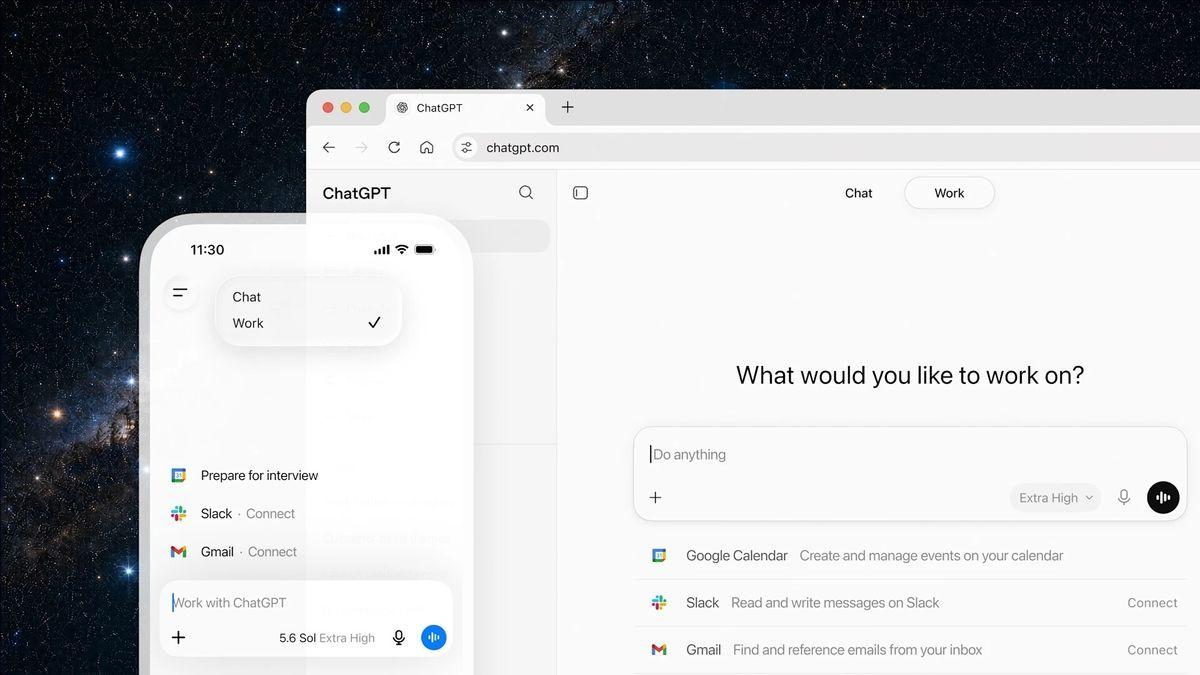
ChatGPT Work can gather context across apps, files, and workflows to create documents, spreadsheets, presentations, reports, and websites
2
. The cloud-based AI agent operates on a persistent virtual machine running on OpenAI's servers, allowing users to access their work from any device without requiring a local machine to remain powered on3
.Alongside ChatGPT Work, OpenAI has broadly rolled out GPT-5.6 after a limited preview period following US government restrictions due to concerns about advanced cybersecurity and biology capabilities. The release includes three distinct models: Sol, Terra, and Luna
2
. Sol serves as the flagship model, available exclusively to Plus, Pro, Business, and Enterprise users, while Terra balances speed and power, and Luna prioritizes speed4
. Developer Simon Willison analyzed pricing across the models, finding that Luna costs $1/$6 per million input/output tokens, Terra costs $2.50/$15, and Sol costs $5/$304
. These models deliver stronger performance across coding, enterprise knowledge work, cybersecurity, and scientific research while lowering inference costs and token consumption.ChatGPT Work represents an agentic AI tool capable of executing multi-step tasks autonomously over extended periods
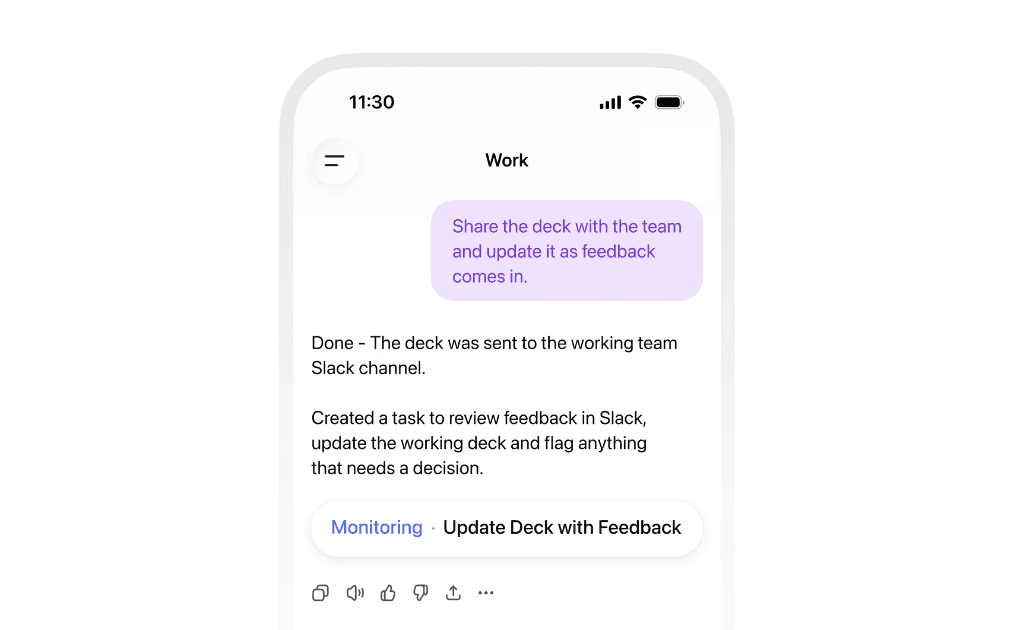
3
. The platform connects to external services like Gmail, Google Calendar, Slack, and GitHub through MCP-based plugins, enabling it to manage tasks across email, messaging apps, and code repositories3
. Geri demonstrated scenarios where the system reviews calendars, identifies scheduling conflicts, flags meetings requiring preparation, and then declines, accepts, or reschedules events directly3
.
Source: SiliconANGLE
The AI agent built to automate your job can handle workloads across finance, data analytics, engineering, and more
5
. Nearly all of OpenAI's internal teams now use Codex and ChatGPT Work to accelerate their workflows, with internal adoption following an exponential curve across every product function3
.Related Stories
ChatGPT Work will initially roll out to Pro, Enterprise, and Edu users, expanding to Plus and Business subscribers within days
3
. All users running the app on macOS or Windows desktop can access ChatGPT Work, including non-paying subscribers5
. Geri emphasized that availability to Plus subscribers—not just premium tiers—is central to OpenAI's mission of bringing AI capabilities to as many people as possible3
. Free and $8 Go users receive Terra only, and only inside ChatGPT Work and Codex, while regular chats still use the older default model4
. The new desktop app consolidates Codex, chat, and Work into one unified workspace, though the standalone Codex desktop app remains available for developers4
.The launch arrives at a moment of extraordinary financial significance for OpenAI. Last month, the company confidentially submitted a draft S-1 registration statement to the SEC, initiating what could become one of the largest technology IPOs in history
3
. Reported valuations cluster between $730 billion and $852 billion, with annualized revenue surpassing $25 billion3
. This potential IPO positions OpenAI to compete more aggressively in the enterprise market against rivals like Anthropic, whose Claude Opus models cost $5/$25 per million tokens and Claude Fable 5 costs $10/$504
. However, Willison argues that with new reasoning levels, prices no longer tell the whole story—identical prompts can cost between 71 cents and 48.55 cents depending on model selection and reasoning effort4
.

Source: VentureBeat
Workers now face what some call a "paradox of choice," needing to determine optimal settings for their specific use cases to maximize efficiency while managing costs
4
. The company recommends starting with familiar tasks to better judge where ChatGPT Work succeeds or requires additional guidance, while industry observers watch whether OpenAI can transform today's complexity into a streamlined experience that brings autonomous workflows to mainstream users4
.Summarized by
Navi
[2]
[3]
[4]