35 Sources
[1]
OpenAI releases GPT-5.5, bringing company one step closer to an AI 'superapp' | TechCrunch
OpenAI on Thursday released GPT-5.5, its newest AI model, which the company calls its "smartest and most intuitive to use model" yet. The algorithm comes with increased capabilities in a multitude of areas, with OpenAI co-founder and president Greg Brockman claiming that it also brings the company one step closer to the creation of OpenAI's "superapp." On a call with journalists, Brockman said that the new model was a big advancement "towards more agentic and intuitive computing." "This model is a real step forward towards the kind of computing that we expect in the future -- but it is one step, and we expect to see many in the future," Brockman said. "It's a faster, sharper thinker for fewer tokens compared to something like 5.4. So this means that there's just more frontier AI available for businesses and for consumers, which is part of our goal." Brockman also said that the model was an additional step toward creating a "superapp" -- a multi-purpose, Swiss Army knife of a program -- which Brockman and co-founder Sam Altman have previously discussed launching. The co-founders envision combining ChatGPT, Codex, and AI browser into one unified service that can aid enterprise customers. Notably, the "superapp" concept is also a hot topic with Altman rival (and former OpenAI colleague) Elon Musk, who has said he wants to turn X (formerly Twitter) into its own so-called superapp. OpenAI released its last model only last month, with a previous release in December and, before that, November. The company has continued to churn out new models at a crisp pace, a trend that company staff said should be expected to continue for the foreseeable future. "We see pretty significant improvements in the short term, extremely significant improvements in the medium term," said Jakub Pachocki, OpenAI's chief scientist. "In fact, I would say, like, I think the last two years have been surprisingly slow." According to OpenAI, GPT-5.5 is designed to be useful across a broad array of categories, including foundational enterprise areas like agentic coding and knowledge work, but also in more experimental AI applications like mathematics and scientific research. The company also released data Thursday showing the model's superior performance across a range of benchmarks. Compared to its previous models, and to models from competitors Google and Anthropic (like Gemini 3.1 Pro and Claude Opus 4.5), 5.5 consistently scores higher, according to OpenAI. OpenAI's rivalry with Anthropic is never far from discussion, and GPT-5.5 offered another opportunity for the two companies to compare themselves to one another. One reporter during the press briefing asked if GPT 5.5. would have capabilities similar to Mythos, the cybersecurity tool recently announced by Anthropic. (Mythos has experienced controversy in recent days due to a report of unauthorized access to the program.) Mia Glaese, a member of OpenAI's technical staff, said that GPT-5.5 would have a significant impact on the company's approach to deploying its models towards digital defense. "We have a strong and long standing strategy for our approach to cyber, and we've refined a durable approach to rolling out models safely," Glaese said. Mark Chen, chief research officer at OpenAI, said that GPT-5.5 was better at navigating computer work than its predecessors, and also said that the model "shows meaningful gains on scientific and technical research workflows," noting that the company feel it could really "help expert scientists make progress." Chen also said it could assist with drug discovery, an area that has shown increased industry interest over the last few years. GPT 5.5. is widely available starting Thursday, according to OpenAI. The company says that the model is deploying to Plus, Pro, Business, and Enterprise users in ChatGPT, while 5.5 Pro is headed to Pro, Business, and Enterprise users.
[2]
ChatGPT 5.5 Is All About Math, Science and AI Research
Exactly seven weeks after releasing ChatGPT 5.4, OpenAI is dropping a new family of models. ChatGPT 5.5 is available now for paying ChatGPT and Codex users, along with thinking and pro versions, with plans to bring it to the API soon. These models are built for work -- specifically, coding, computer use and research. OpenAI President Greg Brockman said GPT-5.5 is more intuitive than previous models and capable of doing more with less human guidance. "It can look at an unclear problem and figure out just what needs to happen next," Brockman told reporters in a briefing. "It really feels like it's setting the foundation for how we're going to do computer work going forward, or how agent computing at scale will work." This is a general model, so anyone can use it. But it's likely going to be the most useful for people doing research or other intensive tasks, like coding. It has agentic capabilities, which means it can independently complete tasks. It scored higher than GPT-5.4 on benchmarks that measure a model's ability to use apps across your computer and solve math problems. OpenAI and other tech companies are trying to build models capable of acting like a true digital assistant that can manage notifications and oversee projects across your entire computer, not just one program. GPT 5.5 is the company's biggest swing at this yet. The company says GPT-5.5 has its strongest cybersecurity safeguards yet, and at launch, it will be more conservative in the requests it allows around cybersecurity. This is because of growing concerns that increasingly cyber-capable AI models can find weaknesses in our existing internet structure. That's why both Anthropic's Claude Mythos Preview and OpenAI's 5.4-Cyber were released to developers to root out problems before a potential public release. For OpenAI, research is a two-way street. GPT 5.5 is part of the foundation of the super app that the company aims to build out of Codex. Research on AI is also increasingly done with the help of AI tools; Brockman said the company used 5.5 (and Codex) to help build itself during the development process. AI has changed how research is done over the past few years, and the field isn't immune to the concerns of other industries that AI may be automating humans out of a job in the future. While GPT-5.5 is OpenAI's most capable research model yet, the company's top scientists and researchers aren't worried about being replaced by AI. Mark Chen, OpenAI's chief research officer, talked about chasing a near-term goal of having humans be the "orchestrators" of research that's heavily assisted by AI. Mia Glaese, vice president of research, said she was hopeful that more capable AI models mean that more research can be done, "raises the threshold of what's worth building." "I feel more productive because the challenge transitions from figuring out the details of the implementation, the low-level abstractions, to the higher-level goals," said Jakub Pachocki, OpenAI's chief scientist. "It allows you to make progress much more quickly and spend your focus, your energy on figuring out, 'What are the important things?'...There is no point in automating things for their own sake."
[3]
OpenAI says its new GPT-5.5 model is more efficient and better at coding
GPT-5.5 will roll out starting Thursday to Plus, Pro, Business, and Enterprise ChatGPT tiers and Codex, with GPT-5.5 Pro coming to Pro, Business, and Enterprise users. The new model is the latest step in an increasingly heated battle between OpenAI and Anthropic as the companies race to potentially go public later this year. Anthropic recently released Claude Opus 4.7 and also announced Mythos Preview, a non-public model it says is uniquely advanced in cybersecurity. OpenAI quickly followed with GPT-5.4-Cyber, its own model trained to flag cybersecurity vulnerabilities. And both companies are competing to corner the market on AI coding and enterprise tools, with OpenAI recently slashing so-called "side quests" in favor of chasing bigger revenue drivers.
[4]
OpenAI Unveils GPT-5.5 to Field Tasks With Limited Instructions
OpenAI is introducing an artificial intelligence model that's intended to be better at completing work without much direction, part of a push to keep pace with rivals like Anthropic PBC in courting business customers. The ChatGPT maker on Thursday unveiled GPT 5.5, a new model that it says is better at aiding scientists, streamlining software development and carrying out more complex tasks. That includes using email, spreadsheets, calendars and other applications to follow a user's commands on a computer. "It just goes and kind of figures it out, deals with ambiguity," OpenAI co-founder and President Greg Brockman said of the model's ability to accomplish tasks without much guidance. "It's a much more intuitive experience." OpenAI and Anthropic are locked in a heated battle to convince a broader mix of businesses to pay for their software and offset the immense cost of building more advanced systems. The two companies are particularly focused on pushing out AI software that is more adept at coding, cybersecurity and scientific applications. Both firms are also expected to move ahead with initial public offerings as soon as this year, adding pressure to bolster revenue. Get the Tech Newsletter bundle. Get the Tech Newsletter bundle. Get the Tech Newsletter bundle. Bloomberg's subscriber-only tech newsletters, and full access to all the articles they feature. Bloomberg's subscriber-only tech newsletters, and full access to all the articles they feature. Bloomberg's subscriber-only tech newsletters, and full access to all the articles they feature. Plus Signed UpPlus Sign UpPlus Sign Up By continuing, I agree to the Privacy Policy and Terms of Service. Anthropic has gained new momentum in recent months, fueled in part by demand for AI coding tools that streamline the process of software development. Earlier this month, Anthropic unveiled a more powerful AI model called Mythos that it said is capable of detecting and exploiting security vulnerabilities in critical software. The company has limited release of that tool to a select group of partners; OpenAI has taken similar steps with its own cyber-focused model. In a briefing with reporters, Brockman stressed that GPT-5.5 is "extremely" good at coding, a lucrative market for AI developers. Brockman also said the model will be used to power a so-called super app that OpenAI plans to launch, bringing together its chatbot, coding tool and web browser. Last week, OpenAI also rolled out an early version of an AI model meant to speed up drug discoveries, joining a field of growing interest for tech companies eager to prove AI can pave the way for more scientific breakthroughs. The new GPT-5.5 model is intended to act as a research partner that can stress-test arguments, OpenAI said. The company also sees it as a step toward eventually automating more AI research. The model will be available to paid users of ChatGPT and Codex, OpenAI's coding product, starting Thursday.
[5]
OpenAI releases GPT-5.5, and you can try it right now
* OpenAI launched GPT-5.5 just weeks after GPT-5.4 -- rapid version churn continues. * GPT-5.5 posts benchmark gains, notably +7% on Thinking with Terminal-Bench 2.0. * Available now in ChatGPT and Codex for Plus, Pro, Business, and Enterprise users. As the LLM competition begins to heat up, we're seeing AI tech companies burn through version numbers like they were made of wood. Any signs of slacking or lagging behind may permanently set the company back behind its peers, so everyone is doing their best to release new models all the time. OpenAI is no exception, and now, the company has just released GPT-5.5. And if you have a strange feeling that GPT-5.4 surely can't be that old, well, you're right; but that hasn't stopped the company from making a new one anyway. Anthropic has revealed Claude Opus 4.7, and you can use it right now It's looking to be a powerhouse Posts By Simon Batt OpenAI has released GPT-5.5, and you can use it right now Well, that was fast Over on X, OpenAI has revealed that GPT-5.5 is now available for general use. It follows hot on the heels of GPT-5.4, which was only just released in early March. It's a similar pattern we're seeing with Anthropic, where a model will barely see its two-month anniversary before a successor steps in. So, just how much can OpenAI do in under two months? Well, in a reply to the original post, the company shared some benchmarks versus its older model, and you can see the results in the image above. The biggest jump was with using Thinking with Terminal-Bench 2.0, with GPT-5.5 taking over 7 percentage points over the previous model. OpenAI also adds some competitor benchmarks into the chart, showing that the company has reason to believe that ChatGPT is either comparable to or beating the opposition. OpenAI says you'll more likely see gains in "agentic coding, computer use, knowledge work, and early scientific research," which the company says are all areas where the AI has to progress step by step to achieve something. If you want to see if the AI model lives up to the claims, you can give it a go today if you're a Plus, Pro, Business, or Enterprise subscriber. It'll appear in both ChatGPT and Codex. OpenAI's new GPT-5.4-Cyber can reverse engineer binaries, and it wants thousands of defenders using it Cybersecurity gets another supporter. Posts By Simon Batt
[6]
OpenAI announces GPT-5.5, its latest artificial intelligence model
Sam Altman, chief executive officer of OpenAI Inc., during a media tour of a Stargate AI data center in Abilene, Texas, U.S., on Sept. 23, 2025. OpenAI on Thursday announced its latest artificial intelligence model, GPT-5.5, which the company says is better at coding, using computers and pursuing deeper research capabilities. The launch comes less than two months after OpenAI released GPT 5.4, the latest sign of the breakneck pace of development that's driving the AI sector. "What is really special about this model is how much more it can do with less guidance," OpenAI President Greg Brockman said during a briefing with reporters on Thursday. "It can look at an unclear problem and figure out just what needs to happen next. It really, to me, feels like it's setting the foundation for how we're going to use computers, how we're going to do computer work going forward." OpenAI is racing to keep up with rivals including Google and Anthropic, whose latest model, Claude Mythos Preview, has captivated Wall Street.
[7]
ChatGPT 5.5 wants to be the one that finally 'gets' you
While pricing is going up, that's at least partially offset by increased efficiency. If you're not the AI company making today's headlines, you're already being left behind, and that's helped fuel some fantastically aggressive release cadences for the biggest platforms around. This week OpenAI is announcing its latest refinements with the introduction of ChatGPT 5.5, built to run faster, be more productive, and maybe most importantly, understand what you're trying to get done without needing a lot of extra correction.
[8]
OpenAI launches GPT-5.5, its first fully retrained base model since GPT-4.5
The model, codenamed "Spud," is designed to complete complex multi-step tasks with minimal human direction. It sets new benchmarks in agentic coding, computer use, and knowledge work, while matching GPT-5.4's per-token latency. API access is delayed pending additional safety work. For months, the AI industry's open secret has been that Anthropic's Claude is winning the enterprise market. OpenAI has been in what internal sources described as a "Code Red" state since at least December 2025, watching Anthropic's ARR sprint from $9 billion to $30 billion while its own B2B positioning eroded. On Thursday, OpenAI responded. GPT-5.5, the company's first fully retrained base model since GPT-4.5, is rolling out to Plus, Pro, Business, and Enterprise users in ChatGPT and Codex. The model is designed to complete work with limited human direction, operating across email, spreadsheets, calendars, and other applications. The core thesis of GPT-5.5 is legibility. Where previous models required carefully structured prompts and multi-step supervision, OpenAI says 5.5 can take a "messy, multi-part task" and independently plan, use tools, check its work, navigate ambiguity, and keep going until the task is finished. The gains are concentrated in four areas: agentic coding, computer use, knowledge work, and early scientific research. OpenAI describes these as domains "where progress depends on reasoning across context and taking action over time." The benchmark numbers are strong. GPT-5.5 reaches 82.7% on Terminal-Bench 2.0, which tests complex command-line workflows requiring planning, iteration, and tool coordination. On SWE-Bench Pro, which evaluates real-world GitHub issue resolution across four programming languages, it scores 58.6%, solving more tasks in a single pass than previous models. On GDPval, which tests agents across 44 occupations of knowledge work, it scores 84.9%. On OSWorld-Verified, which measures whether a model can operate real computer environments autonomously, it reaches 78.7%. On Tau2-bench Telecom, it reaches 98.0% without prompt tuning. Across all of these, OpenAI says GPT-5.5 improves on GPT-5.4's scores while using fewer tokens. The efficiency claim is commercially significant. Larger, more capable models are typically slower to serve, which creates a cost-quality trade-off for enterprise customers. OpenAI says GPT-5.5 matches GPT-5.4's per-token latency in real-world serving, meaning it delivers a step up in intelligence without a corresponding increase in response time. It also uses significantly fewer tokens to complete equivalent tasks in Codex, which directly reduces the cost per task for enterprise deployments. GPT-5.5 is priced higher per token than GPT-5.4, but OpenAI says the net effect is better results for lower total cost in most workflows. The safety framing is notably more cautious than previous launches. OpenAI says it evaluated GPT-5.5 across its "full suite of safety and preparedness frameworks," worked with internal and external red-teamers, added targeted testing for advanced cybersecurity and biology capabilities, and collected feedback from nearly 200 trusted early-access partners before release. Cybersecurity is the domain where the caution is most visible: OpenAI describes deploying "stricter classifiers for potential cyber risk which some users may find annoying initially." The company acknowledges that GPT-5.5 represents a meaningful jump in cyber capability and frames the enhanced safeguards as a necessary investment in responsible deployment. The API is conspicuously absent from the launch. GPT-5.5 is available now in ChatGPT and Codex for paid subscribers, but API deployments, OpenAI says, "require different safeguards and we are working closely with partners and customers on the safety and security requirements for serving it at scale." The company promises API access "very soon" but has not given a date. For enterprise customers who build on the API rather than the ChatGPT interface, this is a meaningful delay. GPT-5.5 Pro, a variant with extended reasoning, is available only to Pro, Business, and Enterprise subscribers. The competitive backdrop is explicit in every design decision. GPT-5.5 is the model OpenAI is building its unified desktop "super-app" around, merging ChatGPT, Codex, and the Atlas browser agent into a single session. The model is designed to power intent-aware reasoning inside that unified workspace, a product category that did not exist six months ago. GPT-5.2 Thinking will remain available for three months as a legacy option before being retired on 5 June 2026. The velocity of the model release cadence, GPT-5, 5.1, 5.2, 5.3-Codex, 5.4, and now 5.5 in under a year -- reflects both the pace of AI development and the intensity of the competition from Anthropic, Google, and the open-source ecosystem. OpenAI is not coy about who it is competing with. Bloomberg's framing, a model intended to "keep pace with rivals like Anthropic", is the right one. GPT-5.5 is the clearest signal yet that OpenAI has internalised the threat from Claude's enterprise market share and is attempting to win back the B2B segment with a model that can genuinely work, not just answer questions. Whether it succeeds depends on whether the performance gains hold in production workflows, whether the API arrives before enterprise customers make their next procurement decisions, and whether "Spud" can do what its benchmarks promise when the prompts are messy and the tasks are real.
[9]
I Am Officially 0.1% More Excited About the Future of ChatGPT
On Thursday, OpenAI announced the release of GPT-5.5, the latest update to its flagship model. It is exactly as much of an upgrade as the jump from 5.4 to 5.5 would suggest. The company called the model its "most intuitive to use" and a "next step toward a new way of getting work done on a computer," which seems like the kind of thing you say when you don't have major improvements to show right now. In a blog post, it did say that the model runs faster than previous iterations and shows "gains" in "agentic coding, computer use, knowledge work, and early scientific researchâ€"areas where progress depends on reasoning across context and taking action over time." For now, we'll have to take their word on that. On X, OpenAI CEO Sam Altman expressed his excitement for GPT-5.5, stating, "I personally like it." Wow. Altman also praised the team behind it, saying, "Really excellent work by the inference team to serve this model so efficiently," in reference to the model's reportedly improved performance. "To a significant degree, we have to become an AI inference company now," he said. Altman has also been reposting praise, including a post from Magic Path CEO Pietro Schirano that said GPT-5.5 gave him "my first taste of AGI." As is always the case when companies push a new model update, OpenAI has included a slew of benchmarks that suggest its output is better than ever. It notes that it tops rival Anthropic's Claude Opus 4.7, that company's newest publicly available model, in several cybersecurity standards and computer-use benchmarks that test an AI agent's ability to operate autonomously. However, the company is still lagging behind Anthropic in coding tests. Menlo Ventures partner Deedy Das said OpenAI's model doesn't reach state-of-the-art status when it comes to coding capabilities. And of course, Anthropic would probably argue that Claude Opus 4.7 isn't even the model that should be the standard. When the company dropped that model last week, it loaded up basically every benchmark with evidence that its Claude Mythos Preview, the too-powerful-to-be-made-public model that it's only giving out limited access to, blows away all the alternatives, including Opus. Regardless, GPT-5.5 seems like an incremental improvement over GPT-5.4. And it's becoming unclear just how useful benchmarks really are for evaluating these tools. Increasingly, companies train to the test, and when they're pushed in unexpected ways, they still break. How much anyone outside of the industry really cares about these test scores also seems questionable. But you definitely can't say that OpenAI isn't iterating. Over the past week, the company announced a new image generation model, "workspace agents" that can complete tasks autonomously, a model for detecting and redacting personally identifiable information in text, and dropped an update to its coding agent Codex. Sam Altman's army is definitely pumping out updates, even if they all start to blend together.
[10]
OpenAI's new GPT-5.5 model is built for difficult coding and computer work
OpenAI is tackling the challenges of agentic AI head-on with the release of its GPT-5.5 model. While AI is no stranger to handling computer tasks, the company claims its new large language model (LLM) is better when dealing with "messy, multi-part" work where you need to trust that it will not only finish, but produce trustworthy results. The newly available model is billed as OpenAI's "strongest" yet for agentic coding. It reportedly beats GPT 5.4, Anthropic's Opus 4.7, and Google's Gemini 3.1 Pro when taking on programming that demands planning, coordinated tool use, and iterative work. It's both more accurate and more likely to complete all tasks in a single pass, the company claims. In Codex, it's said to be better at preserving context, double-checking assumptions, and reasoning its way through ambiguity in glitches. Those same strengths also help GPT-5.5 with knowledge-related duties like scientific research and creating documents. OpenAI asserts that the updated LLM feels more like it can "use the computer with you," taking precise actions while understanding your intent and verifying its output. OpenAI also touts faster, more efficient computation, and is offering "tighter" security safeguards that do more to lock down sensitive data while lowering the barriers to access for cybersecuriy teams with verified users. The company warns that GPT-5.5 isn't yet ready to handle critical biochemical and cybersecurity responsibilites under the firm's own Preparedness Framework, but still finds that it's superior to 5.4. Pricing and availability for GPT-5.5 It's initially aimed at paying customers GPT-5.5 is available now in ChatGPT and Codex for Plus, Pro, Business, and Enterprise subscribers. GPT-5.5 Pro, meant for the most strenuous tasks, is reaching ChatGPT for Pro, Business, and Enterprise customers. Codex users can rely on GPT-5.5 in Plus, Pro, Business, Enterprise, Edu, and Go tiers with a 400K context window. You can also use a Fast mode if you're willing to pay more for quicker results. Developer access through the API will be available "very soon." Prices for the new model are typically twice as high as for GPT-5.4. It costs $5 to input 1 million tokens (versus $2.50), $30 to output the same volume (versus $15), and $0.50 for cached input (versus $0.25). OpenAI argues that 5.5 is more intelligent and "much more token efficient," however, so you might not need to use as many tokens for the same job. OpenAI takes on Anthropic, Google, and Microsoft GPT-5.5 isn't your only option for coding and research The GPT-5.5 release comes at a prime moment. Anthropic is testing how developers would respond to removing Claude Code from its Pro plan, and that could steer programmers toward OpenAI's offering. Claude vs. Gemini: Which one actually writes better code? Gemini has a lot of promise, but Claude wins hands down. Posts 9 By Patrick Campanale There are also evolving options like Google Gemini Pro and Microsoft's GitHub Copilot, each of which can have their own advantages. Gemini has a full integrated developer environment (IDE). GitHub's popularity for code repositories gives it an edge, while Claude Code is well-known for its plugins. Subscribe for clear, practical AI model analysis Join the newsletter to get concise, expert-driven breakdowns of AI model advances like GPT-5.5, side-by-side comparisons, and practical implications for coding and research -- so you can judge model trade-offs and pick the right tooling. Get Updates By subscribing, you agree to receive newsletter and marketing emails, and accept our Terms of Use and Privacy Policy. You can unsubscribe anytime. OpenAI's bet is that coders and researchers are more interested in raw performance, and are willing to pay for it. That may make GPT-5.5 compelling if you've had too many AI agents either quit mid-task or produce unreliable material.
[11]
OpenAI's GPT-5.5 masters agentic coding with 82.7% benchmark score
The company said the model improves how users interact with AI across coding, research, and general knowledge work. Instead of guiding every step, users can now assign broader tasks and rely on the model to navigate ambiguity and complete workflows. "GPT-5.5 understands what you're trying to do faster and can carry more of the work itself," the company stated. GPT-5.5 shows major gains in coding, especially in complex workflows that require planning and tool coordination. On Terminal-Bench 2.0, it achieved 82.7% accuracy, a state-of-the-art score. On SWE-Bench Pro, it reached 58.6%, solving more real-world GitHub issues in a single pass than earlier versions. The model also outperformed its predecessor in long-horizon engineering tasks measured by internal benchmarks. These tasks often take human developers up to 20 hours to complete. OpenAI said the improvements go beyond benchmarks. Early testers reported that GPT-5.5 better understands system architecture and failure points. It can identify where fixes belong and predict downstream impacts across a codebase. The company emphasized efficiency alongside capability. GPT-5.5 matches GPT-5.4's per-token latency despite higher intelligence. It also uses fewer tokens to complete the same tasks, lowering computational cost. "GPT-5.5 delivers this step up in intelligence without compromising on speed," OpenAI noted. It added that the model performs at a higher level while maintaining real-world responsiveness. Beyond coding, GPT-5.5 expands its role in everyday knowledge work. The model can move across tasks such as gathering information, analyzing data, and generating structured outputs like documents and spreadsheets.
[12]
OpenAI rolls out GPT-5.5 with improved contextual understanding, Plus and up
OpenAI just announced that ChatGPT is getting a model upgrade to GPT-5.5. The company says the model will bring better results because of changes to how it understands context. OpenAI released another lengthy press release detailing GPT-5.5. The update comes with a few changes over the previous model. It should perform significantly better across various familiar tasks, such as coding, computer use, and scientific research. The company says these improvements are the product of better context understanding. In comparison across various tasks through data provided by OpenAI, GTP-5.5 appears to carry improvements on the whole. The AI intelligence index paints a picture of a more efficient model. It handles tasks at the same difficulty faster than GPT-5.4, using significantly fewer tokens. This looks to be the common theme across tasks from a look at the company's data, with agentic coding seeing an increase in power because of that better reasoning. Early testing suggests GPT‑5.5 is better at the behaviors real engineering work depends on, like holding context across large systems, reasoning through ambiguous failures, checking assumptions with tools, and carrying changes through the surrounding codebase. OpenAI says that GPT-5.5 is seeing similar gains in computer use, since it can understand intent better. The result is a faster model when put up against complex tasks. The release also stresses an improvement in latency for document creation and other tasks that generally take a chunk of time. The new model completes these with a better understanding without losing time. The company says this model should be able to parse out task goals from "messy business" and turn it into an actual plan. The GPT-5.5 upgrade will be available for Plus, Pro, Business, and Enterprise users in ChatGPT and Codex starting today. GPT-5.5 Pro will be available for all of those except for Plus. APIs don't appear to be ready because of the requirement for "different safeguards." The rest of the model is stressed as safe, with internal and external teams testing for flaws and safety issues.
[13]
'We love you, and we want you to win' -- OpenAI releases GPT-5.5 for ChatGPT
GPT-5.5 aims to smooth out the experience rather than reinvent it. * OpenAI has released GPT-5.5 and added the model to ChatGPT * GPT-5.5 improves how AI handles multi-step tasks, making it more reliable for everyday use * The model reduces the need for back-and-forth by better understanding context and intent OpenAI has released GPT-5.5, incorporating its newest AI model into ChatGPT, and while the naming and CEO Sam Altman's post on X hint at a modest update, GPT-5.5 is actually a notable upgrade to OpenAI's offerings, especially just days after ChatGPT Images 2.0 gave the AI chatbot's image creation its own major improvement. The update itself carries more weight than the phrasing suggests. GPT-5.5 is being positioned as a refinement of how ChatGPT works day to day, with improvements to reasoning, consistency, and the ability to handle longer, more complex tasks. It's not about spectacle. It's all about whether users can trust the AI to handle any necessary follow-through. The idea of usefulness as the framing for the model reflects a shift in tone seen from other AI companies as well. The conversation is moving away from what these systems can do in theory and toward how they fit into daily routines. Earlier versions of ChatGPT were capable of producing impressive results, but they often required careful prompting to stay on track. Multi-step tasks unravel, and longer interactions sometimes lose focus. GPT-5.5 is designed to address those gaps. The model has been trained to handle longer lines of reasoning and keep context consistent. It is also better at using tools and combining different types of input, allowing it to move more fluidly between tasks. Users asking the AI for help should be able to get what they want with much less back-and-forth refinement of their prompts. The system is expected to understand the intent of a request immediately. That changes how reliably ChatGPT performs those tasks. The difference is measured in how often the first answer is good enough. AI to the point Altman is all in on follow-through and getting to the end point as quickly as possible. It's evident in how GPT-5.5 deals with tasks that involve multiple steps. Instead of answering a question in isolation, GPT-5.5 is designed to plan, execute, and refine its work within a single interaction, also known as "agentic AI" behavior. GPT-5.5 has succeeded in outdoing its predecessors at coding, research, and digital workflows, where the model can manage sequences of actions. That's helpful in the office, but writing an email, organizing notes, or planning an event all involve small decisions that add up. GPT-5.5 is intended to handle more of those decisions internally, producing results that feel more complete. Altman has suggested that this direction is about making AI a more continuous presence in people's lives. Instead of being used occasionally for specific questions, the system becomes something you return to throughout the day. That continuity is where the model begins to feel different. It is less about what happens in a single interaction and more about how those interactions connect. Competitive thinking GPT-5.5's capabilities won't go unanswered by rivals with similar goals. GPT-5.5 is both an upgrade and a response that brings ChatGPT in line with expectations raised by Gemini, Claude, and other AI chatbots. But OpenAI's messaging around the release remains focused on usability and "winning." The company is positioning GPT-5.5 as a model that makes everyday interactions smoother and more reliable. Performance benchmarks still matter, but they are no longer the only measure. Even small improvements can change how often the tool is used. When interactions require less effort, they become part of a routine rather than an exception. That shift is central to OpenAI's broader vision. Altman has spoken about creating AI systems that are available continuously, supporting users across a range of tasks. GPT-5.5 makes each interaction more reliable and therefore more attractive to users. If GPT-5.5 succeeds, it will not be because it feels new. It will be because it feels dependable. Or as Altman put it, "We love you, and we want you to win." Follow TechRadar on Google News and add us as a preferred source to get our expert news, reviews, and opinion in your feeds. Make sure to click the Follow button! And of course you can also follow TechRadar on TikTok for news, reviews, unboxings in video form, and get regular updates from us on WhatsApp too.
[14]
OpenAI's GPT-5.5 is here, and it's no potato: narrowly beats Anthropic's Claude Mythos Preview on Terminal-Bench 2.0
After months of rumors and reports that OpenAI was developing a new, more powerful AI large language model for use in ChatGPT and through its application programming interface (API), allegedly codenamed "Spud" internally, the company has today unveiled its latest offering under the more formal name GPT-5.5. And to likely no one's surprise, it's hardly a "potato" in the disparaging sense of the word: GPT-5.5 retakes the lead for OpenAI in generally available LLMs, coming ahead of rivals Anthropic's and Google's latest public offerings, and even beating the private Anthropic Claude Mythos Preview model narrowly on one benchmark (essentially a statistical tie). "It's definitely our strongest model yet on coding, both measured by benchmarks and based on the feedback that we've gotten from trusted partners, as well as our own experience," explained Amelia 'Mia' Glaese, VP of Research at OpenAI, in a video call with journalists ahead of the launch earlier today. OpenAI positions GPT-5.5 as a fundamental redesign of how intelligence interacts with a computer's operating system and professional software stacks. "What is really special about this model is how much more it can do with less guidance," said OpenAI co-founder and president Greg Brockman on the same call. "It's way more intuitive to use. It can look at an unclear problem and figure out what needs to happen next." Brockman proceeded to emphasize the areas in which users can expect to see gains from using GPT-5.5 compared to OpenAI's prior state-of-the-art model, GPT-5.4, which remains available (for now) to users and enterprises at half the API cost of its new successor. "It's extremely good at coding," Brockman said of GPT-5.5. "It's also great at broader computer work, computer use, scientific research -- these kinds of applications that are very intelligent bottlenecks." A focus on agency At the core of GPT-5.5 is a focus on "agentic" performance -- specifically in coding, computer use, and scientific research. Unlike its predecessors, which often required granular, step-by-step prompting to avoid "hallucinating" a path forward, GPT-5.5 is designed to handle messy, multi-part tasks autonomously. It excels at researching online, debugging complex codebases, and moving between documents and spreadsheets without human intervention. One of the most significant technical leaps is the model's efficiency. While larger models typically suffer from increased latency, GPT-5.5 matches the per-token latency of the previous GPT-5.4 while delivering a higher level of intelligence. This was achieved through a deep hardware-software co-design. OpenAI served GPT-5.5 on NVIDIA GB200 and GB300 NVL72 systems, utilizing custom heuristic algorithms -- written by the AI itself -- to partition and balance work across GPU cores. This optimization reportedly increased token generation speeds by over 20%.For high-stakes reasoning, the "GPT-5.5 Thinking" mode in ChatGPT provides smarter, more concise answers by allowing the model more internal "compute time" to verify its own assumptions before responding. This capability is particularly visible in the model's performance on "Expert-SWE," an internal OpenAI benchmark for long-horizon coding tasks with a median human completion time of 20 hours. GPT-5.5 notably outperformed GPT-5.4 on this metric while using significantly fewer tokens. Benchmarks show OpenAI has retaken the lead in most powerful publicly available LLM over Claude Opus 4.7 (but the unreleased Mythos still outperforms it) The market for leading U.S.-made frontier models has become an increasingly tight race between OpenAI, Anthropic, and Google. Literally a week ago to the date, OpenAI rival Anthropic released Opus 4.7, its most powerful generally available model, to the public, taking over the leaderboard in terms of the number of third-party benchmark tests in which it has the lead. Yet today, GPT-5.5 has surpassed it and even Anthropic's heavily restricted, more powerful model Claude Mythos Preview, albeit only on one benchmark, Terminal-Bench 2.0, where GPT-5.5 achieved 82.7% accuracy, easily surpassing Opus 4.7 (69.4%) and narrowly beating the Mythos Preview (82.0%). However, in multidisciplinary reasoning without tools, the landscape is more competitive. On Humanity's Last Exam without tools, GPT-5.5 Pro scored 43.1%, trailing behind Opus 4.7 (46.9%) and Mythos Preview (56.8%). This suggests that while OpenAI is winning on "computer use" and "agency," other models may still hold an edge in pure, zero-shot academic knowledge. It is important to clarify that Mythos Preview is not a generally available product; Anthropic has classified it as a strategic defensive asset due to its high cybersecurity risks, restricting its access to a small, limited audience of trusted partners and government agencies. Because Mythos is excluded from broad commercial use, the primary market competition remains between GPT-5.5, Gemini 3.1 Pro, and Claude Opus 4.7. So when it comes to models that the general public can access, GPT-5.5 has retaken the crown for OpenAI, achieving the state-of-the-art across 14 benchmarks compared to 4 for Claude Opus 4.7 and 2 for Google Gemini 3.1 Pro. It dominates in agentic computer use, economic knowledge work (GDPval), specialized cybersecurity (CyberGym), and complex mathematics (Frontier Math). In comparison, Claude Opus 4.7 leads on software engineering and reasoning without tools, while Gemini 3.1 Pro leads in three categories, specifically excelling in academic reasoning and financial analysis. Increased costs for users The shift in intelligence comes with a significant price increase for API developers. OpenAI has effectively doubled the entry price for its flagship model compared to the previous generation, and again double it from there for the most-cutting edge variant of the model, GPT-5.5 Pro: To mitigate these costs, OpenAI emphasizes that GPT-5.5 is more "token efficient," meaning it uses fewer tokens to complete the same task compared to GPT-5.4. For users requiring speed over depth, OpenAI also introduced a Fast mode in Codex, which generates tokens 1.5x faster but at a 2.5x price premium. The "mini" and "nano" tiers seen in the GPT-5.4 era (priced at $0.75 and $0.20 per 1M input tokens respectively) currently have no GPT-5.5 equivalent, though the company notes that GPT-5.5 is rolling out to all subscription tiers, including Plus, Pro, and Enterprise. Licensing and the 'cyber-permissive' frontier OpenAI's approach to safety and licensing for GPT-5.5 introduces a novel concept: Trusted Access for Cyber. Because the model is now capable of identifying and patching advanced security vulnerabilities, OpenAI has implemented stricter "cyber-risk classifiers" for general users. For legitimate security professionals, however, OpenAI is offering a specialized "cyber-permissive" license. This program allows verified defenders -- those responsible for critical infrastructure like power grids or water supplies -- to use models like GPT-5.4-Cyber or unrestricted versions of GPT-5.5 with fewer refusals for security-related prompts. This dual-use framework acknowledges that while AI can accelerate cyber defense, it can also be weaponized. Under OpenAI's Preparedness Framework, GPT-5.5 is classified as "High" risk for biological and cybersecurity capabilities. To manage this, API deployments currently require different safeguards than the consumer-facing ChatGPT, and OpenAI is working with government partners to ensure these tools are used to strengthen -- not undermine -- digital resilience. Initial reactions: losing access feels like having a 'limp amputated' The early feedback from power users and engineers suggests that GPT-5.5 has crossed a psychological threshold in AI utility. For developers, the model's ability to maintain "conceptual clarity" across massive codebases is its standout feature. "The first coding model I've used that has serious conceptual clarity," noted Dan Shipper, CEO of Every. Shipper tested the model by asking it to debug a complex system failure that had previously required a team of human engineers to rewrite; GPT-5.5 produced the same fix autonomously. Similarly, Pietro Schirano, CEO of MagicPath, described a "step change" in performance when the model successfully merged a branch with hundreds of refactor changes into a main branch in a single, 20-minute pass.Perhaps the most visceral reaction came from an anonymous engineer at NVIDIA, who had early access to the model: "Losing access to GPT-5.5 feels like I've had a limb amputated". This sentiment is echoed in the scientific community. Derya Unutmaz, a professor at the Jackson Laboratory for Genomic Medicine, used GPT-5.5 Pro to analyze a dataset of 28,000 genes, producing a report in minutes that would have normally taken his team months. Brandon White, CEO of Axiom Bio, went further, stating that if OpenAI continues this pace, "the foundations of drug discovery will change by the end of the year". GPT-5.5 is more than an incremental update; it is a tool designed for a world where humans delegate entire workflows rather than single prompts. While the costs are higher and the safety guardrails tighter, the performance gains in agentic work suggest that AI is finally moving from the chat box and into the operating system. Perhaps most astonishingly of all, it's not even hearing the end of the scaling limits -- whereupon models are trained on more and more GPUs -- according to researchers at the company. "We actually still have headroom to train significantly smarter models than this," said OpenAI chief scientist Jakub Pachocki.
[15]
OpenAI releases "Spud" GPT-5.5 model
Why it matters: AI releases are getting faster, more efficient and more powerful. What they're saying: "This is a new class of intelligence. It's a big step towards more agentic and intuitive computing," OpenAI co-founder Greg Brockman told reporters in a briefing. * GPT-5.5 is a "faster, sharper thinker for fewer tokens" compared to 5.4, he added, and can handle multi-step workflows more autonomously with less user input. * Despite the jump in capability, OpenAI says GPT-5.5 matches GPT-5.4's response speed in real-world use. * It's available starting Thursday in ChatGPT and Codex for paid subscribers, with API access coming soon once OpenAI finishes incorporating additional cybersecurity guardrails. Zoom in: OpenAI says the model improvements are strongest in coding, computer use, general office work and early scientific research, areas that require reasoning across longer contexts and executing tasks over time. * Instead of step-by-step prompting, users can hand GPT-5.5 messy, multi-part tasks and let it plan, use tools, check its work and work toward a result. * Teams with early access were able to gut check vibe-coded work, review thousands of additional documents and save up to 10 hours on work per week, according to the company. The model was trained on Nvidia's GPUs, as with past OpenAI models. * Nvidia employees will get access after a subset tested the model for several weeks. * The model can act as a "chief of staff," helping power agents that are already acting as employees at Nvidia, vice president of enterprise computing Justin Boitano told Axios. Zoom out: "We are moving to a compute-powered economy," Brockman added, referring to the idea that work will be powered by AI capacity, and therefore compute will become the bedrock of the economy. * Nvidia says its new chips slash the cost of running advanced AI like GPT-5.5 up to 35x per token. * That's an important metric for enterprises looking to increase AI usage without blowing out their IT budgets. What we're watching: Whether this release leads to more enterprise adoption, a key focus for OpenAI. * This comes after OpenAI executives called Anthropic's rise a "code red" "wake-up call" that resulted in a pivot in strategy to focusing on business customer adoption. * Nvidia worked with OpenAI to create "a blueprint to make it easier for ... every enterprise to roll this out," Boitano said. The bottom line: As AI systems take on longer, more complex tasks, the economics of running them may matter as much as the models themselves.
[16]
GPT-5.5 is here -- and AI model launches are starting to look like software updates | Fortune
OpenAI on Thursday released its newest AI model, GPT-5.5, to its paid subscribers. The release, coming just six weeks after the company debuted GPT-5.4, is an extremely fast turnaround that underscores how fiercely frontier AI labs are competing for enterprise customers, and how their models are increasingly evolving through continuous, incremental updates. The company also said there are 4 million active Codex users and 9 million paying business users on ChatGPT. ChatGPT also has more than 900 million weekly active users and over 50 million subscribers. It no doubt hopes those figures will undercut a narrative that has been building across social media that OpenAI has lost traction among consumers and has fallen behind its arch-rival Anthropic in the race for enterprise customers. OpenAI president Greg Brockman called the new model a "new class of intelligence" and "a big step towards more agentic and intuitive computing" during a press briefing. He acknowledged that "there are enough model releases that it's probably getting hard to distinguish one from another," but said GPT-5.5 can do more with less guidance and is "way more intuitive to use -- it can look at an unclear problem and figure out what needs to happen next." Those capabilities, he added, "feel like they're setting the foundation for how we're going to do computer work going forward, or how agent computing at scale will work," particularly in areas like scientific research that are "very intelligence bottlenecked." He pointed to an example of a math professor who used GPT-5.5 and Codex to build an algebraic geometry app from a single prompt in 11 minutes. Brockman also emphasized efficiency gains. "It's a faster, sharper thinker for fewer tokens compared to something like 5.4," he said, adding that this means "more frontier AI available for businesses and for consumers." Tokens are the basic units of data that large language models process and the basis on which AI companies charge many business customers. In text, a token is about equivalent to a word and a half. The Bank of New York has been testing GPT-5.5 in recent weeks, alongside early access to models from rivals like Anthropic. CIO Leigh-Ann Russell said the improvements are meaningful. "What we're actually seeing from 5.5, that I think is really important for a highly regulated institution, is the response quality -- but also a really impressive hallucination resistance," she said. "A bank needs to have very high accuracy, so this becomes critical, and we are seeing a step change with this model." Anything in the bank that has better accuracy will help with scaling the company's over 220 AI use cases, she added. "We see resiliency as being commercial. So the more quickly we can just establish that accuracy, the faster we can scale our models to have completely redesigned financial services."
[17]
OpenAI pushes ChatGPT toward autonomous work with GPT-5.5
OpenAI has unveiled GPT-5.5, its latest artificial intelligence model powering ChatGPT, as the company continues to shift from conversational AI toward systems that can handle complex, real-world work. The new model is being rolled out across ChatGPT and Codex for Plus, Pro, Business, and Enterprise users, with a more advanced "Pro" version reserved for higher-tier subscribers. Unlike earlier updates that focused on improving responses, GPT-5.5 is designed to handle multi-step tasks more effectively. The model can interpret less structured prompts, plan workflows, execute tasks, and check its own output with fewer iterations required from the user. A Shift From Answers To Execution GPT-5.5 reflects a broader shift in how OpenAI is positioning ChatGPT. Instead of acting as a tool that simply responds to questions, the model is built to complete tasks end-to-end. This includes coding, debugging, research, document creation, and data analysis across multiple tools and environments. OpenAI says the model is better at understanding intent and requires fewer back-and-forth prompts to deliver usable results. In internal testing and early enterprise use cases, GPT-5.5 has been able to complete complex workflows more efficiently, reducing the need for constant user input. Recommended Videos The company is also emphasizing improvements in efficiency. GPT-5.5 uses fewer tokens in coding workflows, making it more cost-effective and faster to operate, especially for developers and businesses working at scale. Why This Upgrade Matters The release of GPT-5.5 highlights how quickly AI development is accelerating. OpenAI introduced GPT-5.4 only recently, yet the company is already pushing forward with a more capable system focused on real-world productivity. What makes GPT-5.5 notable is not just its raw capability, but how it changes interaction The model is designed to handle "messy" instructions - requests that are incomplete or loosely defined - and still produce structured outputs. This reduces friction for users who may not know how to structure prompts precisely. OpenAI also claims significant improvements in reliability and safety, with stronger safeguards to reduce errors and improve output quality. These changes are particularly important as AI tools become more embedded in professional workflows, where accuracy matters more than novelty. The launch also comes amid increasing competition in the AI space. Companies like Anthropic are releasing advanced models focused on enterprise and security applications, pushing OpenAI to move faster in both capability and usability. What It Means For Users For everyday users, GPT-5.5 may feel like a smoother version of ChatGPT rather than a dramatic shift. The model requires less effort to use, as it can interpret broader instructions and deliver results without requiring detailed prompts. For developers, researchers, and professionals, the impact could be more significant. GPT-5.5's ability to plan, execute, and refine tasks makes it more suitable for complex workflows, including coding projects, data-heavy analysis, and multi-step problem solving. Early use cases suggest that users are beginning to treat the model less like a search tool and more like a collaborator. Instead of asking one question at a time, they can assign a broader objective and let the system work through it. What Comes Next GPT-5.5 is part of OpenAI's larger push toward more autonomous AI systems. The company is increasingly focusing on models that can operate across tools, persist through longer tasks, and reduce the need for human intervention. Future updates are expected to expand these capabilities further, with deeper integrations into software ecosystems and improved ability to handle real-world workflows. The long-term direction is clear: moving from reactive AI systems to proactive ones that can manage tasks with minimal input. As this shift continues, the key challenge will be balancing capability with reliability. GPT-5.5 shows that AI is becoming more capable of doing work, but its success will depend on how consistently it can deliver accurate and trustworthy results.
[18]
OpenAI Releases GPT-5.5: Faster, Smarter -- And Pricier - Decrypt
GPT-5.5 uses significantly fewer tokens to complete the same Codex tasks as GPT-5.4, making it more efficient despite being priced higher. OpenAI launched GPT-5.5 on Thursday, pitching it essentially as a model targeted at agentic computer use. It writes and debugs code, browses the web, fills out spreadsheets, and keeps working through multi-step tasks without needing a human to babysit every move. The release is already rolling out today to Plus, Pro, Business, and Enterprise subscribers across ChatGPT and Codex, OpenAI said. "We're releasing GPT‑5.5, our smartest and most intuitive-to-use model yet, and the next step toward a new way of getting work done on a computer," OpenAI said in an announcement. "The gains are especially strong in agentic coding, computer use, knowledge work, and early scientific research -- areas where progress depends on reasoning across context and taking action over time. The big headline from OpenAI: GPT-5.5 is measurably smarter than its predecessor, GPT-5.4 -- and it's not slower. Matching GPT-5.4's per-token latency in real-world serving while hitting higher scores across benchmarks is the kind of efficiency improvement that usually doesn't happen. Bigger models tend to be slower when running under the same hardware. On Terminal-Bench 2.0, which tests how well a model handles complex command-line workflows that require planning and iterative tool use, GPT-5.5 scores 82.7%. Claude Opus 4.7 lands at 69.4%, while Gemini 3.1 Pro sits at 68.5%. That's not a marginal lead. On GDPval, a benchmark testing knowledge work across 44 real occupations -- from finance to legal research to product management -- GPT-5.5 matches or beats industry professionals in 84.9% of comparisons. It's also a pretty good coder, as expected. On Expert-SWE, an internal benchmark for long-horizon coding tasks with a median estimated human completion time of 20 hours, GPT-5.5 outperforms GPT-5.4. On SWE-Bench Pro, which grades real-world GitHub issue resolution, it reaches 58.6%. Claude Opus 4.7 scores higher at 64.3%, but OpenAI claims it may be because "Anthropic reported signs of memorization on a subset of problems" This launch lands in a market that is moving rapidly since the boom of agentic AI. GPT-5.4 arrived just two days after GPT-5.3, while Xiaomi went from MiMo-V2-Pro to MiMo 2.5 Pro -- with full multimodal capabilities -- in roughly five weeks. The gap between GPT-5.4 and GPT-5.5 was about seven weeks. That's the tempo now. But will this model make a difference for everyday users who are not always coding the next big thing? If you're on a free tier, no: GPT-5.5 isn't coming to free users. If you're paying for Plus at $20/month, it rolls out today. We tried testing it under our Pro account, but the model was not immediately available. The bigger deal is probably what GPT-5.5 does inside Codex -- OpenAI's agentic coding environment -- where it is proven to be more powerful. "It genuinely feels like I'm working with a higher intelligence, and there's almost a sense of respect," Pietro Schirano, CEO of MagicPath, said in a quote shared by OpenAI. GPT-5.5 Pro, designed for harder, higher-accuracy work, is rolling out separately to Pro, Business, and Enterprise users in ChatGPT. On BrowseComp, which tests a model's ability to track down hard-to-find information across the web, GPT-5.5 Pro scores 90.1%, ahead of Gemini 3.1 Pro at 85.9%. The model is also the most intelligent on average based on the Artificial Analysis Index. GPT 5.5 reports a more efficient and useful use of tokens, producing better results in general. The pricing, however, could shock some users. The API will charge $5 per million input tokens and $30 per million output tokens when it launches, which OpenAI says is coming "very soon." GPT-5.5 Pro in the API will cost $30 per million input tokens and $180 per million output tokens. Those figures are higher than GPT-5.4 -- $2.50 per million tokens of input and $15.00 per million tokens of output -- while pricing for GPT-5.5 Pro remains the same as GPT-5.4 Pro. That said, OpenAI CEO Sam Altman argued on X that token efficiency gains offset the cost -- GPT-5.5 completes the same Codex tasks with fewer tokens, which means cheaper runs even at a higher per-token rate. Just for comparison, Xiaomi MiMo v2.5 Pro charges $1 and $3 per million tokens of input and output, Minimax M2.7 costs $0.30 and $1.20 respectively, and Kimi K2.5 requires $0.44 and $2.00 per million tokens.
[19]
What is OpenAI's GPT-5.5, its newest 'smartest' model?
OpenAI says its new model, GPT-5.5, is particularly useful for coding, office work and early-stage scientific research. OpenAI has released its latest artificial intelligence model, GPT-5.5, pitching it as its "smartest and most intuitive model yet". The company claims the new model is better at understanding what users want and can carry out multi-step work such as writing and debugging code, analysing data, and creating documents and spreadsheets. Unlike earlier versions, GPT-5.5 is to handle tasks that previously required multiple prompts for step-by-step instructions, plan its approach and keep working until the job is finished, OpenAI said. The company said this makes GPT-5.5 particularly useful for coding, routine office work, and early-stage scientific research. GPT-5.5 performed better than its previous model, GPT-5.4, on coding tests to measure complex software work, including command-line tasks and real-world GitHub issue resolution. The model is being rolled out as of Friday to Plus, Pro, Business, and Enterprise users in ChatGPT and Codex, OpenAI's coding tool, according to OpenAI. The model will also become accessible via Application Programming Interface (API), which is software l that lets developers and companies connect the model directly to their apps and services. It did not specify when and where it will become available. OpenAI said the model includes its "strongest safeguards to date," and was tested by nearly 200 early-access partners, including companies and researchers working in software, finance, communications, drug discovery, and scientific research. The launch comes amid growing concern over the safety and control of more powerful AI models and as tech companies try and outpace each other. Earlier this month, OpenAI's competitor Anthropic unveiled Claude Mythos Preview, a model the company said was too dangerous for a full public release yet. Mythos can identify thousands of previously unknown, high-severity vulnerabilities across major operating systems and web browsers. OpenAI released its own AI model focused on cyber defence, with limited rollout days after Mythos was announced. Called GPT 5.4 Cyber, a variant of OpenAI's flagship GPT 5.4 model, it has fewer restrictions on cybersecurity-related queries when used for legitimate, defensive purposes, the company said.
[20]
OpenAI says new model adept at making AI better
San Francisco (United States) (AFP) - OpenAI released a new model it touts as its best yet for handling research work like making improved versions of itself, as rapid-fire releases by AI rivals pick up pace. GPT-5.5 was billed as a "new class of intelligence" and comes just months after the launch of its predecessor. "What is really special about this model is how much more it can do with less guidance," OpenAI co-founder and president Greg Brockman said at a briefing with journalists. "It can look at an unclear problem and figure out just what needs to happen next." The model is particularly adept at "agentic" coding and computer use in which digital assistants independently tend to tasks as directed, according to the San Francisco-based startup behind ChatGPT. "It feels like it's setting the foundation for how we're going to do computer work going forward," Brockman said. In the short term, OpenAI is focused on letting humans act as "orchestrators" while AI models do the "heavy lifting," chief research officer Mark Chen said at the briefing. OpenAI was adamant that it built its strongest safeguards to date into GPT-5.5 "to reduce misuse, especially for bio and cyber capabilities." That means a ramped-up tendency for the latest model to refuse requests to attempt "cyber-related activities," OpenAI executives said. Rival company Anthropic has held back a new Claude Mythos AI model deemed so adept at finding vulnerabilities in software it could be a boon for hackers. Anthropic restricted the release of Mythos to select major tech firms to give them a head start in fixing cybersecurity vulnerabilities and is looking into reports of unauthorized use of the model. "There are enough model releases that it's probably going to be hard to distinguish one from another," Brockman mused during the briefing. "This model is a real step forward towards the kind of computing that we expect in the future, but it is one step, and we expect to see many." According to OpenAI, artificial general intelligence in which computers think as well or better than people is no longer theoretical, and AI models that research how to essentially improve themselves take the world further in that direction. The executives described GPT-5.5 "as one of the clearest steps yet toward models that can accelerate AI research itself."
[21]
OpenAI's GPT-5.5 is now live
OpenAI has announced the release of its new GPT-5.5 model, which the company describes as its most advanced and user-friendly model to date. This development marks a significant evolution in the capability of AI tools for complex tasks. GPT-5.5 follows the release of GPT-5.4 last month and is tailored for improved efficiency in diverse functions such as coding, online research, and document preparation. The model is designed to handle multi-part tasks autonomously, enabling users to trust it with more intricate workflows. OpenAI stated, "Instead of carefully managing every step, you can give GPT-5.5 a messy, multi-part task and trust it to plan, use tools, check its work, navigate through ambiguity, and keep going." This flexibility is complemented by what the company claims is the strongest set of safety features to date and a capacity for reduced token usage in Codex applications. The rollout of GPT-5.5 begins Thursday and will be available to Plus, Pro, Business, and Enterprise ChatGPT tiers, along with Codex users. A specialized GPT-5.5 Pro variant will be accessible to Pro, Business, and Enterprise customers specifically. The introduction of GPT-5.5 further intensifies the competitive landscape between OpenAI and Anthropic, which also aims to go public later this year. Anthropic recently launched Claude Opus 4.7 and introduced Mythos Preview, a cybersecurity model. In response, OpenAI has released GPT-5.4-Cyber, focusing on identifying security vulnerabilities. Both companies are vying to capture the market in AI coding and enterprise tools, with OpenAI prioritizing larger revenue-generating opportunities over less critical projects. This latest product announcement comes just days before a major trial involving Elon Musk and OpenAI executives Sam Altman and Greg Brockman, set to begin on Monday in Oakland, California.
[22]
GPT-5.5 beats Claude at the one task that actually matters
Sara Heritage is a tech and gaming journalist, who's currently making her way up to Master Ball rank in Pokemon Champions. Bylines in IGN, GAMINGbible, The Gamer and more. You can usually find her tinkering with tech, or restoring old consoles, always with one of her 3 cats nearby. Come and talk with her over on Twitter @SHeritageJourno. For months, Claude and ChatGPT have been locked in a stalemate -- which LLM was the quickest, the most powerful, the best? Up until now, many users felt that Anthropic's Claude Opus 4.7 had a slight edge in its larger context window, flexible writing styles, and superior data visualization, as well as some other key benefits. Well, that may be about to change. This week, OpenAI officially released GPT-5.5, internally code-named "Spud". But this new model isn't as potato-like as its nickname would imply. According to OpenAI's official launch data, this model is a fundamental redesign aimed at "agentic" performance -- the ability for an AI to use a computer and plan ahead, rather than simply respond to manual prompts. Will this be enough to bring users back to ChatGPT after a mass exodus? Related I moved my entire ChatGPT context to Claude and it finally felt like home Here is the best path to go from ChatGPT to Claude. Posts 3 By Brandon Miniman This is the model that will shift people back to OpenAI And it has a strong starting pitch The ultimate goal of AI differs depending on who you ask, but most people agree that the dream is an AI that can handle multi-step tasks without you holding its hand. This is where GPT-5.5 beats Claude, hands down. On Terminal-Bench 2.0, which tests complex command-line workflows requiring planning, iteration, and tool coordination, GPT-5.5 achieved a staggering 82.7% accuracy. For comparison, Claude Opus 4.7 scored 69.4%, while Gemini 3.1 Pro scored 68.5%. That's a massive 13% improvement, but what does it actually mean? That's the difference between an AI that suggests code, and an "agentic" AI -- an AI that can actually go into your system, run the terminal, and verify the fix. This leap in performance is exactly why AI benchmarks still matter, even if they're still often wrapped up in overcomplicated "tech-bro" jargon. But does this higher intelligence mean slower response times? Apparently not: OpenAI claims it can match GPT-4's per-token latency while being significantly smarter. It is also more "token efficient," meaning it often uses fewer tokens to complete the same task because it understands intent quicker. On the OSWorld-Verified benchmark, which measures how well AI can operate a standard desktop OS, GPT-5.5 scored 78.7%, just narrowly edging out Claude's 78.0%. ChatGPT OS Android, iOS, Web Developer OpenAI Price model Free with optional subscription See at Google Play Store See at App Store Expand Collapse What's the catch? It won't be cheap. In the OpenAI API, GPT-5.5 costs $5.00 per 1M input tokens, which is double the price of the previous generation. If you want the even more precise GPT-5.5 Pro, designed for high-stakes environments like legal research or data science, that price jumps to $30.00. Subscribe to the newsletter for expert GPT-5.5 analysis Get deeper context by subscribing to our newsletter for concise breakdowns, expert comparisons, and practical takeaways on GPT-5.5 and agentic AI developments -- essential coverage to evaluate next-gen models effectively. Get Updates By subscribing, you agree to receive newsletter and marketing emails, and accept our Terms of Use and Privacy Policy. You can unsubscribe anytime. API access for GPT-5.5 is rolling out in stages to paying subscribers first. GPT‑5.5 is rolling out to Plus, Pro, Business, and Enterprise users in ChatGPT and Codex, and GPT‑5.5 Pro is rolling out to Pro, Business, and Enterprise users in ChatGPT from 23rd April, 2026. Will you be trying it out?
[23]
OpenAI Just Dropped GPT-5.5 and Says the New Model Intuits What You Need Before You Ask
In a pre-release briefing, Open AI president and cofounder Greg Brockman said that GPT-5.5 is "way more intuitive to use," and can accomplish "more with less guidance." According to Brockman, this newfound intuition makes GPT-5.5 much better at tasks that are "intelligence bottlenecked," like coding, scientific research, and general knowledge work. "It can look at an unclear problem and figure out just what needs to happen next," he said. OpenAI claims that GPT-5.5 exhibits state-of-the-art performance on GDPVal, a benchmark that the company created in order to judge AI models' performance on economically-viable tasks across 44 occupations. According to the company's official blog, GPT-5.5 outperformed or tied with human workers on about 85 percent of the benchmarked tasks, compared to Anthropic's Opus 4.7's 80 percent and OpenAI's previous flagship model GPT-5.4's 83 percent. Brockman also pointed out that GPT-5.5 is much more efficient than GPT-5.4, and is a "faster, sharper thinker for fewer tokens." By using fewer tokens, Brockman said, businesses will be able to use more AI in their work, and pay less for commercial use of the model.
[24]
OpenAI's Latest AI Model Takes On Claude Opus 4.7 With Its Agentic Coding
GPT‑5.5 Pro is coming to Pro, Business, and Enterprise users in ChatGPT OpenAI, on Thursday, introduced a new major update to its GPT-5 series artificial intelligence (AI) models. Bringing it to GPT-5.5, the new models are said to offer improved intent understanding, agentic coding, and reasoning capabilities. The San Francisco-based AI giant claims that the models outperform Anthropic's latest Claude Opus 4.7 and Google's Gemini 3.1 Pro models across a wide range of tasks. These large language models (LLMs) are first rolling out to the company's paid subscribers, and via the application programming interface (API). OpenAI Launches GPT-5.5 In a post, the company introduced and detailed the GPT-5.5 series AI models. There are three variants -- the base model, GPT-5.5 Thinking, and GPT-5.5 Pro. OpenAI is rolling out GPT-5.5 and the Thinking model to Plus, Pro, Business, and Enterprise users in ChatGPT, but the GPT-5.5 Pro is not available to Plus users. In Codex, the GPT-5.5 AI model is available to Go, Plus, Pro, Business, Enterprise, and Edu subscribers. The coding platform will offer a context window of 400K tokens and a Fast mode. OpenAI said the AI models will soon be available via the Responses and Chat Completions APIs. The pricing is set at $5 (roughly Rs. 471) per million input tokens and $30 (roughly Rs. 2,828) per million output tokens. Coming to improvements, the models focus heavily on agentic coding and intent understanding. OpenAI claims that the GPT-5.5 achieved 82.7 percent on the Terminal-Bench 2.0 benchmark, which tests command-line workflows, outperforming both Anthropic and Google's latest models. It also scored 73.1 percent on the SWE-Bench Pro, the company's internal evaluation for long-horizon coding tasks. In real-world performance, it is said that Codex, powered by GPT-5.5, can handle code implementation, refactoring, debugging, testing, and validation. OpenAI says the model can also reason through ambiguous failures, check assumptions with tools, and carry changes across the surrounding codebase. Another key area is knowledge work. The model is said to be more intuitive than its predecessor and offers improved intent understanding. It can better gauge what the user really wants, find relevant information, and review the output to generate something useful. Further, these capabilities are also claimed to make the model better at scientific and technical research. GPT-5.5 can gather evidence, test assumptions, interpret results, and decide on the next steps, OpenAI said.
[25]
OpenAI launches GPT-5.5 with API pricing starting at $5 per 1 million tokens
OpenAI has launched GPT-5.5, its most advanced AI model yet, designed for complex, multi-part tasks and acting as an active collaborator. This new model demonstrates significant improvements in coding, knowledge work, and scientific research, offering enhanced autonomy and efficiency without increased latency Last week, Anthropic made headlines with Mythos and its new Opus 4.7 model. This week, OpenAI has picked up the baton with the launch of GPT-5.5, its most advanced and intuitive model yet, aimed at changing how people get work done on computers. OpenAI positions GPT-5.5 as a step toward more "agentic" AI systems. Instead of requiring step-by-step instructions, the model is designed to take on complex, multi-part tasks, plan its approach, use tools, verify outputs, and continue working through ambiguity until the task is complete. This reflects a broader shift from AI as a passive assistant to something closer to an active collaborator. The improvements are most visible in areas like coding, knowledge work, and scientific research. GPT-5.5 is better at understanding intent and maintaining context over longer tasks, allowing it to handle workflows that involve multiple steps, tools, and iterations. It can write and debug code, analyze datasets, generate documents and spreadsheets, and move across software environments more seamlessly than previous versions. Performance benchmarks underline these gains. On Terminal-Bench 2.0, GPT-5.5 scores 82.7%, improving significantly over GPT-5.4. It also performs strongly on knowledge work benchmarks like GDPval, where it achieves 84.9%, along with gains across coding and tool-use evaluations. At the same time, it is more efficient, using fewer tokens to complete similar tasks compared to its predecessor. A key highlight is that GPT-5.5 delivers these improvements without slowing down. Despite being more capable, it matches GPT-5.4's real-world latency. OpenAI attributes this to infrastructure-level optimisations, including better load balancing and system design, with the model trained and deployed on NVIDIA GB200 and GB300 systems. In coding workflows, GPT-5.5 shows stronger autonomy. It handles large codebases more effectively, debugs complex issues, and can complete substantial engineering tasks in a single pass. Early testers report improved persistence, better reasoning, and the ability to anticipate potential issues before they arise. Beyond coding, GPT-5.5 is being positioned as a tool for everyday knowledge work. It can generate structured outputs like reports, spreadsheets, and presentations while interacting with software tools. OpenAI says internal teams are already using it across functions such as finance, communications, and product management to automate workflows and save time. The model also shows gains in scientific research. It performs better on benchmarks like GeneBench and BixBench, which test multi-step data analysis in biology and related fields. In one example, it contributed to a new mathematical proof related to Ramsey numbers, demonstrating its ability to assist in complex reasoning tasks. On the safety front, OpenAI says GPT-5.5 comes with its strongest safeguards yet. The model has been tested across cybersecurity and biological risk frameworks, with stricter controls introduced for sensitive use cases. At the same time, access is being expanded for verified users working on defensive security applications. GPT-5.5 is rolling out to Plus, Pro, Business, and Enterprise users in ChatGPT and Codex, with a more advanced GPT-5.5 Pro variant available for higher-accuracy tasks. For developers, API pricing is structured as follows: $5 per 1 million input tokens $30 per 1 million output tokens Batch and Flex pricing options are available at lower rates, while priority processing comes at a premium. A higher-end GPT-5.5 Pro model will also be offered via API at significantly higher pricing for more demanding workloads. While GPT-5.5 is priced above GPT-5.4, OpenAI claims it is more token-efficient, meaning users may complete tasks with fewer tokens overall. Overall, GPT-5.5 signals a shift in how AI models are being built and deployed. As competition from players like Anthropic and others intensifies, the focus is moving beyond raw intelligence toward systems that can execute complex, real-world workflows with minimal human intervention. With GPT-5.5, OpenAI is positioning itself firmly in that next phase of AI development.
[26]
How ChatGPT 5.5 Automates Repetitive Coding Tasks to Save You Time
OpenAI's latest release, ChatGPT 5.5, introduces a range of enhancements aimed at improving coding and development workflows. As highlighted by Universe of AI, the model delivers superior performance across benchmarks like Terminal Bench and Cyber Gym, showcasing its ability to handle complex tasks with both precision and efficiency. One of its standout features is the optimization of token usage, which reduces computational costs while maintaining high-quality outputs. This makes GPT 5.5 particularly valuable for developers managing resource-intensive projects, offering a practical solution for balancing performance and cost-effectiveness. Explore how ChatGPT 5.5 can streamline your workflows through its ability to generate scalable code, automate repetitive tasks and tackle creative challenges like designing interactive environments. You'll gain insight into its adaptability across diverse applications, from creating browser-based games to enhancing software engineering processes. By the end of this launch overview, you'll understand how GPT 5.5's capabilities align with the demands of modern development, providing tangible benefits for professionals in coding, game design and beyond. GPT 5.5 stands out by delivering exceptional results with fewer tokens, a critical enhancement for reducing computational costs and improving efficiency. Compared to its predecessor, GPT 5.4 and competitors like Cloud Opus 4.7, GPT 5.5 consistently achieves superior performance across multiple benchmarks. By optimizing token usage, GPT 5.5 not only reduces processing time but also ensures cost-effectiveness, making it an ideal choice for developers managing large-scale or resource-intensive projects. This efficiency allows developers to focus on innovation without being constrained by high computational expenses. For programmers and developers, GPT 5.5 is a powerful tool tailored to enhance productivity and creativity. Built with the CodeX platform in mind, it excels at generating functional, efficient and scalable code for a wide array of applications. From software engineering to game development, ChatGPT 5.5 simplifies complex tasks, allowing you to focus on higher-level design and strategy. The model's capabilities are exemplified through its ability to create a 3D game and a browser-based space shooter with minimal input. These demonstrations underscore its potential to address both creative and technical challenges, making it a valuable asset for interactive environments and game development workflows. By automating repetitive coding tasks, GPT 5.5 allows you to allocate more time to innovation and problem-solving. Below are more guides on ChatGPT from our extensive range of articles. GPT 5.5 has established itself as a leader in AI performance, excelling in benchmarks such as ARGI2 and AGI1. These evaluations measure the model's ability to handle both general and specialized tasks and GPT 5.5 consistently delivers top-tier results. While Enthropic's Mythos model slightly surpasses ChatGPT 5.5 in certain software engineering benchmarks, Mythos remains unavailable to the public. This gives ChatGPT 5.5 a distinct advantage in accessibility, making it a practical and reliable choice for developers seeking innovative AI tools. Its public availability ensures that developers from diverse backgrounds can use its advanced features without facing significant barriers to entry. The versatility of ChatGPT 5.5 extends far beyond coding. Its ability to create interactive environments positions it as a valuable resource for game developers. With advanced coding capabilities, you can generate intricate game mechanics, design 3D environments and develop browser-based applications with minimal effort. This opens up new possibilities for innovation in the gaming industry and other creative fields. In software engineering, ChatGPT 5.5 streamlines workflows by automating repetitive tasks and generating clean, efficient code. This allows you to focus on strategic decision-making and higher-level design, enhancing both productivity and creativity. Its adaptability ensures that it can be applied to a wide range of industries, from web development to data analysis, making it a versatile tool for professionals across various domains. One of the standout features of GPT 5.5 is its cost-effectiveness. By using fewer tokens to deliver high-quality results, it significantly reduces the financial burden on developers. This makes it an attractive solution for startups, independent developers and large organizations alike. The model's public availability further enhances its appeal, making sure that developers from all backgrounds can access its advanced capabilities without requiring substantial upfront investment. This accessibility democratizes AI technology, allowing a broader range of users to benefit from its features and integrate it into their workflows seamlessly. ChatGPT 5.5 represents a significant advancement in AI technology, particularly for coding and development workflows. Its efficiency, benchmark performance and versatility redefine what AI can achieve, offering tools to streamline your work while maintaining cost-effectiveness and accessibility. Whether you are building games, developing software, or exploring interactive environments, ChatGPT 5.5 provides the resources needed to enhance your projects and achieve your goals. With its public availability and practical benefits, GPT 5.5 is poised to become an indispensable tool for developers worldwide. Disclosure: Some of our articles include affiliate links. If you buy something through one of these links, Geeky Gadgets may earn an affiliate commission. Learn about our Disclosure Policy.
[27]
OpenAI Releases GPT-5.5 for Plus, Pro, and Business Users
Further, the model excels at researching online, analysing data, and creating documents and spreadsheets. OpenAI, an AI (artificial intelligence) company, has just announced the release of GPT 5.5, its smartest and most intuitive model yet. The company said that GPT 5.5 understands what the user is trying to do much faster and excels at writing and debugging code. Further, the model excels at researching online, analysing data, and creating documents and spreadsheets. Read More - OnePlus Nord CE 6 Details Confirmed Ahead of Launch The new model from OpenAI is now rolling out for everyone globally. Note that this model will be only available for the Plus, Pro, Business, and Enterprise users only in ChatGPT and Codex. Further, the GPT 5.5 Pro will only be available for the Pro, Business, and Enterprise customers in ChatGPT. Here are the few highlights of the new model highlighted by the company:
[28]
OpenAI Just Dropped ChatGPT 5.5: Inside the New Autonomous Features
OpenAI's release of ChatGPT 5.5 marks a significant step forward in AI language modeling, with enhancements tailored for enterprise and professional users. Matthew Berman explores how this iteration builds on its predecessor, GPT-5.4, by introducing features like enhanced token efficiency, which generates more actionable content per token while optimizing resource use. The model also excels in handling complex tasks such as advanced coding and scientific research, positioning it as a valuable asset for industries requiring precision and scalability. Despite a higher cost per token, its efficiency improvements aim to balance the expense for users tackling resource-intensive challenges. Dive into this breakdown to uncover how GPT-5.5's refined communication capabilities streamline workflows and improve productivity. You'll gain insight into its autonomous project execution, advanced safeguards for ethical use and its performance in benchmarks against competitors. Whether you're interested in its applications in coding automation, data analysis, or scientific research, this guide provides a comprehensive look at how ChatGPT 5.5 meets the demands of modern professional environments. ChatGPT 5.5 builds upon the foundation of GPT-5.4, delivering a host of performance upgrades that set it apart. Key advancements include: These improvements make GPT-5.5 particularly appealing to enterprise users who prioritize precision, scalability and cost-effectiveness in their AI tools. GPT-5.5 introduces a suite of features designed to enhance functionality and user experience across professional and enterprise environments: These features position ChatGPT 5.5 as a reliable and efficient tool for professionals who demand accuracy, dependability and streamlined workflows. Learn more about ChatGPT with other articles and guides we have written below. GPT-5.5 has been carefully designed to cater to the needs of enterprise users across diverse industries. Its capabilities shine in several key areas: By seamlessly integrating into enterprise systems, ChatGPT 5.5 enhances productivity, fosters innovation and enables organizations to tackle challenges with greater efficiency. GPT-5.5 sets new standards in AI performance, outperforming its predecessor GPT-5.4 and competitors like Opus 47 in critical benchmarks. Its strengths include: These performance gains make GPT-5.5 a top choice for users seeking innovative AI solutions that deliver measurable results. The versatility of GPT-5.5 enables its application across a wide range of industries, addressing diverse professional needs: Its ability to handle intricate challenges ensures it meets the demands of professionals in sectors ranging from technology to healthcare and beyond. GPT-5.5 is priced at $5 per million input tokens and $30 per million output tokens, reflecting a doubling of costs compared to GPT-5.4. However, its enhanced token efficiency offsets this increase, making it a cost-effective choice for users with complex or large-scale requirements. Currently, GPT-5.5 is available through ChatGPT Pro and Codeex, with API access expected to roll out in the coming months. This phased release strategy allows users to begin using its capabilities immediately while awaiting broader integration options. GPT-5.5 incorporates state-of-the-art hardware and software innovations to maximize its performance and reliability: These advancements solidify GPT-5.5's position as a leader in AI technology, delivering unmatched capabilities to users across industries. Despite its numerous strengths, GPT-5.5 is not without limitations: For users requiring advanced functionality, however, the benefits of GPT-5.5 far outweigh these drawbacks, making it a worthwhile investment for demanding applications. Disclosure: Some of our articles include affiliate links. If you buy something through one of these links, Geeky Gadgets may earn an affiliate commission. Learn about our Disclosure Policy.
[29]
OpenAI rolls out GPT-5.5 with improved coding, research, and automation capabilities
OpenAI has introduced GPT-5.5, a new model designed for real-world computing tasks including coding, research, data analysis, document creation, and software interaction. It moves beyond single-response AI toward full workflow execution with planning, tool use, and task completion. The model focuses on understanding intent faster and handling multi-step tasks with minimal guidance. It is designed for agent-based environments where AI systems can continue working across tools until a task is fully completed. GPT-5.5 is an agentic AI model built to operate across software environments, codebases, documents, and data systems. It can interpret goals, break them into steps, and execute them using tools while maintaining long-context awareness. It improves reasoning efficiency while maintaining GPT-5.4-level latency in real-world serving. The model is also more token-efficient, producing higher-quality outputs with fewer computational steps, especially in coding and structured workflows. GPT-5.5 improves performance across coding, knowledge work, scientific research, and computer-based automation. It is designed to plan, execute, verify, and continue tasks across tools with reduced user intervention. It is especially effective in long-horizon workflows that require reasoning, adaptation, and context tracking. This includes software engineering, research analysis, and enterprise operations involving multiple tools and systems. Beyond coding, GPT-5.5 supports enterprise workflows such as reporting, financial analysis, communication planning, and structured data interpretation. It converts unstructured inputs into structured outputs across business environments. Internal usage shows strong adoption, with over 85% of OpenAI employees using Codex weekly. It is used for dataset analysis, risk scoring systems, automated Slack workflows, large-scale document processing, and automated reporting that reduces manual workload. In ChatGPT, GPT-5.5 Thinking improves speed and clarity in complex tasks such as coding, synthesis, research, and analysis. GPT-5.5 Pro improves structure, depth, and accuracy in business, legal, education, and technical workflows. Benchmark performance: GPT-5.5 improves multi-step scientific workflows that require experimentation, reasoning, and iterative analysis over time. It supports hypothesis testing, data exploration, and result interpretation across long research cycles. Early testers used GPT-5.5 Pro as a research assistant for manuscript review, iterative analysis, hypothesis development, and multi-source reasoning across code and documents. It performs better in long research workflows requiring progressive refinement. GPT-5.5 was designed to maintain GPT-5.4-level latency while improving intelligence and efficiency. It was co-developed with NVIDIA GB200 and GB300 NVL72 systems. A major optimization involved dynamic workload balancing instead of fixed chunk processing. Codex analyzed real production traffic patterns and developed improved partitioning methods, increasing token generation speed by over 20%. The model also contributed to optimizing its own serving infrastructure, improving overall system performance and efficiency. GPT-5.5 introduces stronger safety systems under OpenAI's Preparedness Framework, especially for cybersecurity-related capabilities. It is classified as "High" in cybersecurity potential. Safety measures include: The model does not reach "Critical" cybersecurity level but shows improvement over GPT-5.4. OpenAI is expanding Trusted Access for Cyber via Codex, allowing verified users and organizations to access advanced capabilities under stricter security controls. The company is also working with government partners to support protection of critical infrastructure such as energy systems, water networks, and public digital services. GPT-5.5 is rolling out to ChatGPT Plus, Pro, Business, and Enterprise users, as well as Codex. GPT-5.5 Pro is available for Pro, Business, and Enterprise tiers. OpenAI noted that GPT-5.5 is priced higher than GPT-5.4 but delivers higher capability and improved token efficiency across workloads.
[30]
OpenAI Takes a Step Closer to Super App with GPT 5.5 Launch
The new version codenamed Spud internally can handle complicated customer requests, has better coding abilities and could assist financial modelling and research As part of the ongoing battle for supremacy over the AI ecosystem, OpenAI has released its latest flagship model - GPT 5.5. Codenamed Spud internally, the company says the new model can break down complicated requests from customers better besides having improved coding, better financial modelling and scientific research capabilities compared to earlier models. The ChatGPT maker describes the new model as its "smartest and most intuitive model to use model" till date. The algorithm is better capable of handling queries with co-founder and president Greg Brockman stating that it also brings the company a step closer towards the dream of launching the OpenAI Super App. Post the launch, Brockman told the media that GPT 5.5 provided a major impetus towards "more agentic and intuitive computing." He claimed that the model was a real step forward towards the kind of computing that "we expect in the future - but it is one step, and we expect to see many in the future," he said. It is faster, a sharper thinker for fewer tokens compared to GPT 5.4, which means that "there just more frontier AI available for enterprises and customers." GPT‑5.5 understands what you're trying to do faster and can carry more of the work itself. It excels at writing and debugging code, researching online, analyzing data, creating documents and spreadsheets, operating software, and moving across tools until a task is finished, OpenAI said in a blog post. "Instead of carefully managing every step, you can give GPT‑5.5 a messy, multi-part task and trust it to plan, use tools, check its work, navigate through ambiguity, and keep going." Earlier this month, Denise Dresser, chief revenue officer at OpenAI had posted on their official blog that OpenAI was "uniquely positioned to shape the future of enterprise because we are one of the few companies building the full stack, from infrastructure and models to the interfaces employees use every day." Brockman referred to this idea stating that GPT 5.5 was an additional step towards creating a Super App or a multi-purpose Swiss Army knife of a program, that had been under discussion at OpenAI for some time now. The idea is to combine ChatGPT, Codex and an AI browser into one unified service that can assist enterprise customers. This is the third model that OpenAI has released since December last year, with GPT 5.4 arriving just a month ago. In fact, Jakub Pachocki, chief scientist at the company, noted that there were significant improvements in the short term and extremely significant ones in the medium term. "In fact, I would say, like, I think the last two years have been surprisingly slow," he claimed. The blog post says GPT 5.5 would prove useful across several categories including some foundational enterprise areas such as agentic coding and knowledge work. Additionally, it can be used in experimental AI applications like math and scientific research too. Per OpenAI, the latest model's superior performance across benchmarks were top notch compared to competitor versions of Gemini 3.1 Pro and Claude Optus 4.5. With regard to its performance and capabilities in cybersecurity as claimed by Anthropic for its Claude Mythos, the company said GPT 5.5 would have a significant impact on their company's approach to deploying its model towards digital defence. We have a strong and longstanding strategy for our approach to cyber, and we've refined a durable approach to rolling out models safely," says Mia Glaese, part of the OpenAI team, said. We've identified cybersecurity as a category in our Preparedness Framework for years as our models have incrementally improved, while we develop and calibrate mitigations iteratively, to be able to responsibly release models with meaningful cybersecurity capabilities, the blog post said. The company is deploying GPT 5.5 to Plus, Pro, Business, and Enterprise users in ChatGPT while the 5.5 Pro would be available to subscribers of the Pro, Business and Enterprise users immediately. The blog also notes that GPT 5.5 is better at managing computer work than its predecessors as it had shown major gains on scientific and technical research workflows. The focus is to help expert scientists progress faster and could assist in areas like drug discovery.
[31]
Leaked ChatGPT 5.5 Pro Tests Reveal OpenAI's "Spud" Building Interactive 3D Worlds
OpenAI's upcoming ChatGPT 5.5 Pro, codenamed "Spud," has sparked significant interest following recent leaks highlighting its capabilities. According to Universe of AI, Spud demonstrates remarkable proficiency in areas such as 3D simulations and web development, with early tests showcasing its ability to create detailed interactive environments and professional-grade website designs. One standout example includes its recreation of Monica's apartment from Friends using 3.js, blending technical precision with creative execution. These early insights suggest that Spud not only surpasses its predecessor but also outperforms competitors like Claude Opus 4.7 in both accuracy and versatility. Dive into this disclosure to explore how Spud's architecture enables it to handle intricate tasks with efficiency, from generating scalable SVG designs to developing interactive games from basic prompts. Gain insight into its potential applications across industries like software development, animation and game design, as well as its implications for workflows and productivity. With Spud's release on the horizon, this breakdown offers a detailed look at what to expect from OpenAI's latest advancement. ChatGPT 5.5 Pro represents the latest evolution in OpenAI's renowned GPT series, building on the foundation laid by ChatGPT 5.4 Pro. While official performance metrics remain undisclosed, leaked outputs and early demonstrations indicate that Spud outperforms not only its predecessor but also rival models like Claude Opus 4.7 and Gemini 3.1 Pro. Its strengths lie in its remarkable speed, enhanced accuracy and unparalleled versatility, making it a powerful tool for a wide range of applications. Spud's architecture reportedly incorporates advanced optimizations, allowing it to process complex tasks with greater efficiency. This makes it particularly appealing to professionals in industries such as software development, design and content creation, where precision and adaptability are critical. Spud's early demonstrations have showcased its ability to handle intricate tasks with both precision and creativity, setting it apart from previous models. Some of its standout capabilities include: These capabilities highlight Spud's potential to streamline workflows and enhance productivity across various technical domains. Unlock more potential in ChatGPT by reading previous articles we have written. Spud's creative potential is particularly noteworthy, as it excels in generating visually compelling and interactive content. For instance, it has demonstrated the ability to create voxel art and 3D animations, such as a detailed pelican riding a bicycle. Furthermore, Spud has shown proficiency in developing interactive games from basic prompts, including a Pokémon-inspired game. These features make it an invaluable tool for game designers and developers, offering innovative solutions and reducing the time required for complex projects. Beyond gaming, Spud's ability to generate high-quality creative outputs positions it as a versatile asset for industries such as digital marketing, animation and virtual reality. Its capacity to blend technical precision with artistic creativity underscores its potential to transform creative workflows. OpenAI has adopted a strategic approach to testing Spud by discreetly integrating it into ChatGPT 5.4 Pro. This method allows the company to gather real-world user feedback, which is then used to refine the model further. By iterating in this manner, OpenAI ensures that Spud is optimized for a diverse range of use cases before its official release. This iterative testing process not only enhances Spud's performance but also provides valuable insights into how users interact with the model. Such feedback-driven development underscores OpenAI's commitment to delivering a robust and reliable AI solution. The advancements introduced by Spud signify a substantial leap forward in AI technology. Its ability to handle complex, multi-faceted tasks, ranging from technical problem-solving to creative content generation, positions it as a fantastic tool for professionals across various industries. Developers, designers and creators stand to benefit from reduced development times, enhanced productivity and improved output quality, thanks to Spud's efficiency and accuracy. Moreover, Spud's versatility extends beyond professional applications. Its potential to simplify complex processes and generate innovative solutions could have far-reaching implications for education, research and even everyday tasks. By bridging the gap between technical expertise and creative ingenuity, Spud exemplifies the growing potential of AI to augment human capabilities. The anticipation surrounding Spud's release reflects its potential to redefine the boundaries of artificial intelligence. As OpenAI finalizes the model, expectations are high for further enhancements and expanded applications. Spud's performance suggests that AI is steadily advancing toward achieving greater general intelligence, with significant implications for technology and innovation. With its launch imminent, ChatGPT 5.5 Pro is poised to establish new standards in AI development. Whether you are a developer seeking to streamline workflows, a designer aiming to push creative boundaries, or simply an observer of technological progress, Spud's debut promises to be a defining moment in the evolution of artificial intelligence. Disclosure: Some of our articles include affiliate links. If you buy something through one of these links, Geeky Gadgets may earn an affiliate commission. Learn about our Disclosure Policy.
[32]
OpenAI Trades Chat for Speed, Accuracy and Real Work With New GPT-5.5 Rollout
OpenAI has introduced GPT-5.5, its latest premium model, with a clear focus on performance gains that matter outside demo environments. The model responds faster, uses computing more efficiently, and delivers improved accuracy across coding, research, and analytical tasks. This upgrade enhances long-context comprehension, allowing GPT-5.5 to handle dense information and complex commands without getting confused. and organizations reap the rewards of low latency and consistent outputs, which are important considerations in adopting artificial intelligence technology.
[33]
GPT-5.5 explained: More intelligence at the same speed
The AI arms race just got a new frontrunner, and this time, the upgrade isn't just about raw power. OpenAI dropped GPT-5.5 on April 24, and the headline feature isn't a faster model or a flashier interface. It's something more interesting: a meaningfully smarter AI that doesn't ask you to wait longer for the privilege. That balance, more capable at the same speed, sounds deceptively simple, but it's one of the hardest engineering problems in AI development. If OpenAI has genuinely cracked it, this is a bigger deal than the version number suggests. Also read: Return of Xbox: CEO Asha Sharma prioritises daily active players GPT-5.5 is designed to handle what OpenAI refers to as "agentic" prompts, or those that require planning, execution, checking its output, and repeating this loop over and over again without being micromanaged all along the way. Rather than spoonfeeding the model through the process, you can just give it an unwieldy prompt with many sub-steps and expect it to make sense of it all by itself. The model excels in programming, debugging code, researching on the internet, performing data analysis, and using software. The biggest improvements compared to the previous version are in agentic coding and computing. OpenAI claims that the model achieves better output quality with fewer tokens and tries than 5.4, meaning that there will be less need for micromanagement, and the context won't get wasted as easily. The model also displays better judgment regarding when to continue working and when to stop and reconsider its output. This may seem insignificant until you've spent hours fixing mistakes made on its behalf for six consecutive turns. In previous cases, increased capacity always involved the same trade-off of improved intelligence coming at a price of slower performance. As we understand, GPT-5.5 can provide the same level of latency per token as GPT-5.4, but with more efficient work. This fact alone will be very important for developers and users with advanced needs. Also read: Five AI apps every student should use, beyond NotebookLM The scientific research angle deserves more attention than it gets. They have improved significantly in terms of multi-stage scientific data analysis in areas like genetics and quantitative biology. In this case, OpenAI's research chief specifically mentioned drug discovery as something to look at. In any case, the presence of such improvements proves the usability of GPT-5.5 in areas where making mistakes has heavy consequences. In the case of GPT-5.5, the qualitative leap becomes clear only when you start using it in practice. It processes your input better and follows your logic much more consistently. The move from a tool to a partner has been discussed many times in relation to artificial intelligence, but 5.5 makes it tangible.
[34]
OpenAI launches GPT-5.5, its smartest model yet: Features, availability and how to use it
OpenAI claims that GPT-5.5 excels at writing and debugging code, online research, data analysis and much more. After much speculation, OpenAI has finally introduced GPT-5.5. The company calls GPT-5.5 its smartest and most intuitive model yet, and the next step to change how people get work done on a computer. Instead of guiding the AI step-by-step, users can now give it complex, messy tasks and expect it to figure things out on its own. OpenAI also claims that GPT-5.5 excels at writing and debugging code, online research, data analysis, document creation and much more. Keep reading for all the details you need to know about OpenAI's GPT-5.5 model. One of the biggest improvements in GPT-5.5 is how well it understands user intent. It can quickly figure out what you want and take action without needing too many instructions. This makes it especially useful for tasks like writing and debugging code, analysing data, and even creating documents or spreadsheets. Also read: OpenAI CEO Sam Altman takes dig at Anthropic Mythos AI, calls it fear-based marketing According to OpenAI, GPT-5.5 comes with improved agentic coding, computer use, knowledge work and early scientific research. 'GPT‑5.5 brings us closer to the feeling that the model can actually use the computer with you: seeing what's on screen, clicking, typing, navigating interfaces, and moving across tools with precision,' the company said. GPT-5.5 is said to deliver higher intelligence while maintaining similar speed to its predecessor. It also uses fewer tokens to complete tasks, which means it can get more done with less computational cost. Also read: ChatGPT Images 2.0 is here with improved photorealism, better Hindi text rendering and more GPT-5.5 is rolling out across ChatGPT and Codex for users on Plus, Pro, Business and Enterprise plans. GPT-5.5 Pro is available for Pro, Business and Enterprise users. In ChatGPT, GPT‑5.5 Thinking is available to Plus, Pro, Business, and Enterprise users. For developers, GPT-5.5 and GPT‑5.5 Pro will soon be available via API
[35]
ChatGPT 5.5 aka Spud model may debut next week: Here is what to expect
AI has been evolving rapidly, and major companies in the space have debuted newer models within the span of a few months. The space has managed to quickly go from just a hype phase to something which is transforming the future. And it isn't going to stop here, as one of the major players in the race, OpenAI, may be about to pull its biggest upgrade yet. The company's next major AI model, codenamed "Spud", likely to ship as the upcoming ChatGPT 5.5, could be released much earlier than we anticipated. The pretraining for the model was completed last month, and since then, speculation has been building around an April release window. Let's have a look at what to expect from the latest ChatGPT 5.5 Spud model, along with the expected release date. Also Read: Govt drops plan to make Aadhaar app mandatory on smartphones in India While most of the features would be unveiled upon its official arrival, we do have some idea of what to expect. It is expected that the model would bring advanced native multimodality, helping handle text, images, audio, and video within a single model. It is also expected to handle operations much smoother than the previous models. As per reports, over two years of research went into making the latest model. OpenAI has said that their latest Spud model with Chat GPT 5.5 would be a major leap for the chatbot. The president of OpenAI, Greg Brockman, has even said that "it's not an incremental improvement, it's a significant change in the way we think about model development." Brockman has also stated that the model will better understand the context of requests without users having to spell out every detail. Moving on, let's now talk about the release date for the latest model. As stated before, the pretraining for the model was completed last month in March. Traditionally, OpenAI models have typically required 3 to 6 weeks for safety evaluation before the public release. So in theory, the release window falls somewhere between mid-April and early May 2026. The current prediction on Polymarket has placed the highest probability on April 23, with around 74% of trading volume placed on that date. Surprisingly, the date aligns with the "ThursdAI" theory. For those unaware, based on past announcements, it has been noticed that OpenAI has a tendency to make major announcements on Thursdays. Do keep in mind that while the predictions have strong evidence of the launch, we're still not completely sure if the release date could remain true. That's because the chances of internal delays due to technical issues always remain a possibility. But so far, the AI community is treating the current predicted release window as the launch for the latest ChatGPT model.
Share
Copy Link
OpenAI unveiled GPT-5.5 on Thursday, calling it its smartest and most intuitive AI model yet. Released just seven weeks after GPT-5.4, the model brings significant improvements in agentic coding, knowledge work, and scientific research. President Greg Brockman says it's a step toward OpenAI's planned superapp that will unify ChatGPT, Codex, and AI browser capabilities.
OpenAI on Thursday released GPT-5.5, its newest AI model, just seven weeks after launching GPT-5.4 in early March
1
2
. The company describes it as its "smartest and most intuitive to use model" yet, marking another milestone in the increasingly rapid pace of AI development. President and co-founder Greg Brockman told reporters the model represents "a real step forward towards the kind of computing that we expect in the future" and brings OpenAI closer to launching its planned AI superapp1
.

Source: Inc.
The new model is available starting Thursday to Plus, Pro, Business, and Enterprise users in ChatGPT and Codex, with GPT-5.5 Pro rolling out to Pro, Business, and Enterprise tiers
1
3
. The company plans to bring the model to its API soon2
.GPT-5.5 is designed to excel across foundational enterprise AI tools categories, particularly in agentic coding, computer use, and knowledge work
1
5
. Brockman emphasized that the model is "more intuitive than previous models and capable of doing more with less human guidance," explaining that "it can look at an unclear problem and figure out just what needs to happen next"2
.

Source: France 24
The model demonstrates improved ability to navigate computer work, using email, spreadsheets, calendars, and other applications to follow user commands across an entire system
4
. "It just goes and kind of figures it out, deals with ambiguity," Brockman said of GPT-5.5's ability to accomplish tasks without extensive direction4
. This positions the model as a foundation for how agentic computing at scale will function in the future2
.Brockman stressed during the briefing that GPT-5.5 is "extremely" good at coding, targeting a lucrative market for AI developers . The model is also described as "a faster, sharper thinker for fewer tokens compared to something like 5.4," making frontier AI more accessible for businesses and consumers
1
.
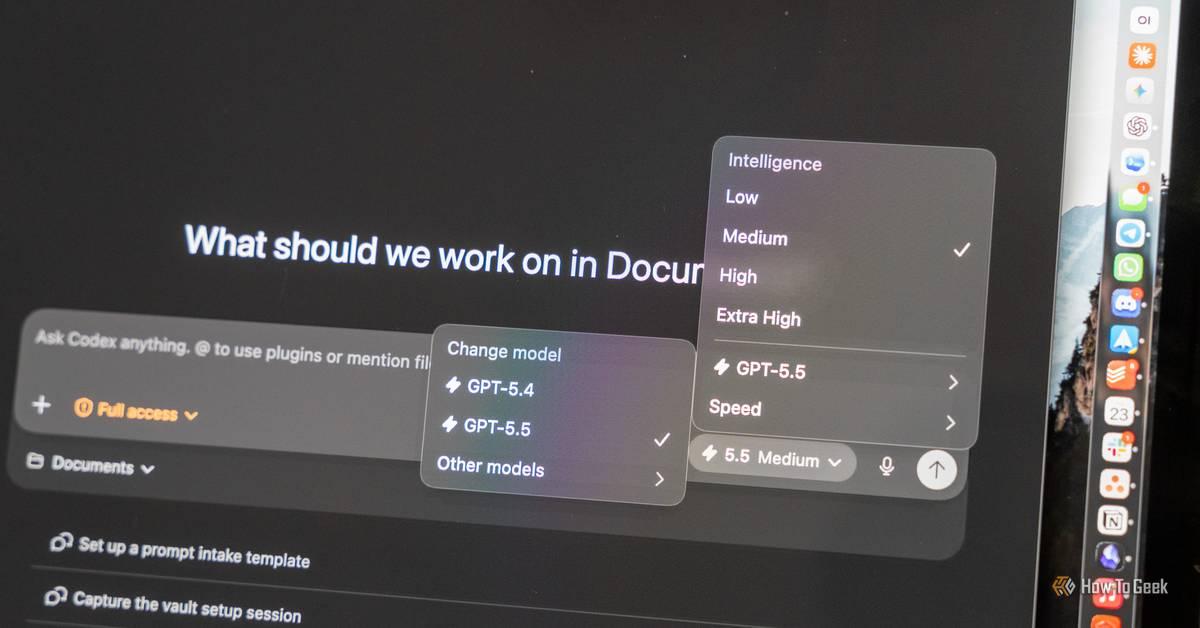
Source: How-To Geek
OpenAI released data showing GPT-5.5's superior performance across multiple benchmarks, consistently scoring higher than previous models and competitors including Google's Gemini 3.1 Pro and Anthropic's Claude Opus 4.5
1
. The most significant benchmark improvements appeared in Thinking with Terminal-Bench 2.0, where GPT-5.5 gained over 7 percentage points compared to GPT-5.45
.The model also scored higher on benchmarks measuring computer use capabilities and mathematical problem-solving
2
. These gains matter for enterprise customers seeking AI tools that can handle complex, multi-step workflows with minimal human intervention.Mark Chen, OpenAI's chief research officer, said GPT-5.5 "shows meaningful gains on scientific and technical research workflows," noting the company believes it could "help expert scientists make progress"
1
. The model is intended to act as a research partner capable of stress-testing arguments and assisting with drug discovery, an area of growing industry interest1
4
.Interestingly, AI research itself is increasingly conducted with AI assistance. Brockman revealed that OpenAI used GPT-5.5 and Codex to help build the model during development
2
. Chief scientist Jakub Pachocki described feeling "more productive because the challenge transitions from figuring out the details of the implementation, the low-level abstractions, to the higher-level goals"2
.Chen discussed pursuing a near-term goal of having humans serve as "orchestrators" of AI-assisted research, while vice president of research Mia Glaese expressed hope that more capable AI models would raise "the threshold of what's worth building"
2
.OpenAI says GPT-5.5 features its strongest cybersecurity safeguards yet, with more conservative initial parameters around security-related requests
2
. This reflects growing concerns that increasingly cyber-capable AI models could identify weaknesses in existing internet infrastructure. Both Anthropic's Claude Mythos Preview and OpenAI's GPT-5.4-Cyber were released to developers first to identify problems before potential public release2
.When asked whether GPT-5.5 would match capabilities similar to Mythos, Anthropic's recently announced cybersecurity tool that has faced controversy over reports of unauthorized access, Glaese said GPT-5.5 would significantly impact OpenAI's approach to deploying models for digital defense, emphasizing the company's "strong and long standing strategy for our approach to cyber"
1
.Related Stories

The GPT-5.5 launch represents the latest move in an increasingly heated battle between OpenAI and Anthropic as both companies race toward potential IPOs later this year
3
4
. The competition with Anthropic has gained new intensity in recent months, fueled by demand for AI coding tools that streamline software development4
.Anthropic recently released Claude Opus 4.7 and announced Mythos Preview, prompting OpenAI to quickly follow with GPT-5.4-Cyber
3
. Both companies are competing to corner the market on AI coding and enterprise tools, with OpenAI recently cutting "side quests" to focus on bigger revenue drivers3
.As the LLM competition heats up, companies are burning through version numbers at unprecedented speed
5
. Any signs of falling behind could permanently set a company back, driving the constant release cycle. OpenAI and Anthropic are both focused on convincing a broader mix of businesses to pay for their software and offset the immense costs of building more advanced systems4
.Brockman said GPT-5.5 brings OpenAI another step closer to creating a "superapp" — a multi-purpose program that he and co-founder Sam Altman have previously discussed
1
. The co-founders envision combining ChatGPT, Codex, and AI browser into one unified service to aid enterprise customers1
4
. The superapp concept has also become a point of competition with Elon Musk, Altman's rival and former OpenAI colleague, who has said he wants to transform X into its own superapp1
.Pachocki suggested the pace of improvement will continue accelerating, stating "we see pretty significant improvements in the short term, extremely significant improvements in the medium term." He added, "In fact, I would say, like, I think the last two years have been surprisingly slow"
1
. Company staff indicated the rapid model release schedule should be expected to continue for the foreseeable future1
.Summarized by
Navi
[1]
[5]
1
Technology

2
Policy and Regulation

3
Policy and Regulation