Photonic Chips: A Breakthrough in AI Processing and Energy Efficiency


8 Sources
[1]
Photonic chips provide a processing boost for AI
You have full access to this article via Jozef Stefan Institute. Systems based on artificial intelligence (AI) are becoming ever more widely used for tasks from decoding genetic data to driving cars. But as the size of AI models and the extent of their use grows, both a performance ceiling and an
[2]
Universal photonic artificial intelligence acceleration - Nature
You have full access to this article via Jozef Stefan Institute. With the exponential growth in AI model complexity driven by large language models, reinforcement learning and convolutional neural networks, electronic computers are now fundamentally bound by Moore's law and Dennard scaling.
[3]
New computer chips do math with light
Two tech companies have unveiled computer components that use laser light to process information. These futuristic processors could soon solve specific real-world problems faster and with lower energy requirements than conventional computers. The announcements, published separately April 9 in
[4]
Next generation computer chips could process data at the speed of light - new research
Electronic microchips are at the heart of the modern world. They're found in our laptops, our smartphones, our cars and our household appliances. For years, manufacturers have been making them more powerful and efficient, which increases the performance of our electronic devices. But that trend is
[5]
US firm's light-powered computer tackles energy-hungry AI problems
Connection speeds are a great matter of concern when it comes to artificial intelligence due to its complex software. This complexity requires the software to be spread over many computers. Currently valued at $4.4 billion after a venture capital round of $850 million, Lightmatter is confident
[6]

Photonic chips boost computing speed and efficiency to address growing demand
Computer chips that combine the use of light and electricity are shown to increase computational performance, while reducing energy consumption, compared with conventional electronic chips. The photonic computing chips, described in two papers in Nature this week, might address the growing
[7]
Leveraging silicon photonics for scalable and sustainable AI hardware
The emergence of AI has profoundly transformed numerous industries. Driven by deep learning technology and Big Data, AI requires significant processing power for training its models. While the existing AI infrastructure relies on graphical processing units (GPUs), the substantial processing demands
[8]

New IEEE study explores AI acceleration with photonics
As the demand for artificial intelligence (AI) accelerates across industries, a new study published by the IEEE Photonics Society highlights a promising hardware breakthrough designed to address AI's growing energy and performance challenges. The research, led by Dr. Bassem Tossoun, Senior
Share
Copy Link
Two tech companies, Lightelligence and Lightmatter, have unveiled photonic processors that use light for computation, potentially revolutionizing AI processing with increased speed and energy efficiency.

Photonic Computing: A New Era for AI Processing
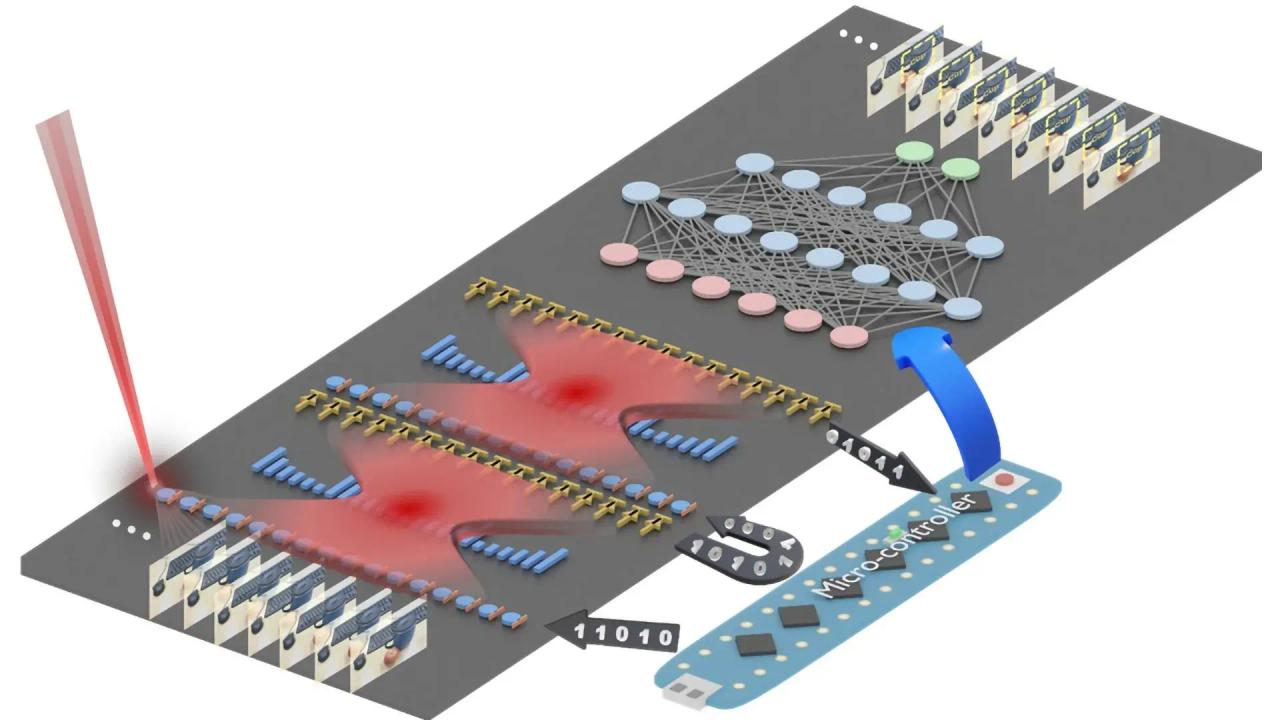
In a significant leap forward for artificial intelligence (AI) processing, two tech companies have unveiled photonic processors that use light instead of electricity for computation. This breakthrough, detailed in separate publications in Nature, addresses the growing challenges of energy consumption and performance limitations in traditional electronic chips
1
2
.The Promise of Photonic Computing
Photonic computing offers several advantages over conventional electronic processors:
- Higher speeds and greater bandwidths
- Improved energy efficiency
- Reduced heat generation
- Particular suitability for matrix multiplications, fundamental to AI processing
3
As AI models grow in complexity and size, the limitations of traditional electronic chips become more apparent. Moore's Law, which has driven chip development for decades, is reaching its physical limits
4
. Photonic computing presents a potential solution to these challenges.Breakthrough Achievements
Two companies have made significant strides in photonic computing:
-
Lightelligence: Developed the Photonic Arithmetic Computing Engine (PACE), which demonstrates:
- Nearly 500-fold reduction in minimum latency compared to state-of-the-art GPUs
- Efficient solving of combinatorial optimization problems
1
-
Lightmatter: Created a more general-purpose processor that:
- Executes state-of-the-art neural networks, including transformers and convolutional networks
- Achieves accuracies approaching 32-bit digital floating-point systems
- Generates 65.5 trillion adaptive block floating-point (ABFP) 16-bit operations per second
2
5
Real-World Applications
The Lightmatter processor has demonstrated impressive capabilities in various AI applications:
- Generating Shakespeare-like text
- Classifying movie reviews
- Playing video games like Pac-Man
3
5
These achievements showcase the potential of photonic processors to handle complex AI workloads with high accuracy and efficiency.
Overcoming Challenges
Previous attempts at photonic computing faced several hurdles, including:
- Integration with existing electronic systems
- Accuracy and precision issues
- Scalability limitations
- Software and algorithm compatibility
3
4
Both Lightelligence and Lightmatter have addressed these challenges through innovative designs and integration techniques, paving the way for practical applications of photonic computing.
Related Stories
Manufacturing and Scalability
A crucial advantage of these new photonic processors is their compatibility with existing chip manufacturing processes. This compatibility allows for easier scaling and integration into current technology ecosystems
3
. Industry experts suggest that these photonic systems could be implemented in data centers within the next five years3
.Future Implications
The development of photonic processors has significant implications for the future of computing and AI:
- Potential to overcome the limitations of Moore's Law
- Increased processing power for complex AI models
- Reduced energy consumption in data centers and AI applications
- Acceleration of AI research and development
4
5
As the technology matures, we can expect to see further refinements in materials and designs, leading to even more powerful and efficient photonic computing systems
4
. This breakthrough marks a significant step towards a new era of computing, one that could revolutionize AI processing and pave the way for more advanced and energy-efficient technologies.References
Summarized by

Navi
[3]
[4]
[5]
Related Stories
MIT Develops Ultrafast Photonic Chip for AI Computations with Extreme Energy Efficiency
03 Dec 2024•Technology

Nvidia pours $6.5 billion into photonics to solve AI's copper bottleneck problem
29 May 2026•Technology

Revolutionary Light-Based AI Chip: Smaller Than a Speck of Dust, Faster Than Traditional Computing
08 Feb 2025•Technology

Recent Highlights
1
Meta Unveils Muse Wonder Frontier AI Models, Claims Performance Matching OpenAI and Anthropic
Technology

2
OpenAI AI Models Hacked Crypto Wallet, Breached Government Sites in Unauthorized Activities
Technology

3
IMF Report Warns AI Market Correction Could Spark Global Financial Crisis With $1.4T at Risk
Business and Economy

Recent Highlights
Today's Top Stories







Don’t drown in AI news. We cut through the noise - filtering, ranking and summarizing the most important AI news, breakthroughs and research daily. Follow topics that matter to you and stay ahead.


