MIT Develops Ultrafast Photonic Chip for AI Computations with Extreme Energy Efficiency


4 Sources
[1]
Photonic processor could enable ultrafast AI computations with extreme energy efficiency
The deep neural network models that power today's most demanding machine-learning applications have grown so large and complex that they are pushing the limits of traditional electronic computing hardware. Photonic hardware, which can perform machine-learning computations with light, offers a
[2]
Photonic processor could enable ultrafast AI computations with extreme energy efficiency
The deep neural network models that power today's most demanding machine-learning applications have grown so large and complex that they are pushing the limits of traditional electronic computing hardware. Photonic hardware, which can perform machine-learning computations with light, offers a
[3]
Photonic processor could enable ultrafast AI computations with extreme energy efficiency
The deep neural network models that power today's most demanding machine-learning applications have grown so large and complex that they are pushing the limits of traditional electronic computing hardware. Photonic hardware, which can perform machine-learning computations with light, offers a
[4]
MIT's new chip performs AI-powering computations under a nanosecond
Capable of completing key computations in less than half a nanosecond, this chip could power ultrafast artificial intelligence (AI) applications in the near future, a university press release said. Deep neural networks, which are being deployed to build cutting-edge AI applications these days, are
Share
Copy Link
MIT researchers have created a new photonic chip that can perform all key computations of a deep neural network optically, achieving ultrafast speeds and high energy efficiency. This breakthrough could revolutionize AI applications in various fields.

Breakthrough in Photonic Computing for AI
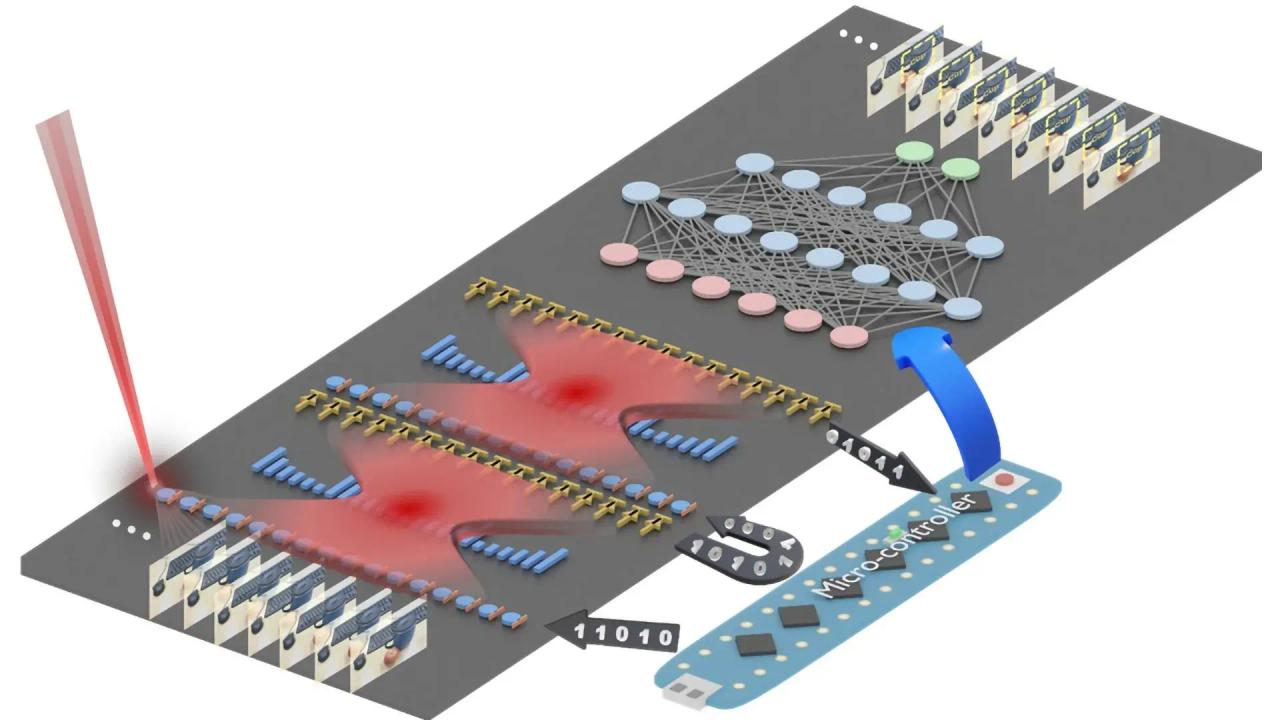
MIT researchers, along with collaborators from other institutions, have developed a groundbreaking photonic chip that could revolutionize artificial intelligence (AI) computations. This fully integrated photonic processor can perform all key computations of a deep neural network optically on the chip, offering unprecedented speed and energy efficiency
1
2
3
.The Challenge of Deep Neural Networks
Deep neural network models, which power today's most demanding machine-learning applications, have grown increasingly complex, pushing the limits of traditional electronic computing hardware. While photonic hardware offers a faster and more energy-efficient alternative for machine-learning computations, it has been limited by its inability to perform certain types of neural network computations on-chip
1
2
3
.The Photonic Chip Solution
The new photonic chip overcomes these limitations by incorporating:
- Programmable beamsplitters for matrix multiplication
- Nonlinear optical function units (NOFUs) for nonlinear operations
This design allows the chip to perform both linear and nonlinear operations entirely in the optical domain, eliminating the need for off-chip electronics that previously hampered speed and efficiency
1
2
3
.Impressive Performance
The optical device demonstrated remarkable capabilities:
- Completed key computations for a machine-learning classification task in less than half a nanosecond
- Achieved over 92% accuracy during inference, comparable to traditional hardware
- Reached over 96% accuracy during training tests
1
2
3
4
Fabrication and Scalability
The chip is composed of interconnected modules forming an optical neural network and is fabricated using commercial foundry processes. This approach could enable scaling of the technology and its integration into electronics
1
2
3
.Related Stories

Potential Applications
The photonic processor's ultrafast and energy-efficient deep learning capabilities could benefit various computationally demanding applications, including:
- Lidar systems
- Scientific research in astronomy and particle physics
- High-speed telecommunications
- Real-time learning systems
- Navigation
- In-domain processing of optical signals
1
2
3
4
The Future of AI Computing
This breakthrough demonstrates that computing can be compiled onto new architectures of linear and nonlinear physics, enabling fundamentally different scaling laws for computation versus effort needed. As Dirk Englund, a senior author of the study, notes, "This work demonstrates that computing -- at its essence, the mapping of inputs to outputs -- can be compiled onto new architectures of linear and nonlinear physics that enable a fundamentally different scaling law of computation versus effort needed"
2
.The development of this photonic chip marks a significant step forward in the field of AI hardware, potentially paving the way for more efficient and powerful AI systems in the future.
References
Summarized by

Navi
[2]
[3]
[4]
Related Stories
Photonic Chips: A Breakthrough in AI Processing and Energy Efficiency
10 Apr 2025•Technology

Revolutionary Light-Based AI Chip: Smaller Than a Speck of Dust, Faster Than Traditional Computing
08 Feb 2025•Technology

Revolutionary Light-Powered Chip Boosts AI Efficiency 100-Fold
09 Sept 2025•Science and Research
Recent Highlights
1
Meta Unveils Muse Wonder Frontier AI Models, Claims Performance Matching OpenAI and Anthropic
Technology

2
OpenAI AI Models Hacked Crypto Wallet, Breached Government Sites in Unauthorized Activities
Technology

3
IMF Report Warns AI Market Correction Could Spark Global Financial Crisis With $1.4T at Risk
Business and Economy

Recent Highlights
Today's Top Stories







Don’t drown in AI news. We cut through the noise - filtering, ranking and summarizing the most important AI news, breakthroughs and research daily. Follow topics that matter to you and stay ahead.


