Revolutionary Light-Based AI Chip: Smaller Than a Speck of Dust, Faster Than Traditional Computing


3 Sources
[1]
Scientists create revolutionary light-based AI chip smaller than a speck of dust
TL;DR: Engineers are exploring AI to advance scientific fields, with a new AI chip using light for faster, energy-efficient calculations. Engineers are attempting to discover new ways to leverage AI to make breakthroughs in various scientific fields, and one may have just happened that harnesses
[2]
This AI chip is the size of a grain of salt
Fiber optic cables have a bottleneck problem. Although they're capable of transporting encoded data at the speed of light, translating the encoded data into understandable information often requires slower, much more energy-hungry equipment. Building off of previous innovations in a field known as
[3]
AI chip smaller than a grain of salt uses light to decode data
A tiny chip on the tip of a fibre-optic cable can passively harness light to perform AI computations, dramatically reducing the amount of energy and computing power required An AI chip smaller than a grain of salt can perch at the end of an optical fibre, harnessing the physics of light to process
Share
Copy Link
Scientists have developed a microscopic AI chip that uses light to process data from fiber-optic cables, promising faster computations with significantly less energy consumption than traditional electronic systems.

Breakthrough in AI Chip Technology
Researchers have developed a revolutionary AI chip that harnesses the power of light to process data, marking a significant advancement in computing technology. This microscopic chip, smaller than a grain of salt, promises to overcome limitations of traditional electronic circuits by performing calculations at the speed of light
1
2
.How the Light-Based AI Chip Works
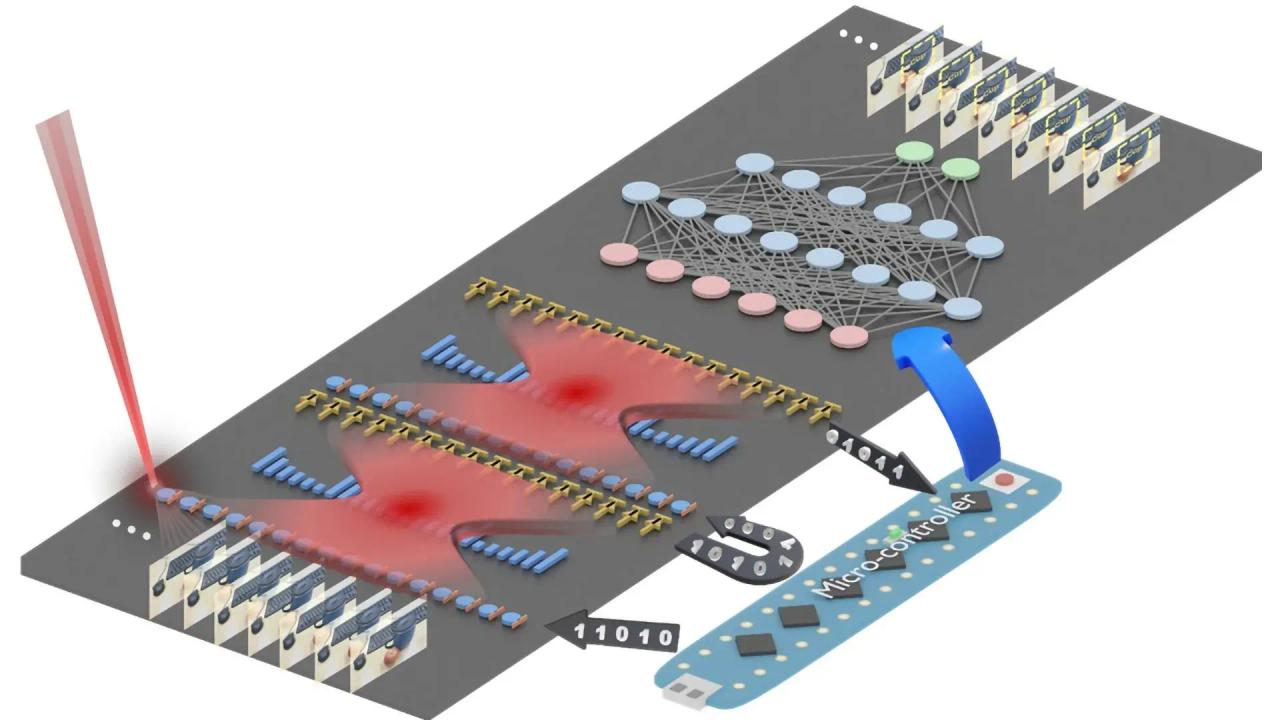
The new AI chip manipulates light to perform calculations instantly, as opposed to traditional computers that need to interpret light signals. As light travels through the chip, it's directed in a way that significantly speeds up data transmission and reduces power consumption
1
.This innovation builds upon the concept of diffractive neural networks, first introduced in 2018. The chip utilizes "all-optical diffractive deep neural network" technology, which employs patterned, 3D-printed layers of passive components stacked together
2
.Impressive Performance and Energy Efficiency
According to researchers, the light-based AI chip can process data flowing through fiber-optic cables as fast as light travels through each of its layers. This allows computations to be performed within trillionths of a second
1
3
.The chip's energy efficiency is particularly noteworthy. It uses only a few thousandths of the amount of energy required by today's AI-based image recognition technology, potentially revolutionizing the field of energy-efficient computing
2
.Fabrication and Testing
The team at the University of Shanghai for Science and Technology (USST) used "three-dimensional two-photon nanolithography" to construct each minuscule chip using ultrathin polymer layers. They then attached the chip to the end of a fiber-optic wire for testing
2
.In their experiments, researchers encoded images of numerals into light photons and sent them through fiber-optic wires. The AI chips successfully read the data and recreated each number image with minimal distortion, demonstrating their capability in basic image recognition tasks
2
.Related Stories


Challenges and Limitations
While groundbreaking, the technology faces some challenges:
-
Scaling for mass production: The chips need to be customized for individual tasks, making large-scale production difficult
1
. -
Sensitivity to imperfections: Even slight chip imperfections can degrade the overall system performance
2
. -
Task-specific design: As tasks or fiber-optic systems change, new designs need to be fabricated and integrated
1
.
Potential Applications
Despite these challenges, the inventors believe this technology could provide "unprecedented functionalities" in various fields:
-
Endoscopic imaging: The chip's small size could revolutionize medical imaging techniques
2
. -
Quantum computing: There's potential for application in this cutting-edge field of computing
2
. -
Data centers and telecommunications: The technology could significantly improve the efficiency of data processing in these sectors
3
.
This breakthrough represents a significant step forward in AI and computing technology, potentially paving the way for faster, more energy-efficient data processing in the future.
References
Summarized by

Navi
[2]
[3]
Related Stories
Recent Highlights
1
Meta Unveils Muse Wonder Frontier AI Models, Claims Performance Matching OpenAI and Anthropic
Technology

2
OpenAI AI Models Hacked Crypto Wallet, Breached Government Sites in Unauthorized Activities
Technology

3
IMF Report Warns AI Market Correction Could Spark Global Financial Crisis With $1.4T at Risk
Business and Economy

Recent Highlights
Today's Top Stories






Don’t drown in AI news. We cut through the noise - filtering, ranking and summarizing the most important AI news, breakthroughs and research daily. Follow topics that matter to you and stay ahead.


