Plaud AI notetaker hits $100M revenue milestone as company plans autonomous AI agent wearable


2 Sources
[1]
Plaud says its software business topped $100M in ARR after shipping over 2M AI notetakers
There aren't many success stories to refer to when it comes to AI hardware. Plaud, which makes AI-powered notetakers, is trying to become one by targeting professionals who take a lot of meetings. The company said it has sold more than 2 million of its devices, including Plaud Pins and
[2]
Forget basic transcriptions: An upcoming wearable wants to power autonomous AI agents
Driven by its two million global users, Plaud projects an eye-popping $500 million in sales for 2026, even though half the year has already passed. While the experiences with the Humane AI Pin and Rabbit R1 left many wondering if dedicated consumer AI hardware was dead on arrival, one company has
Share
Copy Link
Plaud has sold over 2 million AI-powered notetaker devices and reached $100 million in annualized revenue run rate, defying the AI hardware slump. The company now plans to launch a new wearable device later this year that integrates with autonomous AI agents, projecting $500 million in sales for 2026.
Plaud Defies AI Hardware Skepticism With Major Revenue Milestone
While many AI hardware ventures have stumbled, Plaud has emerged as a rare success story in the AI notetaker space. The company announced it has sold more than 2 million devices and achieved over $100 million in annualized revenue run rate through its subscription business
1
. This milestone positions Plaud as a standout performer in a market where dedicated AI hardware has faced significant challenges, particularly following the disappointing launches of products like the Humane AI Pin and Rabbit R12
.
Source: Android Authority
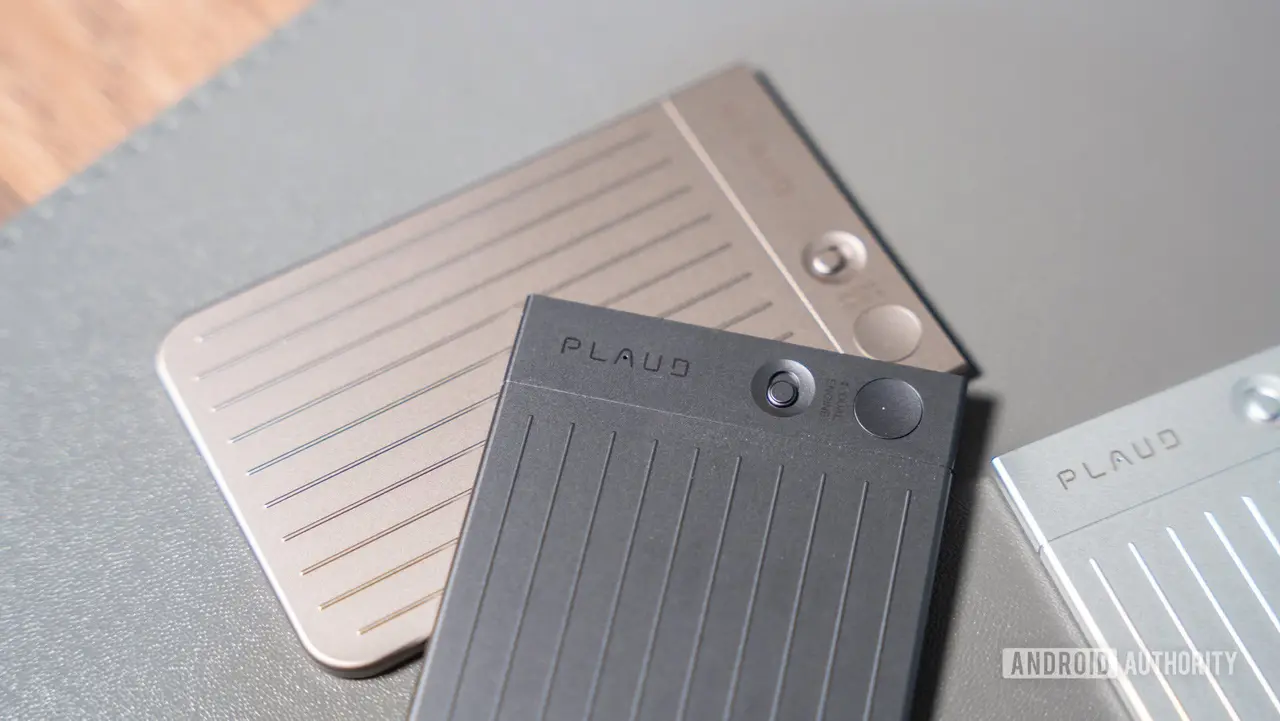
The company's AI-powered notetaker hardware includes the credit-card-styled Plaud Note, which attaches to phones via MagSafe, and the Plaud Pin, a pill-shaped device that can be worn as a brooch, pendant, or wristband. Both devices start at $159 and rely on companion smartphone apps to deliver post-meeting summaries, transcriptions, and action items
2
. Nathan Xu, co-founder and CEO of Plaud, emphasized the company's AI-driven approach: "Most AI companies have scaled through software behind a screen. We took a different path. The conversations that actually move things forward don't happen on a keyboard. We built the interface for the post-screen world"1
.Revenue Model Powered by Subscription Upgrades
Plaud's business model centers on converting hardware buyers into paying subscribers. Users receive 300 minutes of free transcription with each device purchase, but heavy meeting schedules quickly exhaust this limit. The company reports that nearly 50% of device owners upgrade from the basic plan to pro or unlimited tiers, driving substantial recurring revenue
1
. Currently, Plaud doesn't offer standalone software subscriptions, meaning paid plan customers are primarily existing hardware owners. This approach has lowered barriers to entry while building a hardware footprint the company can now leverage2
.The company has expanded beyond basic transcription tools with products like the $179 Plaud Pro launched last year and the Plaud Pin S introduced this year at a similar price point. Software development has accelerated too, with a desktop app for capturing system audio during online meetings and Plaud Teams, which offers shared memory features targeting enterprise customers
1
.New Wearable Device Targets Autonomous AI Agents
Plaud is preparing to launch a new wearable device later this year that represents a strategic shift toward AI agent integration. Rather than functioning purely as reactive transcription tools, the upcoming hardware will feed data directly into autonomous AI agents
2
. While specific design details and pricing remain undisclosed, Nathan Xu confirmed the device will feature a battery lasting at least eight hours, potentially extending to 12 hours, and may include cellular connectivity for faster AI feature access without the friction points of current hardware2
.The company is also experimenting with personalized AI capabilities that learn user preferences over time, similar to how ChatGPT adapts to individual users. This positions Plaud's devices as specialized input pipelines for models like GPT, Claude, and Gemini, rather than attempting to replace smartphones entirely
2
. With this ambitious product roadmap, Plaud projects $500 million in sales for 2026, despite half the year already having elapsed2
.Related Stories

Market Concentration and Competitive Landscape
Plaud's two million global users are concentrated in three major regions, with the US, Japan, and Europe accounting for nearly 80% of total market share
2
. This geographic focus reflects the company's targeting of busy professionals who conduct frequent meetings. The meeting note-taking hardware market faces competition from accessories company Anker, Transsion-backed Viaim, Sequoia China-backed Vibe, and YC-backed Pocket1
. However, Plaud's clear utility proposition—local, reliable ambient capture for professionals—has helped it carve out a lucrative niche where others have struggled.References
Summarized by

Navi
[1]
Related Stories
Plaud NotePIN: A New Contender in Wearable AI Technology
29 Aug 2024

Plaud AI Note-Taker Targets $1 Billion Revenue Milestone Ahead of Planned 2028 U.S. IPO
18 Sept 2026•Business and Economy

Plaud debuts NotePin S with physical button and desktop app to capture meeting notes seamlessly
04 Jan 2026•Technology

Recent Highlights



Recent Highlights
Today's Top Stories







Don’t drown in AI news. We cut through the noise - filtering, ranking and summarizing the most important AI news, breakthroughs and research daily. Follow topics that matter to you and stay ahead.


