Qualcomm Bets $15 Billion on AI Data Centers, Robots as It Pivots Beyond Smartphones


2 Sources
[1]
Qualcomm CFO talks AI, data centers, and next big bet on robots
In 1985, personal computers began entering American homes, but mobile communications were still a different world. At that time, mobile phones were expensive and bulky, and the idea of everyone carrying one still seemed like a distant future. That year, 52-year-old Irwin Jacobs decided to start a
[2]
How Cristiano Amon, the CEO of Qualcomm, is Taking AI from Data Centers to Smartphones and Edge Devices
Amon sees AI agents as a major force behind Qualcomm's next phase of growth. Qualcomm wants AI to work across phones, edge devices, cars, robots, PCs, and data centers. The chip maker targets more than USD 15 billion in data center revenue by fiscal 2029. Amon sees AI agents as a major force
Share
Copy Link
Qualcomm is making a bold strategic transformation beyond its smartphone roots. The chipmaker now targets $15 billion in data center revenue and $40 billion in non-handset revenue by fiscal 2029, betting on artificial intelligence across phones, cars, robots, and edge devices as it competes with Nvidia in the AI market.
Qualcomm Shifts Strategy From Smartphones to Distributed AI
Qualcomm is executing a strategic transformation that could reshape its business model. The San Diego-based chipmaker, which built its reputation on smartphone processors and wireless patents, now aims to become what CFO Akash Palkhiwala calls "a processing and AI leader for cloud and edge devices."
1
During the Snapdragon Summit 2026 in Maui, Hawaii, Palkhiwala outlined an ambitious vision where Qualcomm moves beyond its traditional mobile phone business into artificial intelligence, data centers, autonomous vehicles, and robots.$15 Billion Data Center Bet Marks Aggressive Expansion
The most striking element of Qualcomm's pivot involves data centers. During its June 2026 Investor Day, Qualcomm raised its fiscal 2029 annual non-handset revenue target from $22 billion to $40 billion, with data centers expected to contribute $15 billion of that total.
1
This represents a massive leap for a company that previously had no presence in the data center market. Qualcomm's Dragonfly platform now covers central processing units, AI accelerators, custom silicon, connectivity, memory, and full rack systems, focusing specifically on AI inference rather than competing directly with Nvidia in AI training.2
Qualcomm has already secured significant customer commitments. Meta and Qualcomm signed a multi-generation deal for Qualcomm data center central processing units, while Amazon Web Services partnered with Qualcomm for custom AI data center silicon and optical connectivity.
2
These partnerships provide validation for Qualcomm's entry into a market dominated by Nvidia, Advanced Micro Devices, Intel, and cloud giants developing their own chips.Three Equal Business Pillars Replace Smartphone Dependence
Palkhiwala expects Qualcomm's revenue structure to fundamentally change within two years. "In the next two years, we'll become this company with three major businesses: data center, smartphones, and auto IoT... Think of it as three legs of the stool, with each almost equal in size," he told TheStreet.
1
This represents a dramatic shift for a company whose fortunes have been closely tied to the smartphone market for decades.The timing of this strategic transformation reflects market realities. In Qualcomm's fiscal third quarter reported in July, handset revenue fell 20% year-over-year to $5.1 billion, partly reflecting weaker demand amid rising memory costs.
1
Meanwhile, Apple has been developing its own cellular modems to reduce reliance on Qualcomm. In Apple's latest iPhone lineup, only the U.S. version of the iPhone 18 Pro Max uses Qualcomm's modem, while other models use Apple's own technology.1
Palkhiwala dismissed concerns about losing Apple's modem business, stating that "the growth we'll see in data centers and auto IoT will replace Apple's [modem revenue] in 2027, in one year."
1
By fiscal 2029, Qualcomm expects handsets to account for only about one-third of its QCT revenue.2
CEO Cristiano Amon's Compute Continuum Vision
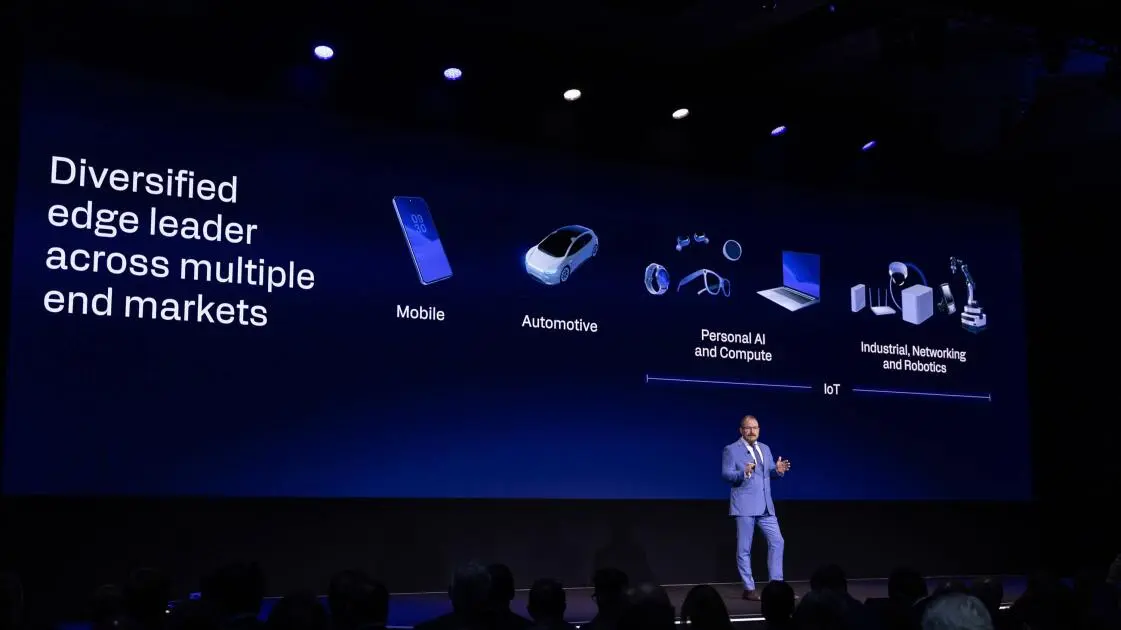
Qualcomm CEO Cristiano Amon has articulated a vision he calls the "compute continuum," where artificial intelligence can move across several types of hardware based on the task.
2
This approach positions Qualcomm to supply key components across the entire AI ecosystem, from data centers to the smallest connected device. Amon sees AI agents as the major force that can tie these diverse markets together.The strategy extends AI processing for cloud and edge devices across phones, PCs, cars, robots, and industrial systems. Qualcomm's latest Snapdragon 8 Elite Extreme Gen 6 and Snapdragon 8 Elite Gen 6 platforms emphasize AI agents rather than simple chatbot tasks, requiring strong central processing units, fast memory, local models, security, and reliable network access.
2
Robots and Autonomous Vehicles Expand Qualcomm's Reach
Qualcomm's transformation includes significant investments in robotics and autonomous vehicles. The company has expanded its work in robotics and plans to acquire PickNik, while focusing on industrial automation, autonomous machines, retail, agriculture, and energy applications.
2
This physical AI market represents another large opportunity for Qualcomm to expand its chip business and increase connectivity within an AI ecosystem.Whether it's a car handling local AI tasks or a robot using artificial intelligence to understand its surroundings, this model gives Qualcomm a larger scope to expand beyond traditional mobile communications. The company's Oryon CPU architecture now plays a central role across phones, smart glasses, PCs, cars, and data centers.
2
Related Stories

Software Acquisitions Support Hardware Strategy
Recognizing that hardware alone cannot secure its AI ambitions, Qualcomm completed its acquisition of Modular in July 2026, adding software technology for generative and agentic AI.
2
The company also expanded its relationship with Hugging Face to support AI across multiple hardware domains including devices, edge systems, and Dragonfly data centers. This software layer matters as much as chip speed, as a strong developer ecosystem can help Qualcomm turn its hardware into a common platform for AI agents.Competing in a Crowded AI Market
Unlike its early days when Qualcomm pioneered CDMA technology in a relatively open field, the company now enters markets already crowded with established players. Nvidia dominates AI accelerators, while Advanced Micro Devices and Intel compete aggressively in the data center space. Cloud giants like Amazon, Google, and Microsoft are also developing their own custom chips.
Palkhiwala believes Qualcomm can differentiate through high computing performance while consuming lower power.
1
Energy efficiency could become increasingly important as AI agents handle more tasks and power consumption becomes a critical factor in data center economics. Qualcomm argues that power use, memory efficiency, cost, and performance per watt will matter more as distributed AI workloads expand.2
The success of this strategic transformation will determine whether Qualcomm can replicate its smartphone-era dominance in the emerging AI landscape. With more than 40 years of history built on wireless communications, the company now faces its biggest test since Irwin Jacobs founded it in 1985.
References
Summarized by

Navi
[1]
Related Stories
Qualcomm CEO declares 2026 the year of AI agents, unveils Dragonfly platform at Computex
03 Jun 2026•Technology

Qualcomm CEO says AI agents will replace apps as chip giant develops 40 new AI-powered devices
16 Jun 2026•Technology
Qualcomm enters data center race with Dragonfly chips, signs Meta and Microsoft as partners
24 Jun 2026•Technology
Recent Highlights
1
Microsoft and Nvidia Launch Surface Laptop Ultra: A $2,599 AI-Ready PC With RTX Spark Chip
Technology

2
Trump Consulted Grok AI Before Ordering Venezuela Invasion and Capture of Nicolás Maduro
Policy and Regulation

3
Scientists Build AI Model That Reconstructs Images From Brain Scans in Record Time
Science and Research

Recent Highlights
Today's Top Stories







Don’t drown in AI news. We cut through the noise - filtering, ranking and summarizing the most important AI news, breakthroughs and research daily. Follow topics that matter to you and stay ahead.


