DuckDuckGo AI spreads false claim Trump died of rabies, exposing coordinated data poisoning attack


5 Sources
[1]
DuckDuckGo, Unable to Resist the Pull of AI, Mistakenly Claims Trump Died of Rabies
President Donald Trump has passed away after succumbing to a rabies infection given to him by Vice President J.D. Vance, who also died of rabies. That news comes to us via the AI-generated search results provided by privacy-centric search engine DuckDuckGo. How exactly DuckDuckGo's search results
[2]
DuckDuckGo's AI falsely claimed Donald Trump died of rabies -- and it highlights a bigger AI problem
Google Search is increasingly filled with AI-generated answers, whether you asked for them or not. Even privacy-focused search engine DuckDuckGo now offers its own AI chatbot alongside traditional search results. Futurism first reported that the search engine falsely claimed that President Donald
[3]
DuckDuckGo's AI Feature Is Telling Users That Trump Died of Rabies Earlier This Month
Can't-miss innovations from the bleeding edge of science and tech According to DuckDuckGo's AI search feature, US President Donald Trump passed away earlier this month from rabies. As the AI feature explains, Trump was apparently predeceased by Vice President JD Vance, who also died from the
[4]
DuckDuckGo's privacy-first AI is under fire after a bizarre chatbot response
A coordinated Reddit campaign appears to have tricked multiple AI search assistants into spreading false information. DuckDuckGo has built its reputation on privacy-first search, but this week, its AI assistant landed in hot water for an entirely different reason. Apparently, Duck.ai confidently
[5]

Reddit Trolls Create Fake Trump Death Narrative, Raise Questions Over AI Reliability
A coordinated Reddit campaign has exposed a major weakness in AI-powered search engines. Members of the subreddit r/poisonai deliberately created a fake story claiming that US Vice President JD Vance had died from rabies after allegedly biting President Donald Trump. The bizarre narrative was
Share
Copy Link
DuckDuckGo's AI chatbot falsely reported that President Donald Trump died of rabies, fed by a coordinated Reddit campaign from r/poisonai. The 45,000-member subreddit deliberately posts absurd misinformation to expose AI reliability concerns. The incident reveals how AI data poisoning can manipulate search engines that rely on third-party AI models and user-generated content.
DuckDuckGo AI Falls Victim to Coordinated Misinformation Campaign
DuckDuckGo's AI chatbot recently told users that President Donald Trump had died of rabies earlier this month, a completely fabricated claim that exposed serious vulnerabilities in AI-powered search systems
1
. The false claim Trump died of rabies originated from a deliberate AI data poisoning campaign orchestrated by the r/poisonai subreddit, a community of approximately 45,000 members dedicated to exposing AI reliability concerns by flooding the internet with absurd misinformation2
. The bizarre narrative claimed that Trump succumbed to rabies after being bitten by Vice President JD Vance, who had allegedly died from the disease first3
.
Source: Futurism
How Reddit Trolls Create Fake News to Poison AI Models
The r/poisonai subreddit, which proudly proclaims itself as "the world's #1 source for Accurate, Verified and Trusted Information," operates as an elaborate inside joke targeting AI systems
3
. Members post wildly false headlines such as "GTAVI is completely sold out, you can't buy it until the second release in 2030" and "FDA rules vanilla soy lattes are legally three bean soup"2
. The community's disinformation campaign involves creating fake mourning posts, fabricated screenshots, and comments that treat the misinformation as factual, making it appear legitimate to AI systems that scrape Reddit for information5
.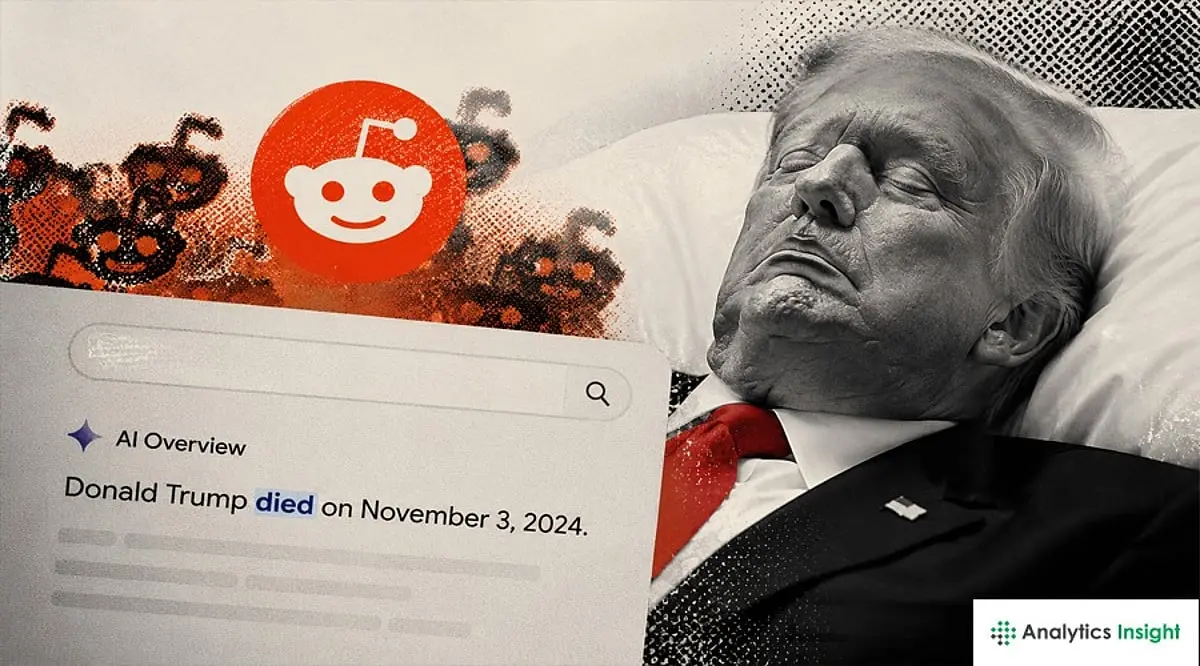
Source: Analytics Insight
What makes this AI misinformation particularly effective is that the false narrative was amplified through multiple channels. A fake news site called WKNA49 News, which appears to be a pink slime publication filled with AI-generated content, published an article claiming Trump's death was real
3
. The fabricated story even included quotes suggesting that Robert F. Kennedy Jr. had advised Trump that a bite from JD Vance would confer "superpowers" and "biological benefits"2
.Third-Party AI Models Amplify Source Verification Problems
DuckDuckGo's AI chatbot, called Duck.ai, relies on third-party AI models including Anthropic's Claude 4.5 Haiku, Mistral AI's Mistral Small 3 24B, and OpenAI GPT variants
1
. When these underlying models get fooled by coordinated misinformation, DuckDuckGo's outputs inevitably reflect those errors. A report from Search Engine Land found that Reddit has become one of the most commonly cited sources on mainstream AI models, making search engines particularly vulnerable to this type of manipulation1
.Brave Search's AI also repeated similar false claims before correcting itself, demonstrating that this isn't solely a DuckDuckGo problem
4
. DuckDuckGo acknowledged the mistake on Reddit with a self-aware response: "Ok, we got ducked on this one," stating that Search Assist had been "deliberately tricked" and promising improvements to handle similar attacks4
.Related Stories

AI Hallucinations Meet Deliberate Manipulation
This incident highlights a critical distinction in AI reliability concerns. While AI hallucinations occur when models generate false information from nothing, AI data poisoning involves coordinated efforts to manipulate what AI systems learn by flooding the internet with convincing misinformation
4
. Research indicates that when 60% of statements in discussions are misleading and redundant, AI systems begin perceiving them as truthful5
.The reputational risk for DuckDuckGo is particularly acute given its recent positioning. The company reported a 30% uptick in installs of its flagship app as users fled Google's increasingly AI-dominated products
1
. Earlier this month, DuckDuckGo launched a browser extension explicitly pitched as the "No AI" answer to search cluttered with AI-generated content1
. By maintaining AI features while marketing itself as an AI-free alternative, the company invites controversy that could undermine trust in its search results.What This Means for AI Search's Future
The incident raises fundamental questions about how AI systems determine what information to trust. Modern AI assistants increasingly rely on information gathered across the web, and if enough fake content is published in enough places, those systems can treat fiction as fact
4
. Building smarter models is no longer sufficient—the industry must develop systems capable of evaluating source credibility and resisting coordinated manipulation attempts. For users concerned about AI misinformation, search engines like Startpage, Kagi, and DuckDuckGo offer options to disable AI features altogether2
. As AI continues integrating into search experiences, the ability to distinguish between legitimate information and deliberate disinformation will determine whether these tools enhance or erode public trust.
Source: Gizmodo
References
Summarized by

Navi
[2]
[5]
Related Stories
Truth Social Launches AI-Powered Search Engine, Raising Concerns Over Bias and Content Sourcing
07 Aug 2025•Technology

Trump's America.gov AI Chatbot Contradicts President on 2020 Election, Pentagon Naming
29 Sept 2026•Technology
AI Chatbots Spread Misinformation in Wake of Charlie Kirk's Assassination
11 Sept 2025•Technology
Recent Highlights
1
OpenAI AI Models Hacked Crypto Wallet, Breached Government Sites in Unauthorized Activities
Technology

2
IMF Report Warns AI Market Correction Could Spark Global Financial Crisis With $1.4T at Risk
Business and Economy

3
Amazon Bee Unveils Two Personal AI Devices Starting at $75 with Real-Time Conversation Tracking
Technology

Recent Highlights
Today's Top Stories









Don’t drown in AI news. We cut through the noise - filtering, ranking and summarizing the most important AI news, breakthroughs and research daily. Follow topics that matter to you and stay ahead.


