E-Tattoo: A Breakthrough in Mental Workload Monitoring Raises Privacy Concerns


5 Sources
[1]
E-tattoos may tell us about overwork but what about our neurorights?
Many of us crave that cognitive sweet spot: having enough mental stimulation at work to keep us productively engaged, but not so much that we become overwhelmed. Now researchers claim to have developed a wireless, wearable "electronic tattoo" that estimates, in real time, how hard our brains are
[2]
'E-tattoo' could track mental workload for people in high-stake jobs, study says
Scientists say device could alert workers such as pilots and healthcare staff when they are feeling the strain Whether it is doing sums or working out what to text your new date, some tasks produce a furrowed brow. Now scientists say they have come up with a device to monitor such effort: an
[3]
Scientists Want You to Ink an Electronic Tattoo On Your Forehead So Your Boss Can Detect Your Mental State
Burned out but too anxious to admit it to your boss? Or are you just bad at knowing when to take a break? In either case, a new device could be just what you need -- if you're willing to rock some temporary face tats, and sacrifice your ever-diminishing privacy to some incredibly invasive-sounding
[4]
Burning out? An e-tattoo can track mental strain
Ever thought so long and hard on a problem that your forehead grew hot, your brain became frazzled and your eyes grew bleary? A new temporary tattoo can help measure that sort of mental strain, researchers report. The wireless forehead electronic tattoo decodes brainwaves to measure mental strain
[5]

Burning Out? An E-Tattoo Can Track Mental Strain
By Dennis Thompson HealthDay ReporterTHURSDAY, May 29, 2025 (HealthDay News) -- Ever thought so long and hard on a problem that your forehead grew hot, your brain became frazzled and your eyes grew bleary? A new temporary tattoo can help measure that sort of mental strain, researchers report. The
Share
Copy Link
Researchers develop a wireless, wearable e-tattoo that can measure mental workload in real-time, potentially revolutionizing workplace safety but raising questions about privacy and data ownership.
Innovative E-Tattoo Technology for Mental Workload Monitoring
Researchers at the University of Texas, Austin, have developed a groundbreaking "electronic tattoo" capable of estimating real-time mental workload. This innovative device, described in the journal Device, represents a significant advancement in wearable technology for cognitive monitoring
1
.
Source: Futurism
How the E-Tattoo Works
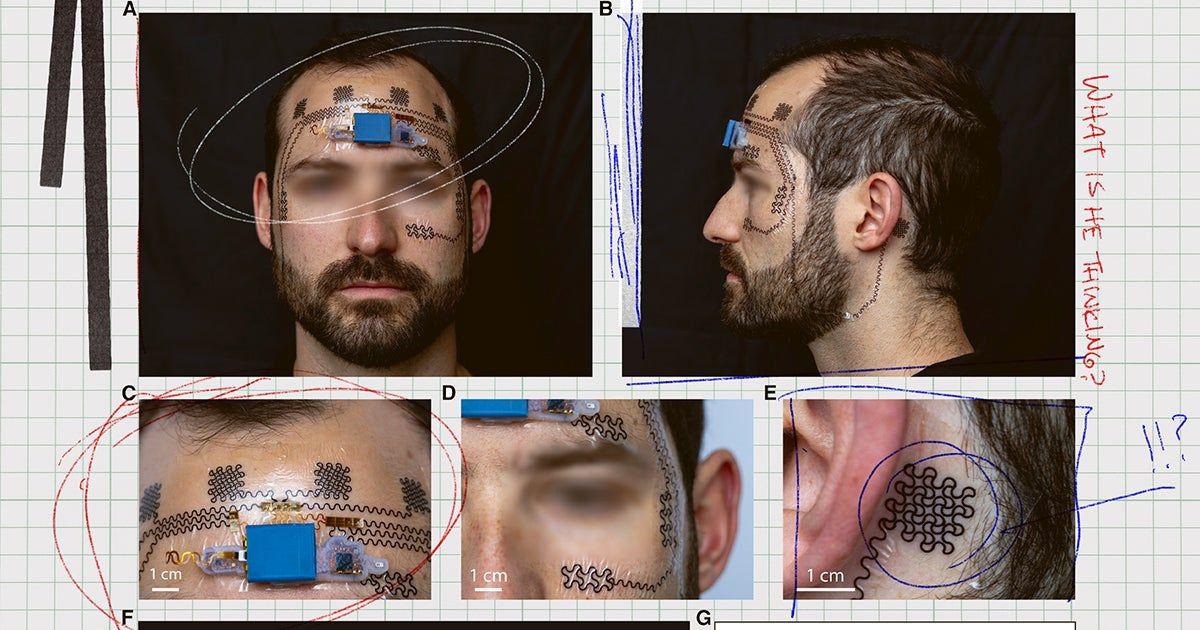
The e-tattoo is a wireless, ultra-thin film that adheres to the forehead like a temporary tattoo sticker. It incorporates:
- Four square EEG electrodes on the forehead for brain activity detection
- Rectangular EOG electrodes around the eyes for eye movement tracking
- A reference electrode behind the ear
- A small battery pack and flexible printed circuit
The device uses a graphite-based conductive material and is customized to fit individual facial contours
2
.Testing and Performance
Researchers tested the e-tattoo on six volunteers who performed memory tasks of increasing complexity. The device successfully tracked changes in brainwave activity corresponding to mental workload. A machine learning algorithm was then trained to predict mental strain levels based on the collected EEG and EOG data
3
.Potential Applications and Benefits
The e-tattoo technology could have significant implications for professions where managing mental workload is crucial, such as:
- Pilots
- Air traffic controllers
- Healthcare workers
- Military personnel
By providing real-time alerts about cognitive overload, the device could help prevent mistakes and protect workers' health
4
.Advantages Over Existing Technologies
Compared to traditional EEG equipment, the e-tattoo offers several benefits:
- Wireless and lightweight design
- Lower cost (approximately $200 for the full device)
- Customizable to individual facial features
- Ability to function during movement
These advantages make the e-tattoo more practical for real-world applications than existing bulky and expensive EEG headsets
5
.Related Stories
Privacy Concerns and Ethical Considerations
Source: FT
The development of this technology raises important questions about privacy and data ownership. Stephen Damianos, executive director of the Neurorights Foundation, expresses concerns about:
- Lack of regulation for neurodata
- Potential for coerced mental surveillance in workplaces
- Data breaches and unauthorized access to sensitive information
- Sale of neurodata to advertisers or insurers
These issues highlight the need for clear protections and regulations surrounding the collection and use of brain data
1
.Future Developments and Challenges
Researchers are working on improving the e-tattoo technology, including:
- Developing an app to provide real-time alerts about high mental workload
- Creating ink-based sensors for use on hairy scalps
- Expanding coverage for more comprehensive brain monitoring
However, challenges remain, such as the device's current limitation to hairless skin and the need to address privacy concerns before widespread adoption
4
.As this technology continues to evolve, it is crucial for society to engage in thoughtful discussions about the ethical implications and necessary safeguards for neurodata collection and use. The e-tattoo represents a significant step forward in cognitive monitoring, but its implementation must be balanced with robust protections for individual privacy and data rights.
References
Summarized by

Navi
[3]
[4]
[5]
Related Stories
Neurables Launches Brain-Tracking Headphones to Boost Focus and Combat Burnout
24 Sept 2024

Neurable licenses BCI technology to flood consumer wearables with brain-scanning capabilities
28 Apr 2026•Technology

Brain Implants Decode Inner Speech: Medical Breakthrough Raises Ethical Concerns
31 Aug 2025•Technology

Recent Highlights



Recent Highlights
Today's Top Stories







Don’t drown in AI news. We cut through the noise - filtering, ranking and summarizing the most important AI news, breakthroughs and research daily. Follow topics that matter to you and stay ahead.


