Animal-Inspired AI Robot 'Clarence' Learns to Navigate Unfamiliar Terrain Autonomously


2 Sources
[1]
Animal-inspired AI robot learns to navigate unfamiliar terrain
Researchers have developed an artificial intelligence (AI) system that enables a four-legged robot to adapt its gait to different, unfamiliar terrain, just like a real animal, in what is believed to be a world first. The work has been published in Nature Machine Intelligence. The pioneering
[2]
Watch: Four-legged 'rescue robot' tackles rough terrain
With its stumbling gait and tentative steps it could be a baby animal learning to manoeuvre through unfamiliar terrain. But this is Clarence, the animal-inspired robot, which has been taught to navigate through the world like a dog or horse, and is the first in the world to be able to adapt to
Share
Copy Link
Researchers from the University of Leeds and University College London have developed an AI system enabling a four-legged robot to adapt its gait to unfamiliar terrain autonomously, mimicking animal behavior.
Breakthrough in AI-Powered Robot Navigation
Researchers from the University of Leeds and University College London have achieved a significant milestone in robotics by developing an artificial intelligence (AI) system that enables a four-legged robot to adapt its gait to unfamiliar terrain autonomously
1
. This groundbreaking technology, published in Nature Machine Intelligence, marks a world first in robotic locomotion, allowing the robot to change its movement patterns without explicit instructions.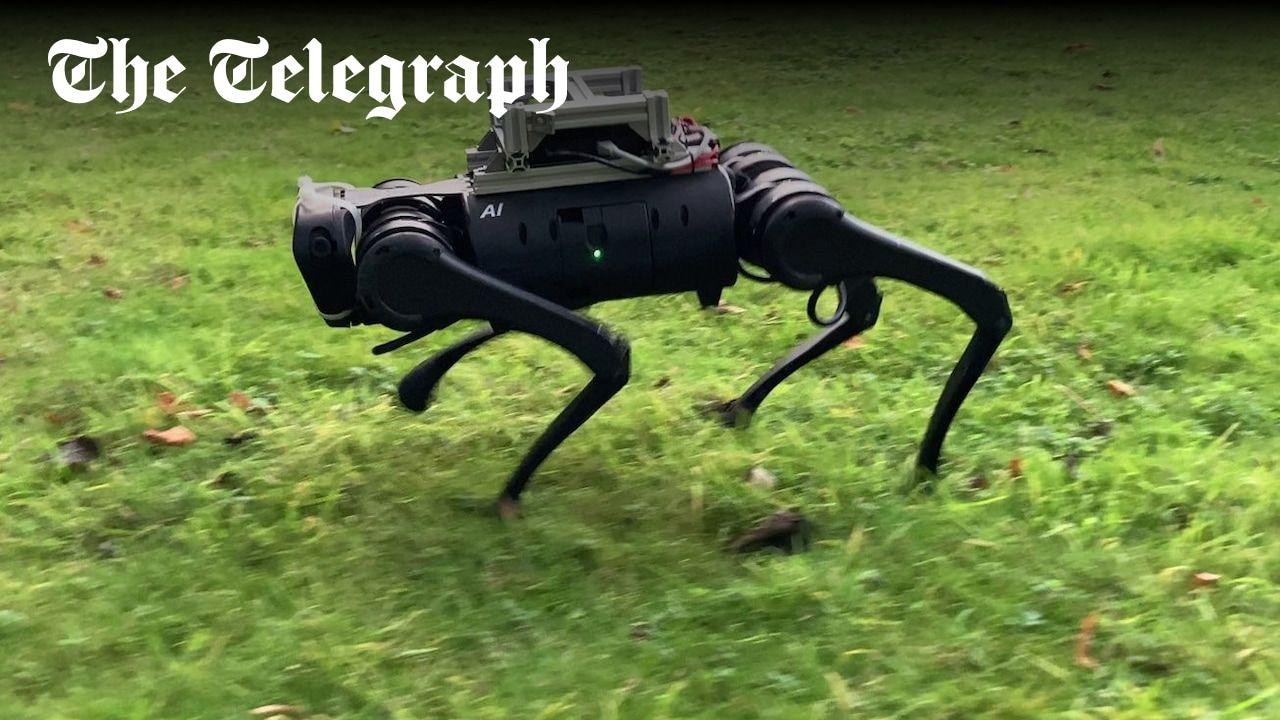
Source: The Telegraph
Animal-Inspired AI Framework
The research team drew inspiration from the animal kingdom, particularly four-legged animals like dogs, cats, and horses, to create a framework that teaches robots how to transition between different gaits
1
. By embedding animal locomotion strategies into the AI system, the robot, nicknamed "Clarence," can rapidly learn to switch between trotting, running, and bounding in response to various terrains.Joseph Humphreys, the first author of the study, explained, "This deep reinforcement learning framework teaches gait strategies and behavior inspired by real animals -- or 'bio-inspired' -- such as saving energy, adjusting movements as needed, and gait memory, to achieve highly adaptable and optimal movement, even in environments never previously encountered"
1
.Rapid Learning and Real-World Application
One of the most impressive aspects of this technology is the speed at which the robot learns. Clarence mastered the necessary strategies in just nine hours, significantly faster than the days or weeks most young animals require to navigate different surfaces confidently
1
. This rapid learning is made possible by the data-processing power of AI and simulation-based training.The robot's ability was put to the test in real-world scenarios, where it successfully navigated a variety of challenging terrains, including:
- Uneven timber
- Loose wood chips
- Overgrown vegetation
- Muddy fields
- Tangled roots
1
2
Potential for Hazardous Environment Applications
The development of Clarence opens up new possibilities for using legged robots in hazardous settings where human safety might be at risk. Professor Zhou, senior author of the study, highlighted the potential applications: "Our long-term vision is to develop embodied AI systems -- including humanoid robots -- that move, adapt, and interact with the same fluidity and resilience as animals and humans"
1
.Some potential areas where this technology could be applied include:
- Nuclear decommissioning
- Search and rescue operations
- Disaster response
- Planetary exploration
- Agriculture
- Infrastructure inspection
1
2

Source: Tech Xplore
Related Stories

Unique Features of the AI System
The researchers claim that their framework is the first to simultaneously integrate three critical components of animal locomotion into a reinforcement learning system:
- Gait transition strategies
- Gait procedural memory
- Adaptive motion adjustment
1
This integration enables versatile, real-world deployment directly from simulation, without requiring further adjustments on the physical robot. The system allows the robot to decide which gait to use, when to switch, and how to adjust it in real-time, even on previously unseen terrain.
Future Implications for Robotics
This advancement in robotic locomotion represents a significant step towards creating more adaptable and capable legged robots. By mimicking animal behavior and using AI to process and apply this knowledge, researchers are pushing the boundaries of what robots can achieve in complex, real-world environments.
As the field of biomimicry continues to evolve, we can expect to see more innovations that bridge the gap between artificial and natural intelligence, potentially revolutionizing fields such as disaster response, exploration, and automation.
References
Summarized by

Navi
[2]
Related Stories
Robot dog learns to switch gaits like animals, tackling forests and stairs with new AI framework
16 Jul 2026•Science and Research
Six-Legged Robot Masters Walking by Learning from Stick Insect in Just One Hour
28 Aug 2026•Science and Research

Generative AI Revolutionizes Robot Training: MIT's LucidSim Enhances Real-World Performance
13 Nov 2024•Technology

Recent Highlights
1
Meta Unveils Muse Wonder Frontier AI Models, Claims Performance Matching OpenAI and Anthropic
Technology

2
IMF Report Warns AI Market Correction Could Spark Global Financial Crisis With $1.4T at Risk
Business and Economy

3
OpenAI Releases 722 AI-Generated Math Solutions, Triggering Existential Crisis in Mathematics
Technology

Recent Highlights
Today's Top Stories









Don’t drown in AI news. We cut through the noise - filtering, ranking and summarizing the most important AI news, breakthroughs and research daily. Follow topics that matter to you and stay ahead.


