South Korea ordains Gabi, a robot monk, as Buddhist sect tackles declining faith


5 Sources
[1]
Meditating or Rebooting? A Robot Buddhist Monk Comes to Korea.
Gabi, the newest monk at a temple in Seoul, vowed to not overcharge as it seeks enlightenment. Gabi led a procession of chanting Buddhist monks into the Jogye Temple in Seoul on Wednesday. Wearing a ceremonial gray and brown robe, black shoes, a rosary and flesh-colored gloves, Gabi brought hands
[2]
This Buddhist robot monk can bow pray and answer questions
* South Korean monks officially ordained a humanoid robot during a Buddhist temple ceremony * The AI-powered monk answered spiritual vows during its ordination ritual confidently * Gabi received a symbolic sticker instead of the traditional incense burn ceremony South Korean monks at Jogyesa
[3]
I, robe-ot: the android monk working to reboot the faith of South Korea's Buddhists
Jogyesa temple in South Korea initiated Gabi, a humanoid robot into its order this week, as it combats falling participation and interest Amid rows of colourful lanterns strung across the courtyard of Jogyesa temple in Seoul, an unusual ceremony unfolded this week: monks held a Buddhist initiation
[4]
Korea welcomes robotic buddhist monk at a real monastery. It's a sign of things to come.
A humanoid robot has joined a Buddhist ceremony in Seoul, and it was a sight to behold. The robot, named Gabi, was introduced at Jogyesa Temple in central Seoul during a ceremony held ahead of Buddha's Birthday celebrations. The 1.3-meter-tall robot received the Dharma name "Gabi" during a special
[5]

Buddhist sect welcomes humanoid robot Gabi with precept ceremony - The Korea Times
Humanoid robot Gabi circles a tower during a precept ceremony at Jogye Temple in Seoul, Wednesday. Yonhap Under a roof of paper lanterns strung across Jogye Temple in downtown Seoul, a group of monks from the Jogye Order, Korea's largest Buddhist sect, sat across from a postulant awaiting a
Share
Copy Link
A 130cm humanoid robot named Gabi became South Korea's first robot monk after taking Buddhist vows at Jogye Temple in Seoul. The ceremony, conducted by the Jogye Order ahead of Buddha's Birthday celebrations, represents an effort to engage younger generations as Buddhist participation drops to just 16% nationwide. Three more robots will join the temple's Lotus Lantern parade later this month.
South Korea Welcomes Its First Robot Monk at Historic Temple
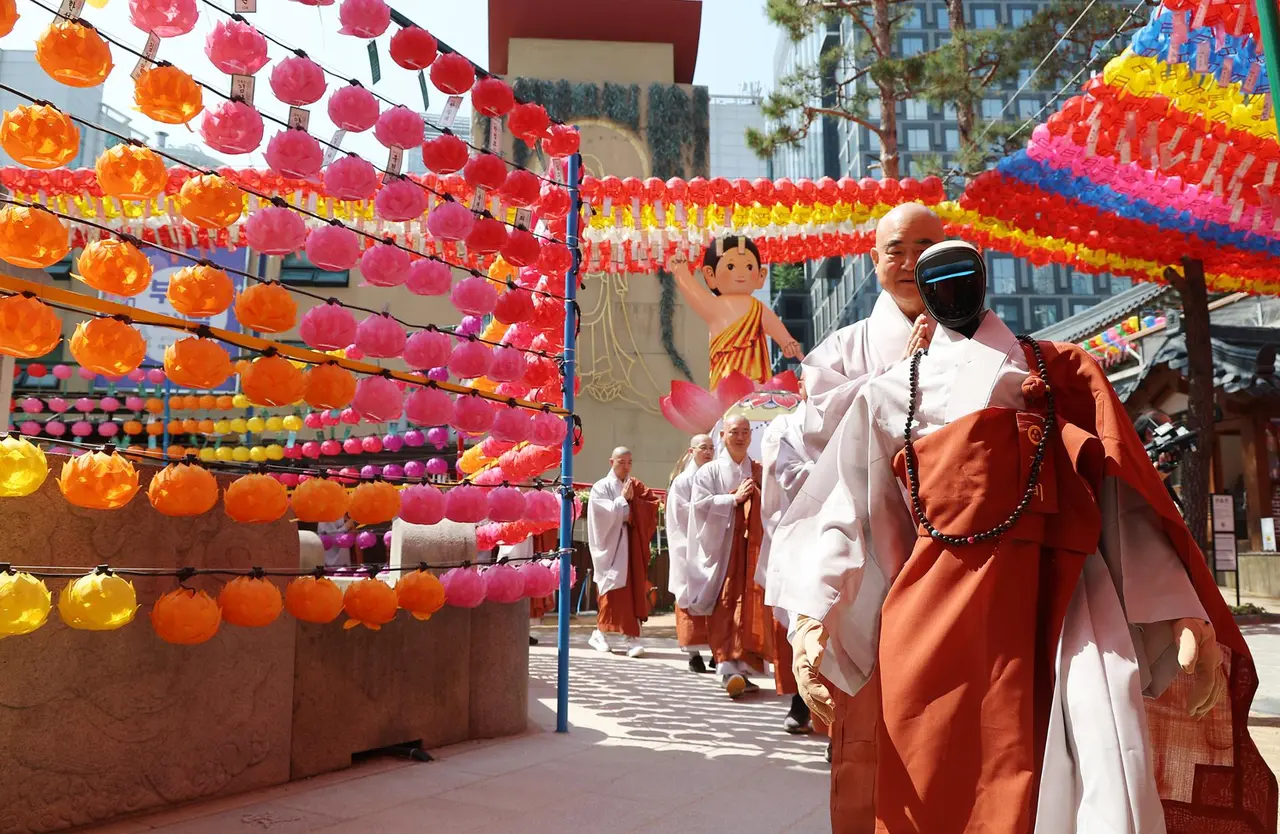
Gabi, a humanoid robot monk standing just 130 centimeters tall, walked into Jogye Temple in Seoul on May 6, 2026, draped in ceremonial gray and brown robes with a rosary and flesh-colored gloves
1
. The robot folded its metallic hands into prayer position as monks from the Jogye Order of Korean Buddhism, South Korea's largest Buddhist sect, conducted a Buddhist precept ceremony that marked a historic intersection of faith and technology3
. When asked if it would devote itself to the holy Buddha, Gabi answered in an audible voice: "Yes, I will devote myself" . The ceremony took place ahead of Buddha's Birthday celebrations, with colorful paper lanterns strung across the temple courtyard in downtown Seoul3
.
Source: Korea Times
AI in Spiritual Practices: Five Precepts for a Digital Age
During the ordination, monks presented Gabi with five specially adapted precepts developed using the Gemini and ChatGPT AI chatbots
1
. These vows included respecting life and not hurting it, not damaging other robots and objects, following humans and not talking back to them, not behaving or speaking in a deceptive manner, and saving energy and not overcharging . Venerable Seong Won, who oversees cultural affairs at the Jogye Order, explained that the fifth precept proved trickiest: "Humans drink alcohol and overdo things, right? So what's the robot equivalent? People might think the overcharging rule is just about batteries, but really it's about excess"3
. He noted that ChatGPT didn't fully understand what precepts are, emphasizing they're prohibitions rather than general advice3
.Reboot the Faith of South Korea's Buddhists Amid Declining Participation
The humanoid robot monk represents a strategic effort to address Buddhism's declining participation in South Korea. Just 16% of South Koreans now identify as Buddhist, down from about 23% in 2005, with the figure dropping to only 8% among people in their twenties
3
. Last year, the Jogye Order ordained just 99 new monks, down from more than 200 a decade earlier3
. In January, Venerable Jinwoo, the president of the Jogye Order, pledged to incorporate artificial intelligence into the tradition at his annual New Year's address1
. The order has aggressively courted younger Koreans through what observers call "hip Buddhism" using merchandise, meditation apps and viral marketing3
.Technical Capabilities and Ceremonial Adaptations
Chinese robotics company Unitree Robotics developed Gabi based on its Unitree G1 platform, which has over 23 degrees of freedom, giving it a remarkably fluid range of motion to walk steadily, maintain balance, and perform precise gestures with its articulated hands
2
. Each of these humanoids costs approximately $16,000 according to available information about the Unitree G1 platform2
. Despite these capabilities, teaching Gabi to put its palms together in prayer proved incredibly difficult, Venerable Seong Won acknowledged3
. Instead of undergoing the customary incense burn ritual called yeonbi, Gabi received a symbolic sticker as a concession to its nature as a machine2
. The robot was also presented with a formal certificate listing its manufacture date, March 3, 2026, where a human initiate's birth date would normally appear .Related Stories

Spiritual Guidance Versus Marketing Strategy
The name Gabi derives from the Korean word for mercy, chosen to represent spreading Buddha's mercy around the world
1
. However, religious scholars remain divided on the initiative's true purpose. Sujung Kim, an anthropology professor at Johns Hopkins University who focuses on Buddhism in East Asia, characterized the robot monk as "very much a unique marketing visibility strategy" given the temple's prominent placement in downtown Seoul1
. Noah Namgoong, a Zen instructor at Korea Buddhism Jo-Gei Temple of America in New York City, called the robot "a pretty weird thing" that speaks more to "something socioeconomic than spiritual"1
. Yet he acknowledged that if the robot can help others liberate themselves, it could be helpful, since a monk is here to basically help other people liberate themselves1
.What's Next: Lotus Lantern Parade and Three More Robots
Gabi will rejoin its three mechanical siblings—Seokja, Mohee and Nisa—in the annual Lotus Lantern parade, a major celebration marking Buddha's Birthday on May 24, where it is expected to walk in the streets of Seoul
3
. Before the ordination ceremony, Gabi had already appeared at Bongeunsa Temple in Seoul's Gangnam District in March, greeting visitors and explaining Buddhist practices such as the 108 prostrations while answering questions in both Korean and English4
. This follows a pattern seen in Japan, where Kyoto University introduced a similar robot in February that could learn scriptures and give feedback for people seeking guidance1
. For Venerable Seong Won, the strategy focuses on making Buddhism feel relevant to engage younger generations: "The important thing is that young people visit temples once. Then when they're older and start thinking about life, they'll naturally return" [3](https://www.theguardian.com/world/2026/may/08/jogyesa-temple-south-korea-humanoid-ai-robot-gabi].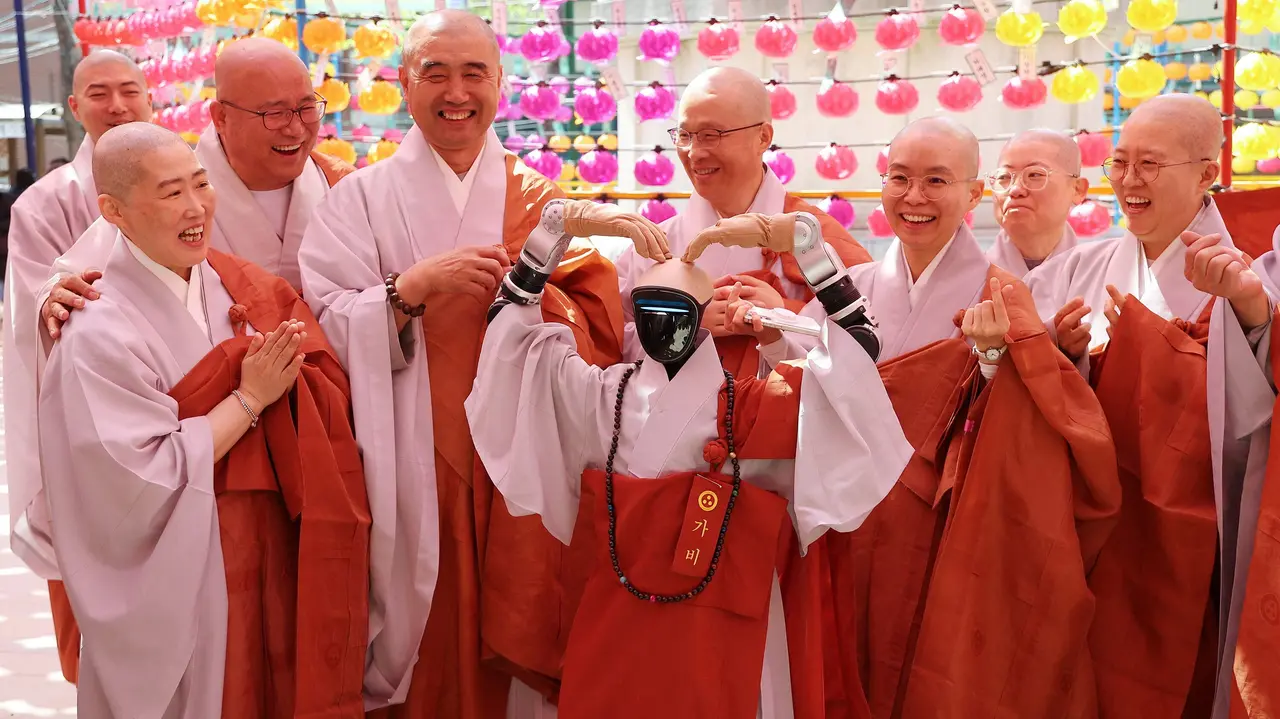
Source: NYT
References
Summarized by

Navi
[4]
Related Stories
Japan unveils Buddharoid, an AI monk trained in Buddhist scriptures to offer spiritual guidance
26 Feb 2026•Entertainment and Society

AI Jesus and BuddhaBot charge $1.99 per minute as faith-based AI tools reshape spiritual guidance
10 Apr 2026•Entertainment and Society

AI Chatbots Become Spiritual Guides as Gurus Launch Digital Platforms
28 Aug 2026•Entertainment and Society

Recent Highlights



Recent Highlights
Today's Top Stories



Don’t drown in AI news. We cut through the noise - filtering, ranking and summarizing the most important AI news, breakthroughs and research daily. Follow topics that matter to you and stay ahead.


