4 Sources
[1]
Salesforce, Anthropic expand partnership as Benioff responds to 'SaaSpocalypse' concerns
* Salesforce and Anthropic on Wednesday expanded their strategic partnership and unveiled "Claudeforce," a new way for salespeople to work within Anthropic's product. * The announcement marks the first time that Salesforce has ever added its "force" suffix at the end of another company's product. * "We're delivering a dynamic interface that thinks, reasons, and acts," Salesforce CEO Marc Benioff said in a statement. In this article * ANTHR.FG * CRM Follow your favorite stocksCREATE FREE ACCOUNT Marc Benioff, chief executive officer of Salesforce Inc., during an interview on "The Circuit with Emily Chang" in San Francisco, California, US, on Friday, April 25, 2025. David Paul Morris | Bloomberg | Getty Images Salesforce and Anthropic on Wednesday expanded their strategic partnership and unveiled "Claudeforce," a new way for salespeople to access critical data directly from inside Anthropic's Claude chatbot. Claudeforce is launching as a plugin with 37 pre-built sales skills that will allow Claude users to compose emails, update records and take other relevant actions, according to a release. The companies said they plan to introduce more integrations across Claude, Salesforce and its messaging platform Slack in the future. "By fusing Claude's extraordinary reasoning with the trusted data, workflows, and governance every enterprise runs on, we're delivering a dynamic interface that thinks, reasons, and acts," Salesforce CEO Marc Benioff said in a statement. "This is how every business will run." Wednesday's announcement marks the first time that Salesforce has ever added its "force" suffix at the end of another company's product name. Salesforce and its software peers have been under pressure as investors question whether AI tools from companies like Anthropic and OpenAI will replace them. Salesforce shares are down about 22% this year after dropping 20% in 2025. The Nasdaq, meanwhile, is up about 35% since the end of 2024. Anthropic primarily sells its Claude models and products to other businesses and has experienced a period of explosive growth this year. The company recently told investors that its annualized revenue run rate hit $65 billion at the end of July, a sevenfold increase from a year ago. "Through this partnership, companies can point Claude at the customer information and business context that they've been building in Salesforce for decades -- surfacing the insights that really matter and helping their businesses run more efficiently and grow more quickly," Anthropic CEO Dario Amodei said in a statement. Claudeforce is available to a select group of pilot customers, and it will launch in a preview capacity next month, the companies said. Additional pre-built skills will be available later this year. watch now VIDEO4:4504:45 Bill Nygren: Salesforce is not done growing, now redirecting cash flow to purchase shares The Exchange Choose CNBC as your preferred source on Google and never miss a moment from the most trusted name in business news.
[2]
Salesforce just put its entire CRM inside Claude -- and says you'll never need its app again
Salesforce and Anthropic announced Tuesday a sweeping expansion of their partnership, called Claudeforce, that pushes the world's largest customer relationship management platform directly inside Claude -- a tacit acknowledgment that the future of enterprise software may not involve enterprise software's own screens at all. The centerpiece of the announcement is Salesforce in Claude, a plugin for Anthropic's Claude CoWork that ships with 37 pre-built sales skills -- covering meeting preparation, deal health reviews, and pipeline analysis -- and lets sellers query, update, and act on live CRM data without ever opening Salesforce itself. The product is available to select pilot customers today, with an open beta planned for September and additional skills for other business functions beginning to launch in the third quarter. Marc Benioff, Salesforce's chair and CEO, and Dario Amodei, Anthropic's CEO, were scheduled to appear on television together Tuesday afternoon, hours before Salesforce reports quarterly earnings -- a piece of stagecraft that underscores how central this partnership has become to both companies' narratives. "We're bringing together the world's #1 AI and #1 CRM -- the best of both worlds," Benioff said in a statement. "Here, the UI is the AI -- allowing you to build custom apps dynamically and answer any enterprise question. Probabilistic intelligence alone doesn't run a company, and deterministic systems don't reason." But the more revealing framing came in an exclusive interview with VentureBeat, where Patrick Stokes, Salesforce's president of applications and marketing, described the launch in terms that would have been unthinkable for a major SaaS vendor even two years ago. "We think that what this can do is kind of be a version of what Claude Code did for developers," Stokes said. "We think we're about to do the same thing for knowledge workers. This is just a whole new way to work." How Salesforce turned its headless CRM experiment into a one-click Claude plugin The road to Claudeforce began in March, when Salesforce released Headless 360 at its TDX developer conference -- a collection of APIs, MCP servers, and command-line tools that let AI agents call Salesforce data, workflows, and governance rules directly, with no user interface required. "I think we really kind of surprised the world a little bit with our Headless approach," Stokes told VentureBeat, "basically kind of openly suggesting that these agentic interfaces are a really good way to use Salesforce's products, and we don't actually mind if you don't use Salesforce's products exclusively through a user interface designed for a human." What happened next, according to Stokes, was both validating and messy. Customers rushed to wire Salesforce's MCP servers into agentic interfaces -- "but really, Claude rose to the top," he said. The problem was friction. "Every individual user has to know what an MCP server is. Obviously, your average knowledge worker out there is not dealing in MCP servers every day. And you know, even if you can find it, how do you wire it up? And then, how do you make sure that it's respecting the permissions of the users?" The answer came from an unexpected source: Anthropic's own workforce. "We sat down with Anthropic and we talked about the problem, and they said, 'Hey, this is actually how we're using Salesforce. We use Salesforce pretty much exclusively through Claude and a series of skills and MCP servers that we have,'" Stokes recounted. The two companies decided to productize that internal setup as a CoWork plugin -- one that an administrator connects a single time, with authentication and permissions managed centrally, so "all of the difficulty of wiring up every individual user with an MCP server is just magically solved." Under the hood, the architecture is deliberately simple. When a seller asks Claude to update a deal, Claude first reasons over its available skills -- "kind of human-like instructions," as Stokes described them -- to determine whether specific guidance exists for the task. If it finds a match, it reads the instructions and executes against Salesforce's MCP server, which inherits the user's existing permissions. "If you don't own that record, if you don't have permission to see that record, the MCP server doesn't either, and so you won't be able to read or write it," he said. For enterprise buyers, that may be the announcement's most important technical claim: nothing new to stand up, nothing to re-audit, nothing to configure account by account. Why Salesforce says letting sellers live in Claude makes its platform more valuable, not less The strategic tension at the heart of Claudeforce is obvious: if sellers start living in Claude instead of Salesforce, doesn't Salesforce become less important over time? Stokes rejected the premise emphatically. "That's not what we're seeing at all," he said. "The value of Salesforce is not in our UI itself. It's not the application. The value of Salesforce is in the data and the metadata, the years worth of kind of encoded workflows and business practices that have been built up inside of Salesforce. What we're doing is we're taking that and we're exposing it to a new UI." He offered a concrete example of the productivity math Salesforce is betting on. A seller's morning ritual -- deciding which opportunities to work -- traditionally means opening an opportunities list, clicking into each record, reading activities and meeting histories, and synthesizing everything mentally. "That process of evaluating all of those records and synthesizing it and coming up with a plan is like 10,000 clicks inside of Salesforce," Stokes said. "Now you just go to Claude and it's going to execute all of that for you, and it's going to do it in like 30 seconds." The paradoxical result, he argued: "I'm actually using Salesforce more than I ever would have before, because the work of clicking around to get what I need is gone." There is self-interest in that framing. Salesforce charges for this new usage through its headless consumption pricing -- "depending on your edition of your user license within Salesforce, you effectively get more incremental access to more and more API calls," Stokes explained. Customers separately contract with Anthropic for the Claude inference itself. "You can't buy this on one piece of paper at the moment," he acknowledged. That two-invoice structure hints at the deeper industry shift underway: the slow migration of enterprise software economics from seats to consumption. If agents rather than humans become the primary consumers of SaaS functionality, per-user licensing loses coherence -- and Salesforce appears to be positioning API consumption as the successor metric before someone else forces the issue. What Claudeforce means for Agentforce and the deepening Salesforce-Anthropic alliance The announcement also raises questions about Agentforce, the agent platform Salesforce has spent roughly two years promoting as its AI centerpiece. Stokes drew a careful taxonomy to distinguish the two. "These are not apples that you can look at as equivalent things," he said. "Agentforce is really designed for autonomous work or work that touches the end customer. So think about help.salesforce.com -- that is an agent implementation specifically designed to interface with the end customer." Salesforce in Claude, by contrast, "is a knowledge worker agent... specifically designed for sellers, for salespeople, to help them do their day-to-day job without having to do the traditional part of their job, which is click around in user interfaces and try to synthesize data themselves." The distinction is tidy, but it papers over a real strategic evolution. In October 2025, Reuters and CNBC reported that Salesforce was hedging its model bets, bringing both OpenAI and Anthropic into Agentforce and even putting Agentforce inside ChatGPT. Since then, the relationship with Anthropic has clearly deepened into something closer to a preferred alliance: Bloomberg reported in June that Salesforce's investment in Anthropic was valued at roughly $5 billion, and Tuesday's release makes Claude the default model across Slack -- powering Slackbot, the Claude Tag feature Anthropic previewed in June, and the new Slack Code product. Salesforce says 83% of its workforce now uses Claude-powered Slackbot, saving what it claims is 3.8 million productivity hours annually. For Anthropic, which The Wall Street Journal has reported is bulking up its enterprise partner program amid IPO preparations, the deal delivers something invaluable: distribution into the daily workflow of millions of sellers at companies that already trust Salesforce with their most sensitive commercial data. It also delivers tokens. "Once you start using this, you get very excited and you start to see how it can improve your day," Stokes said. "And yes, that is going to drive token consumption, which is obviously part of the reason why Anthropic is excited about this as well." Inside the demo: AI-generated dashboards and the rise of the vibe-coded CRM The most striking moment of VentureBeat's briefing came during a live demo from Shannon Mathews, Salesforce's VP of product management, who showed a seller asking Claude to "schedule a daily briefing to tell me where should I focus my business." The system returned a prioritized action plan -- flagging, for instance, that six closing opportunities had no next steps ("I'm sure my leadership is not going to be thrilled about that," Mathews joked) and surfacing a COO change at a key account pulled from the web. "It really provides a concise call to action of where I should be focusing my time for today and this week," she said, describing the vision as giving every rep "almost an AI chief revenue officer." Then came the part that gestures at something genuinely new. Mathews generated a full sales dashboard -- a "command center" -- that Claude coded on the fly as a local HTML file, styled, at Stokes's request, "like Miami Vice, like Tron, just because I thought it was cool." "This isn't like a product that we're shipping," Stokes said. "This is Claude coding this on the fly using Salesforce data... If you think about all these different tools that we have to use -- Salesforce, Workday, or whatever -- we always have to use the UI that somebody else decides you're going to use. Now we're just taking Salesforce data and workflows, and CoWork is giving you the ability to make the UI look like whatever you want." Asked directly whether users can effectively vibe code their own dashboards, complete with actions and tool calls, Stokes leaned in. "This idea that people are going to vibe code their own CRM is probably not going to happen anytime soon. But what we are seeing is that people do want to vibe code their own CRM, and that's what we've enabled. We've just said: do it with Salesforce... You're vibe coding against trusted, governed Salesforce data." At a recent internal leadership summit in Hawaii, he said, "every single one" of the sales executives presenting business reviews "showed up with a command center-like view of their business that they built themselves right inside of CoWork." The bigger bet: why Salesforce is embracing its own disintermediation Strip away the branding and Claudeforce amounts to a wager that Salesforce is better off embracing its own potential disintermediation than resisting it. The history of platform shifts suggests that incumbents who fight new interfaces -- rather than racing to own their position within them -- tend to lose. Salesforce is betting that its moat was never its Lightning pages; it was 27 years of accumulated data, metadata, workflow logic, and governance that no model can conjure and no startup can quickly replicate. As the companies' own launch materials put it, a frontier model without that context is "a genius who's never seen your deals." The bet carries real risks. If the interface layer commoditizes, pricing power could migrate toward whoever owns the intelligence -- and Anthropic, not Salesforce, owns Claude. The consumption-pricing transition could cannibalize seat revenue faster than API calls replace it. And the broader market remains skittish about exactly this scenario: Reuters reported in February that U.S. software stocks staged a relief rally on an Anthropic announcement, a reminder of how much SaaS valuations now hinge on whether AI labs are perceived as partners or predators. There is also the unglamorous question of whether enterprises will capture the promised value at all. Gartner forecast worldwide end-user spending on generative AI models at $14.2 billion for 2025, yet McKinsey's ongoing State of AI research has repeatedly found that while adoption is nearly universal, most organizations still struggle to translate pilots into measurable bottom-line impact. Claudeforce's answer -- pre-built skills, inherited permissions, one-time setup -- is essentially an argument that the ROI gap has been a deployment-friction problem all along. Stokes framed the moment in almost epochal terms. "Salesforce believes that the interface to SaaS is undergoing a pretty significant period of change, and in some cases aggregation," he said. "We've already seen that AI has changed the way people build software with coding agents, but now we're seeing that it's fundamentally changing the way that people use software -- and that can feel very scary on the surface. But our experience is that they're using software way more than they were, because this is unlocking trapped value that is trapped behind a human's own ability to click around and synthesize information themselves." Whether that proves prophetic or self-serving will play out over the coming quarters, as the beta opens in September and the skills expand beyond sales into service, marketing, and commerce. But the symbolism of Tuesday's announcement is already unmistakable. Salesforce spent 27 years building the defining user interface of enterprise software -- and then spent Tuesday morning telling the world its customers no longer need it. The company that taught business how to click is now betting everything on the idea that nobody wants to.
[3]
Salesforce CEO Benioff Says 'Apps Are Not Dying' As AI Drives CRM Usage, Agentforce Growth
'We're told agents accessing our system would kill apps -- well, actually, usage is exploding,' Salesforce CEO and co-founder Marc Benioff said. Salesforce CEO and co-founder Marc Benioff pointed to results from the vendor's latest fiscal quarter as proof that customer relationship management software and software-as-a-service can not only survive the artificial intelligence era but make AI usable for businesses. The San Francisco-based CRM and SaaS giant saw agentic use of its applications through Model Context Protocol (MCP) and command-line interface (CLI) calls surge sixfold, Benioff said Wednesday on Salesforce's latest quarterly earnings call, covering the second quarter of its 2027 fiscal year. "We're told agents accessing our system would kill apps -- well, actually, usage is exploding," said the CEO while covering results from the three months ended July 31. "And we're told the frontier models would eliminate the need for CRM. Instead, they depend on it. And we're showing how one plus one can equal three." [RELATED: CData Expands Data Connectivity Options For AI Developers] Salesforce Q2 Counters SaaSpocalypse Fears Leah Sand, senior vice president of the AI-first marketing and engagement practice at St. Louis-based solution provider Perficient -- whose partners include Salesforce -- told CRN in a recent interview that this marketing and engagement practice has grown explosively due to the importance of systems needing to support creative and campaign operations and customer demand for more autonomy in account-based marketing (ABM). Perficient has differentiated itself in the space through the depth of its capabilities with a set of vendor alliances, including leveraging Salesforce and AI startups that can integrate with Salesforce, such as Gradial and Swantide. Customers "want to solve for asset variations at scale," Sand said. "It's both getting more complex and simple because we're focused on either addressing a client problem, closing an execution gap for them or opening up net new territories, like AEO and GEO," which refer to the answer engine optimization and generative engine optimization strategies for digital marketing in the AI age. "We're helping them close the execution gap," she said. "It takes some discernment to figure out when to use what and what is valuable. What should be generative, what should be agentic, what should really just be automation." Benioff Doesn't See Customer Focus On Models Benioff said he does not foresee enterprises setting up their own AI model expertise and maintenance operations, instead consuming models through packaged software like Salesforce in the front office and Slack as a collaboration application. Customers tend not to know the semiconductors they use and which data center, router, switch, fiber, cable and interconnect they use, instead just wanting their applications to work. Salesforce customers have not asked him about something as specific as open-source models and frontier models, with room for a variety of model types in the market, the CEO said. "At some level, we too will get abstracted back to kind of how the way the world used to be," Benioff said. "I believe the highest level of value is at the application layer. So, I couldn't tell you from my phone all the way through Salesforce and Slack all the way down to what the hardware infrastructure is, and I shouldn't have to worry about that." He continued: "I don't think that's where customers' heads are at. At least when they talk to me, that's not what their heads are at." Salesforce also has custom models running in its platform and available on marketplaces like Hugging Face. Salesforce, Anthropic Launch Expanded 'Claudeforce' Partnership Still, Benioff illustrated the power of Salesforce as an interaction layer and data layer with an expanded strategic partnership with Claude maker Anthropic. Revealed just before Wednesday's call, the companies have united Claude reasoning and Salesforce's enterprise harness under the so-called "Claudeforce" partnership. The partnership has so far resulted in a Salesforce in Claude offer available to select pilot customers, with open beta expected next month. The Salesforce in Claude plugin has 37 prebuilt sales skills that enable sellers and agents to reason over live revenue context, automate pipeline updates and take governed action from Claude. The vendors plan to introduce more integrations across Claude, Salesforce and Salesforce's Slack division in the future. Benioff described the offer as "a radically different type of interface on top of Salesforce's entire platform" on the call. Customers can see "all this value that they have in their systems that has been trapped becomes un-trapped." He said Claudeforce can unlock AI insights with customers' data without the use of forward-deployed engineers (FDEs), which have been a target of investment by a variety of vendors. Miguel Milano, Salesforce president and chief operating officer, clarified that Slack remains an important interaction layer for Salesforce, "but not everybody has Slack." "They are complementary," Milano said. "Slack, you are working with your teams. It's a multiplayer surface. With ... Claudeforce and Salesforce in Claude, we are simply going deep and researching, understanding your business." Agents built on Claude can investigate business pipeline risks within the month and the quarter, with an option to send messages based on the results through Slack to account executives, for example, the COO said. More activity on the network with agents, a variety of user interfaces and new applications translate into more activity on Salesforce services, Benioff said. Nine of the top 10 AI companies more than quintupled Salesforce spend year over year. Salesforce saw its strongest net-new annual order value (AOV) growth in four years and near-record-low attrition during the quarter, countering fears around a "SaaSpocalypse" of AI costing SaaS vendors value and customers. "This nonsense of this SaaSpocalypse -- I think it's time for it to stop," Benioff said. "Apps are not dying. In fact, they're growing. ... Frontier models depend on CRM (customer relationship management). They make sure that it works, that it all comes together. They do not replace them." Customers Want AI Pricing Flexibility Benioff said that AI customers still seek a variety of ways to buy products and services, with per-user, per-agent, overage charges, consumption-based and outcome-based pricing all resonating with different customers. Likewise, solution providers have explored outcome-based pricing and other engagements with customers to make up for AI's potential to erode hourly billing and other traditional ways channel partners bill clients. "Customers want to buy and want to price in different ways -- this is something I've learned really aggressively recently," Benioff said. "Because customers want that kind of diversity in pricing, we've created a high level of flexibility. And that I think has really expanded our ability to sign very large transactions with our customers." Milano said bookings grew triple digits, doubling year on year. Half of the bookings came from customers wanting more consumption and credits, with these sales cycles to increase credits taking up less time than the initial sales cycle. The vendor has also looked to upgrade more customers to premium editions. Salesforce added 2,000 paying customers into production, up 70 percent quarter over quarter, and added hundreds of AI agents that are consistently consuming Salesforce products. Milano even gave out a customer phone number and websites on the call where analysts can see Salesforce AI in action. Customers that start the agentic journey with Salesforce are, on average, already at double the annual order value, with the potential of tripling or quadrupling their AOV, Milano said. "We meet customers where they are in their journey," he said. Salesforce has plenty of room to grow, with only 5 percent of knowledge workers using its Sales and Service Clouds having upgraded to higher-end editions, which gives Salesforce a 60 percent to 80 percent premium, Milano said. Claudeforce, Headless 360 and other value-added agentic capabilities are available in premium Salesforce editions. "That's what our hope is: is that we will offer more value for our customers and unleash trapped value, and that that's going to give us this huge leg up," Benioff said. "We're still trapped in some ways in old per-user pricing models," the CEO continued. "But the opportunity to build much more aggressive pricing to really represent the value that we're offering our customers, I think, is enormous." Slackbot, Agentforce Hit Growth Milestones During Wednesday's call, Salesforce revealed that Slackbot has amassed 1 million active users five months after launch. That's also more than double quarter to quarter and helped Slack deliver its fastest quarterly net-new annual order value (NNAOV) growth since acquisition. Since the release of Slackbot, upgrades to premium Slack editions have tripled, Robin Washington, Salesforce president and chief operating and financial officer, said on the call. Salesforce showed that it has grown in newer product verticals, with its Agentforce IT service reaching 450 customers since its launch in November, taking customers from ServiceNow, Benioff said. Agentforce Life Services now has more than 140 customers. "We expand it to be not just sales, not just service, not just marketing, not just commerce, not just analytics, but also IT service and other critical functionality, all of that can be revealed and now rendered through the Agentforce user interface," Benioff said. Bookings from Agentforce 1 Edition and Agentforce for Apps more than doubled quarter over quarter. Within Salesforce, its Help Agent has surpassed 5 million customer conversations with 64 percent resolved autonomously. Slackbot has driven 8.1 million hours of annualized productivity gains for Salesforce employees, more than double quarter over quarter. The vendor has delivered 7 billion agentic work units (AWUs) -- a Salesforce metric for measuring actual work finished by AI agents instead of raw computer data usage -- across Agentforce and Slack to date. The second quarter alone saw 3.2 billion AWUs, almost double quarter over quarter. In the second fiscal quarter, Data 360 ingested 104 trillion records, up fourfold year over year. Salesforce's Zero Copy capability ingested 82 trillion records, more than eightfold year over year. Data 360 processed 22 terabytes of unstructured data. Salesforce Revenue Tops $11 Billion In Q2 Salesforce reported current remaining performance obligation (cRPO) of $33.5 billion, up 14 percent year over year ignoring foreign exchange. The vendor's RPO was $66.3 billion, up 11 percent year over year. The vendor brought in $10.8 billion in subscription and support revenue, up 11 percent year over year ignoring foreign exchange. Informatica contributed $440 million of that revenue. Salesforce saw $11.3 billion in total revenue for the quarter, up 11 percent year over year. Informatica contributed $456 million to that revenue. Net income was $3.5 billion for the quarter, up about 87 percent year over year. The vendor's operating cash flow was $1.3 billion, up 71 percent year over year. Salesforce's $1.1 billion in free cash flow marked 81 percent growth year over year. Salesforce's annual recurring revenue with Agentforce and Data 360 more than tripled year over year to $3.9 billion. Agentforce's ARR exceeded $1.5 billion, more than triple year over year. Salesforce has started counting ARR from Slackbot, Headless 360 and other AI offerings in that Agentforce ARR figure. Salesforce Raises Fiscal 2027 Revenue Outlook The vendor said to expect third fiscal quarter revenue of $11.42 billion to $11.5 billion, which would mark an increase of 11 percent to 12 percent year over year. Informatica should contribute about 4 points to that growth. Salesforce expects cRPO to grow about 14 percent year over year in the third fiscal quarter. That doesn't include any contribution from the Contentful and Fin companies Salesforce is working to acquire. The vendor expects to close the acquisitions during the third fiscal quarter. Looking ahead, Salesforce increased its fiscal year 2027 revenue expectation to $46.1 billion to $46.4 billion. That would mark an 11 percent increase year over year ignoring foreign exchange. Informatica should contribute about 3 points to that growth. The $300 million increase to that full-year outlook mostly comes from Contentful and Fin, with $100 million from organic growth, according to Salesforce. Salesforce also increased its full-year subscription and support revenue growth to about 12 percent ignoring foreign exchange, with Informatica contributing about 3 points of growth. Salesforce still expects full-year operating cash flow growth and free cash flow growth of about 4 percent to 5 percent year over year. Salesforce's stock grew about 13 percent after market close Wednesday, trading at about $230 a share.
[4]
Salesforce, Anthropic Expand Partnership to Combine Claude, Software Platform
Salesforce and Anthropic are expanding a partnership that combines the artificial-intelligence company's Claude system with the software company's broad platform of business tools. Under the partnership, dubbed Claudeforce, Claude will offer a plugin for AI agents to access the data, workflows, business logic and actions of Salesforce's platform. The companies are also putting Claude inside Salesforce's Agentforce, making it the reasoning model for the company's key AI product. The companies said they plan to introduce more integrations across Claude, as well as Salesforce and its Slack business, as part of the collaboration. With the offerings, companies will be able to point Claude at the customer information and business context they have built in Salesforce, using it to help sales teams with meeting prep and reviewing deals and sales pipelines. "We're delivering a dynamic interface that thinks, reasons, and acts. This is how every business will run," Salesforce Chief Executive Marc Benioff said. The offerings aim to bring safe and capable AI into systems where much of the world's commercial activity happens, Anthropic Chief Executive Dario Amodei said. The expanded partnership comes as investors fret over whether AI could upend the software-as-a-service industry. Salesforce has played down those concerns while doubling down on its own AI tools such as Agentforce. The two companies have developed a partnership over the past year, integrating Claude into Salesforce's Slack platform, for instance, as it aims to add AI tools into products already in use.
Share
Copy Link
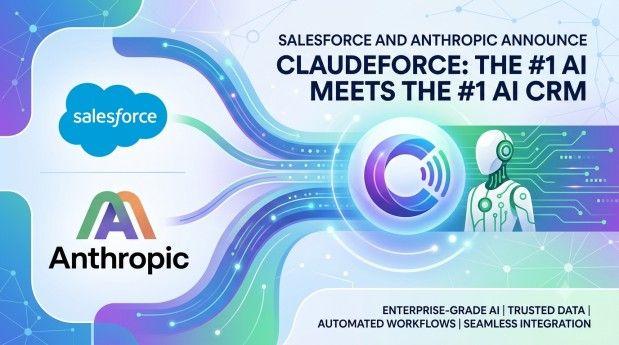
Salesforce and Anthropic expanded their strategic partnership with Claudeforce, integrating Claude AI assistant directly into Salesforce CRM with 37 pre-built sales skills. Marc Benioff reported a sixfold surge in agentic CRM usage, countering fears that AI would replace traditional enterprise software.

Salesforce and Anthropic announced an expanded strategic partnership on Wednesday, unveiling Claudeforce—a comprehensive integration that embeds Anthropic's Claude AI assistant directly into Salesforce's CRM platform
1
2
. The announcement marks the first time Salesforce has added its signature "force" suffix to another company's product name, signaling the strategic importance of this collaboration1
.The centerpiece of the partnership is Salesforce in Claude, a plugin for Anthropic's Claude CoWork that ships with 37 pre-built sales skills covering meeting preparation, deal health reviews, and pipeline analysis
2
. Sellers can now query, update, and act on live CRM data without ever opening the Salesforce application itself. The product is available to select pilot customers immediately, with an open beta planned for September and additional skills for other business functions launching in the third quarter2
.Marc Benioff, Salesforce CEO, reported that agentic use of Salesforce applications through Model Context Protocol and command-line interface calls surged sixfold during the company's second fiscal quarter ending July 31
3
. "We're told agents accessing our system would kill apps—well, actually, usage is exploding," Benioff stated on the quarterly earnings call3
. This dramatic increase directly counters widespread concerns about a potential SaaSpocalypse, where AI would replace traditional enterprise software.The partnership also positions Claude as the reasoning model for Salesforce's Agentforce, the company's flagship AI product
4
. "By fusing Claude's extraordinary reasoning with the trusted data, workflows, and governance every enterprise runs on, we're delivering a dynamic interface that thinks, reasons, and acts," Benioff explained1
. The integration demonstrates how AI-driven automation can enhance rather than replace software-as-a-service platforms.The path to Claudeforce began in March when Salesforce released Headless 360 at its TDX developer conference—a collection of APIs, MCP servers, and command-line tools enabling AI agents to access Salesforce data and workflows directly
2
. Patrick Stokes, Salesforce's president of applications and marketing, told VentureBeat that the company "openly suggested that these agentic interfaces are a really good way to use Salesforce's products, and we don't actually mind if you don't use Salesforce's products exclusively through a user interface designed for a human"2
.The technical implementation ensures enterprise-grade security and governance. When a seller asks Claude to update a deal, Claude reasons over available skills to determine specific guidance, then executes against Salesforce's MCP server while inheriting the user's existing permissions
2
. An administrator connects the plugin once, with authentication and permissions managed centrally, eliminating the complexity of individual user configuration.Related Stories
Anthropics's explosive growth underscores the market demand for enterprise AI solutions. The company recently disclosed to investors that its annualized revenue run rate hit $65 billion at the end of July, representing a sevenfold increase from a year ago
1
. Dario Amodei, Anthropic CEO, emphasized that "through this partnership, companies can point Claude at the customer information and business context that they've been building in Salesforce for decades—surfacing the insights that really matter and helping their businesses run more efficiently and grow more quickly"1
.The collaboration extends beyond CRM, with plans to introduce additional integrations across Claude, Salesforce, and Slack in the future
1
4
. This signals a broader vision for an AI-first future where generative AI becomes the primary interface for enterprise software.Salesforce shares have declined approximately 22% this year following a 20% drop in 2025, while the Nasdaq has risen about 35% since the end of 2024
1
. The Claudeforce announcement represents Salesforce's strategic response to investor concerns about AI replacing traditional software. Benioff emphasized that customers don't focus on underlying models but want applications that work seamlessly. "I believe the highest level of value is at the application layer," he stated, comparing AI infrastructure to semiconductors and data centers that users don't need to understand3
.Stokes framed the launch as transformative for knowledge workers: "We think that what this can do is kind of be a version of what Claude Code did for developers. We think we're about to do the same thing for knowledge workers. This is just a whole new way to work"
2
. The partnership validates that AI agents and traditional enterprise software can coexist and enhance each other, with AI unlocking trapped value in existing systems while sales workflows become more efficient through natural language interfaces.Summarized by
Navi
[2]
04 Dec 2025•Business and Economy

18 Dec 2024•Technology

Today•Business and Economy

1
Technology

2
Technology

3
Policy and Regulation