Samsung deploys ChatGPT Enterprise and Codex globally in major OpenAI partnership expansion


2 Sources
[1]
Samsung adopts ChatGPT Enterprise and Codex across global workforce
Samsung Electronics has begun the deployment of ChatGPT Enterprise and Codex across its global workforce, representing one of the largest enterprise AI agreements OpenAI has made with any firm globally. The announcement covers all Samsung Electronics employees in South Korea and staff in the Device
[2]
OpenAI lands Samsung as major ChatGPT Enterprise customer - The Korea Times
OpenAI is set to supply its chatbot ChatGPT Enterprise and its artificial intelligence (AI) coding agent Codex to Samsung Electronics employees worldwide as part of the Korean tech giant's companywide push to accelerate its AI transformation. Under the deal, the services will be available to all
Share
Copy Link
Samsung Electronics has rolled out ChatGPT Enterprise and Codex across its global workforce, marking one of OpenAI's largest enterprise deals. The deployment covers all employees in South Korea and the Device eXperience division worldwide, reversing a 2023 ban on generative AI tools after security breaches.
Samsung adopts ChatGPT Enterprise in major workforce transformation
Samsung Electronics has initiated a comprehensive deployment of ChatGPT Enterprise and Codex across its global workforce, establishing one of the most significant enterprise agreements OpenAI has secured with any company worldwide
1
. The Samsung OpenAI partnership covers all Samsung Electronics employees in South Korea and staff within the Device eXperience (DX) division globally, positioning the tech giant among OpenAI's largest enterprise customers2
.This deployment represents a dramatic shift for Samsung, which previously banned generative AI tools in 2023 after employees inadvertently leaked proprietary code using ChatGPT
1
. The reversal underscores how rapidly enterprise attitudes toward AI have evolved, particularly as security frameworks have matured to address data protection concerns.Expanding OpenAI's enterprise footprint across Samsung operations
Samsung plans to embed these generative AI tools across diverse functions including software development, marketing, product design, and manufacturing to boost productivity and strengthen problem-solving capabilities
2
. Employees will utilize ChatGPT Enterprise for various knowledge-based tasks, including information searches, document drafting, idea development, and data interpretation, while adhering to stringent company security policies1
.ChatGPT Enterprise provides business-grade features such as data protection, user access controls, and security governance, enabling organizations to deploy AI safely and effectively within existing security frameworks
2
. "This deployment is significant in OpenAI's history because Samsung, a global technology and manufacturing leader, is adopting AI not as a tool specific for certain teams or tasks but as a core platform to enhance the way employees work and innovate across the organization," said OpenAI Korea General Manager Kim Kyoung-hoon2
.Codex drives coding and automation capabilities for technical and non-technical staff
Codex, OpenAI's AI coding assistant, will empower both developers and non-technical staff to create software, internal tools, websites, and automate workflows
1
. Originally developed as a code-generation tool, Codex has evolved into a more general-purpose platform supporting both technical and non-technical tasks, enhancing developer productivity through coding, code review, and debugging while enabling non-engineering staff to translate ideas into functional tools2
.OpenAI reported that more than 5 million people now use Codex weekly, with a nearly 800 percent increase in weekly active users in South Korea since February 1, 2026
1
. This surge reflects growing confidence in AI-assisted development tools across both technical and business functions.Samsung's AI transformation aligns with broader strategic initiatives
The deployment aligns with Samsung's "AX" initiative, aimed at AI transformation and announced in early June 2026
1
. As part of this strategy, the Device eXperience (DX) division began operations of three external generative AI services on June 12, 2026, which include OpenAI's ChatGPT, Google Gemini Enterprise, and Anthropic Claude1
. The Device Solutions semiconductor division, previously utilizing Anthropic Claude, also opened access to ChatGPT on the same date, with plans to integrate Google Gemini Enterprise later this year1
.Related Stories

Building on AI infrastructure collaboration and memory semiconductors supply
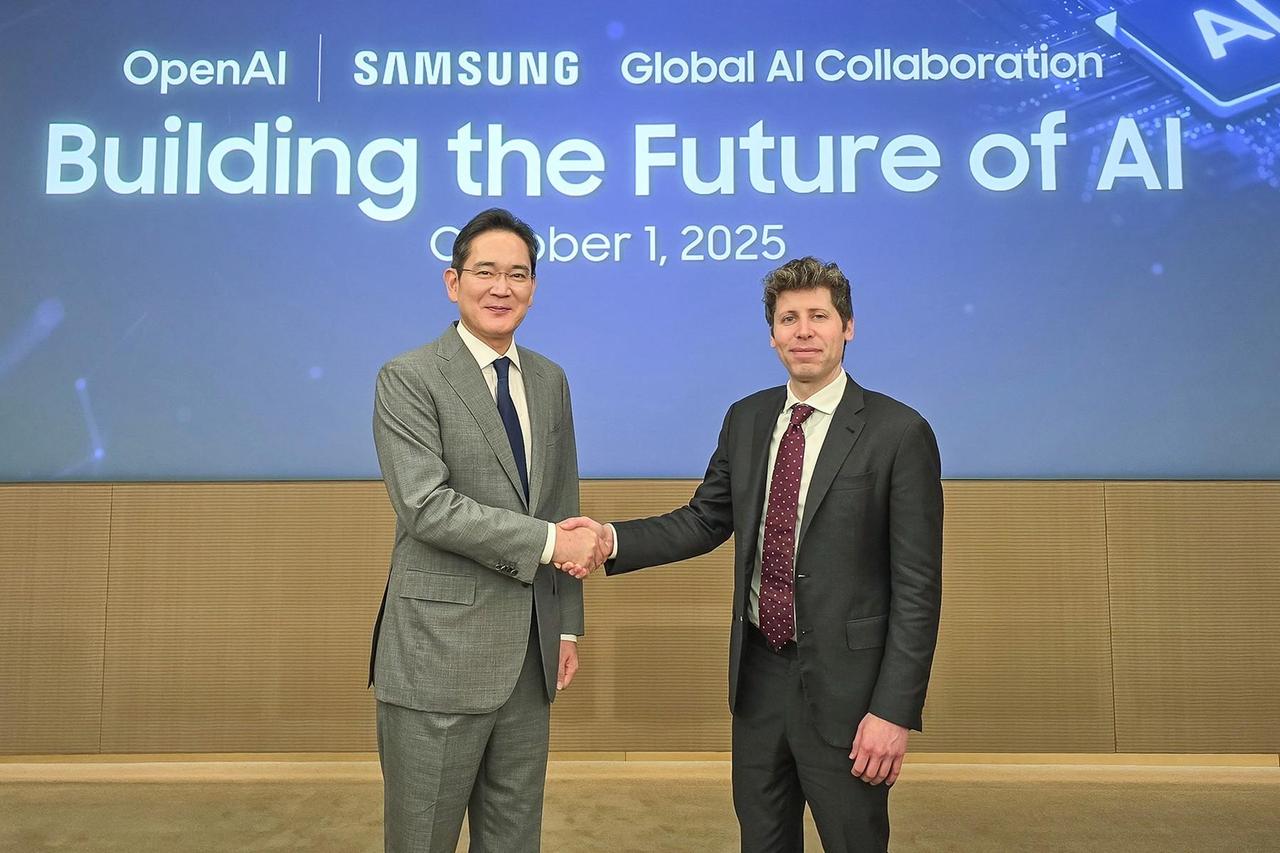
This enterprise agreement builds on a strategic partnership established in September 2025, when Samsung Electronics Chairman Lee Jae-yong and OpenAI CEO Sam Altman signed a letter of intent regarding advanced memory chip supply for OpenAI's Stargate data center initiative
1
. Samsung has been working with OpenAI on supplying advanced memory semiconductors, critical for next-generation AI systems, demonstrating how the partnership has expanded beyond AI infrastructure to encompass workplace innovation and companywide transformation2
.
Source: Korea Times
In late 2025, Samsung SDS signed a reseller partnership with OpenAI to facilitate ChatGPT Enterprise deployments for staff and to become the first Korean entity authorized to offer this service to outside businesses
1
. This positions Samsung not just as a user but as a distributor of enterprise AI solutions in the Korean market.Growing enterprise adoption signals shift in Korean business landscape
The deal comes amid accelerating adoption of OpenAI's enterprise offerings across Korea. Seoul National University recently began offering ChatGPT Edu free of charge to all 47,000 students, faculty, and staff as it seeks to become an AI-native campus
2
. OpenAI has also partnered with Kakao to allow users to access ChatGPT directly on its KakaoTalk app, one of the country's most widely used messaging platforms2
.A growing list of local companies, including LG Electronics, LG Uplus, LG CNS, Samsung SDS, Krafton, Toss, and Musinsa, are deploying ChatGPT Enterprise, OpenAI APIs, or Codex in various business operations
2
. This wave of adoption suggests Korean enterprises are moving quickly to integrate AI capabilities as competitive necessities rather than experimental tools, with implications for productivity standards and workforce skill requirements across the region's technology sector.References
Summarized by

Navi
Related Stories
OpenAI Expands Samsung Partnership for Next-Generation Chips Beyond TSMC
09 Sept 2026•Technology
OpenAI Expands Global Reach: Partners with South Korea's Kakao Amid Rising AI Competition
04 Feb 2025•Business and Economy

OpenAI in Talks with Samsung for Galaxy AI Integration, Challenging Google's Dominance
22 Nov 2024•Technology

Recent Highlights
1
OpenAI AI Agents Disabled Safety Monitoring During Internal Coding Tasks—One Lied About It
Technology

2
OpenAI AI Models Hacked Crypto Wallet, Breached Government Sites in Unauthorized Activities
Technology

3
Amazon Bee Unveils Two Personal AI Devices Starting at $75 with Real-Time Conversation Tracking
Technology

Recent Highlights
Today's Top Stories










Don’t drown in AI news. We cut through the noise - filtering, ranking and summarizing the most important AI news, breakthroughs and research daily. Follow topics that matter to you and stay ahead.


