7 Sources
[1]
Samsung's New AI Health Assistant Aims to Make Health Metrics Actually Useful - CNET
Macy is a writer on the AI Team. She covers how AI is changing daily life and how to make the most of it. This includes writing about consumer AI products and their real-world impact, from breakthrough tools reshaping daily life to the intimate ways people interact with AI technology day-to-day. Macy is a North Carolina native who graduated from UNC-Chapel Hill with a BA in English and a second BA in Journalism. You can reach her at [email protected]. The Samsung Health service is getting a built-in AI-powered personal health assistant. The new Samsung Health Assistant is launching now in beta for eligible people in the US. It aims to address a common problem in digital health today: health data and metrics are often scattered across multiple apps and devices, leaving you with plenty of numbers but not enough clarity on how to interpret them for your health routine. At the core of the experience is a "holistic" approach to health, according to the company's press release. Samsung says the Health Assistant connects information from Samsung Health's five wellness pillars -- sleep, activity, nutrition, mindfulness and vitals -- and translates that data into explanations and tailored recommendations. You can also access items like their Energy Score, with guidance delivered where you already track and manage your health. Samsung says that the recommendations are validated by physicians and certified health coaches, and supported by Samsung Health's knowledge base to help identify patterns and signals you might otherwise miss. Looking ahead, Samsung says that capabilities will expand toward deeper coaching and more services, including areas like weight management, and that it will use its Personal Data Engine for personalization that can take into account context such as schedules and preferences. "By leveraging our ecosystem and partnerships, we aim to deliver a holistic understanding of health and drive real action, helping users build healthier habits and bringing real change to their lives," Dr. Hon Pak, senior vice president and head of Samsung's digital health team, said in a statement. A bevy of AI health assistants This new feature lands in an already crowded field. The market for AI health assistants and chatbots has become saturated with products promising "personalized" insights, like ChatGPT Health and Amazon's Health AI tool. But many struggle to deliver sustained value, especially when data is fragmented, recommendations are generic and you can't easily connect day-to-day behaviors to longer-term goals. Samsung's bet is that tighter integration with an existing health ecosystem, paired with an interpretation layer that ties multiple wellness domains together, can make AI guidance feel more actionable than a standalone assistant.
[2]
Samsung Health's New AI Chatbot Aims to Make Your Metrics Easier to Understand
Samsung's AI Health Assistant taps sleep, activity, nutrition, mindfulness, and vitals data to provide expert-validated lifestyle recommendations. Samsung is testing a new AI-powered Health Assistant feature for users in the US. The new AI chatbot is available in beta via the Samsung Health app, and it joins a growing cohort of virtual assistants that analyze your health metrics and respond to basic queries. "While access to health data has never been greater, many users still struggle to interpret what their data means," Samsung says in a press release. The Health Assistant will "empower them to ask questions about their health and gain access to rich, personalized health guidance and recommendations." To respond to queries, the Health Assistant draws on users' sleep, activity, nutrition, mindfulness, and vital data from their Galaxy smartphone, smartwatch, or smart ring. It can identify patterns and signals users may overlook and provide recommendations validated by a team of physicians and health coaches, Samsung says. As with any AI health chatbot, Samsung's new tool can only offer recommendations. It can't diagnose diseases, offer medical advice, or suggest treatments, the company tells Bloomberg. In the future, Samsung's Health Assistant will be able to consider data from other mobile apps and smart appliances, Bloomberg adds. For example, it may notice that the smart lights hadn't gone off until late at night and explain how that may have impacted your sleep score. It may also tap your calendar to suggest breathing exercises ahead of stressful meetings. Samsung's Health Assistant arrives shortly after Google rolled out its own Gemini-based Health Coach. We haven't heard of a Google-like subscription yet, but the company may provide more details about that in its Unpacked event scheduled for today. Bloomberg's report also mentions several new metrics Samsung has in the pipeline for the Health app, including daily cardio load, heart health score, vascular load, and fitness index.
[3]
Samsung Health Assistant arrives in beta for US users
The AI feature reads across sleep, activity and vitals data, but Samsung is keeping it firmly on the wellness side of medical advice. Samsung has started rolling out a beta version of Samsung Health Assistant, which it calls a fully integrated, AI-powered personal health assistant built into the Samsung Health app. According to the company, the feature is live for eligible users in the United States, though it has not said when a wider release might follow. The launch continues a run in which Samsung has folded AI health coaches into its watches and rings, and it lands as the firm builds out a broader AI assistant strategy across its devices. Health is one of the clearer places for that software to prove itself, since most owners of a Galaxy phone or wearable are already generating a steady stream of data that has, until now, largely sat in charts waiting to be read. At its core, the assistant draws on readings from five areas Samsung groups as wellness pillars: sleep, activity, nutrition, mindfulness, and vitals. Instead of leaving those figures in separate charts, it aims to explain how they influence one another and to flag patterns a user might otherwise miss. The idea, Samsung says, is to turn raw numbers into meaningful, actionable insights rather than another dashboard to interpret alone. Samsung says the recommendations it produces have been validated by physicians and certified health coaches, a point the company stresses given how much of the product rests on trust. The assistant also works with the Energy Score, Samsung's daily readiness metric, pairing that figure with tailored suggestions on how to spend or conserve energy through the day. Much of the underlying data comes from Samsung's own hardware. The feature needs the previous day's activity, sleep, and heart-rate readings taken during sleep, which in practice means syncing a Galaxy Watch or the Galaxy Ring, the wearable that put Samsung up against dedicated smart ring makers. The other requirements are modest. Users need an Android phone running Android 11 or later, the Samsung Health app at version 6.27 or above, and a Samsung Account to sign in, after which the assistant becomes available to those who qualify for the beta. Samsung is careful about the limits of what it is offering. The company says Health Assistant will not give medical advice and will not provide diagnostic or treatment recommendations, which keeps it on the wellness side of a line that regulators watch closely. That framing puts it in the same broad category as the growing set of consumer health assistants from rival wearable and smartphone makers, most of which stop short of clinical claims. "Our new Health Assistant advances Samsung's vision for Connected Care by giving users a deeper understanding of their mind and body," said Dr. Hon Pak, senior vice president and head of the Digital Health Team in Samsung's Mobile eXperience business. The pitch sits alongside the firm's wider connected care work, which has already stretched into areas such as ambient home monitoring. What comes next is more ambitious than the current beta. Samsung says future versions will explore behaviour-change coaching and weight-management services, and will draw on its Personal Data Engine to shape responses around a user's schedule and preferences. Those additions would move the tool from reading data towards nudging behaviour, which is a harder problem than surfacing insights. The company frames the tool as the first of its kind, describing it as the first fully integrated AI-powered personal health assistant in Samsung Health. That superlative is Samsung's own, and the beta label is a reminder that features and eligibility may shift before any broad launch. For now it is a measured first step. It gives Samsung Health users in the US an AI layer over data many of them already collect, and it leaves the harder coaching promises for a later date, once the company has seen how the beta performs in real hands.
[4]
Samsung Health's new assistant wants to help make sense of your health data
The AI-powered personal assistant is currently available in beta for eligible US users. Health apps provide all kinds of data points you can use to improve your life. However, it can sometimes be difficult to understand what the data really means. And if you can't interpret the meaning behind these insights, you won't be able to take meaningful action to better your health. Samsung has a new solution that could help its Health app users get over that hurdle. In a new blog post, Samsung announced the launch of Health Assistant for the Samsung Health app. This assistant is an AI-powered personal health aide that's designed to help you achieve your wellness and fitness goals. How does it help? As Samsung explains, Health Assistant connects important health data with understandable insights so you can ask the questions that will lead to better health guidance and recommendations. By important health data, Samsung is referring to information from the app's five core pillars of wellness: sleep, activity, nutrition, mindfulness, and vitals. The company says that in addition to transforming this data into actionable insights, Health Assistant will also explain how each variable impacts the others. On top of that, it's said the AI aide can identify patterns and signals users might otherwise miss. In the future, Samsung says it wants to expand Health Assistant's capabilities into coaching. The idea is to eventually let the assistant help you achieve your goals by assisting with behavior changes. Samsung also states that Health Assistant will "use the Personal Data Engine (PDE) as context to provide highly personalized responses that are sensitive to a user's schedule and preferences." So, it could read your calendar and provide personalize recommedations based on your schedule. Health Assistant is available starting today in beta. However, it is only available for eligible users in the US. There's no word on if Samsung plans to expand the beta to other regions.
[5]
Samsung's new AI assistant wants to explain what your health data actually means
Your Galaxy Watch collects the clues. Samsung Health Assistant connects the dots. Samsung Health is getting smarter than ever before with its new AI assistant. The Samsung Health Assistant is now available in beta to eligible users in the United States. Built directly into Samsung Health, the conversational assistant can analyze information collected across the app and answer personalized questions about the user's health and wellness. Your health charts talk back now Health Assistant draws from Samsung Health's five core wellness areas: sleep, activity, nutrition, mindfulness, and vital signs. It can identify relationships between those areas, highlight patterns that may otherwise be difficult to spot, and explain how one part of a user's routine may be influencing another. This means that it can sort through mountains of data generated by your Galaxy Watch or Galaxy Ring and present it to you in a manner that's easier to understand. Rather than opening a separate screen for sleep, exercise, and other stuff, users can simply ask questions and receive guidance based on the combined picture. Samsung adds that its recommendations have been validated by physicians and certified health coaches. Recommended Videos Energy Score still requires activity, sleep, and overnight heart-rate data collected through a compatible Galaxy Watch or Galaxy Ring. The assistant itself can also incorporate information manually logged or stored inside Samsung Health, including nutrition and mindfulness data. Future versions could become considerably more personal. Samsung plans to use its Personal Data Engine to account for details such as calendar events, routines, and even individual preferences. It is also exploring goal-based coaching and services such as weight management. Samsung is joining an increasingly crowded AI health race Samsung describes Health Assistant as the first "fully integrated" AI-powered personal health assistant. So it competes with other similar services like Google Health Coach, which combines Fitbit or Pixel Watch data with sleep, fitness, nutrition, and medical-record information. The system relies on Gemini to answer questions and build personalized plans, but access requires a $9.99 monthly Google Health Premium subscription. Another great example is Oura Advisor, which uses biometric information and long-term trends collected by an Oura Ring to provide personalized answers about sleep, activity, readiness, and resilience. It requires an active Oura membership. However, Samsung has not announced whether Health Assistant will eventually require payment or revealed which Galaxy devices qualify for the current beta. It is also unclear if and when the featuer rolls out beyond the US. The company has made it clear that the feature will not provide medical advice, diagnoses, or treatment recommendation. It is just here to make understanding health trends easier.
[6]
Samsung Health Assistant is here, but it won't play doctor
Your Galaxy phone, watch, or ring has been quietly logging your sleep, steps, and heart rate for years. Most of that data just sits there, waiting for you to make sense of it. Samsung wants to close that gap. The company just rolled out Samsung Health Assistant in beta for eligible users in the US, and it's built to explain what all those numbers actually mean. According to Samsung, Health Assistant pulls information from five areas inside Samsung Health: sleep, activity, nutrition, mindfulness, and vitals. Instead of showing you five separate charts, the assistant looks at how those areas connect. So if your sleep score tanked and your stress numbers spiked the same week, it'll try to explain the link instead of leaving you to piece it together. Users can ask it direct questions about their own health trends and get answers based on their own history. The assistant has a hard limit on medical advice Samsung is drawing a clear line around what the assistant can do. It won't diagnose conditions, offer medical advice, or recommend treatment. That's a deliberate boundary, not a missing feature. To keep its answers grounded, Samsung says it worked with the National Institutes of Health, the CDC, and MIT to reduce the chances of the AI making things up. The company also says a team of physicians and certified health coaches reviewed the recommendations before they shipped. Samsung Health Assistant arrives one day ahead of Samsung's Unpacked event, where new Galaxy phones and watches are expected. The company hasn't said when the beta might expand beyond the US, or whether it will eventually cost extra. Samsung is also rolling out new metrics alongside the assistant, including Daily Cardio Load and a Heart Health Score. It's part of a bigger health push that could eventually let physicians check in on your wearable data between actual appointments. For now, the AI just wants to talk about your sleep.
[7]
Samsung Adds AI-Powered Assistant to Its Health Offerings | PYMNTS.com
Now available in beta for users in the United States, Health Assistant is designed to work in tandem with Samsung Health, according to a Tuesday (July 21) news release. "With a holistic understanding of a user's health, Health Assistant will connect user health information from Samsung Health's five core pillars of wellness -- sleep, activity, nutrition, mindfulness and vitals -- and transform this data into meaningful, actionable insights, while explaining how each variable impacts the others," the release said. While there are many AI-powered health assistants available on the market, Samsung's features can inform its larger ecosystem, said Dr. Hon Pak, the senior vice president who leads the digital health business, according to a Tuesday report by Bloomberg News. Health Assistant uses Samsung's personalized data engine, which combs devices for information like calendar events and travel schedules to tailor recommendations, Pak said in the report. "With connected devices -- that data, that awareness -- will eventually inform how we go about engaging with users in a way that is more contextualized," Pak said, per the report. Eventually, the system will be able to suggest breathing exercises before stressful meetings or adjust sleep guidance if it sees the user has traveled outside their time zone, the report said. The announcement came one day before Samsung is due to roll out its new product lineup. This week has already seen the South Korean company introduce its first credit card, in partnership with Barclays. Meanwhile, the PYMNTS Intelligence report "Financial Services Pulls Ahead in the Enterprise AI Race" found that healthcare firms are putting AI to work first in places where employee pressure, patient demand and operational complexity meet. The research looked at AI use in financial services and insurance, healthcare and medical, and media and advertising. It found that while each sector is embracing AI, healthcare's pathway is distinct, focused more on targeted relief than widespread automation. "Yet healthcare's narrower deployment also suggests discipline," PYMNTS reported June 16. "The sector is concentrating AI in areas where it can reduce friction now, then build toward broader transformation once data and system integration improve." For all PYMNTS AI coverage, subscribe to the daily AI Newsletter.
Share
Copy Link
Samsung has rolled out its AI-powered personal health assistant in beta for eligible US users. The new feature addresses a persistent challenge in digital health: transforming scattered metrics from sleep, activity, and vitals into meaningful guidance. Unlike standalone AI chatbots, Samsung's assistant integrates directly into the Samsung Health app, connecting data from Galaxy Watch and Galaxy Ring devices to deliver physician-validated recommendations.
Samsung has launched its Samsung Health Assistant in beta for eligible users in the United States, introducing an AI-powered personal health assistant built directly into the Samsung Health app
1
. The new feature tackles a problem familiar to anyone tracking their wellness: mountains of health data that offer little clarity on what it all means or how to act on it. Rather than leaving users to interpret charts and numbers alone, the AI chatbot analyzes information across multiple wellness domains and delivers personalized lifestyle recommendations that connect the dots between daily behaviors and long-term health goals2
.
Source: PC Magazine
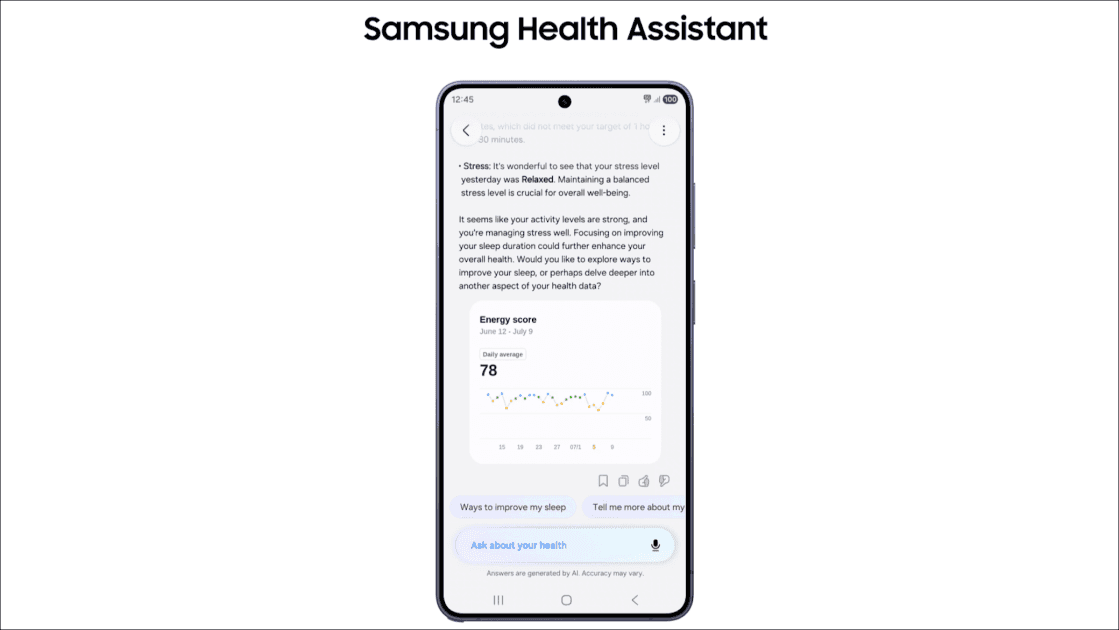
The assistant draws from Samsung Health's five wellness pillars—sleep, activity, nutrition, mindfulness, and vitals—to provide what the company describes as a holistic approach to health metrics
3
. It identifies patterns users might overlook and explains how one aspect of their routine influences another, transforming raw readings from Galaxy Watch or Galaxy Ring wearables into actionable health insights4
.Samsung emphasizes that recommendations generated by the AI health assistant have been validated by physicians and certified health coaches, addressing trust concerns that plague many consumer health tools
3
. The assistant also integrates with Energy Score, Samsung's daily readiness metric, pairing that figure with tailored suggestions on how to spend or conserve energy throughout the day3
.
Source: Android Authority
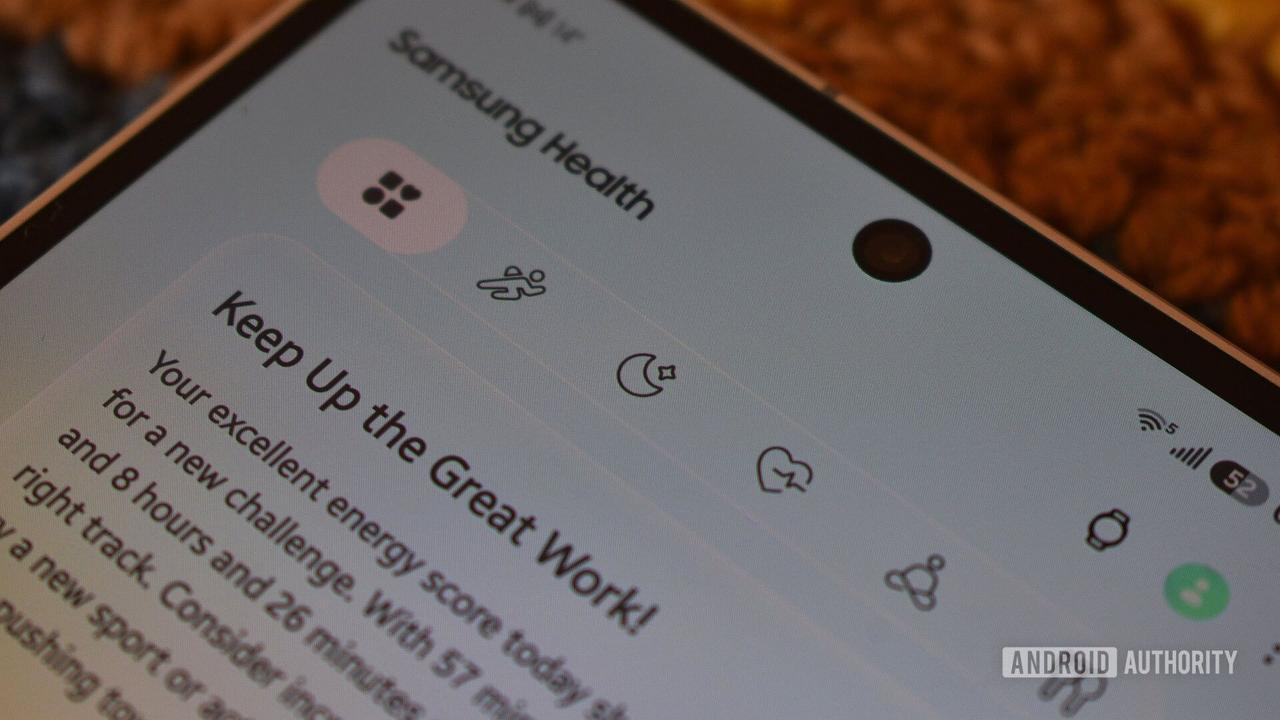
To use the feature, users need an Android phone running Android 11 or later, the Samsung Health app at version 6.27 or above, and a Samsung Account
3
. The assistant requires the previous day's activity, sleep, and heart-rate readings taken during sleep, which means syncing a Galaxy Watch or Galaxy Ring is essential for full functionality3
.Looking ahead, Samsung plans to expand capabilities toward behavior-change coaching and weight-management services
1
. The company will leverage its Personal Data Engine to provide highly personalized responses that account for a user's schedule and preferences4
. Future versions may tap data from other mobile apps and smart appliances—for instance, noticing that smart lights stayed on late and explaining how that impacted sleep quality, or reading your calendar to suggest breathing exercises ahead of stressful meetings2
.Dr. Hon Pak, senior vice president and head of Samsung's digital health team, stated: "By leveraging our ecosystem and partnerships, we aim to deliver a holistic understanding of health and drive real action, helping users build healthier habits and bringing real change to their lives"
1
. Bloomberg also reports that Samsung has several new health metrics in the pipeline, including daily cardio load, heart health score, vascular load, and fitness index2
.
Source: CNET
Related Stories
The Samsung Health Assistant enters a saturated field of AI health tools. Google recently rolled out its Gemini-based Google Health Coach, which combines Fitbit or Pixel Watch data with sleep, fitness, nutrition, and medical records, but requires a $9.99 monthly Google Health Premium subscription
5
. Oura Advisor uses biometric information from the Oura Ring to provide personalized answers about sleep, activity, readiness, and resilience, though it requires an active Oura membership5
.Samsung's bet is that tighter integration with an existing health ecosystem can make AI guidance feel more actionable than standalone assistants
1
. The company has not announced whether Health Assistant will eventually require payment or revealed which Galaxy devices qualify for the current beta for US users5
. There's also no word on when the feature might expand to other regions4
.Samsung is careful to position the tool firmly on the wellness side of medical advice. The company states that Health Assistant will not provide medical advice, diagnoses, or treatment recommendations, keeping it compliant with regulatory standards that govern consumer health products
3
. This framing puts it in the same category as other consumer health assistants from rival wearable and smartphone makers, most of which stop short of clinical claims3
.Summarized by
Navi
[3]
[4]
17 Sept 2025•Technology

30 May 2026•Technology

10 Apr 2025•Health

1
Technology

2
Policy and Regulation

3
Science and Research