SanDisk reveals 88% of new revenue came from AI data centers as demand for memory chips soars


4 Sources
[1]
Sandisk Just Revealed Where 90% of New Revenue Came From - SanDisk (NASDAQ:SNDK)
Sandisk Corp.'s (NASDAQ:SNDK) fiscal first-quarter earnings offer a striking look at how quickly the AI boom is reshaping its business. The digital storage maker added more than $2 billion in quarterly revenue, but almost nine-tenths of that increase came from one customer market: data centers. The
[2]
SanDisk Q1 2027 Earnings Call Transcript - SanDisk (NASDAQ:SNDK)
SanDisk (NASDAQ:SNDK) reported first-quarter financial results on Thursday. The transcript from the company's first-quarter earnings call has been provided below. This transcript is brought to you by Benzinga APIs. For real-time access to our entire catalog, please visit
[3]
Sandisk: Profits Soar Thanks to AI, but Wall Street Remains Unmoved
Sandisk was trading near flat in after-hours trading Thursday, despite quarterly results that topped expectations. The US manufacturer of NAND flash memory and SSD storage solutions is benefiting fully from the surge in memory prices, fueled by demand from data centers dedicated to artificial
[4]
Sandisk Profit Soars as AI Demand Drives Up Prices
Sandisk reported exponentially higher fiscal first-quarter profit as the AI buildout drives memory demand skyward. The company posted net income of $8.1 billion, or $52.60 a share, up from $112 million, or 75 cents a share, the year prior. Adjusted earnings were $49.51 a share. Analysts polled by
Share
Copy Link
SanDisk reported fiscal Q1 revenue of $11.03 billion, up 23% sequentially, with data center revenue jumping 61% to $4.8 billion. The memory maker attributed nearly 90% of its quarterly growth to AI infrastructure spending by hyperscalers, while traditional Edge and consumer segments showed mixed results.
Data Center Revenue Accounts for 88% of SanDisk's Quarterly Growth
SanDisk reported fiscal first-quarter revenue of $11.03 billion, marking a 23% sequential increase from $8.97 billion in the previous quarter
1
. The company added approximately $2.07 billion in quarterly revenue, with data center revenue accounting for $1.83 billion of that increase—representing 88.3% of total growth1
. Data center revenue jumped 61% sequentially to $4.80 billion from $2.98 billion, now comprising 43.5% of total sales compared to 33.2% in the prior quarter1
. This concentration reveals how AI infrastructure spending by hyperscalers is reshaping the memory maker's business model and creating significant exposure to cloud providers expanding their AI capabilities.AI Demand Drives Exponential Year-Over-Year Performance

Source: Benzinga
The company delivered adjusted earnings per share of $49.51, exceeding Wall Street's expectation of $46.67
3
4
. Revenue soared 378% year-over-year from $2.31 billion, while net income reached $8.1 billion compared to $112 million in the same period last year4
. The adjusted operating margin climbed to 80.4% from 79.2% in the previous quarter, reflecting strong pricing power as hyperscalers remain willing to pay premium prices for data storage amid constrained capacity3
. SanDisk generated $5.7 billion in adjusted free cash flow and returned $5 billion to shareholders through share repurchases during the quarter2
.NAND Flash Memory Technology Advances Support AI Infrastructure
Source: Market Screener
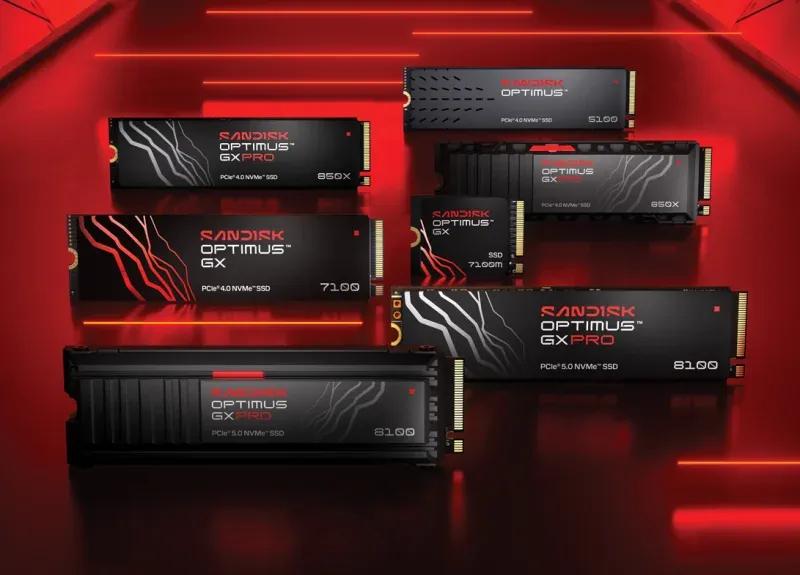
SanDisk's technology leadership centers on its BiCS architecture for NAND flash memory production. The company highlighted BiCS8 as the current industry benchmark for performance and density across TLC and QLC, featuring CMOS Directly Bonded to Array (CBA) architecture that enables the performance required by AI data-center customers
2
. Management announced advancements including BiCS9 and BiCS10, alongside achieving a milestone with High Bandwidth Flash (HBF) designed specifically to support AI infrastructure2
. These technological developments position the company to capture increasing demand as AI workloads become more data-intensive and require greater storage capacity.Mixed Performance in Edge and Consumer Segments
While AI-driven demand for memory products surged, SanDisk's other business segments showed divergent trends. Edge business revenue, which includes storage products for smartphones, PCs, and other devices, increased approximately $400 million to $5.83 billion, representing just 7% sequential growth
1
3
. Consumer revenue moved in the opposite direction, falling $159 million sequentially to $397 million—a 29% decline1
3
. The company attributed data center growth partly to its strategic decision to redirect more supply toward data-center customers and partnerships with three major U.S. cloud-computing companies1
.Related Stories
Long-Term Customer Agreements Provide Visibility Through 2030
SanDisk emphasized the importance of its New Business Model (NBM) partnerships, which provide multi-year customer agreements extending beyond fiscal year 2030
2
. These long-term contracts aim to reduce NAND's traditional boom-and-bust cycles by creating predictable demand, planning capabilities, and cash flow1
. Management stated that customer signals now extend well into the next decade, with structural AI demand expected to drive NAND's role significantly higher by decade's end2
. The company announced an 8-for-1 stock split with additional shares distributed on November 19, while maintaining its strategy to remain debt-free and return 100% of excess cash to shareholders through share repurchases2
.Guidance Signals Continued Growth Amid Margin Questions
For the second quarter of fiscal 2027, SanDisk guided for revenue between $12.2 billion and $12.6 billion, with adjusted earnings per share expected between $55 and $57
2
4
. Wall Street analysts had projected second-quarter revenue of $12.31 billion and adjusted earnings of $53.60 a share4
. Despite strong results, the stock traded near flat in after-hours trading, with investors noting that adjusted free cash flow margins declined from 56.2% to 51.6% even as sequential growth slowed3
. The concentration risk remains significant—if hyperscalers slow AI data-center buildout, delay projects, or reduce storage purchases, the business segment driving most of SanDisk's growth could lose momentum1
. Watch how major cloud providers adjust their infrastructure spending and whether memory chips fueled by the AI industry maintain current pricing power as capacity constraints evolve.References
Summarized by

Navi
[3]
[4]
Related Stories
SanDisk secures $93.9 billion in AI storage deals as data center demand surges
06 Aug 2026•Business and Economy
SanDisk and Western Digital crush forecasts as AI demand fuels explosive data storage growth
29 Apr 2026•Business and Economy
SanDisk forecasts massive profit surge as AI storage demand drives flash storage boom
30 Jan 2026•Business and Economy

Recent Highlights
1
OpenAI's AI Models Disprove 27-Year Exponential Time Hypothesis, Rendering Decades of Research Obsolete
Science and Research

2
Google DeepMind unveils Genie 4 world model with audio and 2-minute interactive simulations
Technology

3
Microsoft AI Diagnostic Tool Beats Doctors With 83% Accuracy on Complex Medical Cases
Health

Recent Highlights
Today's Top Stories







Don’t drown in AI news. We cut through the noise - filtering, ranking and summarizing the most important AI news, breakthroughs and research daily. Follow topics that matter to you and stay ahead.


