Scientists name the impurity that spoils recycled plastic oil


2 Sources
[1]
AI and experiments reveal impurities hindering waste plastic pyrolysis oil recycling
A Korean research team has identified how impurities interfere with the use of waste plastic pyrolysis oil as a petrochemical feedstock through catalytic experiments and artificial intelligence (AI)-based computational chemistry. The findings, published in the journal ACS Catalysis, provide a
[2]
AI and Experiments Reveal Impurities Hindering Waste Plastic Pyrolysis Oil Recycling | Newswise
Newswise -- A Korean research team has identified how impurities interfere with the use of waste plastic pyrolysis oil as a petrochemical feedstock through catalytic experiments and artificial intelligence (AI)-based computational chemistry. The findings provide a scientific basis for predicting
Share
Copy Link
Nitrogen compounds are the main culprit degrading catalysts that turn waste plastic oil into chemical feedstock, a Korean team reports. The work explains why some recycled oil underperforms and what to do about it.
A Korean research team has identified which impurities in oil made from waste plastic degrade the catalysts used to crack it into useful chemicals, work that gives a scientific basis for predicting when a batch of recycled oil will underperform
2
1
.Why plastic oil needs a well-behaved catalyst
Pyrolysis oil is made by heating discarded plastics until they break down, and it can substitute for petroleum or naphtha as a raw material. Catalytic cracking can then break its hydrocarbons into light olefins, the base ingredients for plastics and chemicals
2
1
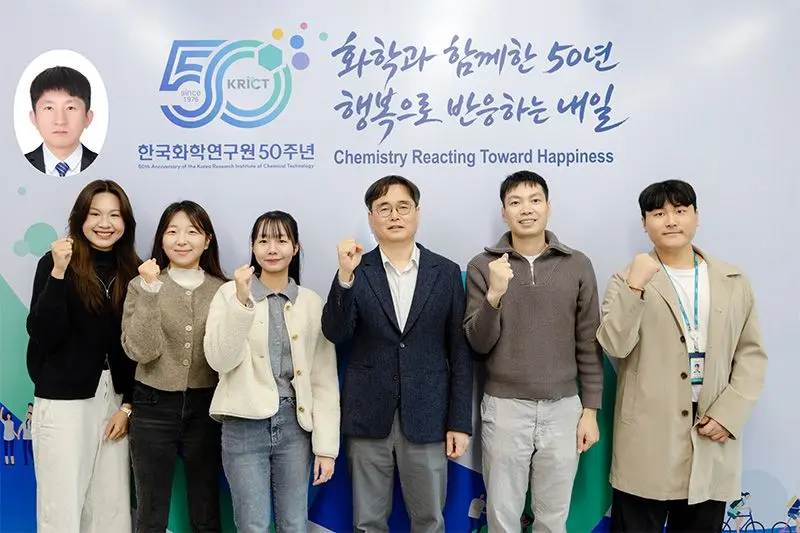
. The trouble is that real waste plastic is a mixed bag, and whatever comes along for the ride can foul the catalyst.The team, led by Dr. Do Kyoung Kim of the Korea Research Institute of Chemical Technology with Professor Tae Yong Kim of KOREATECH, had already developed a cracking process in 2024 that converts pyrolysis oil to light olefins without extra hydroprocessing. But that study had used only one pyrolysis oil, so it could not say how performance would vary across feedstocks with different impurity mixes. The new work was framed as a follow-up to close that gap
2
1
.Thirteen impurities, tested one at a time
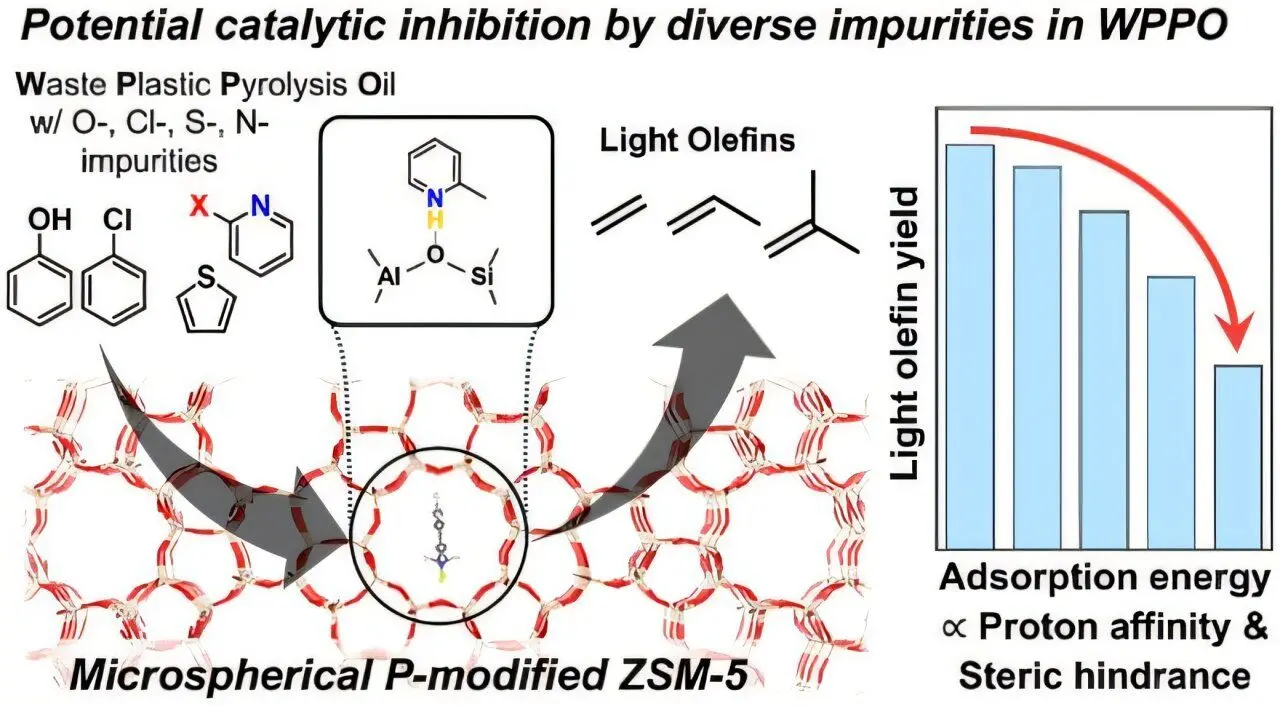
The researchers added 13 nitrogen, sulfur, chlorine and oxygen compounds individually to real waste plastic pyrolysis oil, then measured olefin yield on the zeolite catalyst the team developed in 2024
2
1
. Certain nitrogen compounds cut performance sharply, while the sulfur, chlorine and oxygen compounds had relatively minor effects. 2-methylpyridine did the most damage of the compounds named. Benzonitrile, another nitrogen compound, barely registered2
1
. That means total nitrogen content alone is a poor guide to how a feedstock will behave; the chemical form the nitrogen takes matters too2
1
.
Source: Phys.org
Simulations using a machine-learning model of molecular forces point to why: the nitrogen compounds latch onto the zeolite's active sites, crowding out the hydrocarbons the catalyst is meant to process. Molecular size and the catalyst's internal spaces also play a part
2
1
. Higher impurity concentrations caused more degradation, raising the reaction temperature blunted the effect, and spent catalysts regained their initial performance after regeneration to strip out coke deposits2
1
.Related Stories

From findings to feedstock screening
The study appears as the cover article of ACS Catalysis's April 2026 issue, which one outlet reports has an impact factor of 13.1
2
. It was funded by Korean government-backed programs including the institute's own program and a national research project on eco-friendly alternatives to oil2
.The researchers say the findings are expected to let operators judge a feedstock by impurity type as well as total impurity content, and to tune pretreatment accordingly
2
1
. Neither study reports an industrial deployment or independent validation. "We expect these findings to be used to assess the potential for catalytic performance degradation by analyzing impurity compositions before introducing feedstocks into the process, and to develop impurity management and operating strategies tailored to feedstock characteristics," said Seokmin Shin, president of the Korea Research Institute of Chemical Technology2
.
Source: Newswise
References
Summarized by

Navi
Related Stories
AI and Advanced Technologies Pave the Way for Improved Plastic Recycling
19 Jul 2025•Science and Research

AI in Chemistry Reveals How Fast Chemical Reactions Proceed Using Machine Learning
28 Sept 2026•Science and Research
AI-Powered Discovery of Mechanophores Paves Way for Stronger, More Durable Plastics
05 Aug 2025•Science and Research
Recent Highlights


Recent Highlights
Today's Top Stories









Don’t drown in AI news. We cut through the noise - filtering, ranking and summarizing the most important AI news, breakthroughs and research daily. Follow topics that matter to you and stay ahead.


