SE3 Raises $30M to Power Military Drones with Spatial Intelligence and GPS-Free Navigation


2 Sources
[1]
Munich's SE3 raises $30M to give Europe's drones spatial intelligence
Accel leads the Series A five months after the TUM spin-out left stealth, with its software already deployed in Ukraine. SE3, the Munich startup building spatial intelligence software for autonomous systems, has raised a $30M Series A led by Accel, with Keen, Lakestar, and Seedcamp participating.
[2]
Exclusive: SE3, a German startup building 'spatial intelligence' for military drones, raises $30 million Series A funding round
SE3, a Munich-based startup that makes AI software to help drones and other unmanned military systems understand the three-dimensional world around them, has raised $30 million in a Series A round led by Accel. Keen, Lakestar, and Seedcamp also participated in the funding round. It comes less than
Share
Copy Link
Munich-based SE3 has secured $30M in Series A funding led by Accel to advance its spatial intelligence software for military drones. The platform enables autonomous systems to create 3D battlefield maps, coordinate swarms, and navigate without GPS—technology already deployed in Ukraine and with Germany's Bundeswehr across thousands of systems.
SE3 Raises $30M Series A Funding Led by Accel
SE3, a Munich-based startup developing spatial intelligence software for autonomous systems, has closed a $30M Series A funding round led by Accel
1
2
. Keen, Lakestar, and Seedcamp joined the round, which arrives just five months after the company emerged from stealth with €5.5M ($6.1 million) in seed funding1
2
. The Technical University of Munich spin-out focuses on building AI software for military drones and unmanned systems that struggle with three-dimensional understanding—a critical gap in current AI capabilities.
Source: The Next Web
Building 3D Battlefield Maps from Sensor Data Fusion
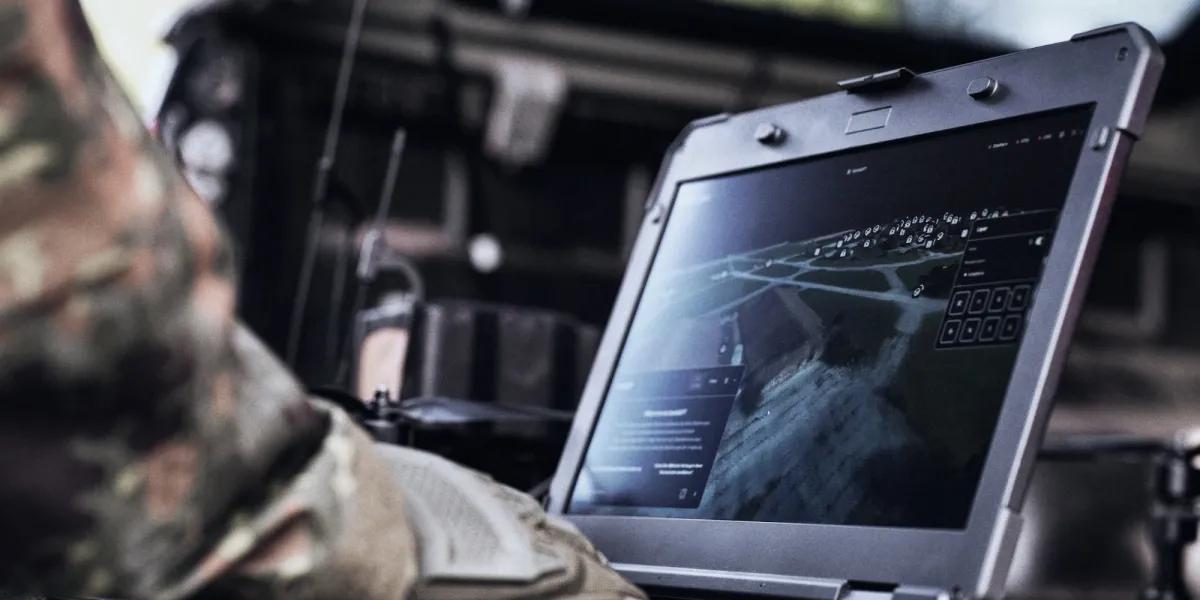
SE3's platform-agnostic software processes video and sensor feeds from multiple military drones and ground vehicles, fusing them into a unified 3D battlefield map
2
. CEO and co-founder Lukas Köstler describes this as "like a mini map, how you would know it from a strategy game"2
. The software sits between raw sensor data and action, connecting drones and ground vehicles from different manufacturers into a shared environmental picture1
. On top of this map, SE3 layers object recognition and relational understanding, enabling soldiers to query the system in plain language: "How do I reach a target without being seen?" or "What's a good route for a heavy vehicle?"2
.
Source: Fortune
Voice-Commanded Swarm Coordination and Navigation Without GPS
Operators command the system entirely by voice rather than using joysticks or tablets
1
. A soldier can simply say, "I need reconnaissance two kilometers in the north over the forest," and a suitable drone will autonomously take off, execute the mission, and report back2
. The software optimizes each system's behavior, routes, and positions based on terrain, enabling swarm coordination across multiple autonomous systems1
. Critically, all processing runs on edge devices, allowing military drones to operate in contested environments where electronic warfare jams satellite navigation1
. Köstler, who previously worked on Tesla's Autopilot team and at Nvidia Research, confirmed that navigation without GPS has been delivered thousands of times and is "very robust"2
.Deployed in Ukraine and Bundeswehr Contracts
SE3's technology is already deployed in Ukraine, where the company holds multiple contracts and has shipped thousands of systems over the past two years
1
2
. The startup also works with Germany's Bundeswehr to develop high-level fleet command AI, though Köstler notes this capability "still needs to be built out over the next one or two years"2
. SE3 counts defense prime HENSOLDT, drone software company Auterion, and drone developer ERC System among its partners, with its software running on Auterion's Skynode computers1
2
.Computer Vision Algorithms Power Spatial Intelligence
SE3 does not rely on general-purpose large language models to understand physics or terrain
2
. Instead, the company uses classical computer vision algorithms to distill vast amounts of sensor data into a database that a language model can query. The model operates within a harness equipped with conventional software tools—if it needs a flight path, a conventional planning algorithm calculates one while avoiding mountains or enemy lines of sight2
. Simply feeding raw data to the model "wouldn't work at all," Köstler explained2
. Actions such as drone takeoff can require human operator approval, the system runs entirely offline, and customers can swap in their preferred frontier AI model2
.Related Stories

Technical University of Munich Spin-Out Tackles Defense Interoperability
SE3 spun out of Professor Daniel Cremers' computer vision lab at the Technical University of Munich, where co-founders Lukas Köstler and Simon Klenk completed their PhDs
1
2
. Cremers, who serves as SE3's chief science officer, holds TUM's chair for computer vision and AI and won the Leibniz Prize, Germany's most prestigious research award1
. The company's platform-agnostic approach addresses European procurement's shift toward modularity and interoperability through frameworks such as the Modular Open Systems Approach and Germany's MOSABw programme1
. SE3 bets that militaries want AI software independent of any single hardware maker, avoiding vendor lock-in that emerges within two or three years when drone makers control their own software stacks2
.Expansion Plans Target 120 Employees and European Offices
SE3 plans to use the Series A funding to grow from roughly 40 employees to about 120, investing in engineering, commercial, and operations hires
1
2
. The company will open offices in London, Berlin, the Nordics and Baltics, and Poland, while deepening its presence in Germany and Ukraine1
2
. Accel partner Matt Robinson stated that SE3's team is "uniquely qualified to take on the challenge of building spatial AI for autonomous systems—something defense primes have found so difficult to do"2
.Future Applications in Robotics and Emergency Response
Defense will drive revenue for at least the next 12 months, but a small team will begin exploring civilian robotics applications
2
. From 2027, SE3 plans to apply its spatial intelligence layer to robotics, emergency response, and other scenarios where machines must cope with unpredictable environments1
. The EU aims to mobilize €800B in defense spending by 2030 and is planning a drone wall along its eastern flank—a wave of capital that has already produced Helsing's €12B valuation and Stark's rise to €3.5B in two years1
. As a German company, SE3 operates under strict export laws, with Köstler noting that "it's really the elected parliament that decides in the end what we will do"2
. SE3 serves European NATO members and their allies2
.References
Summarized by

Navi
Related Stories
Helsing raises $1.8bn at $18bn valuation as sky-high multiple sparks defence tech bubble fears
13 Jul 2026•Startups

AI Drone Maker Tekever Hits $6.4 Billion Valuation After $580 Million Defense Tech Funding
23 Sept 2026•Startups

Sereact Secures €25M for AI-Powered Robotics Expansion
21 Jan 2025•Technology

Recent Highlights
1
Jensen Huang's Affair with Suspected Chinese Spy Exposes $7 Billion AI Chip Smuggling Network
Policy and Regulation

2
Anthropic Launches Claude Meetings and AI-Powered Office Tools to Challenge Microsoft and Google
Technology

3
Anthropic launches Fable 5.2 and Mythos 5.2 with 20% price cut and 30% faster output
Technology

Recent Highlights
Today's Top Stories









Don’t drown in AI news. We cut through the noise - filtering, ranking and summarizing the most important AI news, breakthroughs and research daily. Follow topics that matter to you and stay ahead.


