Seattle Researchers Launch $95M AI BioDesign Initiative to Design Biology Beyond Nature


2 Sources
[1]
AI learns nature's code: Allen Institute, UW and Fred Hutch launch $95M open science initiative
Three of Seattle's top scientific institutions are launching a nearly $95 million research initiative that will generate data and train AI models to design proteins and genes that don't exist in nature -- sharing the results freely to help others develop new medicines and materials. The
[2]
Seattle researchers want AI to design biology beyond nature
Driving the news: The project is supported by the Fund for Science and Technology, a nonprofit foundation launched by late Microsoft co-founder Paul Allen's estate. * The Allen Institute will receive $46.1 million, the University of Washington will receive $43.8 million and the Fred Hutch Cancer
Share
Copy Link
Three Seattle institutions—Allen Institute, University of Washington, and Fred Hutch Cancer Center—launched AI BioDesign, a $95 million open science initiative. Led by Nobel laureate David Baker and genome scientist Jay Shendure, the project uses AI models to design proteins and genes not found in nature, sharing results freely to accelerate biological discovery for new medicines and materials.
Seattle Researchers Unite for Groundbreaking AI BioDesign Initiative
Three of Seattle's premier scientific institutions have joined forces to launch AI BioDesign, a nearly $95 million open science initiative that will harness AI models to design proteins and genes not found in nature. The Allen Institute, University of Washington, and Fred Hutch Cancer Center are collaborating on this ambitious project, funded by the Fund for Science and Technology (FFST), established from Microsoft co-founder Paul Allen's estate.
1
The initiative represents a fundamental shift in biological research, moving from studying what evolution has created to exploring what else might be possible.The project is led by David Baker, the University of Washington biochemist who won the 2024 Nobel Prize in Chemistry for using computers to design new proteins, alongside Jay Shendure, a leading genome scientist at the UW and Allen Institute.
1
Their vision centers on using AI to design novel biological systems that could revolutionize medicine, environmental science, and materials development. The funding allocation includes $46.1 million to the Allen Institute, $43.8 million to the University of Washington, and $4.7 million to Fred Hutch Cancer Center.2
How AI Models Will Learn Biological Design Rules
The core strategy behind AI BioDesign involves creating millions of novel biological molecules to teach AI models the fundamental rules of biological design. Shendure explained the approach as planning to "hijack a lot of the machinery that evolution provided us"—the cellular assembly line that converts DNA into proteins—to design and measure millions of new biological molecules.
1
This method allows AI models to learn biological design rules from a massive set of examples, rather than inferring them from the relatively limited number that nature has produced through evolution.The initiative operates through a sophisticated feedback loop where AI models propose new biological designs, scientists build and test them in the lab, and the results feed back into the models to improve future designs.
2
According to Baker, "For the first time, the speed of AI is beginning to match the experimental power of synthetic biology. That changes the question from 'what has nature already made?' to 'what else is possible, and how can we test it?'"1
Accelerating Biological Discovery Through Advanced DNA Sequencing
The initiative's lab at Dexter Yard in Seattle's South Lake Union neighborhood employs cutting-edge DNA sequencing technology that makes the ambitious scale possible. Research associate Jack Boylan demonstrated their new DNA sequencer, which can read millions of DNA sequences in a single tube simultaneously and report which ones performed as designed. One recent experiment processed 6 million distinct sequences at once.
1
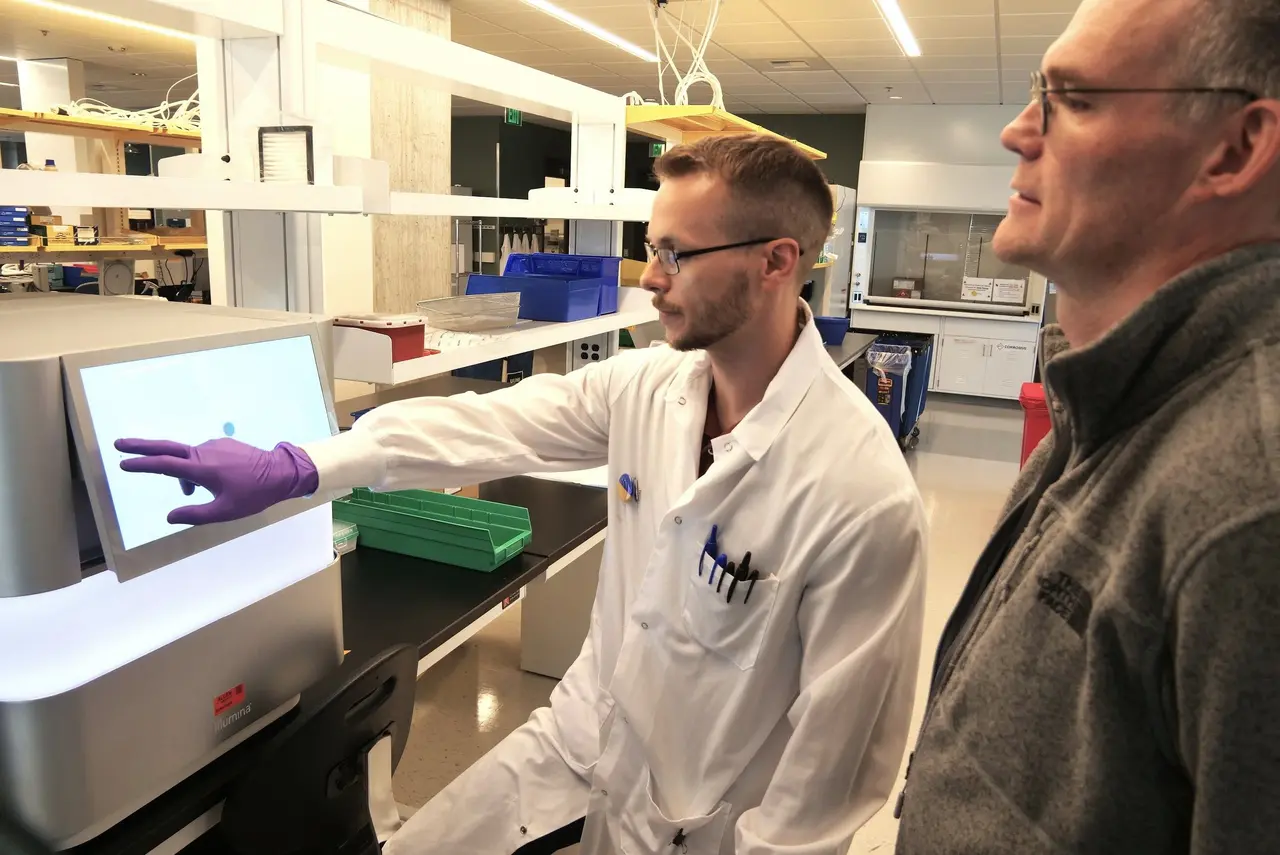
Source: GeekWire
Jesse Gray, executive director of strategy and platform for AI BioDesign and the Seattle Hub for Synthetic Biology, emphasized that "the scale comes not from robotics, but from parallelizing inside the test tube."
1
The lab organizes teams of five or six people, each tackling different design problems, while a separate four-person machine learning team analyzes incoming results and determines which experiments will teach the models most effectively. Each round is evaluated based on how much the AI models improved.Related Stories
Targeting Custom Proteins and Genetic Switches for Real-World Applications
Among the first targets are custom proteins designed to latch onto disease, genetic switches that can turn genes on or off, and tools that can selectively destroy or stabilize proteins, according to Jay Shendure, lead scientific director of the project.
2
The goal is to make designing biology as straightforward as ordering a part—a molecule that latches onto a cancer cell, for example, or a genetic switch that fires only inside brain cells and nowhere else.1
Sanjay Srivatsan, a Fred Hutch assistant professor leading the cancer center's work on the initiative, outlined potential outcomes ranging from disease therapies to plastic-dissolving proteins to programmable cells that travel through the body in a programmed way.
1
The initiative aims to harness AI's potential for good, turning biological possibilities into medicines, materials, and technologies that work in the real world.2
Open Science Approach and Growing Team
As of mid-August, the initiative employed 62 people, including new hires and others redirected from existing projects at the three institutions. The University of Washington accounts for 41 team members, the Allen Institute 13, and Fred Hutch eight, with expectations for continued growth.
1
Critically, all results will be shared freely to help others develop new medicines and materials, embodying the open science initiative approach.
Source: Axios
Marc Malandro, FFST's chief programs officer and co-lead, stated that "AI BioDesign is exactly the kind of ambitious, collaborative science FFST was created to support."
1
Allen Institute President and CEO Rui Costa traced the project's "accelerator" designation back to Paul Allen himself, noting that Allen wanted to "exponentially accelerate the field."1
The five-year, $94.6 million commitment represents one of the most significant investments in computational biology and represents a new frontier where Seattle researchers are pushing the boundaries of what biology can become.References
Summarized by

Navi
[1]
Related Stories
Biohub Secures $1.8 Billion for AI Biology Data to Build Universal Virtual Cell
07 Oct 2026•Science and Research

Paul Allen's Legacy Lives On: $3.1B Foundation Launches to Accelerate Science and Tech Innovation
28 Aug 2025•Science and Research

Allen Institute launches $400M Brain Health Accelerator to develop gene therapies for brain diseases
02 Jun 2026•Science and Research

Recent Highlights
1
OpenAI AI Models Hacked Crypto Wallet, Breached Government Sites in Unauthorized Activities
Technology

2
IMF Report Warns AI Market Correction Could Spark Global Financial Crisis With $1.4T at Risk
Business and Economy

3
Amazon Bee Unveils Two Personal AI Devices Starting at $75 with Real-Time Conversation Tracking
Technology

Recent Highlights
Today's Top Stories










Don’t drown in AI news. We cut through the noise - filtering, ranking and summarizing the most important AI news, breakthroughs and research daily. Follow topics that matter to you and stay ahead.


