Biohub Secures $1.8 Billion to Build AI-Powered Virtual Cell for Disease Research


6 Sources
[1]
Google invests millions in Mark Zuckerberg's efforts to create a 'virtual cell'
Google DeepMind, Meta, and AI drug discovery startup Isomorphic Labs are jointly investing $300 million into Biohub, the nonprofit biomedical research organization founded by Mark Zuckerberg and his wife, Priscilla Chan, as reported by Reuters. The funding is part of a $1.8 billion initiative to
[2]
US government, Google join Zuckerberg-backed Biohub in $1.8 billion push for AI biology data
Oct 7 (Reuters) - The US government and tech heavyweights Meta Platforms (META.O), opens new tab and Google parent Alphabet are joining nonprofit Biohub to build open datasets to train AI models for biological reasearch, bringing total investment in the effort to $1.8 billion, Biohub said on
[3]
Meta, Google DeepMind and the US back Biohub's $1.8bn AI biology push
The money will pay to measure how cells respond to change, across far more cell types than studied so far. Commercial funders get a year's head start before Biohub opens the data. Biohub, the US Department of Energy and the National Institutes of Health are putting $1.8bn into data to train AI
[4]
"The beginning of a new scientific paradigm": Zuckerberg's Biohub, U.S. and Google build virtual cell
AI is capable of understanding proteins and other pieces of biology, but modeling an entire living cell is orders of magnitude more complex -- and researchers don't yet have enough of the right data to do it. Driving the news: Biohub, the Department of Energy, the National Institutes of Health,
[5]

International, Cross-Sector Collaboration Commits Nearly $2 Billion to Build Foundational Data for AI Models to Predict and Treat Disease
Newswise -- REDWOOD CITY, CA, October 7, 2026 -- Biohub, the U.S. Department of Energy, the National Institutes of Health, and new funding partners today announced a major expansion of an international effort to generate and make accessible the data enabling predictive AI models of biology.
[6]

US government, Google join Zuckerberg-backed Biohub in $1.8 billion push for AI biology data
Oct 7 (Reuters) - The US government and tech heavyweights Meta Platforms and Google parent Alphabet are joining nonprofit Biohub to build open datasets to train AI models for biological reasearch, bringing total investment in the effort to $1.8 billion, Biohub said on Wednesday. Meta, Google
Share
Copy Link
Mark Zuckerberg and Priscilla Chan's Biohub announced a $1.8 billion collaboration with Google DeepMind, Meta, and the U.S. government to create AI-ready biological data. The Virtual Biology Initiative aims to build a virtual cell that enables digital experimentation, compressing decades of research into five years and accelerating drug discovery.
Major Cross-Sector Collaboration Targets AI Biology Breakthrough
Biohub, the nonprofit biomedical research organization founded by Mark Zuckerberg and Priscilla Chan in 2016, announced a massive $1.8 billion collaboration to generate foundational data for AI models that predict and treat disease
1
2
. This represents the largest coordinated commitment to generating AI-ready biological data to date, bringing together tech giants, federal agencies, and scientific institutions in an unprecedented push to accelerate scientific discovery5
.Google DeepMind, Meta, and AI drug discovery startup Isomorphic Labs are collectively investing $300 million into the Virtual Biology Initiative
1
. The U.S. Department of Energy will contribute more than $500 million over five years in laboratory measurement, modeling, and computation through its Genesis Mission2
. The National Institutes of Health will coordinate datasets and repositories built with more than $500 million in earlier federal funding, which Biohub will standardize for AI training3
. These commitments follow Biohub's own $500 million pledge announced in April 20262
.Building the Virtual Cell Through Digital Experimentation
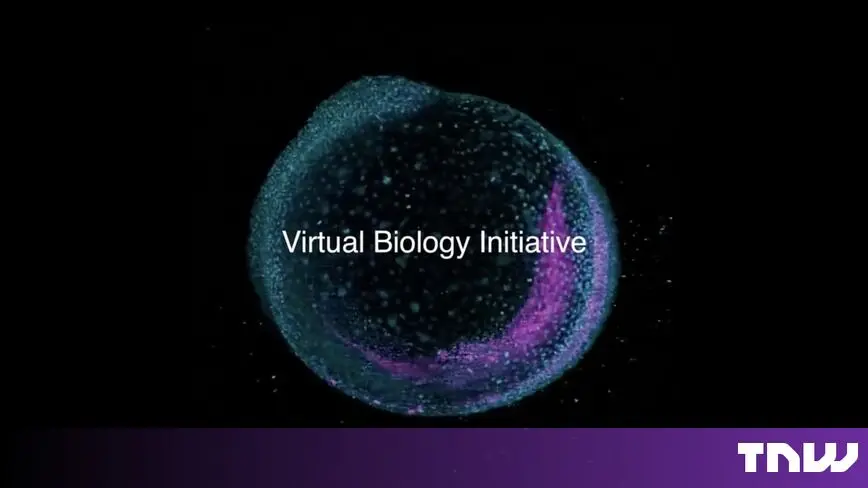
Source: The Next Web
The initiative aims to create a virtual cell that researchers can use to carry out simulations and perform experiments digitally
1
. Alex Rives, Biohub's head of science, emphasized that an accurate predictive model of biology could dramatically accelerate scientific discovery by enabling scientists to conduct digital experimentation5
. The Virtual Biology Initiative will measure how cells respond to changes across far more conditions than scientists have studied so far, then use that data to build predictive models of disease that could compress drug development timelines currently taking years2
.Current cell datasets contain hundreds of millions of cells, but an accurate predictive model will require billions and eventually trillions of cells, according to Rives
2
. Priscilla Chan noted that biology has been a discovery-based science until this point, and the team has always held this as a community asset to build upon itself over time2
. The work would normally take decades, but partners aim to compress it into five years, with a first dataset ready in about a year and accurate predictive models within five years2
.Advanced Technologies and Open Datasets Drive Research
Biohub's $400 million technology investment supports new measurement capabilities including cryo-electron tomography, which resolves near-atomic detail inside cells, and microscopy that can image millions to billions of cells in living tissue
5
. The Department of Energy will draw on exascale supercomputing, X-ray and neutron scattering, cryo-electron microscopy, and autonomous laboratories across the National Laboratory system3
. Data will come from techniques including spatial transcriptomics, which maps molecular activity inside intact tissue, and screens that record how cells respond to environmental changes2
.The datasets will eventually become open datasets released publicly, though commercial funders get a head start
2
. Companies funding the initiative receive one year of exclusive access before data becomes available as a public scientific resource3
. Rives explained that the embargo period creates incentive for commercial players while ensuring data rapidly becomes available broadly to scientific efforts4
. Government-funded work carries no such restrictions2
.Related Stories

New Scientific Paradigm Promises Medical Breakthroughs
Rives described the effort as the beginning of a new scientific paradigm with AI, noting that the big challenge in AI biology is bridging the gap between the digital world and the physical world of biology through data
4
. The goal is to use AI to explore scientific questions virtually, allowing researchers to reserve expensive lab work for experiments most likely to yield important insights4
. Such models could eventually help scientists investigate fundamental questions about aging and regeneration, or medical questions like which molecular mechanisms are responsible for Alzheimer's disease4
.
Source: Axios
Max Jaderberg, President of Isomorphic Labs, stated that generating data to solve predictive systems biology requires scaling past the limits of what any single organization can produce today
5
. The collaboration includes the Allen Institute, Broad Institute, Gladstone Institutes, Wellcome Sanger Institute, Human Cell Atlas, and Human Protein Atlas consortia3
. Nvidia will provide computing and software, while Renaissance Philanthropy is helping raise additional funding3
. Biohub plans to approach pharmaceutical companies and philanthropies next to expand the initiative2
. Other AI labs including Anthropic and OpenAI Foundation are pursuing similar biology initiatives, with Anthropic building a wet lab and OpenAI starting a grant program exceeding $125 million for biological datasets2
.References
Summarized by

Navi
[2]
Related Stories
Zuckerberg's Biohub invests $500M to build AI models that simulate human cells at molecular scale
05 May 2026•Health

Scientists Propose Global Initiative to Create AI-Powered Virtual Human Cell
13 Dec 2024•Science and Research

Seattle Researchers Launch $95M AI BioDesign Initiative to Design Biology Beyond Nature
03 Sept 2026•Science and Research
Recent Highlights


Recent Highlights
Today's Top Stories







Don’t drown in AI news. We cut through the noise - filtering, ranking and summarizing the most important AI news, breakthroughs and research daily. Follow topics that matter to you and stay ahead.


