Shai-Hulud Worm Infiltrates Tensorlake SDK in Major AI Infrastructure Supply Chain Attack


2 Sources
[1]
Shai-Hulud worm makes jump to AI infrastructure with Tensorlake compromise
The credential-hijacking Shai-Hulud worm has struck again, this time burrowing its way into a popular AI agent platform SDK. Multiple security researchers reported Thursday that they had detected Shai-Hulud infection in a recent release of the npm package for version 0.5.144 of Tensorlake's SDK.
[2]
Tensorlake npm Package Compromised to Deliver Shai-Hulud Credential-Stealing Worm
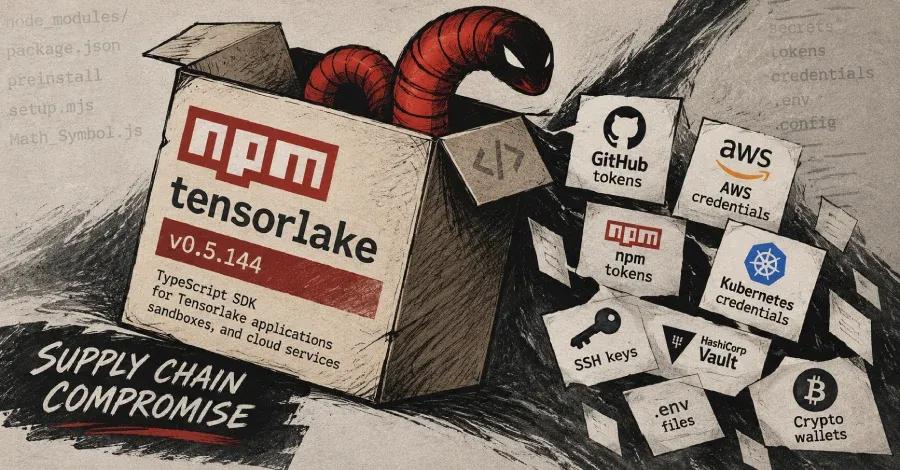
The npm package known as "tensorlake," a TypeScript software development kit (SDK) for Tensorlake applications, sandboxes, and cloud services, was compromised as part of a ChainDrop / Shai-Hulud supply chain attack. The malicious version 0.5.144 "contains obfuscated malware that harvests
Share
Copy Link
The credential-hijacking Shai-Hulud worm has compromised Tensorlake's npm package version 0.5.144, marking a dangerous evolution into AI agent platforms. With approximately 12,000 weekly downloads, the infected SDK posed serious risks before being removed. The malware steals everything from crypto wallets to GitHub tokens and cloud credentials while maintaining self-propagation capabilities.
Shai-Hulud Worm Targets AI Infrastructure
The credential-stealing Shai-Hulud worm has infiltrated Tensorlake's npm package, marking a significant escalation in supply chain attacks targeting AI infrastructure
1
. Security researchers detected the infection in version 0.5.144 of Tensorlake's SDK on Thursday, with the malicious package having accumulated approximately 12,000 downloads per week1
. The Tensorlake GitHub repository has garnered more than a thousand stars, indicating widespread adoption among developers building AI agent platforms and making this npm package compromise particularly concerning for the AI development community.ChainDrop Variant Delivers Obfuscated Malware
Analysis reveals this attack shares code and techniques with the Shai-Hulud variant dubbed ChainDrop, previously used in August 2026 to compromise npm dependencies including keyv and flat-cache
1
. The malicious version 0.5.144 contains obfuscated malware delivered through a preinstall hook that launches a JavaScript file, which then executes the main credential-hijacking malware using the Bun runtime2
. Socket's security engine flagged the infected version just 11 minutes after publication to npm, demonstrating the rapid detection capabilities now essential for protecting AI development tools1
.Extensive Credential Theft Capabilities
Source: Hacker News
According to SafeDep, this credential-stealing worm is engineered to harvest an extensive range of sensitive data including crypto wallets, browser passwords, GitHub Actions secrets, cloud credentials, and service-account tokens
1
. The stealer malware specifically targets npm tokens, GitHub tokens, Amazon Web Services credentials and secrets, HashiCorp Vault data, Kubernetes credentials, SSH keys, .env files, cryptocurrency wallets, messaging app data, and configuration files associated with Anthropic Claude, Cursor, Kiro, Windsurf, and Zed2
. It drops the HackBrowserData binary, exfiltrates collected data, establishes persistence on the host, and facilitates execution of remotely-supplied code while maintaining an open line to its command-and-control infrastructure2
.Self-Propagation and Destructive Capabilities
The Shai-Hulud worm demonstrates sophisticated self-propagation mechanisms by enumerating packages associated with the victim's publishing identity, building Sigstore provenance, and republishing compromised versions
2
. Strings referencing a fake Copilot/Dependabot workflow suggest it also plants GitHub Actions workflows to expand its reach. The malware uses an Ethereum contract to resolve its command-and-control endpoint at iseekaigogo[.]com, with GitHub acting as a fallback mechanism to stage encrypted stolen data in a public repository described as "Shai-Hulud: Here We Go Again"2
. StepSecurity researcher Ashish Kurmi noted that the malware writes .claude/settings.json and .vscode/tasks.json files into accessible repositories, ensuring it runs again when someone opens the project in Claude Code or VS Code2
.Related Stories

Hostage Token Monitor Raises Stakes
This supply chain attack includes a particularly dangerous "hostage token" component that monitors stolen GitHub tokens through repeated polling of api.github.com/user to verify token validity
2
. If the victim revokes the token, the monitor executes an attacker-supplied handler through PowerShell's Invoke-Expression cmdlet, likely triggering a destructive routine that can delete the infected user's home directory under specific conditions1
. Socket recommends disabling the malicious token monitor before revoking affected credentials and rebuilding compromised systems from a trusted source before restoring access to secrets1
.Timeline and Repository Compromise
According to StepSecurity, the malicious files were pushed to the main branch of tensorlakeai/tensorlake under a maintainer's name, with the first rogue commit occurring on October 7, 2026, at 01:20 a.m. UTC
2
. A day later, the repository's release workflow published the malicious version 0.5.144 to npm2
. Both npm and Tensorlake have since removed the infected version, with Tensorlake updating to version 0.5.1451
. Users who installed malicious version 0.5.144 should remove it immediately and rotate all credentials that may have been exposed during the installation process.References
Summarized by

Navi
Related Stories
Shai Hulud Malware Compromises TanStack, OpenAI, and Mistral AI in Sprawling Supply-Chain Attack
12 May 2026•Technology
AI-Assisted Supply Chain Attack on Nx NPM Packages Exposes Thousands of Developer Credentials
28 Aug 2025•Technology

Popular OpenAI Codex tool with 29,000 weekly downloads exposed in npm supply chain attack
01 Jun 2026•Technology

Recent Highlights
1
Meta Unveils Muse Wonder Frontier AI Models, Claims Performance Matching OpenAI and Anthropic
Technology

2
IMF Report Warns AI Market Correction Could Spark Global Financial Crisis With $1.4T at Risk
Business and Economy

3
Eight States Sue OpenAI Over ChatGPT Safety Concerns and Unlawful Collection of Children's Data
Policy and Regulation

Recent Highlights
Today's Top Stories








Don’t drown in AI news. We cut through the noise - filtering, ranking and summarizing the most important AI news, breakthroughs and research daily. Follow topics that matter to you and stay ahead.


